If you live in Toronto long enough, you eventually look at a tree on your property and think, “This thing might be a problem.” Maybe it leans a little more every year. Maybe big branches keep dropping in storms. Maybe roots are lifting your driveway or heading toward your foundation.
That is usually when the big question shows up: how much does tree removal cost in Toronto and what exactly are you paying for?
Tree removal is not just cutting a trunk and hoping for the best. In a city like Toronto, it involves safety planning, trained crews, tight spaces, wires, neighbours, and city rules. In this guide, we will walk through the real factors that affect tree removal cost, the questions people ask on Google every day, and how to make a smart decision for your property.
Our goal is simple. By the end of this article, you should feel confident enough to look at a quote and say, “Yes, I understand why that price makes sense.”
Every tree is different, so there is no single price that fits every situation. In Toronto, tree removal usually ranges from a few hundred dollars for smaller and straightforward trees to a few thousand dollars for large or risky removals.
Most jobs land somewhere in the middle. The final number depends on a mix of size, access, risk, and cleanup. When you see a quote, you are not just paying for someone with a chainsaw. You are paying for:
If the tree is small, open, and simple, the job is quick. If it is large, leaning, decayed, or squeezed between houses under power lines, the job becomes more complex, and the cost rises.
When you call a tree company in Toronto and they start asking a lot of questions, it is not to annoy you. They are trying to understand the details that change the price. These are the main factors.
Height and trunk diameter matter. A small ornamental tree in the front yard is one type of job. A huge mature maple behind a garage is a completely different project.
Bigger trees mean:
If your main concern is size, you can review basic removal information here: Tree Removal Services.
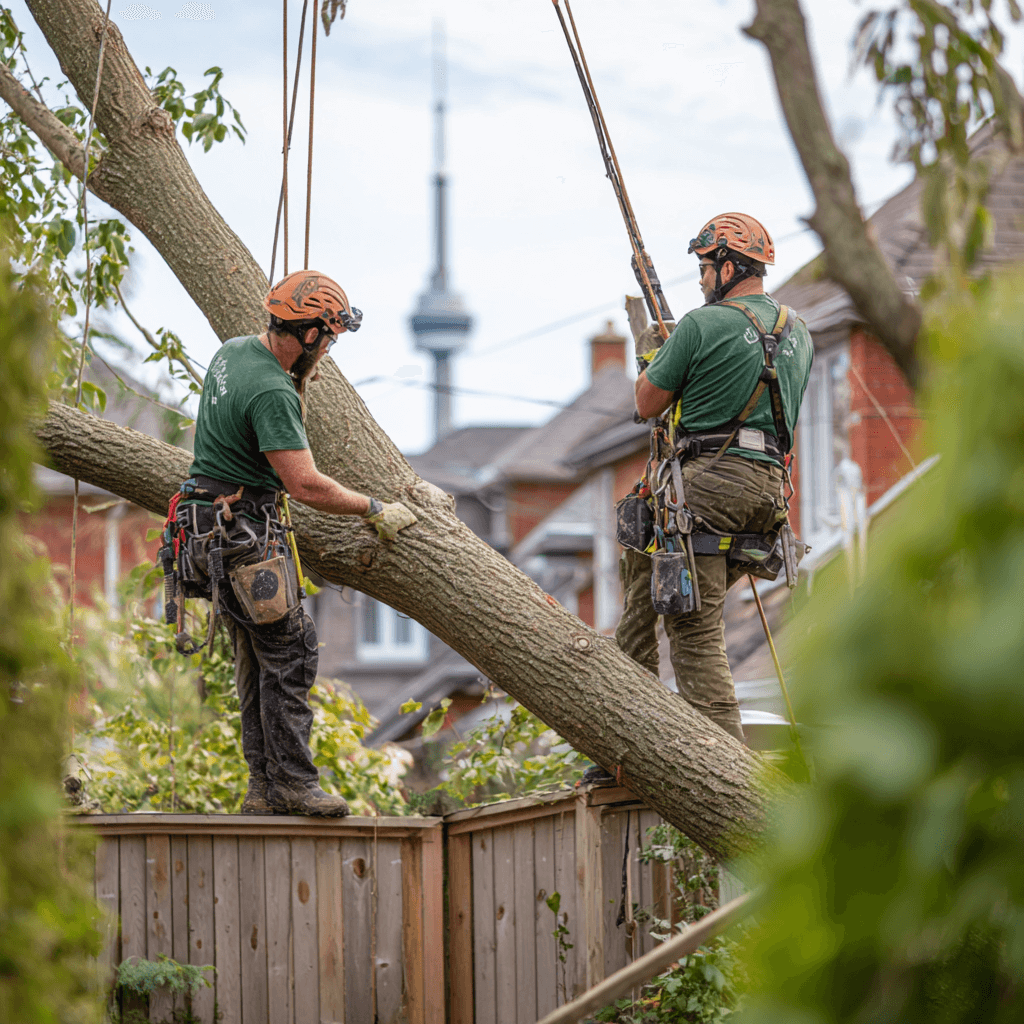
A tree in an open front yard near the street is relatively straightforward. A tree in a narrow Toronto backyard behind a detached garage, with a fence on every side, is more challenging. The crew may not be able to bring large equipment close to the tree, which means more climbing and more manual work.
Access affects:
The more difficult the access, the more labor is required, and the more the price increases.
A healthy, upright tree is usually predictable. A cracked, rotting, storm damaged, or leaning tree is not. When a tree is unstable, crews must work slowly and carefully to avoid sudden failures. That extra risk and time is reflected in the quote.
If you have branches that have already fallen or are hanging dangerously, you may be looking for fallen limb and fallen tree removal or even emergency service, which can carry different pricing than planned work.
Some trees can be handled with climbing gear, ropes, and chainsaws. Others require a bucket truck or even a crane. The more specialized the equipment, the higher the cost you can expect. Toronto’s mix of tight access and mature trees often means careful planning around what machinery can actually reach the tree.
When you see a tree removal quote, always ask what is included. Options usually include:
On top of that, you may want the stump dealt with. Stumps can be tripping hazards, attract pests, and make future landscaping difficult. Stump removal is usually done with a grinder and is priced separately. You can read more about that on our stump grinding service page.
If you type “tree removal cost Toronto” into Google, you will see a list of common questions people ask. Here are some of those questions, answered clearly and simply.
Tree removal in Toronto is more involved than many people expect. Crews work around houses, garages, fences, cars, and power lines, often in tight spaces. They must carry proper insurance and follow safety standards. The work is physical, technical, and sometimes dangerous. All of this drives the cost up compared to simple yard work. You can also review power line vegetation safety guidelines from Hydro One to understand why tree work near electrical infrastructure requires extra caution.
The City of Toronto is responsible for trees that are on city property. If the tree is on your private property, removal is almost always your responsibility. If you are not sure whether a tree is a city tree or a private tree, a professional inspection or a check with the city can clarify it.
Large tree removals are usually the most expensive jobs. Depending on the size, condition, and access, the cost can reach well over a thousand dollars and sometimes several thousand. Factors like whether the tree overhangs a house, wires, or a neighbour’s property will play a big role in the price.
Technically, you can attempt it, but it is rarely a good idea. Homeowners often underestimate how heavy branches are, how fast they move, and how far they can swing when cut. In a Toronto yard, there are usually things nearby that you do not want to crush. Serious injuries and property damage are common when people try to remove larger trees themselves. For anything beyond very small trees, let professionals handle it.
No, you do not have to grind the stump, but most people choose to. Leaving a stump can lead to:
Stump grinding is a one-time service that makes the yard much easier to work with in the future. Again, this is typically quoted separately from the tree removal itself.
This is another big question that shows up in Google results, and for good reason. Toronto has strong tree protection bylaws that you must follow when removing certain trees. In many cases, you cannot simply cut down a tree without permission.
You may need a permit if:
Removing a protected tree without a permit can lead to fines and forced corrective action. The safest path is to talk with a company that is familiar with Toronto bylaws and can advise whether a permit is likely needed.
In some cases you may also need reports or documentation. That is where services like arborist reports and tree preservation plans for fencing and construction come into play.
When comparing quotes, it helps to understand the less obvious costs that can show up in Toronto tree work.
As mentioned earlier, stump grinding is almost always priced separately from the removal itself. Price is based on stump size, root spread, and access for the grinder. If you want the area leveled and ready for grass, garden, or a new feature, make sure stump grinding is included in your quote.
Sometimes the tree is already on the ground or hanging halfway. That is where fallen limb and fallen tree removal becomes important. Working on a tree that has failed in a storm can be more dangerous than a standing tree, because wood is under tension and can move unexpectedly.
If you have a situation that cannot wait, such as a tree threatening a building or blocking a driveway, you may need emergency tree service. Emergency work often carries a different rate because crews need to respond quickly, sometimes in bad weather or off hours.
In some situations, full removal is not the only option. Proper tree pruning can extend the life of a tree, reduce risk, and improve clearance around roofs, wires, and walkways. If you are not sure whether a tree truly has to go, a professional assessment can often save you money by recommending pruning instead of removal.
While you are dealing with a problem tree, it can sometimes make sense to tidy up the rest of your property. Services like hedge trimming and removal and even snow removal in the winter can be combined into a more efficient plan for your outdoor space.
Tree removal is not a fun expense, but sometimes it is the smart one. Here are signs that removal should be on the table:
If you are unsure, a professional visit can help. Sometimes the right answer is pruning and monitoring instead of removal. Honest advice matters. You should not feel pressured into cutting a tree if it can be safely managed in another way.
When you invite a tree crew onto your property, you are trusting them with your home, your neighbours, and your safety. Price matters, but it should not be the only thing you look at. Here are key points to consider.
Always ask if the company is fully insured for tree work and ask if they can provide proof. Tree removal has real risk. Insurance protects you if something goes wrong. Experience in Toronto also matters. Crews that work here regularly understand the challenges of small yards, busy streets, overhead wires, and city bylaws. For more information on certified arborists and industry standards, you can also visit the International Society of Arboriculture (ISA).
A reliable company should be able to handle the full picture: removal, pruning, storm work, stump grinding, and planning. For example, at Toronto Tree Services we provide:
This kind of full service approach makes it easier to get a long term plan for your property instead of treating each issue as a one time problem.
A good company will explain what they plan to do, how they plan to do it, and what is included in the price. Your quote should clearly state whether:
If one quote is much cheaper than the others, look at what might be missing. Lack of insurance, poor cleanup, or cutting corners on safety can make a “cheap” job very expensive in the long run.
Small trees in easy locations can sometimes be removed in under an hour. Larger trees or complex urban jobs can take most of the day. Storm damaged or emergency work can also take longer because crews must move more slowly for safety.
Homeowners insurance might help if a tree has already fallen and caused covered damage, such as hitting your roof. Purely preventative removal of a standing tree is usually not covered. It is best to speak with your insurance provider for specifics.
Winter tree work can actually be a good option. There are no leaves, visibility is better, and the ground is often firmer when it is frozen. Access can be a challenge during heavy snow, but winter removal is very common in Toronto.
Every property and every tree is different. The fastest way to get a clear idea of tree removal cost in Toronto is to have an experienced crew look at your situation in person.
At Toronto Tree Services, we work with residential, commercial, industrial, and even city clients across Toronto. We focus on safe, professional work and honest advice. If removal is not necessary and pruning, cabling, or other options make more sense, we will tell you that.
If you are worried about a tree, or simply want a quote so you know where you stand, you can reach our team at co*****@*****************es.ca. Tell us about your tree, your property, and your concerns. We will help you figure out the right next step.