Tree Pruning and Trimming in Etobicoke
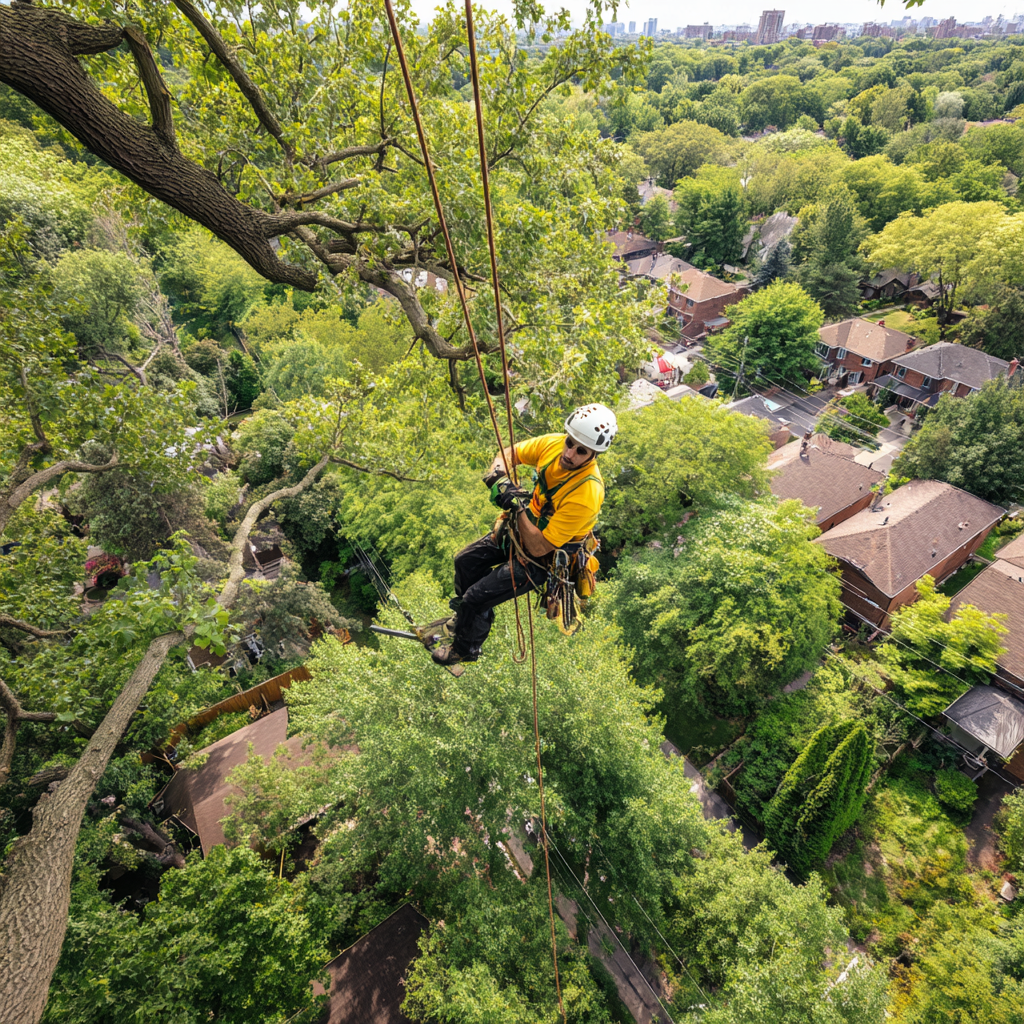
Tree pruning in Etobicoke covers territory as varied as the district itself. At one extreme are the century-old white oaks, copper beeches, American elms and sugar maples on Kingsway and Humber Valley Village properties, trees that Robert Home Smith's landscape architects planted in the 1910s and 1920s as foundational elements of a planned estate landscape. These trees have been growing for over a hundred years, and managing them responsibly requires an arborist who can read their structure, identify their specific risks, and make pruning decisions that serve the tree's long-term health rather than simply responding to the most visible immediate problem. At the other extreme are the Norway maples and silver maples on compact Mimico and Long Branch lots, trees that grow fast, develop structural problems quickly, and require regular management to keep them from becoming hazards on properties with little clearance between the canopy and the structure below.
Our ISA certified arborists bring the same standard to every pruning job in Etobicoke regardless of the neighbourhood or the tree's size. We work to ANSI A300 standards on every cut. We assess the whole tree before making any pruning decisions. And we do not top trees, ever, because topping destroys structural integrity, accelerates decay, and shortens a tree's life significantly regardless of how large or small the tree is.
Pruning the Estate Trees of The Kingsway and Humber Valley Village
The trees planted as part of Home Smith's Humber Valley Survey are now among the most significant private tree specimens in Etobicoke. White oaks that were planted as young trees in the 1920s now have trunks 70 to 90 centimetres in diameter and canopies that spread over the full width of a standard residential lot. Copper beeches, not native to Ontario but commonly planted in the estate tradition Home Smith was emulating, have developed enormous smooth-barked trunks and dense pendulous canopies that need periodic deadwood removal and clearance management. Managing these trees requires arborists who can work at scale and who understand species-specific pruning requirements.
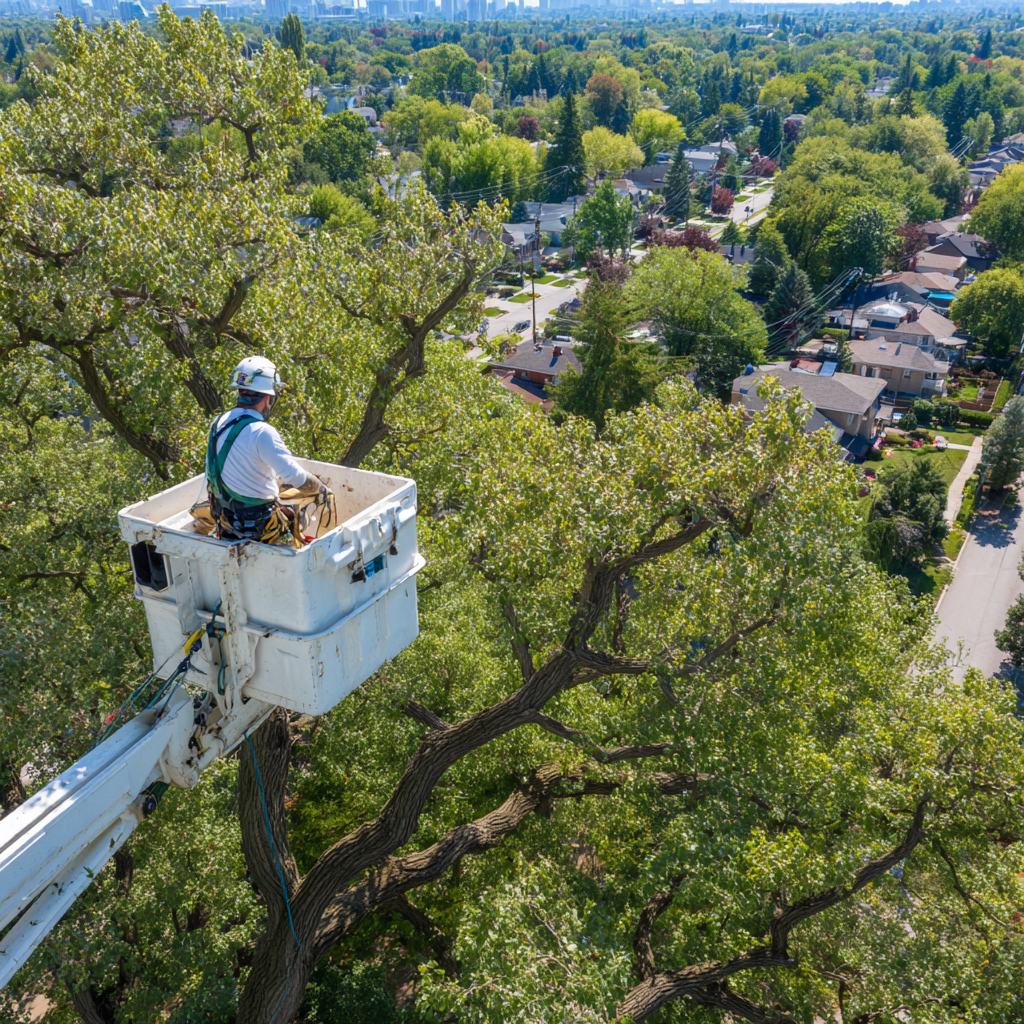
For very large trees in The Kingsway and Humber Valley Village where rope climbing alone gives limited access to the upper structural framework, we use aerial work platforms that allow the pruning arborist to work from a stable position with clear sight lines into the canopy. The result is better cut quality and better structural decision-making than climbing in a tight old-growth canopy where positioning is limited by the tree itself.
Pruning Near TRCA Regulated Corridors
Pruning trees that overhang TRCA regulated areas along the Humber River, Mimico Creek or Etobicoke Creek corridors requires care. Standard maintenance pruning that does not constitute injury to a protected tree does not require a Chapter 813 permit. However, if pruning work near a regulated corridor would involve entering the regulated area itself, bringing equipment across the top-of-bank line, or if the tree being pruned is partially within the regulated area, TRCA review may be required before work begins. We identify these situations during the site assessment and advise on the appropriate process before scheduling any work.
Pruning for Storm Risk Reduction in Etobicoke
Etobicoke's position along Lake Ontario makes it one of the more storm-exposed residential districts in the Toronto area. Lake-effect storms tracking northeast bring high winds and wet snow loads that test structural weaknesses in mature trees. Crown thinning to reduce wind resistance, deadwood removal to eliminate the most likely first-failure points, and cabling of significant codominant unions are all tools we use for storm risk management in Etobicoke. Trees near the lakefront in Mimico and Long Branch are particularly exposed and benefit from more frequent pruning cycles than trees in sheltered inland locations.
Tree Pruning vs. Tree Trimming
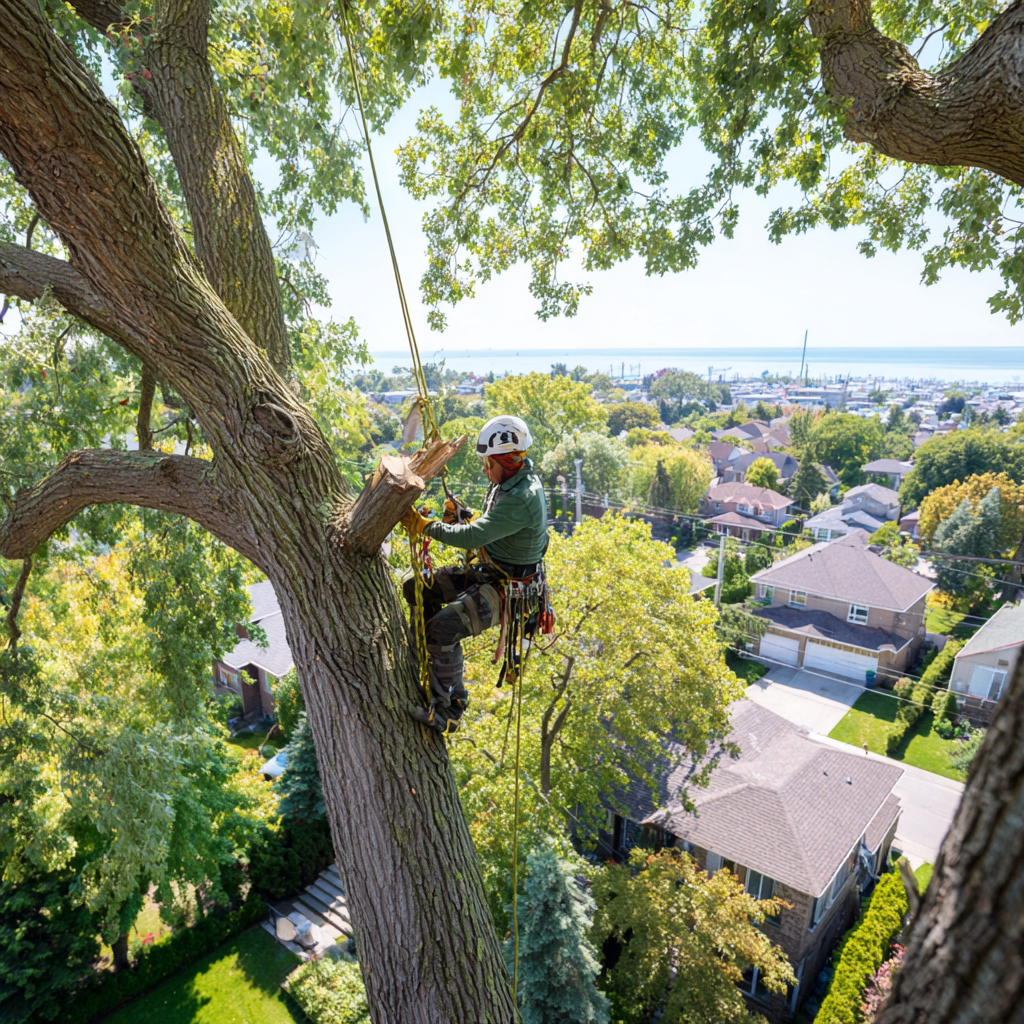
The two terms are often used interchangeably, but they describe work with different primary goals. Pruning is health and structure focused: removing dead or diseased wood, correcting poor branch attachments, addressing codominant stems, and making decisions about the tree's long-term structural integrity. Trimming is clearance and appearance focused: reducing a branch that is contacting a roof, lifting a canopy above a fence line, or tidying the outline of a tree that has grown unevenly. Most jobs we do involve elements of both. A branch overhanging a driveway may need to come off for clearance reasons, but how it is cut and where the cut is made is a pruning decision governed by tree biology. We don't treat these as separate service categories because in practice they're almost always the same job.
Frequently Asked Questions About Tree Pruning in Etobicoke
Do I need a permit to prune a large tree in Etobicoke?
Standard maintenance pruning of a private property tree does not require a Chapter 813 permit. If the proposed pruning would remove more than one-third of the live crown of a tree with a DBH of 30 cm or greater, it may be considered injury under Chapter 813 and a permit might be required. We confirm whether your planned pruning crosses the injury threshold before scheduling work on any protected tree in Etobicoke.
How do you prune trees hanging over the Humber River valley on Kingsway properties?
Trees with significant canopy extending over the Humber River valley edge are approached carefully. We establish rigging anchors on the safe upper ground side of the tree, work from the property side at all times, and direct cut material away from the valley slope to avoid sending debris down the slope face. For trees where limb weight over the valley edge creates significant tension in the rigging, we assess whether additional ground anchoring or crane support is needed before cutting begins.
When should oaks in Etobicoke be pruned?
Oak trees in Etobicoke should be pruned from November through March to reduce the risk of oak wilt infection. The pathogen causing oak wilt is spread by sap beetles that are attracted to fresh pruning wounds during the growing season from April through October. If emergency pruning is required on an oak during the growing season, applying wound treatment to reduce beetle attraction is advisable. We schedule all planned oak work during the dormant season.
Can a copper beech or other ornamental tree on a Kingsway property be pruned safely?
Yes. Copper beeches are prone to development of included bark at codominant unions, which is a common structural issue in Etobicoke's Kingsway estate specimens. They also have relatively thin bark that is susceptible to sunscald if large sections of canopy are removed too quickly, exposing previously shaded bark to direct sun. We prune copper beeches conservatively, removing no more than one-quarter of the live crown in any single pruning cycle, and avoid cuts that would expose large sections of the smooth trunk to sudden direct sunlight.
How often should Mimico and Long Branch lakefront trees be pruned?
Trees on lakefront properties in Mimico and Long Branch typically benefit from a two to three year pruning cycle given the greater storm exposure from Lake Ontario. Deadwood accumulates faster in trees under higher wind stress, and structural asymmetry from prevailing wind direction should be monitored and corrected through directional pruning on a more frequent schedule than trees in sheltered inland locations. We can set up a maintenance program tailored to the specific exposure of your property.
More Etobicoke Tree Services
Get a Free Estimate for Tree Work in Etobicoke
We serve all of Etobicoke including The Kingsway, Humber Valley Village, Sunnylea, Islington Village, Baby Point, Thorncrest Village, Princess Anne Manor, Mimico, Long Branch, New Toronto, Humber Bay Shores, Markland Woods, Rexdale, Thistletown, Richview and Stonegate-Queensway. Our certified arborist visits your property, assesses the Chapter 813, TRCA and Heritage Conservation District requirements that apply, and provides a firm quote before any work begins.