Tree Pruning and Trimming in North York
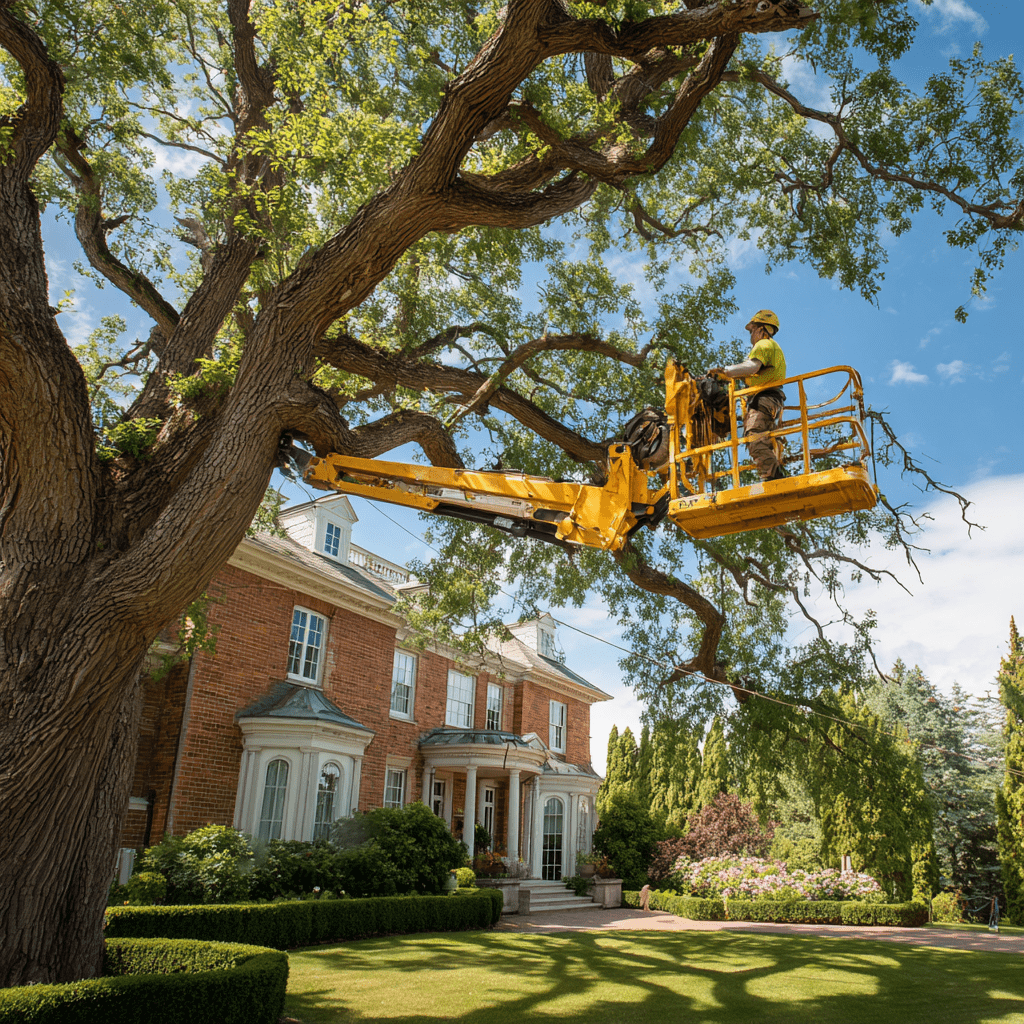
Tree pruning in North York operates on a different scale from most of the GTA. The large estate properties in Bridle Path, York Mills and St. Andrew-Windfields carry individual trees that have grown for 80 or 100 years with minimal management, developing enormous canopies that in some cases require aerial work platforms rather than climbing crews to access the upper structure safely. On the other end of the scale, the dense mid-century residential plantings in Don Mills and Willowdale have produced trees where the urban forest is genuinely continuous across property lines, requiring coordination with neighbouring properties and careful assessment of how pruning one tree will affect the ones growing alongside it.
Our pruning work in North York is ISA certified, ANSI A300 compliant, and based on a thorough initial assessment of every tree's structure, health, and specific risk factors before a single cut is made. We bring aerial lift equipment to estate tree jobs where climbing alone would mean compromised access and inferior cuts. We do not top trees. We do not leave stubs. We do not undertake work that is going to cause more problems than it solves.
Pruning Estate Specimen Trees in North York
The white oaks, sugar maples, American elms and bur oaks found on Bridle Path and York Mills estate properties represent irreplaceable specimens. Many of them were already mature when the current homes were built. Pruning decisions on trees like these need to be made with a long view of the tree's structural development over decades, not just the immediate desire to create clearance from the roofline or thin the canopy for aesthetic reasons. Our approach on estate specimens begins with a full structural assessment, identification of any existing defects including codominant unions with included bark, cavities, or previous wound failures, and a pruning plan that addresses the highest priority structural concerns first.
For very large trees where access to the upper canopy is limited from the ground, we use an aerial work platform that allows the pruning arborist to work in the canopy from a stable position. This produces better pruning cut quality than rope climbing alone on large old-growth specimens, and reduces the risk of causing additional damage through rope movement in a tight canopy with structural concerns.
Supplemental Support Cabling for North York Trees
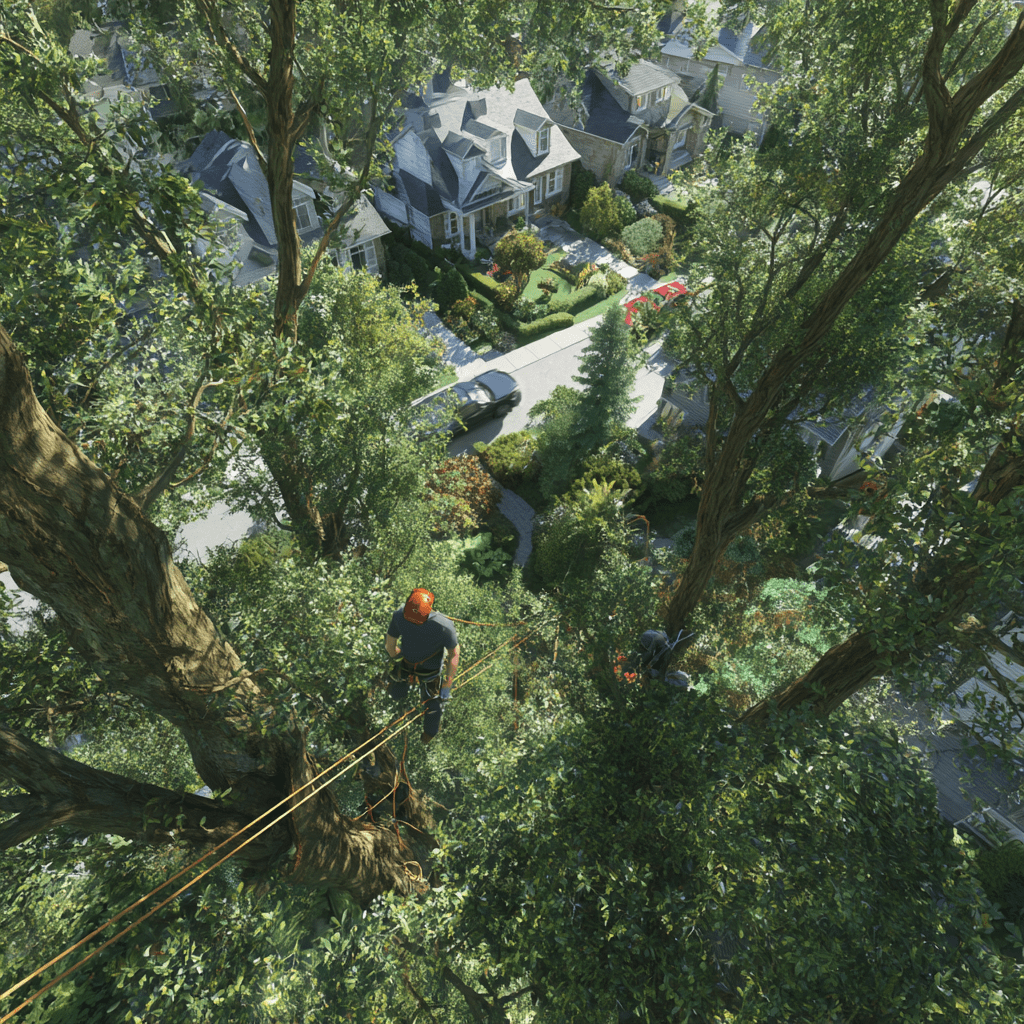
Cable bracing is a supplemental support system installed between codominant stems or significant laterals in a tree that carries a structural defect that cannot be corrected through pruning alone. A properly installed high-strength steel cable reduces the movement between stems during wind loading, decreasing the probability of failure at a structural weakness such as a codominant union with included bark. We install supplemental support cables according to ISA and ANSI A300 Part 3 standards, with follow-up inspection recommended on a two-year cycle to monitor the cable condition and the tree's structural response.
Cable installation does not make a tree with a structural defect safe without conditions. It is a risk reduction measure that extends the window during which a defective tree can be safely retained, not an indefinite fix. Our arborists are clear about what cabling can and cannot accomplish when we recommend it, so that property owners in North York can make informed decisions about whether to retain, cable or remove a tree with known structural concerns.
Pruning for Clearance Near Structures and Utilities
Many North York properties have trees growing close to hydro lines, rooflines, chimneys and outbuildings. In Willowdale and Don Mills in particular, where lots are smaller and trees are large, clearance pruning is among the most common requests we receive. We create clearance from structures using directional pruning that maintains the structural integrity of the tree's canopy rather than simply removing everything that is in the way. Where clearance requirements are in conflict with the tree's structural needs, we advise honestly on the trade-offs and recommend removal where that is the better long-term outcome for the property.
Tree Pruning vs. Tree Trimming
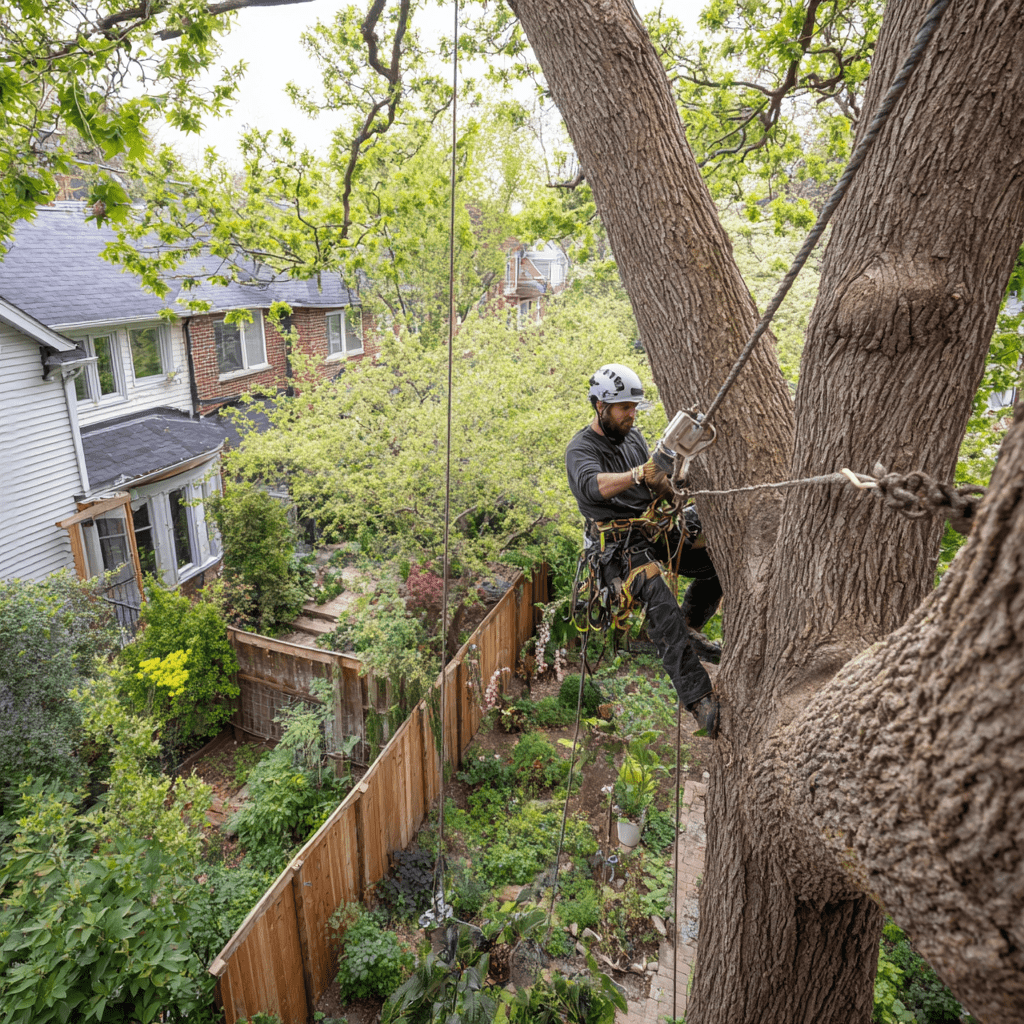
The two terms are often used interchangeably, but they describe work with different primary goals. Pruning is health and structure focused: removing dead or diseased wood, correcting poor branch attachments, addressing codominant stems, and making decisions about the tree's long-term structural integrity. Trimming is clearance and appearance focused: reducing a branch that is contacting a roof, lifting a canopy above a fence line, or tidying the outline of a tree that has grown unevenly. Most jobs we do involve elements of both. A branch overhanging a driveway may need to come off for clearance reasons, but how it is cut and where the cut is made is a pruning decision governed by tree biology. We don't treat these as separate service categories because in practice they're almost always the same job.
Frequently Asked Questions About Tree Pruning in North York
Do I need a permit to prune a large tree in North York?
Standard maintenance pruning that does not constitute injury to a protected tree does not require a Chapter 813 permit. If the proposed pruning would remove more than one-third of the live crown of a tree with a DBH of 30 cm or greater, Toronto Urban Forestry may consider it injury and a permit may be required. We advise on whether your planned pruning crosses the injury threshold before scheduling any work.
How often do large estate trees in North York need to be pruned?
Large specimen trees on Bridle Path and York Mills estate properties typically benefit from a structured pruning cycle of three to five years. The initial assessment often reveals accumulated deadwood, structural defects and crossing branch conflicts that have developed over years of limited management. Once these are addressed in a thorough first pass, subsequent maintenance pruning cycles are less intensive. Annual monitoring is advisable for trees with known structural defects.
What is included bark and why does it matter?
Included bark forms at the junction between two codominant stems when the angle between them is narrow enough that bark tissue is compressed and trapped between the two growing stems rather than forming a proper branch collar. As both stems grow the included bark creates an embedded fault line that concentrates stress at the union point. Codominant stems with included bark are much more likely to fail under wind or ice load than stems with a proper open-angle union. Our arborists identify included bark unions during structural assessments and advise on pruning or cabling interventions accordingly.
Can pruning help a North York tree that was affected by ice storm damage?
Yes, but carefully. Ice storm damage in North York, which has historically experienced significant canopy loss in major winter events, often leaves partially attached limbs, cracked branch unions and large wounds that need to be managed to promote proper closure and reduce infection risk. Corrective pruning after ice storm damage focuses on removing hanging material, cleaning up ragged cuts to smooth wound edges that will close more efficiently, and assessing whether the remaining crown structure is sound enough to retain the tree long term.
How long does cable bracing last on a North York estate tree?
High-strength steel arboricultural cables are rated for extended service but should be inspected every two years to assess cable condition, hardware tension and the tree's structural response to the support system. As the stems continue to grow, the cable installation may need to be adjusted or the hardware may need to be upgraded. We follow up on cable installations we have done and advise on maintenance requirements.
Is there a season I should avoid pruning my North York oak trees?
Oak trees should not be pruned from April through October to minimize the risk of oak wilt infection. The pathogen that causes oak wilt is spread by sap beetles that are active during this window and are attracted to fresh pruning wounds. We schedule oak pruning in North York from November through March. If emergency pruning is required during the growing season on an oak, wound treatment to reduce beetle attraction is advisable.
More North York Tree Services
Get a Free Estimate for Tree Work in North York
We serve all of North York including Willowdale, Bayview Village, York Mills, Bridle Path, Don Mills, Newtonbrook, St. Andrew-Windfields, Hogg's Hollow, Bathurst Manor, Lawrence Park North, Clanton Park, Henry Farm, Don Valley Village and Parkwoods-Donalda. Our certified arborist visits your property, assesses the Chapter 813 and TRCA requirements that apply, and provides a firm quote before any work begins.