
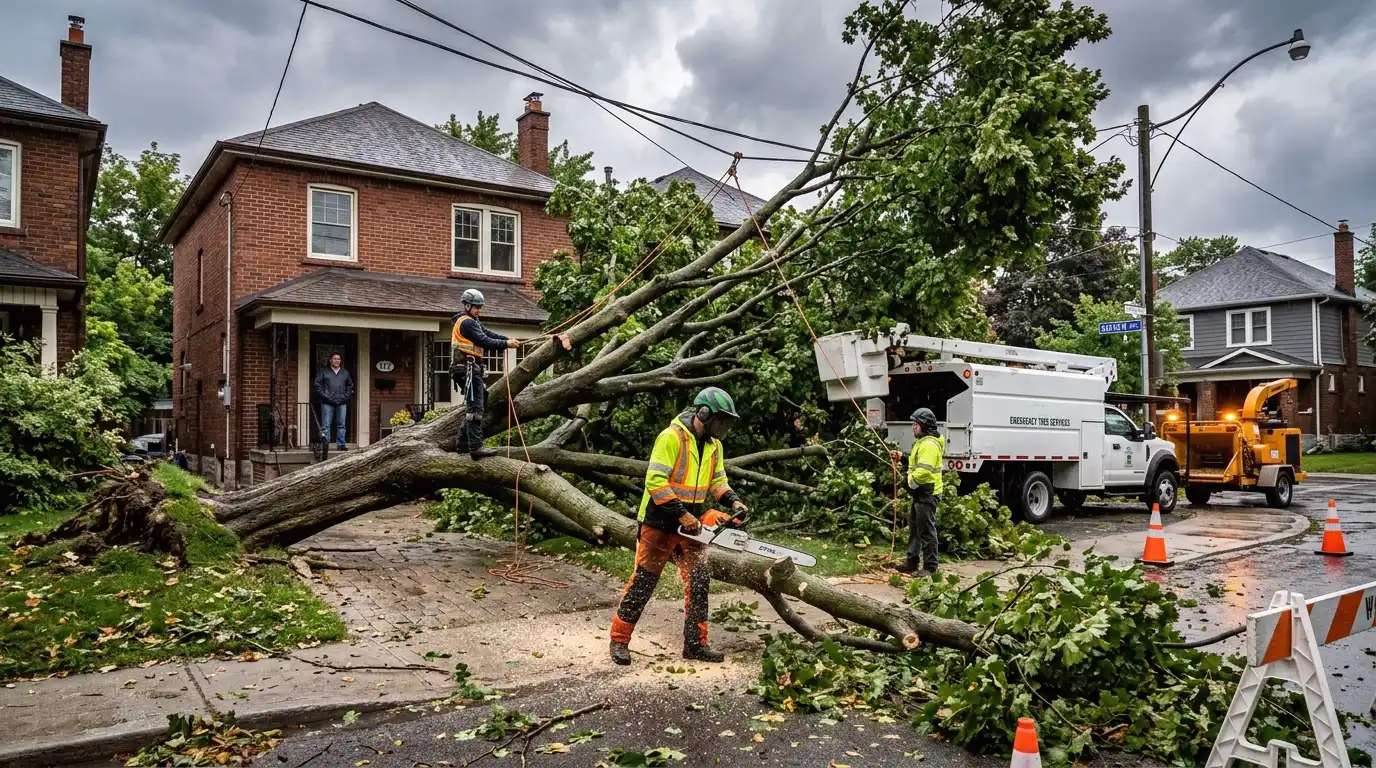
Emergency tree removal cost in the GTA can vary with tree size, access, risk, required approvals and the exact scope of work. Emergency tree removal costs in the GTA can vary widely because storm-damaged trees are not priced like simple scheduled work. Tree size, access, urgency, after-hours timing, whether the tree is on a structure, whether powerlines are involved, debris handling, crane access, and qualified tree contractor pricing all affect the final number. This guide explains common cost factors, insurance questions, City vs private responsibility, and what to do first when a tree comes down.
The following situations show how emergency tree-removal costs can change; they are not fixed quotes for a specific property. Actual pricing must be confirmed directly with the qualified tree contractor after the site is reviewed.
| Situation | General Cost Context |
|---|---|
| Small to mid-size tree, urgent daytime request | Often lower than large-tree emergency work, depending on access and cleanup |
| Large tree, urgent daytime request | Often higher because of labour, rigging, equipment, and debris volume |
| After-hours, weekend, or holiday request | May include an urgency or overtime premium set by the qualified tree contractor |
| Tree on or threatening a structure | Usually more complex because of structural contact, careful cutting, and damage risk |
| Tree contacting utility lines | Do not approach. Utility or emergency channels may need to be involved before any tree work |
| Crane-assisted or restricted-access removal | Can cost significantly more because of equipment, permits, access, and labour |
Every emergency job is different. A tree that falls into an open backyard is not the same as a storm-damaged tree resting on a roof in a tight Rosedale, East York, North York, Scarborough, or Etobicoke property. If the situation allows, ask the qualified tree contractor for a written scope, what is included, what is excluded, cleanup terms, payment terms, and whether stump grinding is separate before approving work.
Urgency pricing reality check: Emergency work may cost more because the qualified tree contractor may need to mobilize quickly, work outside normal hours, handle unstable wood, operate in difficult weather, or work around structures and utilities. Property owners should still ask for a clear explanation of pricing, scope, and payment terms before authorizing non-life-safety work where possible.
What Makes Emergency Tree Removal More Expensive Than Regular Removal
Immediate Mobilization
Scheduled tree work can be planned around weather, crew availability, equipment, permits, parking, debris handling, and site access. Emergency work often starts with limited information and a hazard that cannot wait. Qualified tree contractors may price that urgency differently.
Unpredictable Site Conditions
Storm-damaged trees can hold hidden tension. A partially fallen trunk, split limb, hung-up branch, or uprooted root plate can move suddenly if cut in the wrong sequence. This risk is one reason emergency work should not be treated as a simple chainsaw job.
Debris in Tight Spaces
Fallen trees often land across fences, decks, patios, sheds, garages, driveways, pools, gardens, or rooflines. Pieces may need to be removed carefully rather than dragged out quickly. Restricted access, stairs, narrow side yards, and no equipment access can increase labour time.
Overnight, Weekend, and Storm-Backlog Conditions
Major storms create high demand and limited contractor availability. Qualified tree contractors may apply different pricing for after-hours, weekend, holiday, or storm-response work.
What to Do When a Tree Falls: Step by Step
The first minutes after a tree falls are about safety, not cleanup.
- Clear the area immediately. Keep people, pets, and vehicles away from the fallen tree, the remaining trunk, hanging branches, and anything the tree hit.
- Check for utility line contact from a safe distance. If the tree or branch is touching or near powerlines, do not approach. Toronto Hydro says to stay back at least 10 metres from downed powerlines and report the issue immediately.
- Do not re-enter a damaged structure unless it is safe. A tree on a roof, porch, garage, or wall can create structural risk. Emergency services, a structural professional, or the insurer may need to be involved depending on the damage.
- Contact your insurer where a claim may be involved. If the tree hit a house, garage, shed, fence, or other insured structure, ask your insurer what documentation they need before cleanup starts, unless immediate life-safety work is required.
- Document everything if safe. Take photos and video of the tree, damage, wires, roof contact, vehicles, fence damage, access routes, and debris before work begins.
- Confirm contractor scope directly. Ask the qualified tree contractor what work will be done, what is excluded, whether debris hauling is included, whether stump grinding is separate, how payment works, and what documents are provided afterward.
Does Home Insurance Cover Emergency Tree Removal in Ontario?
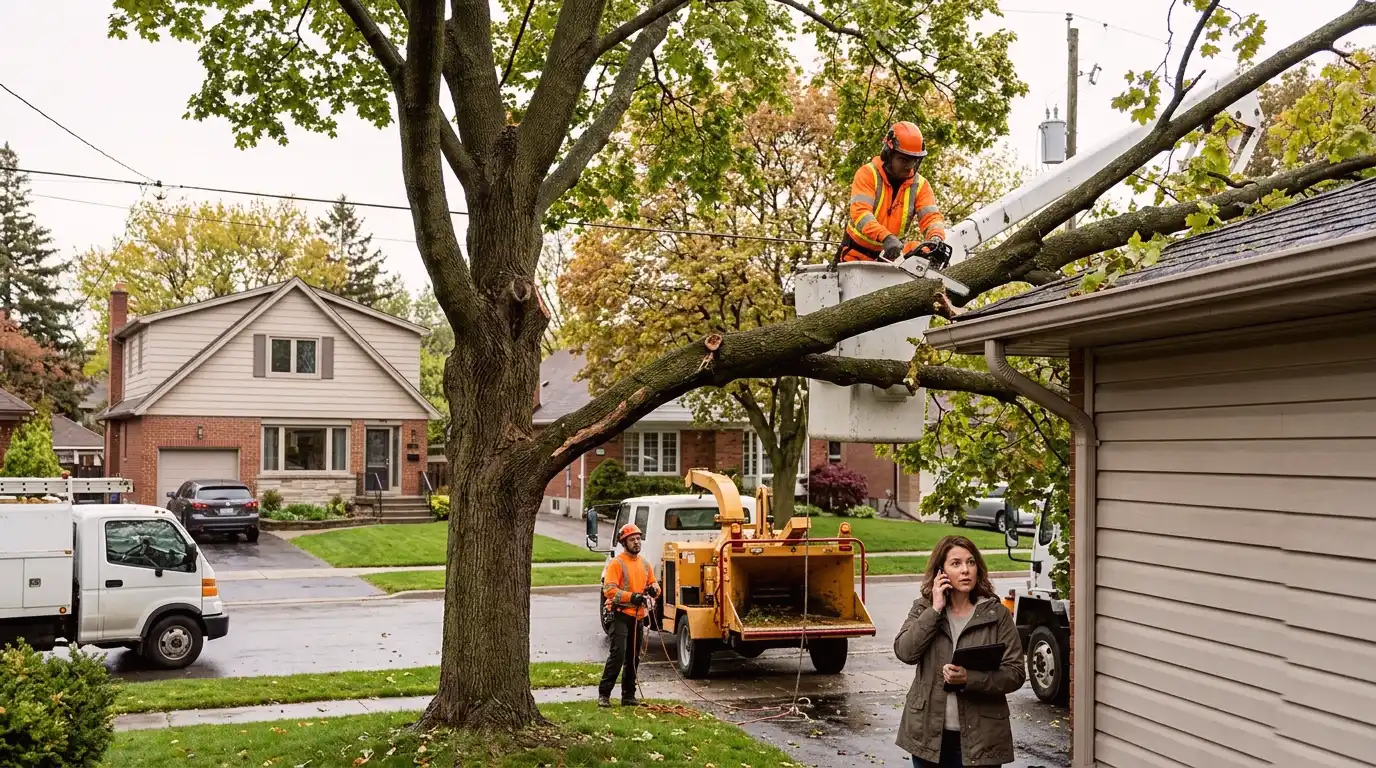
Insurance coverage depends on the specific policy, the cause of the loss, what the tree hit, whether there was physical damage to an insured structure, deductibles, exclusions, and insurer documentation requirements. Do not assume coverage based only on the fact that a tree fell.
Often more likely to involve a claim: a tree or large branch falls onto a house, attached structure, garage, shed, fence, or other insured structure and causes physical damage. The insurer decides what is covered and what documentation is required.
Often less likely to be covered as a tree-removal claim: a tree falls onto a lawn, garden, or driveway without damaging an insured structure. Vehicle damage is usually handled through the relevant auto insurance policy if applicable.
Neighbour tree situations: If a neighbour’s tree falls onto your property, your own insurer may still be the first call. Fault, negligence, notice of prior hazard, and responsibility are fact-specific. Property owners should speak directly with their insurer or legal advisor where needed.
Property owners should confirm documentation requirements directly with their insurer.
Need to Send an Urgent Tree Request?
City of Toronto vs Private Responsibility: Who Handles What
After a storm, one of the most common points of confusion is whether a fallen tree is a City issue, a utility issue, an insurance issue, or a private-property issue.
City-owned trees: If a City-owned tree has fallen or poses a hazard to pedestrians or traffic, the City says to contact 311 or submit an online request for emergency cleanup. City trees can include boulevard trees, park trees, and trees on City-owned land.
Private-property trees: For dangerous trees located on private property, responsibility generally lies with the property owner. The City says concerns about a privately owned tree that presents an immediate danger can be reported to 311 to create a bylaw enforcement investigation.
Utility lines: If a tree or branch is on or near a powerline, do not touch the tree, fence, water, or nearby objects. Follow Toronto Hydro safety guidance and report the issue through the appropriate utility or emergency channel.
If you are not sure whether a tree is private, City-owned, or near a regulated area, check official City guidance or contact 311 before spending money on private work that may not be yours to authorize.
Permit Rules for Emergency Removals in Toronto
Toronto identifies private trees with a diameter of 30 cm or more, measured at 1.4 m above ground, as protected. City-owned trees, replacement trees, ravine-area trees, and natural-feature areas may involve additional rules. In ordinary situations, removal or injury of a protected tree may require City approval before work begins.
Toronto’s current permit guidance treats an imminently hazardous private tree as a permit-exception situation rather than an ordinary permit application. The City says the owner must request and receive exception confirmation before removal or injury, unless immediate tree work is required to eliminate a dangerous situation. Keep clear photos and tree details, and use the City’s current Tree Protection and Plan Review instructions rather than assuming storm damage automatically waives documentation.
Avoiding Fraud After a Storm: What to Watch For
Major storm events can bring out rushed, underinsured, or unclear operators. Even when a tree problem feels urgent, property owners should pause long enough to confirm the basics unless there is immediate danger to life or safety.
- Full cash payment demanded before any work begins
- No written scope or price for non-life-safety work
- No proof of liability insurance when asked
- No clear business name, contact details, or service terms
- Pressure to approve work before contacting your insurer
- Unclear debris, cleanup, stump grinding, or restoration terms
- No explanation of how powerlines, City trees, or permit issues are handled
A legitimate qualified tree contractor should be able to explain what they will do, what is excluded, what it costs, what happens to debris, whether stump grinding is separate, what insurance information is available, and how payment is handled.
Related Guides
- Tree Removal Cost in Toronto
- Large Tree Removal Cost Toronto
- Signs Your Tree Is Dead or Dying
- Is My Leaning Tree Dangerous?
- Toronto Tree Permit Guide
- Emergency Tree Service Requests
Official Emergency and Tree Resources
- City of Toronto: City-Owned Tree Maintenance
- City of Toronto: Storm Damage to Trees
- 311 Toronto: Hazardous or Dangerous Trees
- 311 Toronto: Tree and Ravine Permit Applications
- Toronto Hydro: Electrical Safety Tips
- Toronto Hydro: Powerline Safety
- ISA: Find an Arborist
Frequently Asked Questions
How much does emergency tree removal cost in the GTA?
Emergency tree removal costs in the GTA vary widely based on tree size, storm damage, access, whether the tree is on a structure, whether utility lines are involved, equipment required, timing, and qualified tree contractor pricing.
Does home insurance cover emergency tree removal in Ontario?
Coverage depends on the policy, cause of loss, what the tree hit, and whether there was covered damage to an insured structure. Property owners should contact their insurer before authorizing work where possible.
What counts as a tree emergency?
Potential emergency situations include a tree or large limb on a house, garage, vehicle, utility line, road, sidewalk, driveway access, or other high-use area, or a tree that appears likely to fail imminently. If wires, fire, gas, injury, or immediate public danger are involved, contact the proper emergency, utility, or City channel first.
Can any tree service guarantee an emergency response time?
No universal response time applies across the GTA. Availability depends on storm demand, travel conditions, utility involvement, equipment, access and the contractor’s schedule. If a contractor offers a response-time commitment, confirm exactly what is promised and any conditions in writing.
Should I call the City of Toronto for a fallen tree emergency?
If the fallen or hazardous tree is City-owned, such as a boulevard, park, or other City tree, contact 311. If a private tree is creating immediate danger, the property owner is generally responsible and may also contact 311 to create a record where appropriate. If powerlines are involved, stay back and contact Toronto Hydro or emergency services as appropriate.
Do emergency tree removals still need a permit in Toronto?
An imminently hazardous private tree may qualify for Toronto’s permit-exception process rather than a standard permit application. The City says exception confirmation is required before work unless immediate tree work is necessary to eliminate a dangerous situation. Document the condition and follow the current City instructions.
Can I clean up a fallen tree myself to save money?
Small loose branches may be moved only if they can be handled safely from the ground and are not near wires, unstable wood, or structures. Trees under tension, partially fallen trunks, overhead limbs, and any work near powerlines should be left to qualified professionals or the appropriate utility service.
What should I do first when a tree falls on my house?
Leave the affected area, keep people away, check for utility or fire risk from a safe distance, contact emergency services or the utility if required, document the damage with photos where safe, and contact your insurer before authorizing non-life-safety work where possible. Structural safety, insurance requirements, and contractor work are handled by the appropriate qualified professionals.
Why is emergency tree removal often more expensive?
Emergency work can cost more because of urgent mobilization, after-hours availability, storm-damaged wood under tension, limited planning time, structural contact, restricted access, utility concerns, and increased safety risk. Qualified tree contractors set their own pricing and should explain the scope and charges directly.
Is stump grinding done during emergency tree removal?
Often it is separate. Emergency work usually focuses on removing the immediate hazard first. Stump grinding, backfill, restoration, debris hauling, and cleanup standards should be confirmed directly with the qualified tree contractor.
Does the type of storm affect emergency tree removal cost?
Yes. Ice, wind, saturated soil, flooding, heavy rain, snow load, and broken limbs under tension can all affect risk, equipment needs, access, and labour.
How do I find a legitimate emergency tree contractor after a storm?
Ask for written scope, proof of insurance, WSIB status where applicable, business details, payment terms, cleanup terms, and who is responsible for damage or disputes. Be cautious with full upfront payment, pressure tactics, no written quote, or unclear company identity.