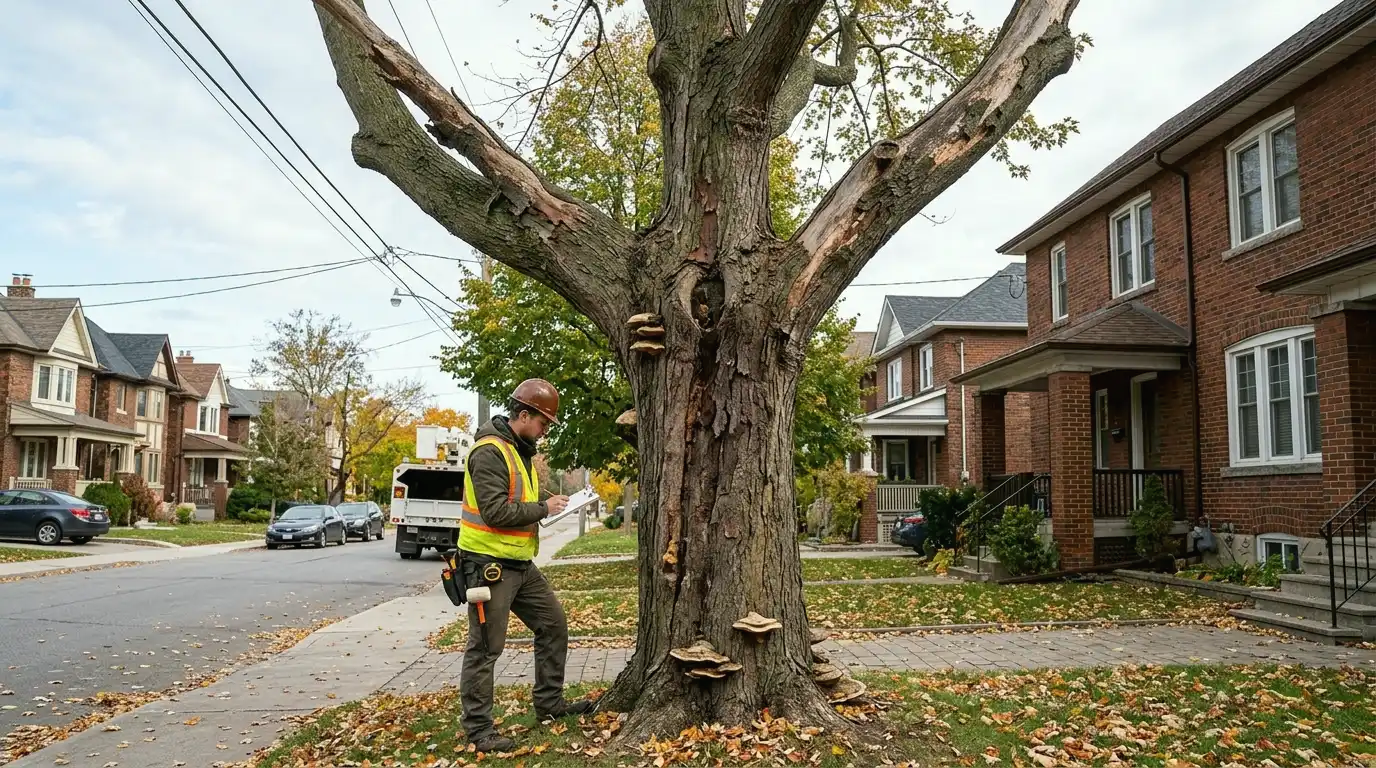
Signs your tree is dead or dying in Toronto can include canopy decline, structural defects or other changes that deserve closer assessment. A dead or seriously declining tree often shows a clear set of warning signs: no leaf-out in spring, brittle branches, peeling or slipping bark, dry brown tissue under the bark, fungal growth at the base, major deadwood in the crown, or visible root-area decay. Spotting these signs early gives you time to request qualified professional review, confirm whether the tree is fully dead or only stressed, and avoid waiting until a branch or trunk failure becomes urgent.
The Clearest Signs That a Tree May Be Dead
These signs often point to a tree that is fully dead, nearly dead, or far enough into decline that professional review is sensible:
No Leaf-Out in Spring
By late May in much of the GTA, most healthy deciduous trees have started leafing out. If one tree remains bare while nearby trees of the same species are fully leafed out, that is a strong warning sign. One completely bare tree standing among healthy green trees is usually not just “running late.” It may be dead, severely stressed, or affected by root, trunk, pest, or disease issues.
There are exceptions. Some species naturally leaf out later than others, and late spring weather can affect timing. Catalpa and Kentucky coffeetree, for example, are known for late leaf-out. Species identification matters before assuming a tree is dead in early spring.
The Scratch Test
The scratch test is a simple homeowner check for individual branches. Use a fingernail or small knife to gently scratch through the outer bark of a twig or small branch. The layer beneath the bark should be green and slightly moist in a living branch. If the tissue is consistently dry, tan, brown, or grey, that branch section is likely dead.
Test several small branches in different parts of the crown. A tree may have dead upper branches but still be alive lower down, or one side of the crown may be declining faster than the rest. The scratch test can help you notice patterns, but it is not a complete structural assessment.
Bark Peeling or Slipping
Healthy bark is usually firmly attached to the trunk. When a tree dies or declines severely, the tissue between bark and wood may dry out, causing bark to loosen, crack, slide, or fall away in large sections. If bark moves when pressed or large pieces are separating from a species that does not naturally shed bark that way, the tree should be reviewed.
Some bark peeling is normal for certain species. Birch, sycamore, and some other trees naturally shed or exfoliate bark. The concern is unusual bark loss, loose bark combined with dead branches, fungal growth, trunk cracks, cavities, or no leaf-out.
Fungal Growth at the Base or on the Trunk
Bracket fungi, shelf fungi, conks, or mushrooms growing from the trunk, root flare, or base can indicate internal decay. The visible fungal growth is only part of the organism. Decay may already be active inside the wood or root system.
Not every fungal growth means immediate removal, but the location matters. Fungal growth at the base, root flare, major trunk wound, or large union can be more concerning than a small mushroom in nearby mulch. A qualified arborist may assess the tree’s structure and discuss whether further testing, monitoring, pruning, or removal should be considered.
Deadwood Accumulation in the Crown
A small amount of interior deadwood can be normal, especially on older trees where shaded branches decline naturally. The concern increases when dead branches extend throughout the outer canopy, when large dead limbs are present, or when dead branches hang over a driveway, roof, sidewalk, patio, play area, garage, or neighbouring property.
Dead branches can fail without a storm. Wind, weight, decay, temperature change, and normal movement can all contribute to sudden limb failure. If large deadwood is visible above people or property, keep the area clear and request a qualified arborist review.
Mushrooms Around the Base
Mushrooms or honey fungus-type growth around the base may indicate root decay or moisture-related stress. Root decay is important because it can reduce anchorage, and the full extent may not be visible above ground. A tree with active root decay near a structure, public walkway, or frequently used yard area should be taken seriously.
Signs a Tree Is Declining But May Still Be Manageable
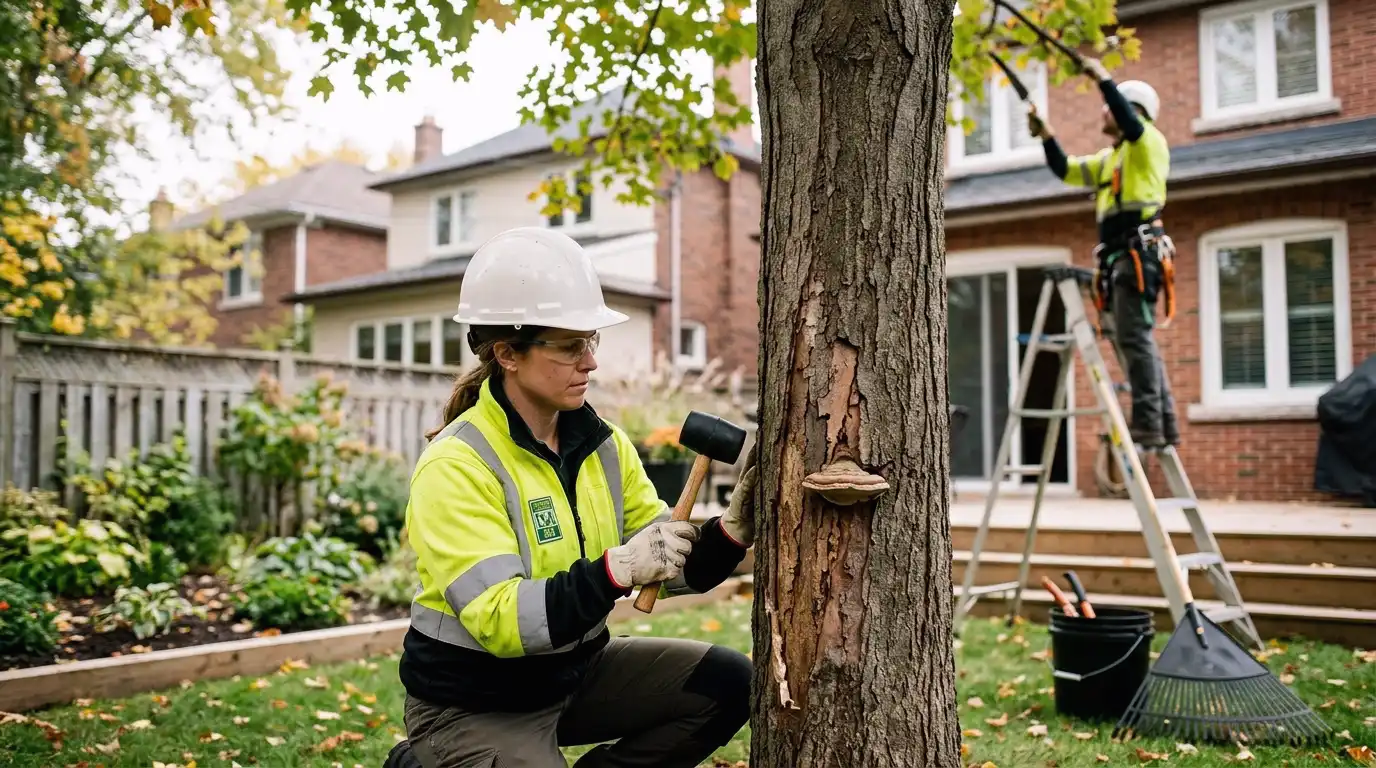
Not every struggling tree is beyond help. Some symptoms suggest stress, partial decline, or a site issue that may still be managed if it is caught early:
- Smaller than normal leaves: Reduced leaf size can occur with drought stress, compacted soil, root injury, nutrient issues, or construction damage.
- Yellowing leaves outside of fall: Off-season yellowing may point to soil conditions, moisture stress, drainage issues, nutrient imbalance, or disease.
- Dieback limited to one section: One dead limb or one declining side may indicate a localized issue rather than full tree death.
- Epicormic growth: Dense clusters of small shoots from the trunk or major branches can be a stress response. It is a warning sign, not automatically a death sentence.
- Thin canopy: Sparse foliage can suggest root stress, drought, pest activity, compaction, age, construction disturbance, or other site conditions.
A qualified arborist or qualified tree care professional may be able to discuss whether the tree can be monitored, pruned, treated, or managed.
Signs Your Tree Is Dead or Dying in Toronto: Not Sure If Your Tree Is Dead or Dying
Dead Tree, Dead Branches: Which Is More Urgent?
A large dead tree close to a house, garage, driveway, sidewalk, neighbour’s property, play area, or frequently used outdoor space should be treated as a priority concern. As dead wood dries and decay progresses, branches can become more brittle and the tree’s structure can weaken. Species, size, decay, lean, root condition, and nearby targets all affect urgency.
Individual dead branches in a living tree can also be hazardous. A large dead limb in the crown of an otherwise living maple, oak, ash, or spruce can still fall unexpectedly. Removing dead limbs may reduce risk without removing the whole tree, but that decision should be discussed directly with a qualified arborist or qualified tree care professional.
Do You Need a Permit to Remove a Dead Tree in Toronto?
Toronto’s current permit guidance says a tree that is 100% dead does not require the standard removal permit, but dead trees are handled through the City’s permit-exception process. Property owners should request and receive exception confirmation before removal unless immediate work is required to eliminate a dangerous situation. Trees that are merely declining or in poor condition are different and may still require a permit.
If the tree may be protected, document its condition before removal. For a 100% dead tree, Toronto’s current page uses a permit-exception confirmation process; for a dangerous private tree, immediate-danger concerns can also be reported through 311. City-owned trees, ravine or natural-feature areas, and other protected situations have separate rules, so check the official City instructions before work starts.
For more detail on this specific issue, see the guide on dead tree removal permit questions in Toronto.
What to Do Next
If you see several warning signs, start by keeping people, pets, and vehicles away from the potential fall zone if the tree or large limbs appear unstable. Do not climb the tree, cut hanging limbs, or work near overhead wires. If the tree is touching utility lines or creating immediate danger, contact the proper utility, emergency channel, or City service.
Next, collect clear photos from a safe distance. Capture the whole tree, base, trunk, crown, major dead branches, fungal growth, cracks, lean, and nearby targets. Those photos can help a qualified professional understand the situation before a visit.
Related Guides
- Dead Tree Removal Permit Toronto
- Is My Leaning Tree Dangerous?
- How to Get a Toronto Tree Permit
- Arborist Report Cost Toronto
- Tree Removal Cost Toronto
- Tree Removal Requests
Official and Helpful Resources
- City of Toronto: Tree and Ravine Protection
- City of Toronto: When to Apply for a Tree or Ravine Permit
- 311 Toronto: Private Tree and Ravine Permit Exceptions
- 311 Toronto: Hazardous or Dangerous Trees
- ISA: Find an Arborist
Frequently Asked Questions
How do I know if my tree is dead?
A dead tree often shows no leaf-out in spring, brittle branches, dry brown tissue under the bark, peeling or slipping bark, fungal growth, and major deadwood throughout the crown. The scratch test can help check individual branches, but a full-tree decision should be made carefully, especially if the tree is near a house, driveway, sidewalk, fence, or utility line.
Can a half-dead tree be saved?
Sometimes. A declining tree may still have options if the trunk, root system, and remaining live crown are structurally sound and the cause of stress can be addressed. A qualified arborist or qualified tree care professional may assess the tree and discuss whether pruning, monitoring, treatment, or removal should be considered.
Do I need a permit to remove a dead tree in Toronto?
Toronto’s current guidance says a 100% dead tree does not require the standard removal permit, but the owner must request and receive permit-exception confirmation before removal unless immediate work is needed to eliminate a dangerous situation. Trees in poor condition are different and may still require a permit.
Is a dead tree dangerous?
A dead tree can become more hazardous over time as branches dry, decay advances, and root anchorage weakens. Risk depends on tree size, species, location, decay, nearby targets, and how long the tree has been dead. A dead tree near people, structures, driveways, sidewalks, or wires should be reviewed promptly by a qualified professional.
What is the scratch test for trees?
The scratch test involves gently scratching a small patch of outer bark on a twig or small branch. Green, moist tissue underneath suggests that branch section is alive. Dry, brown, tan, or grey tissue suggests that section is dead. Testing several branches can help, but it does not replace a full tree assessment where safety is a concern.