
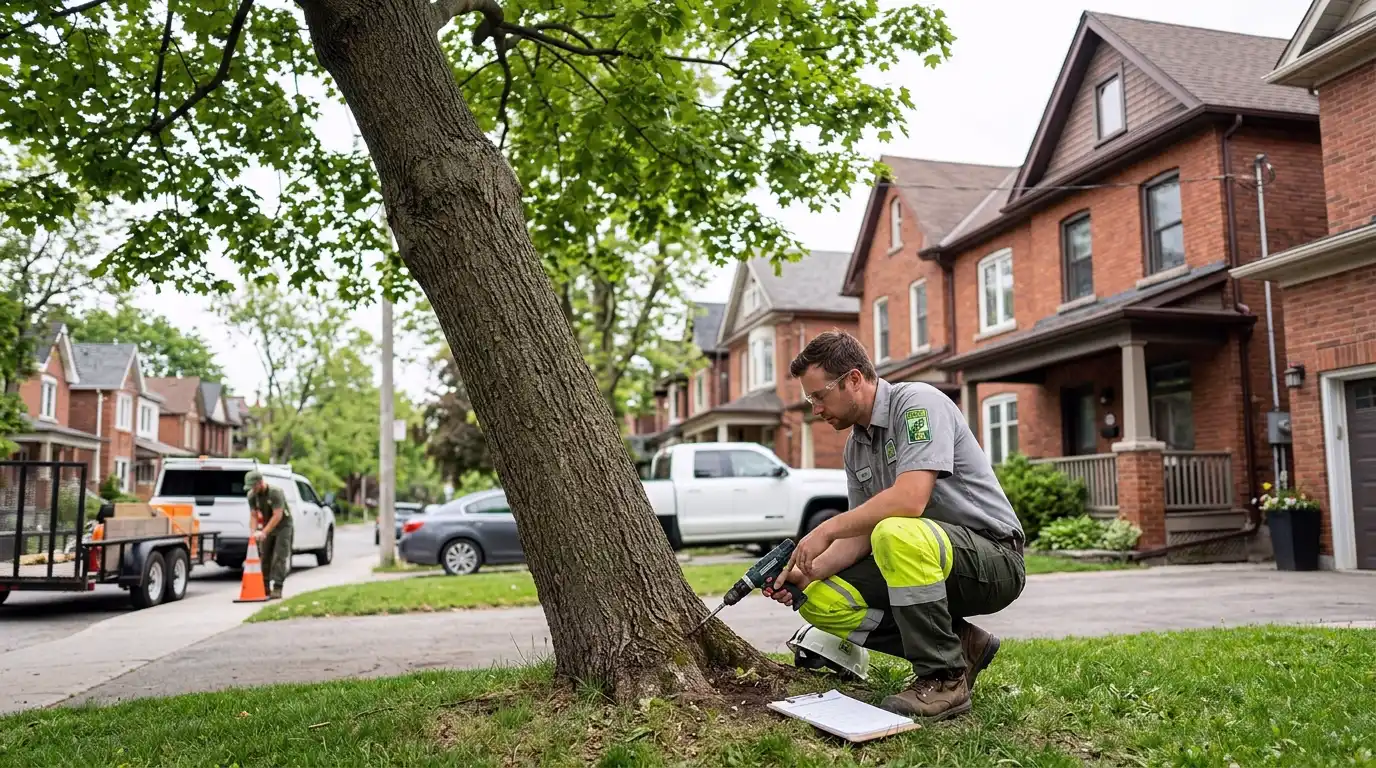
A useful way to approach dangerous leaning tree in Toronto is to start with property conditions, safety concerns and any local rules that apply. A leaning tree is not automatically dangerous. Some trees have grown at a modest angle for decades and may remain stable. What matters is whether the lean is new, whether it is getting worse, what is happening around the root area, and what sits in the possible fall path. A tree that recently started leaning, has soil cracking or root plate movement, or leans toward a house, driveway, sidewalk, garage, vehicle, or neighbouring property should be treated seriously and reviewed by a qualified professional.
Not All Leans Are the Same
The first question is whether the lean is old or new. That single detail changes the risk picture.
An old, established lean is one the tree has had for years. Trees near homes, fences, neighbouring trees, or shaded areas may grow toward available light and develop a natural lean. If old photos show the same angle over many years and there are no new root-zone changes, soil cracks, fresh movement, or decay signs, the tree may not be an immediate concern.
A new or increasing lean is different. If the tree was upright last season and now has a visible angle, or if the lean has increased after heavy rain, wind, construction, utility work, excavation, or soil disturbance, the tree may have root anchorage problems. Keep people away from the likely fall path and request qualified professional review.
Warning Signs That a Leaning Tree May Be Unstable
These signs, especially when combined with a lean toward a target, can indicate a tree that needs urgent review:
Soil Heaving or Cracking Near the Base
Look at the ground around the trunk, especially on the side opposite the lean. When a tree starts to tip, roots on the opposite side can pull upward and disturb the soil. Cracking, lifting, raised ridges, fresh gaps, or mounded soil near the base can suggest root plate movement. Do not stand near the tree or under the fall path if these signs are present.
Exposed Root Plate
A visible lifting root plate means the tree may already be partially uprooted. The remaining roots may be carrying uneven load, especially during wet soil conditions or wind. This can progress quickly. Keep people, pets, vehicles, and outdoor furniture away from the likely fall zone.
The Lean Is Toward a Structure or High-Use Area
Direction matters. A tree leaning away from targets is a different risk than a tree leaning toward a house, garage, driveway, sidewalk, street, patio, playground, neighbour’s property, or overhead line. If something valuable or occupied is in the fall path, treat the situation with more urgency.
Recent Root Zone Disturbance
Leaning that appears after excavation, trenching, driveway work, basement underpinning, landscaping, drainage work, utility installation, fence post digging, or grade changes may point to root damage. Heavy rain and saturated soil can make the situation worse because roots may lose grip in softened soil.
Decay or Fungal Growth at the Base
A leaning tree with fungal conks, mushrooms, cavities, soft wood, bark loss, or decay near the root flare has more than one concern. Decay can weaken the roots or lower trunk while the lean increases mechanical stress. A qualified arborist may assess the tree’s visible structure and discuss next steps.
Lean Angle: Does the Degree of Lean Matter?
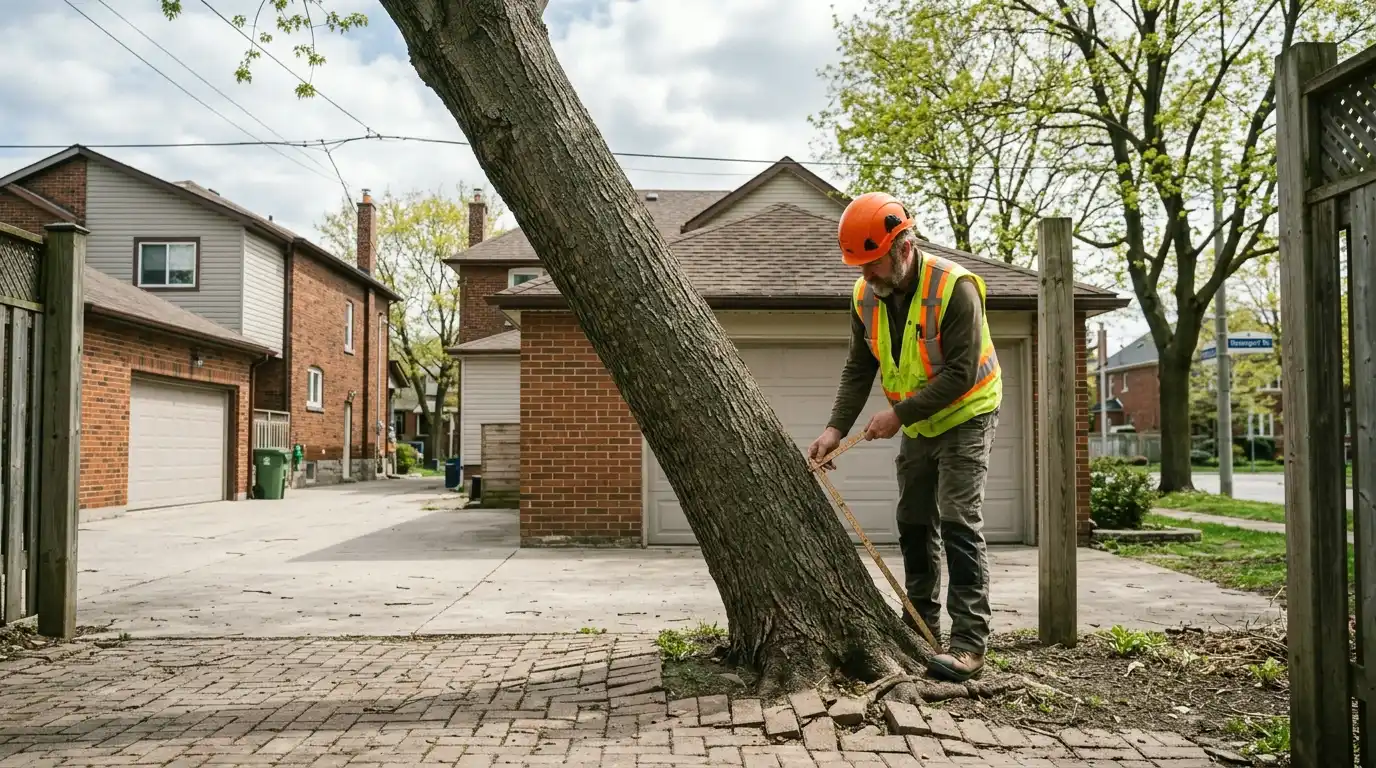
The angle matters, but it is not the only factor. A tree leaning at a noticeable angle for decades can be more stable than a tree that recently moved only a few degrees. What matters most is whether the lean is changing, whether roots are lifting, whether soil is cracking, whether decay is present, and what sits below the tree.
Large mature trees with significant lean, visible root movement, decay, or nearby targets should not be treated casually. Measuring the angle can help document change over time, but it does not replace assessment by a qualified arborist or qualified tree care professional where safety is a concern.
Concerned About a Leaning Tree?
Can a Leaning Tree Be Saved?
Sometimes, depending on age, size, cause, species, root condition, soil conditions, and nearby targets. A young tree that shifted after planting or minor soil movement may sometimes be corrected by a qualified professional if the roots are intact and the cause is manageable.
A large mature tree is different. Pulling or winching a mature leaning tree upright can damage roots and may increase failure risk. If the lean is old and stable, monitoring may be enough. If the lean is new, progressing, or linked to root failure, removal or other risk-reduction options may need to be discussed directly with a qualified arborist or qualified tree care professional.
Support systems such as cabling or bracing are not a universal fix and do not correct root failure. They may be discussed in specific structural situations, but they must be evaluated by a qualified professional.
When Removal May Be the Right Call
Removal may become part of the discussion when the lean is actively increasing, root plate movement is visible, soil is cracking or heaving, decay is present at the base, the fall path includes a structure or high-use area, or a qualified professional concludes the tree cannot be reasonably managed.
A stable old lean does not automatically mean removal is needed. A new lean with root movement is different. The safest approach is to document the signs, keep clear of the fall zone, and request a qualified arborist review. If the tree is creating an immediate danger, contact the proper emergency, utility, or City channel and follow official instructions.
Dangerous Leaning Tree in Toronto: Permit Requirements for Leaning Tree Removal in Toronto
If the leaning tree is a bylaw-protected private tree and is not an imminent hazard, a City of Toronto permit may be required before removal. Toronto identifies private trees with a diameter of 30 cm or more, measured at 1.4 m above ground, as protected. City-owned trees, ravine-area trees, boundary trees, and replacement trees may involve additional rules.
Toronto’s current permit page treats an imminently hazardous private tree as a permit-exception situation. The owner must request and receive exception confirmation before removal or injury unless immediate tree work is required to eliminate a dangerous situation. Photos and tree details are useful for the City record.
For general permit steps, see the guide on how to get a tree removal permit in Toronto. For cost context, see emergency tree removal cost in the GTA.
Related Guides
- Signs Your Tree Is Dead or Dying
- How to Get a Toronto Tree Permit
- Emergency Tree Removal Cost GTA
- Arborist Report Cost Toronto
- Tree Growing Into My House
- Tree Removal Requests
Official Toronto Resources
- City of Toronto: Tree and Ravine Protection
- 311 Toronto: Tree and Ravine Permit Applications
- 311 Toronto: Hazardous or Dangerous Trees
- City of Toronto: Storm Damage to Trees
- ISA: Find an Arborist
Related professional service: For urgent private-tree concerns, review the emergency tree service request information.
Frequently Asked Questions
Is a leaning tree always dangerous?
No. Some trees have grown at a stable angle for many years and are not automatically an immediate hazard. The bigger concern is a new lean, a lean that is getting worse, soil cracking, root plate movement, decay at the base, or a lean toward a structure, driveway, sidewalk, or other target.
How do I know if my leaning tree is about to fall?
Warning signs include soil heaving or cracking near the base, root plate lifting, fresh soil disturbance, a visibly increasing lean, broken roots, fungal growth at the base, or a lean toward a house, garage, vehicle, sidewalk, or neighbouring property. Keep people away from the fall path and request qualified professional review.
What causes a tree to suddenly start leaning?
Sudden lean is often linked to root failure or soil movement. Heavy rain, saturated soil, root decay, construction damage, trenching, excavation, utility work, grade changes, or wind loading can all reduce root anchorage. A tree that was upright recently and is now leaning should be treated seriously.
Can a leaning tree be straightened?
Small young trees may sometimes be corrected if the roots are still intact and the cause is minor. Large mature trees generally should not be pulled back upright because that can damage roots and increase failure risk. A qualified arborist or qualified tree care professional may assess whether monitoring, pruning, support, or removal should be considered.
Do I need a permit to remove a leaning tree in Toronto?
If the tree is a bylaw-protected private tree and is not an imminent hazard, a City of Toronto permit may be required before removal. If it is imminently hazardous, the current City process uses permit-exception confirmation, with immediate work allowed when necessary to eliminate a dangerous situation.