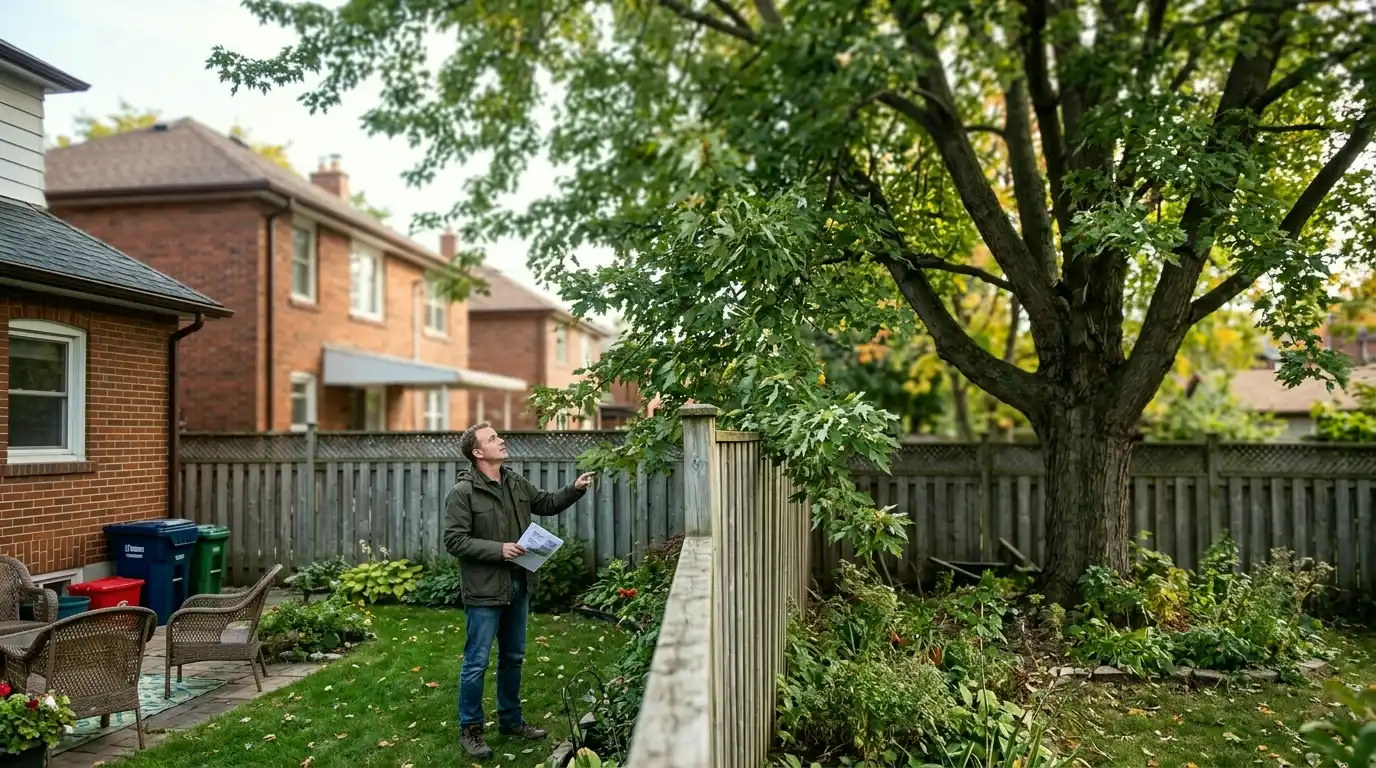
Questions about neighbour’s tree overhanging my property in Toronto usually come down to the rules, site conditions, risks and practical options for the property. When a neighbour’s tree hangs over your Toronto property, the issue is usually a civil matter between property owners. Toronto says it does not regulate ordinary trimming of trees on private property, but there are important limits: you cannot trespass onto your neighbour’s land, you cannot damage your neighbour’s tree, and protected-tree rules may still apply if the pruning would injure or destroy a bylaw-protected tree.
If the trunk itself is shared or sits on the boundary, see the guide to a tree on a property line in Toronto.
Toronto’s public guidance gives three practical points for neighbouring private trees: do not trespass onto your neighbour’s property, do not damage your neighbour’s property, including the tree, and maintain your own property in a safe condition. The City recommends discussing the issue with your neighbour because tree trimming on neighbouring private property affects private property rights.
That means overhanging branches should not be treated like a normal yard cleanup job. A small branch over a fence may be simple. A major limb over a roof, a large root near a foundation, or heavy pruning on a mature protected tree can create legal, safety, and by-law risk. If the work could seriously injure the tree, affect stability, or lead to a dispute, get advice from the right professionals before cutting.
This page is general information only. It is not legal advice. If you need to know your exact legal rights or responsibilities, speak with a lawyer. If you need tree-condition input, a qualified arborist or qualified tree care professional may assist.
What You May Be Able to Trim
Property owners often deal with branches that cross over fences, sheds, walkways, driveways, roofs, gardens, decks, and garages. In general civil-property terms, encroaching branches or roots are often dealt with at the property line. However, the work must stay on your side, must not involve entering the neighbour’s property, and must not seriously injure or destroy the tree.
Toronto also states that where a private tree is protected under the City’s tree bylaws, pruning is permitted only when it is completed according to good arboricultural standards. If the work would injure or destroy the tree, a permit may be needed. This is why heavy pruning or large root cutting near a mature tree should not be done casually.
Key limits to remember:
- Do not enter your neighbour’s property without permission.
- Do not reach across the line to cut branches on your neighbour’s side.
- Do not cut in a way that seriously injures, destabilizes, or kills the tree.
- If the tree is protected, pruning must follow good arboricultural standards.
- If the work would injure or remove a protected tree, a City permit may be required.
- Neighbour disputes, costs, and damage claims are civil issues.
When Branches or Roots Cause Actual Damage
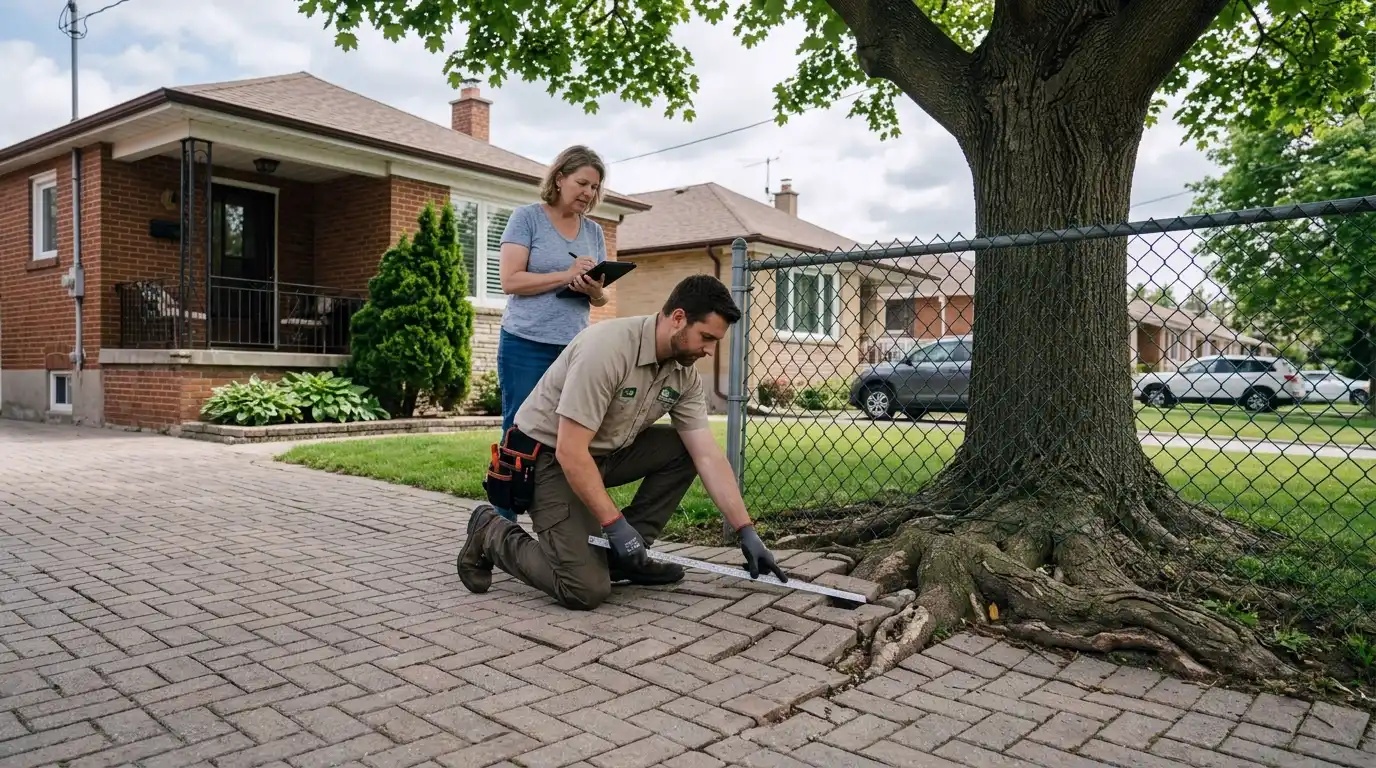
Overhanging branches and encroaching roots are one issue. Property damage is another. If roots are lifting a driveway, blocking drains, affecting a retaining wall, or raising concerns about a foundation, that may involve arboricultural, drainage, engineering, insurance, or legal questions.
For hardscape and foundation concerns, Toronto’s current tree guidance also notes that roots do not cause lifts or cracks in properly constructed and well-maintained infrastructure; drainage, freeze-thaw movement and existing defects can create spaces that roots later occupy. Document the actual damage and have the relevant building, drainage or tree professional diagnose the cause rather than assuming proximity proves responsibility.
Document the issue clearly. Take photos, keep dates, save invoices, and send written notice to the neighbour if you believe their tree is causing damage. Do not rely only on a verbal conversation if the issue is serious. If the matter may become a claim or dispute, speak with a lawyer or insurer.
A qualified arborist may document visible tree condition, species, approximate location, root concerns, branch structure, or risk factors. A drainage contractor, structural engineer, foundation specialist, surveyor, or lawyer may also be needed depending on the issue.
When the Tree Looks Hazardous
If your neighbour’s tree looks like it may fail, start with safety and documentation. Stay away from the likely fall area, notify the property owner in writing, and include clear details such as broken limbs, a new lean, root lifting, cracked soil, a split trunk, fungal growth at the base, or large dead branches over your property.
Toronto says property owners are responsible for maintaining their trees. If a tree or branch on neighbouring property looks like it might fall, the City advises staying away and telling the property owner right away so they can act. The City also says contacting the City for inspection should generally be a last resort.
If the tree presents an immediate danger, dangerous private trees can be reported to 311. Urban Forestry may investigate and, if the City confirms an immediate danger, notify the property owner and issue an Order to Comply. If there is immediate life-safety danger, wires, fire, or structural damage, contact the proper emergency or utility service first.
Does Chapter 813 Affect This Situation?
Yes, it can. Toronto’s tree rules may still apply even if the branches or roots affect your property. Private trees with a diameter of 30 cm or more, measured at 1.4 m above ground, may be protected. City-owned trees, ravine-area trees, replacement trees, and boundary trees may involve additional rules.
Toronto distinguishes between neighbour trees and boundary trees. A neighbour tree is one where the trunk is fully on another property but branches or roots affect a neighbouring property. Toronto says the impacted owner may apply for a permit if required, but the permit does not determine ownership and does not authorize entering another person’s property or removing another person’s tree without consent.
A boundary tree is different. Toronto says if any part of a trunk grows across one or more property lines, the tree is known as a boundary tree and is owned by both or all property owners. The Ontario Forestry Act also says a tree whose trunk grows on the boundary between adjoining lands is common property of the adjoining owners. If a tree may be on the boundary, confirm ownership before any work is approved.
What Counts as Injuring a Tree?
Tree injury is broader than many property owners realize. Toronto lists examples of activities that may injure a protected tree, including cutting, breaking, tearing, crushing, exposing, or stripping roots, trunk, or branches, and excessive canopy removal or improper pruning. That matters when a neighbour’s roots are under your driveway or a large limb crosses your roofline.
Root cutting can be especially risky. Large roots may contribute to stability and water uptake. Cutting too much root mass can increase decline or failure risk. Heavy canopy pruning can also stress or destabilize the tree, especially if large limbs are removed poorly.
If the tree is mature, protected, structurally important, or already disputed, do not guess. Ask a qualified arborist or qualified tree care professional what pruning or root work may be reasonable, and speak with a lawyer where property rights or neighbour consent are unclear.
Communicating With Your Neighbour First
Even where you believe you have the right to trim encroaching branches on your side, communication is usually the better first step. Let your neighbour know what is happening, show photos, explain the concern, and ask whether they are willing to discuss a professional review or shared solution.
Written communication helps if the issue later becomes a dispute. A short note with photos, dates, and a simple request is better than an argument at the fence. Keep the tone factual. Explain what is overhanging, what damage or risk you are concerned about, and what next step you are asking for.
If both neighbours agree that pruning or removal should be considered, confirm ownership, permit rules, access, scope, cost-sharing, cleanup, and responsibility in writing before hiring anyone. If the tree is protected, boundary-owned, City-owned, or in a ravine-related area, do not schedule work until the proper rules are checked.
Need to Send an Overhanging Tree Request?
Legal questions should be reviewed with a lawyer.
Official Toronto and Ontario Resources
- 311 Toronto: Pruning a Neighbour’s Overhanging Branches
- 311 Toronto: Dangerous Private Trees
- City of Toronto: When to Apply for a Tree or Ravine Permit
- City of Toronto: How to Apply for a Tree or Ravine Permit
- Ontario Forestry Act
- ISA: Find an Arborist
Frequently Asked Questions
Can I cut my neighbour’s tree branches that hang over my yard in Toronto?
Toronto says private-tree trimming between neighbours is generally a civil issue. Property owners should not trespass onto a neighbour’s property, should not damage the neighbour’s tree, and should use good arboricultural standards. If the tree is protected and the pruning would injure or destroy it, a permit may be required. Property owners should speak with a lawyer for legal-rights advice.
My neighbour’s tree root is lifting my driveway. Who pays for the repair?
Tree-root damage between neighbours is usually a civil property issue; a tree contractor cannot decide legal rights or property ownership. The affected property owner should document the issue, communicate with the neighbour in writing, and speak with a lawyer, insurer, drainage contractor, engineer, or qualified arborist where appropriate.
My neighbour’s tree looks like it could fall on my property. Can I force them to remove it?
A neighbour generally cannot be forced by another resident to remove a tree without proper process. Toronto says property owners are responsible for maintaining their trees, and dangerous private trees can be reported to 311 when there is an immediate danger. Urban Forestry may investigate and issue an order if the tree meets the City’s dangerous-tree criteria.
Can my neighbour’s tree still be protected if it hangs over my property?
Yes. A tree can be protected even if its branches or roots affect a neighbouring property. Toronto says a neighbour-tree permit does not determine ownership and does not authorize entry onto another person’s property or removal of another person’s tree without consent. Private trees 30 cm or more in diameter may be protected by City rules.
What if the trunk is on the property line?
A tree with any part of the trunk growing across one or more property lines may be a boundary tree. Toronto says boundary trees are owned by both or all property owners, and consent from the other owner may be required. Ontario’s Forestry Act also treats boundary trees as common property of adjoining owners.
Related Guides
- Tree Removal Permit Toronto
- Tree Growing Into House or Foundation
- Leaning Tree Dangerous Toronto
- Tree Removal Requests
- Arborist Report Requests