
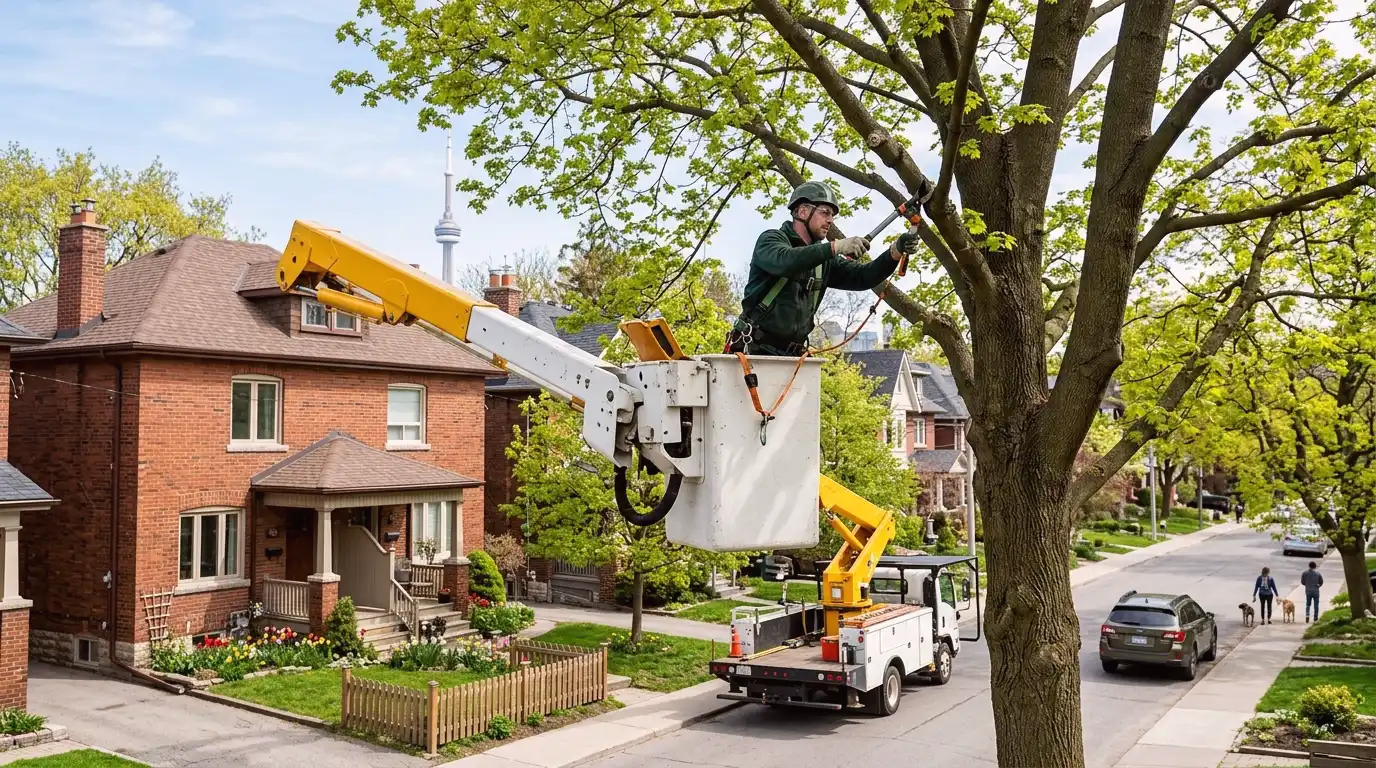
Property owners dealing with spring tree care checklist for Toronto should first consider tree condition, site constraints and any municipal requirements. Spring is a useful time for Toronto homeowners to look closely at their trees because winter damage, broken branches, trunk cracks, pest symptoms, and structural problems are often easier to see before the full canopy fills in. A careful spring walkaround can help you decide what needs urgent attention, what may need a qualified arborist assessment, and what can simply be monitored as the growing season begins.
For the other end of the growing season, use the fall tree care in Toronto guide.
1. Walk every significant tree before full leaf-out
Inspect important trees in late March or April if conditions are safe. Before the leaves fully emerge, it is easier to see branch structure, dead wood, broken limbs, co-dominant stems, trunk cracks, and hanging sections left from winter storms. Look from the ground only. Do not climb the tree or stand below damaged limbs.
2. Look up for dead and hanging branches
Dead branches are often easier to spot before leaf-out because they may lack healthy buds while the surrounding canopy is beginning to swell. Hanging branches caught in the canopy are more urgent, especially over walkways, driveways, patios, roofs, vehicles, play areas, or neighbouring property. Large dead or hanging branches should be reviewed by a qualified arborist or qualified tree care professional.
3. Check co-dominant stem unions for cracks
A co-dominant stem occurs when two similarly sized stems grow from the same area. These unions can be weaker when bark is included between the stems. Winter wind, snow, and ice can widen cracks or shift a weak union. Walk around the tree and look for fresh cracks, bark separation, oozing, movement, or a visible gap near major branch unions. If the tree is large or over a high-use area, treat new cracking as a serious warning sign.
4. Check ash trees for Emerald Ash Borer symptoms
If you have ash trees, spring is a good time to check for Emerald Ash Borer symptoms. Look for D-shaped exit holes, bark splitting, S-shaped galleries under loose bark, thinning upper canopy, dead branches near the crown, and heavy woodpecker activity. Ash trees can become brittle as decline advances, so visible symptoms should not be ignored.
5. Look for fungal growth at the trunk or root flare
Mushrooms, conks, or shelf-like fungal growth on the trunk, root flare, or surrounding root area may indicate internal decay or root decay. That does not automatically mean removal is required, but it does mean the tree deserves closer attention. A tree with significant fungal growth at the base, especially near targets such as homes, driveways, sidewalks, decks, or neighbour areas, should be assessed by a qualified arborist.
Spring tree care: what may need attention first
- Request qualified arborist review soon: Large hanging branches, cracks at co-dominant unions, mushrooms or conks at the trunk base, visible root heave, a new lean, or major ash decline symptoms
- Plan for later spring or summer: General clearance pruning, smaller deadwood cleanup, stump grinding from a past removal, or routine canopy review
- Often reasonable to monitor: Small dead twig tips, minor winter tip damage, sparse early leafing that improves as the tree fully leafs out, or small frost cracks without decay signs
- Do not DIY: Large dead limbs, high canopy work, branches near wires, branches over structures, or cutting under tension
Spring Pruning: What to Discuss and When
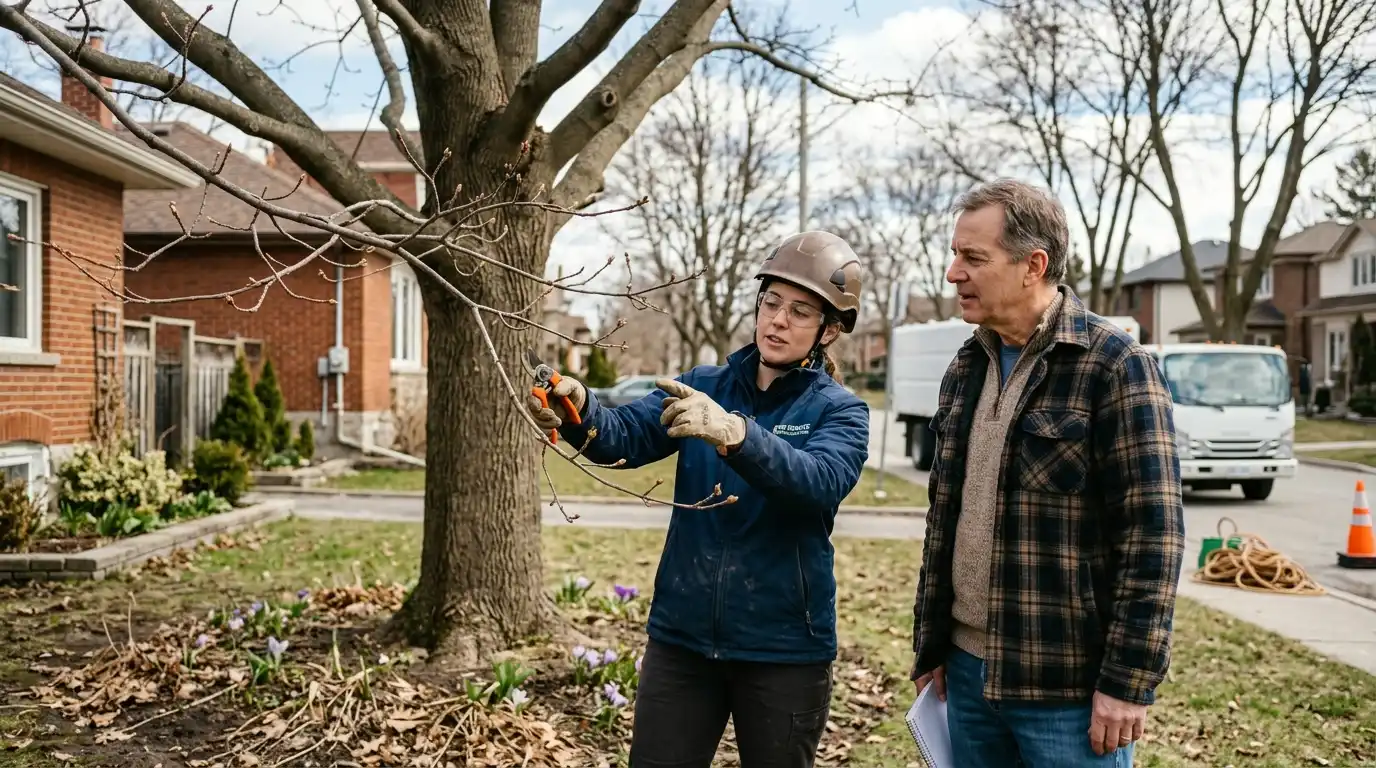
Many Toronto deciduous trees are commonly reviewed for pruning in late winter or early spring because the branch structure is visible and the tree is approaching active growth. Crown cleaning, smaller deadwood removal, structural pruning, and clearance pruning may be discussed during this period depending on species, tree health, location, and the reason for pruning.
Oak pruning requires extra caution because oak wilt has been found in Southern Ontario. Ontario advises avoiding oak pruning or wounding from the beginning of April to the end of July, which is considered the high-risk period. Ideally, oaks should not be pruned or wounded between April and November while sap beetles that spread the disease are active. If an oak has storm damage or another urgent issue during that period, a qualified arborist should discuss the safest next step with the property owner.
Elm trees and other species can also have species-specific timing concerns. Fruit tree pruning is often handled differently from shade tree pruning because fruit production, disease management, and timing all matter. The right timing should be based on the species, the pruning objective, and the tree’s condition, not only the month on the calendar.
What Can Often Wait Until Later in the Season
Not everything needs to be handled immediately in spring. Some routine pruning, smaller deadwood cleanup, young-tree structural pruning, or stump grinding can often be scheduled later depending on risk, access, weather, and the property owner’s plans for the property.
If the tree is stable, not over a high-use target, and only has minor cosmetic or low-risk issues, monitoring may be reasonable. If the tree has large dead limbs, visible cracks, root movement, major canopy dieback, or fungal growth at the base, waiting may increase risk and should be discussed with a qualified arborist or qualified tree care professional.
Managing Spring Tree Care With Toronto Permit Rules
Routine private-tree pruning following good arboricultural practices does not generally require a City tree permit. However, Toronto requires a permit to injure or remove a bylaw-protected tree, ravine, or natural feature. Private trees, City-owned trees, ravine or natural feature areas, and construction-related tree impacts can all raise different requirements.
If spring inspection reveals a protected tree that may need removal, root work, construction-related disturbance, or pruning severe enough to injure the tree, confirm City requirements before work begins. Toronto says routine private-tree pruning performed according to good arboricultural practice does not require a permit. Private trees meeting the protected threshold, City-owned trees, and trees or work in ravine and natural-feature areas have separate rules.
Spring Tree Concern?
Spring Soil, Mulch, and Watering Checks
Spring care is not only about pruning. Soil, mulch, and moisture can affect tree health through the entire growing season. Check whether mulch is piled against the trunk, whether soil is compacted around the root zone, whether downspouts or grading are changing water flow, and whether construction materials or vehicles have been stored near major roots.
Mulch should not be volcanoed against the trunk. Keep mulch pulled back from the bark and spread it over the root zone where practical. Compacted soil, limited rooting space, poor drainage, and drought stress can all weaken trees over time, especially in urban yards with driveways, patios, sidewalks, and hardscape.
Most established trees do not automatically need spring fertilizer. Fertilization should be based on visible symptoms, soil conditions, species, site stress, and the tree’s overall condition. A qualified arborist or qualified tree professional may discuss whether soil improvement, watering, mulching, or fertilization is appropriate.
When Spring Issues Become Safety Issues
Some spring tree problems are not urgent. Others should be treated seriously. Large dead branches over a driveway, a new trunk crack, a sudden lean, root plate movement, a split co-dominant union, or a large broken limb caught in the canopy can create safety concerns.
If a tree or branch is near power lines, stay away and contact the appropriate electrical utility. If there is immediate danger to life, call 911 first. If a City-owned tree or public hazard is involved, contact 311. For private-property tree concerns, a qualified arborist or qualified tree care professional may review the situation with the property owner.
Spring Tree Care and Insurance Documentation
If winter or spring damage affects a roof, fence, vehicle, garage, shed, neighbour property, driveway, or public access, document the scene before cleanup where it is safe. Take photos from several angles and contact your insurer directly to confirm documentation requirements.
Frequently Asked Questions
What should I do first for spring tree care in Toronto?
Start with a careful visual check of significant trees before full leaf-out. Look for hanging dead branches, winter cracks, root movement, fungal growth at the base, and signs of Emerald Ash Borer if you have ash trees. If you see serious warning signs, speak with a qualified arborist or qualified tree care professional.
When should I prune trees in Toronto in spring?
Timing depends on species, tree health, pruning objective, and risk. Many deciduous trees are commonly reviewed in late winter or early spring before full leaf-out. For oaks, Ontario advises avoiding pruning during the high-risk oak wilt period from April through July, and ideally avoiding oak pruning from April through November.
Should I fertilize my trees in spring in Toronto?
Many established residential trees do not need routine spring fertilization. If a tree shows poor growth, yellowing foliage, sparse canopy, compacted soil, or stress symptoms, a qualified arborist or qualified tree professional may discuss soil and tree condition with the property owner.
How do I know if my Toronto tree needs professional spring care or simple monitoring?
Professional review may be useful for large dead or hanging branches, cracks at major unions, fungal growth at the trunk or root flare, root heave, a new lean, or ash trees with D-shaped exit holes, bark splitting, or crown dieback. Small dead twigs or minor winter tip damage may be monitored if no structural warning signs are present.
Does spring pruning require a Chapter 813 permit in Toronto?
Toronto says a permit is not required to prune and maintain a private tree following good arboricultural practices. However, a permit is required to injure or remove a bylaw-protected tree, ravine, or natural feature. If pruning is heavy, affects roots, involves a City tree, or occurs in a ravine or natural feature area, confirm requirements before work begins.
Related Guides
- Signs Your Tree Is Dead or Dying
- Dangerous Tree Assessment Toronto
- Tree Removal Permit Toronto
- Tree Pruning Cost Toronto
- Tree Pruning Requests