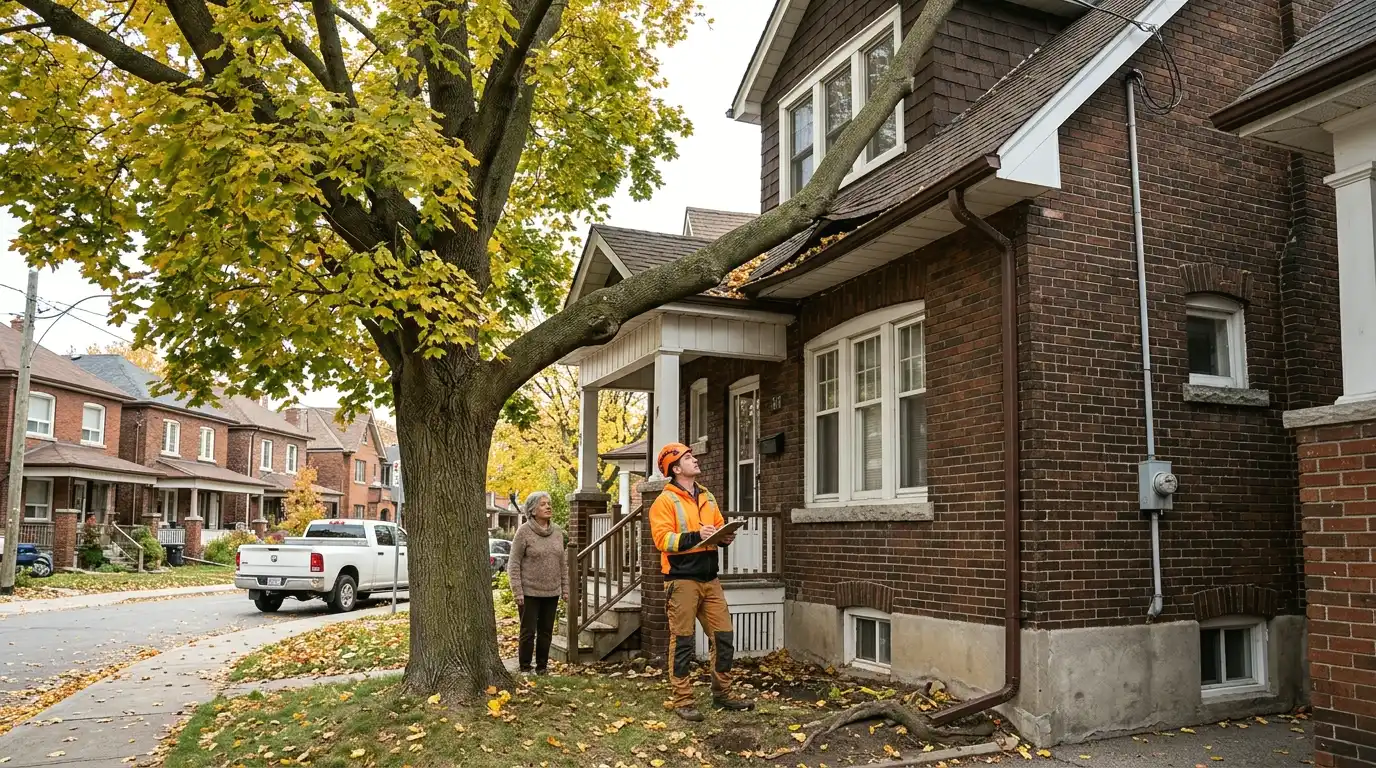
Property owners dealing with tree growing into a house or foundation in Toronto should first consider tree condition, site constraints and any municipal requirements. A tree growing against your house, roofline, drain system, or foundation is worth taking seriously, but it is not always the emergency it feels like. Branches pressing on a roof can cause visible damage over time. Roots near a foundation are more nuanced. The right next step depends on what is actually happening, the tree’s condition, the building’s condition, and whether City of Toronto tree rules may apply.
Branches Against the Roof or Walls
This is usually the more straightforward problem. Branches that physically touch a roof, soffit, eaves, gutter, siding, chimney, balcony, or wall can create damage in three common ways: abrasion, moisture retention, and pest access.
Abrasion: Branches moving against shingles in the wind can wear away the protective granule layer on asphalt shingles. Where branches make repeated contact with wood siding, fascia, trim, or soffits, the same slow mechanical wear can happen over time.
Moisture: Branches resting on a roof can hold leaves and debris against the surface. That can trap moisture, clog gutters, encourage moss growth, and increase the chance of water backing up into areas where it should not sit.
Pest access: A branch touching the roofline can act like a bridge. Squirrels, raccoons, mice, and other wildlife may use overhanging branches to reach soffits, vents, gutters, roof edges, and attic entry points. If you have recurring wildlife issues, roofline branches are worth checking.
The usual solution is clearance pruning, but the correct amount and method depend on the tree species, branch size, structure, roofline, ownership, and City rules. A qualified arborist or qualified tree care professional may review the tree and discuss whether clearance pruning is appropriate.
How much clearance is enough? Aim for enough separation that branches do not rub the roof, siding, chimney or gutters during normal movement, while preserving sound tree structure. The right clearance is site-specific and depends on species, growth rate, roofline, branch size, tree health and how much live canopy can be pruned without harming the tree. A qualified professional can explain what is realistic for that tree.
Roots and Your Foundation
Roots near foundations are often misunderstood. Toronto’s current tree guidance says roots do not cause lifts or cracks in properly constructed and well-maintained infrastructure. Poor drainage, freeze-thaw movement, settlement, existing cracks, open joints and other building or site defects can create spaces that roots later grow into. That is why foundation concerns should be diagnosed from evidence rather than tree proximity alone.
Toronto’s clay-heavy soils can also complicate the picture. Clay can shrink in dry conditions and swell when wet. That movement may contribute to cracks, settlement, or foundation movement independently of tree roots. Drainage, grading, downspouts, basement waterproofing issues, soil moisture, foundation age, and construction type can all matter.
If foundation cracking, settlement, water infiltration, or structural movement is present, a structural engineer or qualified foundation professional may be needed. A qualified arborist may discuss tree species, size, root behaviour, health, and whether the tree appears to be part of the issue. These are separate professional roles, and property owners should confirm scope and responsibility directly with each qualified professional.
When Roots May Be Part of the Problem
Roots may be part of the evidence when they are visibly entering an existing opening, a drain camera confirms root intrusion, or excavation shows direct root contact with already damaged infrastructure. Cracking or settlement on the tree-facing side of a building, by itself, does not prove the tree caused the problem. A structural, drainage or foundation professional may need to determine the building-side cause while a qualified arborist assesses the tree.
When Roots May Not Be the Main Problem
A tree several metres away from a sound poured concrete foundation may not be the cause of a structural issue. Drainage patterns, soil movement, construction age, past excavation, waterproofing defects, and settlement can all produce similar symptoms. If someone recommends removing a healthy mature tree based only on general “root concern” language without evidence, getting another professional opinion is wise.
Roots in Your Drain Lines
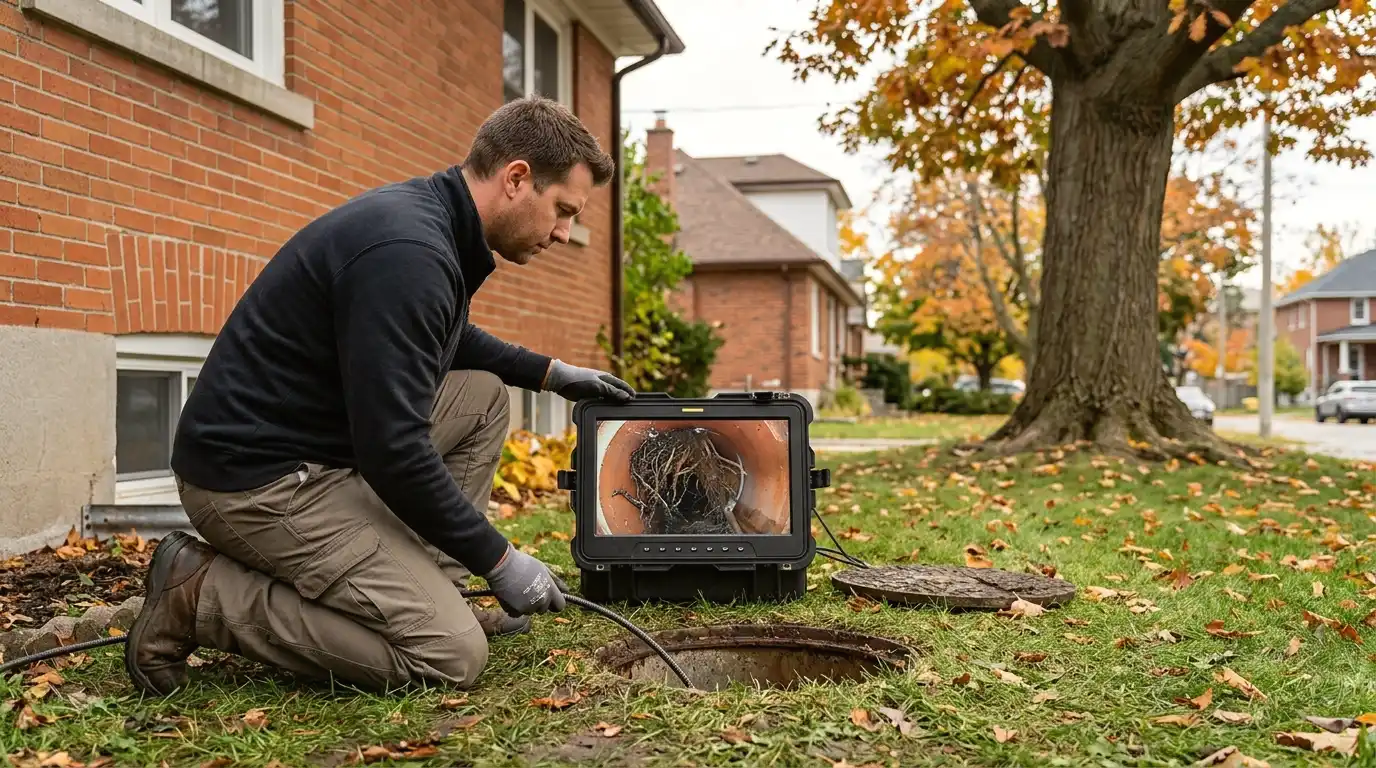
Drain-line root intrusion is one of the more common practical root problems for Toronto homeowners. Older clay, cast iron, or damaged drain pipes may have joints, gaps, cracks, or deteriorated sections that roots can enter. Once roots reach a water source inside a pipe, they can grow and contribute to recurring blockages.
Signs that roots may be involved include slow drains that return after clearing, gurgling sounds, repeated backups, damp areas, or blockages that recur in the same line. A drain camera inspection from a qualified drainage professional is the clearest way to confirm whether roots are actually inside the pipe and where the issue is located.
Fixing a drain problem usually requires more than cutting nearby branches or removing small surface roots. Pipe clearing, pipe lining, pipe replacement, excavation, insurance documentation, and any tree-related work should be discussed directly with the appropriate qualified professionals.
Tree Growing into a House or Foundation in Toronto: Concerned About a Tree Near Your House
Does the Tree Need to Come Down?
The answer depends on the full picture, not just proximity. A healthy mature tree that can be managed with appropriate clearance pruning may be worth keeping. Mature canopy trees provide shade, habitat, privacy, stormwater benefits, and property character that can take decades to replace.
Removal may become part of the discussion when the tree is declining, structurally compromised, repeatedly contacting the house despite pruning, confirmed to be involved in serious drain or foundation issues, or planted in a location where the risk cannot be managed reasonably. Species can also matter. Fast-growing or weak-wooded trees close to structures may need closer review than a well-placed, structurally sound tree.
If removal is being considered and the tree may be a bylaw-protected private tree, City-owned tree, boundary tree, or ravine-area tree, review the City of Toronto’s tree and ravine permit guidance before work begins. A qualified arborist may discuss permit-related documents with the property owner.
Pruning Without Removing: What Is Actually Possible
Strategic pruning may help maintain clearance between a tree and a house if the tree is otherwise healthy and suitable for the location. Crown reduction, clearance pruning, deadwood removal, and selective branch reduction may be discussed by a qualified arborist or qualified tree care professional.
Pruning cannot change an established root system, repair a cracked foundation, fix a drain pipe, or guarantee that branches will never regrow toward the structure. Heavy topping or removing too much live canopy can weaken a tree and may create future risk. If root intrusion or foundation movement is the main concern, pruning alone is unlikely to address the source of the issue.
For budgeting context, see the full guide on tree pruning cost in Toronto if you are comparing periodic pruning, monitoring, and possible removal as longer-term options.
Related Guides
- Signs Your Tree Is Dead or Dying
- Is My Leaning Tree Dangerous?
- How to Get a Toronto Tree Permit
- Arborist Report Cost Toronto
- Tree Pruning Cost Toronto
- Tree Pruning Requests
Official and Helpful Resources
- City of Toronto: Tree and Ravine Protection
- City of Toronto: When to Apply for a Tree or Ravine Permit
- 311 Toronto: Hazardous or Dangerous Trees
- ISA: Find an Arborist
Related professional service: See the stump grinding service information for stump and root-related requests.
Frequently Asked Questions
Can tree roots actually damage a foundation in Toronto?
Toronto’s current guidance says tree roots do not cause lifts or cracks in properly constructed and well-maintained infrastructure. Roots can exploit existing cracks, gaps, failed joints or moisture paths, and they can enter damaged drain lines. Foundation movement may also involve drainage, soil, construction age or structural conditions, so evidence from the appropriate building, drainage and tree professionals matters.
What should I do if tree branches are touching my roof?
Branches touching a roof, soffit, siding, or gutter should be reviewed because they can cause abrasion, moisture buildup, debris accumulation, and wildlife access.
Do I need a permit to prune branches touching my house in Toronto?
Routine clearance pruning is different from injuring or removing a bylaw-protected tree. City-owned trees, ravine-area trees, boundary trees, and major pruning that could injure a protected tree may involve City rules. Property owners should review official City guidance or speak with a qualified arborist before major pruning.
Should I remove a tree that is close to my house in Toronto?
Not necessarily. Distance from the house is only one factor. Species, health, structure, root concerns, roof contact, drain issues, foundation condition, property layout, and permit rules can all matter. A qualified arborist or other qualified professional may assess the situation, but removal decisions should be based on evidence rather than proximity alone.
Can tree roots block or damage drain pipes in Toronto?
Yes. Roots can enter older or damaged drain pipes through joints, cracks, gaps, or deteriorated sections. A drain camera inspection from a qualified drainage professional can confirm whether roots are involved. Tree work, pipe repair, pipe lining, insurance documentation, and contractor responsibility must be handled directly with the appropriate qualified professional.