How to Reduce Tree Damage During Home Renovation in Toronto (2026)
If you need to protect trees during construction in Toronto, start with the applicable rules, site conditions and practical steps for the property. Construction activity near trees can cause serious damage long before the tree looks unhealthy. Soil compaction, trenching, grade changes, root disturbance, and material storage near mature trees can reduce root function in ways that may not show up until one to three growing seasons later. If you are planning a Toronto home renovation, addition, driveway project, pool installation, retaining wall, drainage change, or major landscaping work, tree-related risks should be checked before the first machine arrives.
For projects that need formal arborist documentation and construction controls, see tree protection plans in Toronto.
Why Renovation Work Can Damage Trees
Trees often decline after construction because the damage happens underground. A tree may look normal during the renovation, leaf out the next spring, and only begin showing thinning, dieback, stress growth, or branch failure later. By then, the root damage may be difficult or impossible to reverse.
The four main ways renovation work can harm trees are:
- Soil compaction: Heavy equipment, repeated foot traffic, bins, trailers, material piles, and vehicles can compress soil around roots. Compacted soil holds less oxygen and water, making it harder for roots to function.
- Root cutting: Trenching for utilities, drainage, footings, irrigation, gas lines, electrical lines, or retaining walls can cut through important roots. Torn roots from excavation are more damaging than cleanly managed cuts discussed with a qualified arborist before work begins.
- Material storage: Piling gravel, sand, fill, lumber, concrete bags, equipment, or demolition debris near a tree can crush soil structure and smother the root area.
- Grade changes: Adding soil can bury the root flare and reduce oxygen movement. Removing soil can expose roots, dry the root area, and reduce stability.
The Root Area: Why Distance From the Trunk Matters
The most important tree roots are not only directly beside the trunk. They can extend far beyond the visible canopy edge, especially in older Toronto lots with mature maples, oaks, lindens, spruce, locusts, elms, and ash. That is why construction activity that seems a few metres away can still injure the tree.
City and arboricultural guidance often uses trunk size, species, condition, and site layout to estimate the area where construction should be carefully controlled. On a small Toronto lot, the ideal no-disturbance area may be difficult to maintain, which makes early planning even more important. If work must happen near a mature tree, a qualified arborist may discuss lower-impact methods, sequencing, root-sensitive excavation, or revised work limits.
Do not rely on a contractor’s visual guess alone when the work is near a mature private tree, a City tree, a neighbouring tree, or a ravine-area tree. Root damage can still trigger practical, financial, or bylaw issues even if the trunk itself is never touched.
Physical Barriers and Site Boundaries
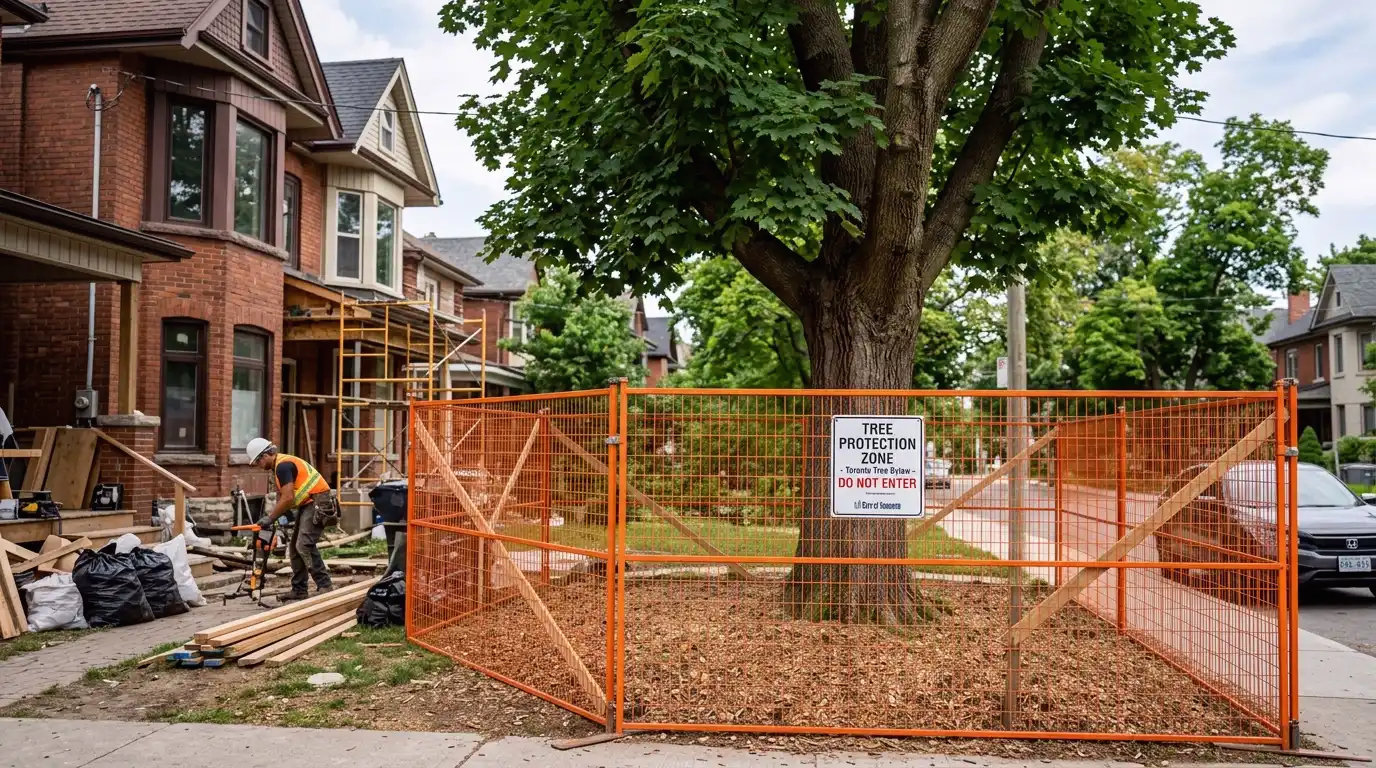
Before construction starts, property owners should make sure there is a clear written understanding of where equipment, bins, materials, and vehicles are allowed to go. If City permit conditions, contractor terms, or a qualified arborist’s recommendations require temporary barriers or no-access areas, those rules should be in place before any machinery, bins, or materials arrive.
Barriers are not decoration. Their purpose is to stop accidental soil compaction, material storage, root disturbance, and trunk damage before they happen. A barrier installed only for an inspection and then removed while heavy work continues does not solve the actual risk. The property owner should confirm who is responsible for maintaining site boundaries, communicating rules to trades, and documenting any changes.
When Renovation Work May Trigger City Tree Rules
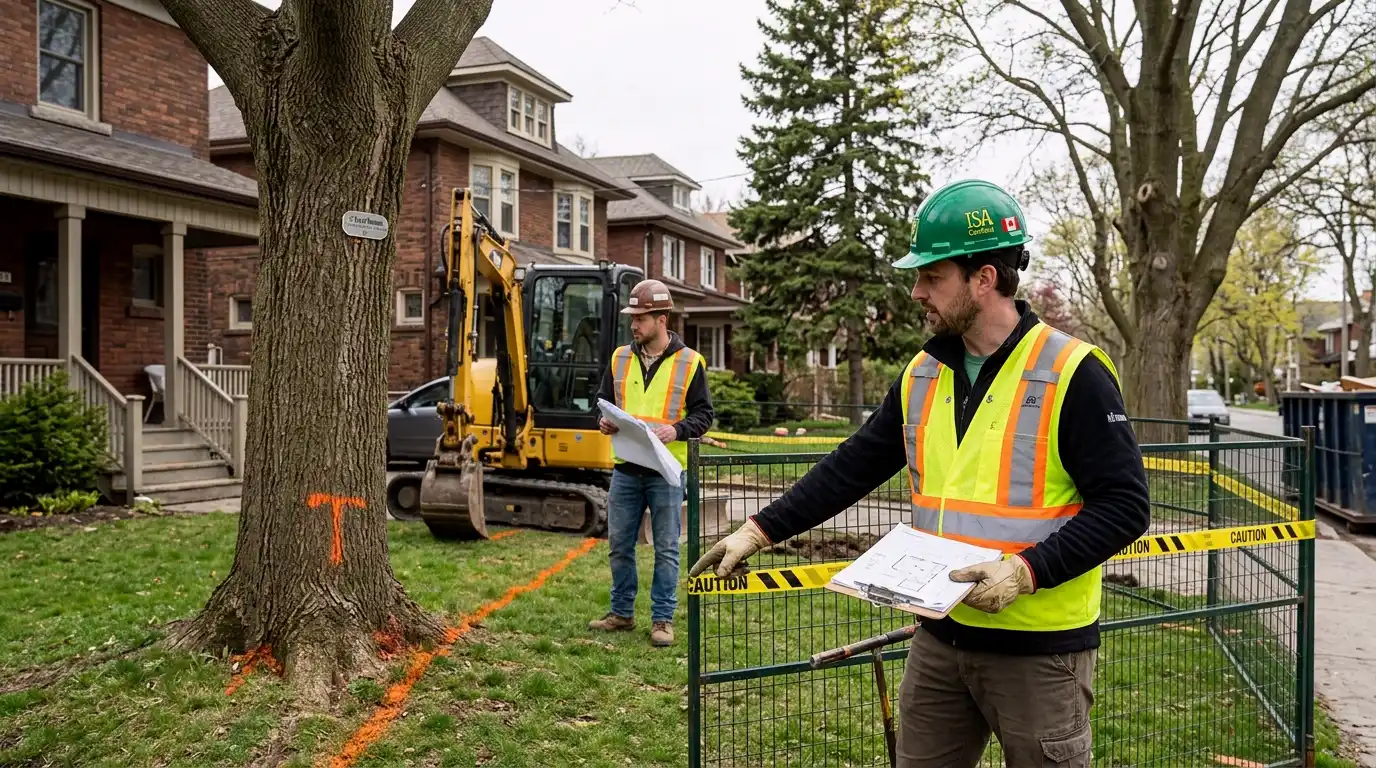
Toronto rules can apply when construction may injure or remove a bylaw-protected tree, a City-owned street tree, a ravine, or a natural feature. The City protects private trees 30 cm or more in diameter at 1.4 m above ground and City street trees of any size. Current City guidance says that if construction, access or storage will affect a protected tree’s Tree Protection Zone (TPZ), a permit to injure or remove the tree is required. If the work will not affect the TPZ, a permit may not be required, but nearby protected trees must still be protected and a Tree Protection Plan is required in consultation with an arborist.
Permit questions can come up for additions, underpinning, garages, garden suites, pools, driveway widening, retaining walls, sewer or water service work, grade changes, excavation, demolition, and major landscaping. The issue is not only whether the tree is being removed. Work that injures roots, trunk, branches, or the growing environment can also matter.
Planning Renovation Work Near Trees?
Practical Steps Before Renovating Near Trees
- Identify the trees early. Note mature trees on your property, near the sidewalk, beside the driveway, along the lot line, and on neighbouring properties where branches or roots may be affected.
- Confirm ownership and location. A tree may be private, City-owned, shared with a neighbour, or connected to a ravine or regulated natural feature area. Do not assume ownership based only on where the trunk appears to sit.
- Check whether City rules may apply. Review City guidance before excavation, grading, demolition, driveway work, pool work, or major landscaping near mature trees.
- Discuss tree risk before hiring trades. Ask your contractor how equipment access, bins, excavation, trenching, material storage, and soil movement will be handled near trees.
- Put site restrictions in writing. If there are no-access areas, barrier requirements, root-sensitive work methods, or City permit conditions, include those details in contractor instructions and project documents.
- Brief every trade. The general contractor may understand the rules, but a subcontractor arriving later for trenching, waterproofing, drainage, utilities, or landscaping may not.
- Keep records. Save photos before construction, during major excavation, after grade changes, and after completion. Records may be useful if a tree declines later or if an insurance, contractor, neighbour, or City issue arises.
What Happens If a Contractor Damages a Protected Tree
If construction injures or removes a bylaw-protected tree without proper authorization, the City may inspect and take enforcement action. That can include orders, corrective requirements, stop work orders, orders to comply, prosecution, and fines. The City states that injuring or removing a bylaw-protected tree without a permit can result in fines of up to $100,000 per tree.
The property owner may still be responsible for bylaw compliance even if a qualified tree contractor caused the damage. Contractor responsibility, insurance claims, reimbursement, documentation, repairs, and payment disputes should be confirmed in writing with the relevant qualified professional before work begins. Property owners should confirm insurance, WSIB status where applicable, written scope, site rules, and damage procedures before construction begins.
Related Guides
- What Is an Arborist Report in Ontario?
- How to Get a Toronto Tree Permit
- Arborist Report Cost Toronto
How to Protect Trees During Construction in Toronto: Official Toronto Resources for Renovation Near Trees
- City of Toronto: Tree and Ravine Protection
- City of Toronto: When to Apply for a Tree or Ravine Permit
- City of Toronto: How to Apply for a Tree or Ravine Permit
- City of Toronto: How to Report a Tree or Ravine Contravention
- Toronto Municipal Code Chapter 813
- ISA: Find an Arborist
Related professional service: See the arborist report request information when professional documentation may be needed.
Frequently Asked Questions
Can renovation work damage a protected tree in Toronto?
Yes. Excavation, grading, root cutting, heavy equipment, material storage, and soil compaction near a bylaw-protected private tree, City tree, ravine, or natural feature can create permit and enforcement concerns. Property owners should review City guidance before construction starts and may choose to speak with a qualified arborist.
What part of a tree is most at risk during construction?
The root area is often most at risk because damage can happen underground before visible symptoms appear. Soil compaction, trenching, grade changes, and storage of heavy materials near the tree can reduce root function and may lead to canopy decline months or years later.
Can construction damage to a tree be repaired?
Some damage may be reduced or managed if it is caught early, but serious root loss, prolonged compaction, trunk injury, or grade changes can cause long-term decline. A qualified arborist may assess the tree and discuss possible options, but outcomes are not guaranteed.
Who is responsible if a contractor damages a protected tree during a Toronto renovation?
The property owner may still face City enforcement if a bylaw-protected tree is injured or removed without proper authorization, even if a contractor caused the damage.
Should I speak with an arborist before renovating near mature trees?
It is usually wise to speak with a qualified arborist before construction begins near mature private trees, City trees, neighbouring trees, or ravine areas.