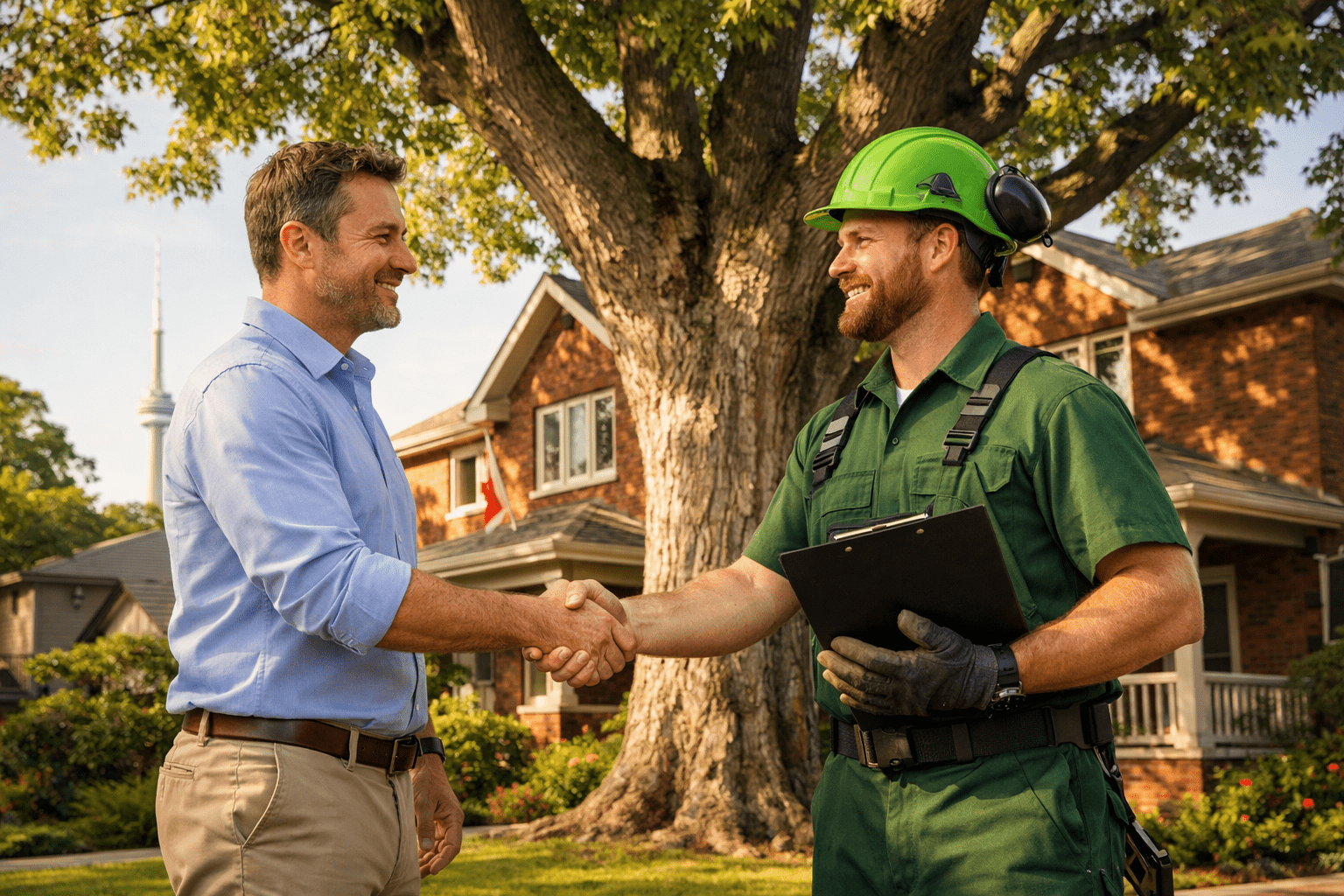
Across the GTA, thousands of professionals encounter tree problems that are not their core business but are absolutely their client's problem. The landscaper whose client's new patio cannot go in because a Norway maple is sitting in the footprint. The realtor whose listing stalled because a buyer's inspector flagged a co-dominant stem over the garage. The roofing contractor who cannot start a re-roof until someone removes the branches that are resting on the shingles. The estate lawyer whose property cannot close because an outstanding Chapter 813 replacement tree condition has never been fulfilled. Every one of these situations requires the same thing: one reliable call to someone who knows exactly what to do, connects the right certified arborist to the situation, and takes the problem completely off your desk.
That is what we do. Toronto Tree Services connects GTA professionals to ISA certified arborists for tree removal, permit management, emergency response, stump grinding, structural pruning, arborist reports, and tree protection zone installation. We know which arborist fits which job. We know the bylaws in every GTA municipality. We manage the process from the first call to the final cleanup. And when it is done, your client relationship stays exactly where it was: yours.
This page exists because no one in the GTA has built this service for the full range of professionals who encounter tree problems. Most arborist companies have a single generic commercial page. None of them have spent time thinking about what it is like to be a home inspector who flags a hazardous tree on a report and has no one to hand it to. Or a solar installer who cannot deliver the system efficiency they promised because a silver maple is shading the south face. We have thought about all of it. Scroll through to find your category, read what we offer specifically for your situation, and then call us.
One number. Every tree situation. Every GTA municipality.
Call (437) 367-8733 or send a message through our contact page. We connect you with the right certified arborist for your client's specific job within one business day.
Tree removal and permits that your crew cannot legally take on under Chapter 813 and other GTA bylaws.
Arborist reports for listings, pre-purchase tree assessments, and clearing permit conditions before closing.
Tree Protection Zone installation and arborist reports required as conditions of building permits across the GTA.
A professional referral for every hazardous tree condition you flag, so your report leads to a resolution.
Branch clearance and permitted removal before re-roofing begins, coordinated around your installation schedule.
Trees in footprints that require permitted removal before your excavation or installation can proceed.
Shading analysis, permit applications, and removal of trees blocking south-facing roof panels.
Annual inspection contracts, duty-of-care documentation, and emergency response for managed portfolios.
Storm damage arborist documentation, emergency removal after weather events, and valuation reports for claims.
Outstanding bylaw conditions resolved before title transfer, and estate property tree assessments.
If you run a landscaping company in the GTA, you already know this situation. A client hires you to redo a backyard. A tree is in the way. The tree has a trunk diameter over 30cm in Toronto, over 20cm in Richmond Hill or Markham, or over 15cm in Oakville or Newmarket. That tree is protected. Removing it without a permit exposes your client to fines of up to $100,000 under Toronto Chapter 813. Removing it with a permit requires an ISA certified arborist report, which a landscaping company cannot legally prepare regardless of experience or equipment.
When you refer the tree work to us, we arrange for an ISA certified arborist to assess the tree, prepare the report, submit the permit application, pay the filing fee, and track it through to issuance. We coordinate the removal and stump grinding to clear the area before your installation crew needs it. Your client gets one professional process. You avoid the liability exposure entirely. The typical Toronto permit takes 20 to 30 days from a complete submission, and we communicate the timeline to both you and the client at the outset so nobody is surprised. For a full breakdown of how the permit process works, our guide on applying for a Chapter 813 permit online covers every step.
We also handle stump grinding, tree pruning, Tree Protection Zone fencing installation, and emergency storm response. For landscapers whose clients have commercial properties and need annual tree management documentation, we can arrange that as well. Billing works either way: we invoice you at trade rate, you invoice your client, or we invoice the client directly with a referral acknowledgment to you. We do not offer landscaping services. Your client relationship stays yours.
Trees affect real estate transactions in several ways that most agents encounter regularly but few have a clean solution for. The first is the pre-listing situation. A mature silver maple with a visible co-dominant stem over the garage is going to come up in every buyer's home inspection. An outstanding Chapter 813 replacement tree condition that the previous owner never fulfilled is going to show up on a title search. A certified arborist report before listing documents the current condition of every protected tree on the property, confirms which trees are protected, and flags any outstanding compliance issues before buyers are involved. Clearing those issues before listing is almost always faster and cheaper than negotiating them off the purchase price after a buyer's inspector raises them.
The second situation is the buyer-side assessment. When a client is purchasing a property with large established trees, a pre-purchase tree assessment from an ISA certified arborist gives them a realistic picture of the condition, protection status, and estimated maintenance cost of those trees before they close. For properties in Toronto neighbourhoods with mature canopy, particularly Rosedale, Forest Hill, Lawrence Park, Leaside, and the Annex, this is information that can materially affect a purchase decision. We arrange that assessment quickly, typically within two to three business days of a referral call.
The third situation is the closing condition. If a property has an outstanding Chapter 813 condition from a prior permit, including a replacement tree that was never planted or a stump that was never ground, that condition follows the title. We connect the parties to the right arborist to document and resolve those conditions so the transaction can proceed. We have done this for estate sales, power of sale properties, and standard resale listings where prior work was done without proper follow-through on the permit conditions.
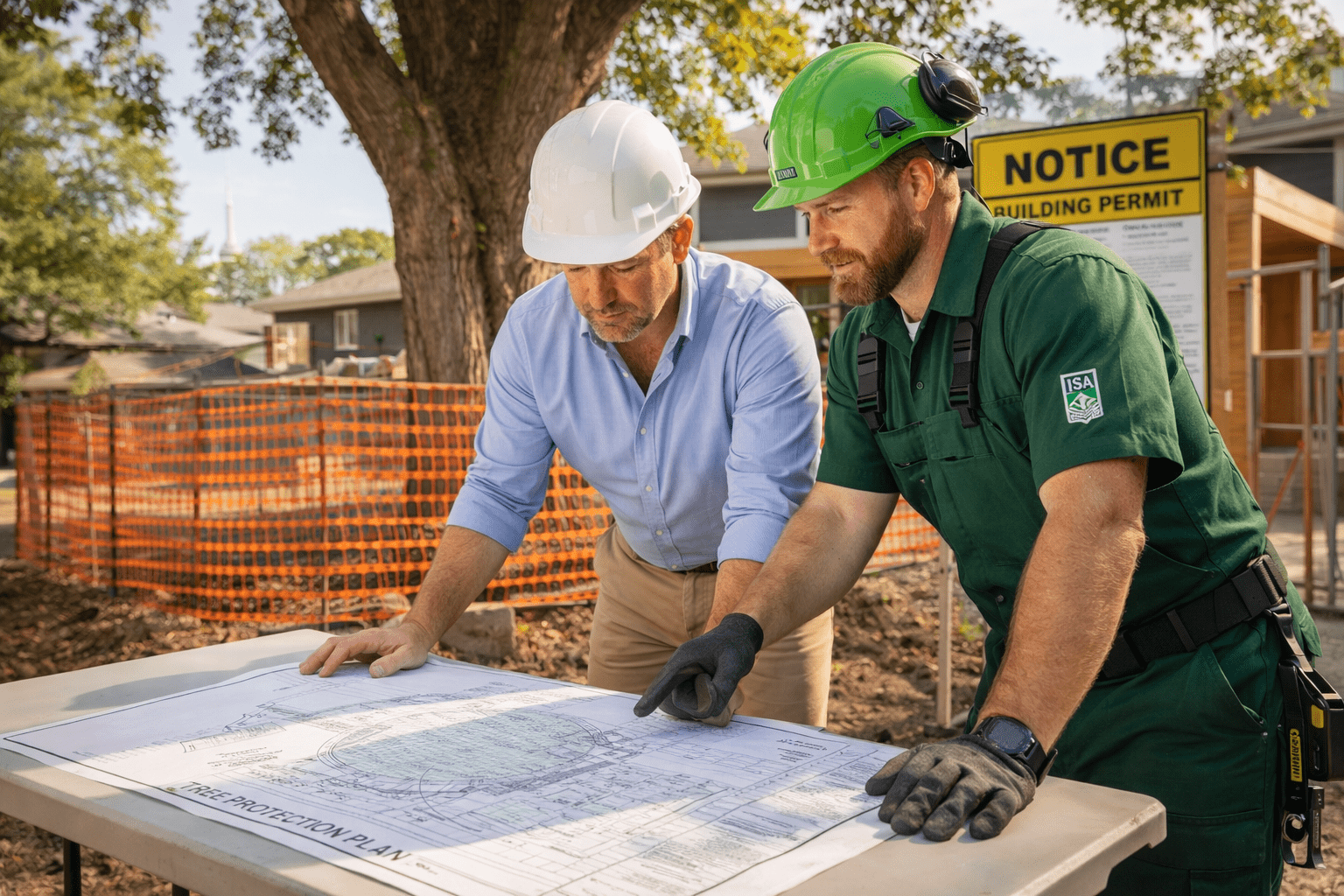
If you are pulling a building permit in Toronto or most GTA municipalities for an addition, a detached garage, a new structure, or any significant excavation on a property with protected trees, you already know what comes next: the city wants an arborist report and a Tree Protection Plan before the permit issues. Chapter 813 requires that plan to be prepared by an ISA certified arborist. The TPZ fencing must be installed before any ground disturbance begins, and a monitoring arborist must sign off on compliance at intervals throughout the build. These are not optional steps and they are not something a general contractor can self-certify regardless of experience.
We connect contractors to ISA certified arborists who prepare construction arborist reports and Tree Protection Plans that meet the City of Toronto Urban Forestry standard and the equivalent standards in every other GTA municipality. We arrange TPZ fencing installation, root pruning where required, and monitoring visits timed to your construction milestones. We know how to write arborist reports that pass the planning review without going back for revisions, which matters when your building permit timeline is already tight. For more on what a Chapter 813 construction arborist report must contain, see our arborist reports page.
Pool installers and fence companies face the same issue at smaller scale. A pool excavation that crosses into the Tree Protection Zone of a protected tree requires a permit and an arborist on site. A fence installation that requires removal of a protected tree to create a clear line requires a permit before a shovel goes in the ground. We connect you to the right arborist for the scope quickly, so these regulatory steps happen before they become delays.
Home inspectors flag tree issues on virtually every inspection involving a mature property in the GTA. Co-dominant stems with included bark over occupied structures. Root heaving near foundation walls. Fungal fruiting bodies at the base of a large backyard tree. Dead crown sections over a garage. Branches in contact with the roof. These are legitimate findings and you document them correctly. The problem is that most inspectors have no reliable arborist referral to put in that report. The client reads your flag, calls whoever comes up first on Google, and gets wildly inconsistent advice.
When you refer your clients to us, we connect them with an ISA certified arborist who has done the specific type of assessment your report is pointing to. A structural risk assessment for a co-dominant stem, a root proximity evaluation for foundation concerns, a full tree health assessment for a tree showing signs of decline. The arborist provides a written assessment with clear recommendations. Your flag is taken seriously, followed through professionally, and your client has documentation that addresses the concern you identified. That is a better outcome for everyone including you, because a referred client who receives prompt professional follow-up on your flag is more likely to recommend your inspection service than one who is left to navigate the process alone.
The referral requires nothing from you beyond a property address and a brief note on what you flagged. We take it from there. For inspectors who want to formalize the arrangement, we can discuss a standard referral process that makes it easy to include a referral card or link in your inspection report delivery.
Roofing companies in the GTA deal with overhanging branches on almost every job in established residential neighbourhoods. Branches resting on shingles cause ongoing damage, trap moisture, create access challenges for your crew, and present a liability issue if your workers are operating near unstable limbs during the install. The right sequence is to remove or lift the overhanging branches before your crew goes on the roof, not after the job is done and the client is complaining about debris already.
The regulatory piece matters here too. If the overhanging branches belong to a tree with a DBH over 30cm in Toronto, pruning more than 25% of the live crown requires a permit under Chapter 813. Most roofing companies do not know this threshold and neither do most homeowners. If a complaint is filed after work is done on a protected tree without authorization, the property owner receives the enforcement notice regardless of who performed the work. We connect you to an arborist who assesses the scope, confirms whether a permit applies to the proposed pruning, and carries out the work legally and safely. Our tree pruning service page covers the full range of what this involves.
For jobs where the tree is too close to the structure to allow roofing to proceed safely and the tree needs to come down entirely, we manage the full permit process and removal. We coordinate our schedule to clear the area before your installation start date. You call us when the job is booked, tell us your start date, and we work backward from there.
Solar panel installers across the GTA face a situation that is becoming more common as older trees mature and new installations become more popular: a tree that was not a problem when the home was built is now shading the south-facing roof during the peak generation hours of the afternoon. The client has invested significantly in a solar system and the expected return depends on unobstructed exposure. When a silver maple or Norway spruce is reducing generation by 15 to 25 percent, the tree is the problem and it needs to be addressed through the proper permit pathway before the system can perform as promised.
We connect installers to ISA certified arborists who produce shading analysis documentation, apply the applicable bylaw criteria to determine whether the tree meets the threshold for a removal permit (not all municipalities include shading as a justification under their private tree bylaws, and this varies by municipality and specific circumstances), and manage the permit application where one is available. We also advise on alternatives including crown reduction that may provide meaningful shading relief without requiring full removal. The solar installer who can tell a client "we have a partner who handles the tree issue before we install" is offering a more complete service than one who leaves that problem for the client to figure out independently. For the permit sequencing that applies to solar and tree removal combinations, our guide on tree removal for solar panel installation covers the process in full.
Property managers overseeing residential or commercial portfolios in the GTA carry legal obligation around the trees on the properties they manage. A tree that fails and damages a tenant's vehicle, injures a visitor, or strikes a building creates a duty-of-care exposure. If the property manager cannot demonstrate that the tree was assessed by a competent professional and that identified hazards were acted on, that exposure becomes a claim. Annual tree inspection reports from an ISA certified arborist create the documentation trail that demonstrates the obligation was taken seriously.
We connect property management companies to ISA certified arborists who provide annual tree inspection contracts for residential and commercial portfolios. These contracts include a written report for each property documenting every protected tree, its species, DBH, structural condition, and any recommended work, with a risk priority ranking. The report becomes part of the property file and is updated annually. For any tree where work is recommended, we connect the appropriate arborist for the removal or pruning, manage the permit process, and coordinate with the property manager on scheduling and access. Emergency response for storm events is available 24 hours a day with the same priority as a direct client call. Our property manager guide to tree bylaws and liability covers the full duty-of-care framework in detail.
For condo corporations specifically, Chapter 813 applies to common element trees. The corporation holds the obligation, not individual unit owners. Trees on the boundary of a condominium property that straddle a property line require consent from all affected property owners before a permit can be issued. We manage that process and the associated documentation. For corporations managing large properties with significant tree stock, we can arrange a multi-year inspection and maintenance contract that provides budget predictability and continuous compliance documentation.
What GTA Private Tree Bylaws Require: At a Glance for Professionals
| Municipality | Protection Threshold | ISA Report Required | Standard Permit Timeline |
|---|---|---|---|
| City of Toronto | Over 30cm DBH | Yes - ISA Certified Arborist only | 20 to 30 days from complete submission |
| Richmond Hill | Over 20cm DBH | Yes | 15 to 25 days |
| Markham | Over 20cm DBH | Yes | 15 to 25 days |
| Brampton | Over 20cm DBH | Yes | 15 to 25 days |
| Oakville / Burlington / Milton / Newmarket | Over 15cm DBH | Yes | 15 to 25 days |
| Ajax / Pickering / Whitby / Oshawa | No private tree bylaw | Not required for private tree removal (TRCA rules still apply near watercourses) | N/A |
When a storm drops a tree or major limb on a structure in the GTA, the insurance claim process benefits significantly from ISA certified arborist documentation. The arborist assessment documents the condition of the tree before the incident (where records exist), confirms whether the failure was foreseeable or sudden, provides a valuation of the tree if applicable, and generates the emergency certificate documentation that allows hazardous tree removal to proceed under the Chapter 813 emergency pathway. That documentation supports the adjuster's claim assessment and reduces the dispute surface around the loss.
We connect restoration companies and adjusters to ISA certified arborists who can respond to storm damage sites quickly, assess and document the condition and failure mechanism, arrange emergency hazardous tree removal under the appropriate bylaw pathway, and provide written reports suitable for claim submission. Emergency response is available around the clock. For restoration companies managing multiple storm damage sites after a major weather event, we can coordinate arborist coverage across multiple properties simultaneously. Insurers including Intact, Aviva, and others who work with the Toronto restoration sector recognize the ISA arborist standard as the appropriate documentation source for tree-related claims. The International Society of Arboriculture maintains a public verification database for confirming ISA credential status on any arborist providing documentation for a claim.
This is one of the most overlooked situations in GTA real estate transactions. Chapter 813 permit conditions run with the land, not with the property owner who obtained the permit. A homeowner who received a permit to remove a protected tree in 2019 and was required to plant a replacement tree by the following spring, but never did, has created an outstanding bylaw condition that surfaces on title search. The property cannot close cleanly until that condition is resolved. Resolving it requires either planting the replacement tree, paying cash-in-lieu to the City, or obtaining documentation from Urban Forestry that the condition has been discharged. None of those steps happen without engaging an ISA certified arborist.
We connect real estate lawyers and estate executors to arborists who identify outstanding Chapter 813 conditions, assess what resolution requires, arrange for replacement planting or cash-in-lieu documentation, and produce the Urban Forestry correspondence needed to confirm the condition has been addressed. For estate properties that have been sitting vacant, trees that were previously maintained may have deteriorated into hazardous condition during the estate administration period. We arrange a full tree assessment of the estate property, identify any tree work required before the property can be listed or transferred, manage the permit process for any necessary removals, and provide the executor with written documentation confirming the property is tree-bylaw compliant at closing. Our guide on estate and probate tree issues for Toronto executors covers the full scope of what this involves.
The referral process is designed to require as little from you as possible after the initial call. You provide the property address, a description of the tree issue, and your preferred timeline. We assess the regulatory situation before the arborist even visits, so we arrive knowing which bylaw applies, whether TRCA or ravine rules create additional layers, and what permit pathway is most likely to apply. We contact the client to schedule the assessment, keep you informed at the key milestones, and coordinate the execution around whatever construction or installation schedule your project requires.
Information That Helps Us Move Fastest on a Referral
| What to Tell Us | Why It Matters |
|---|---|
| Full property address | We confirm the applicable bylaw and check for TRCA regulated area or ravine designation before the arborist visit |
| What the tree issue is | Removal, pruning, stump grinding, emergency, or report determines which pathway applies and how fast we can move |
| Your project or closing timeline | We build the permit and removal schedule backward from your deadline so there are no surprises |
| How you want billing handled | We invoice you at trade rate, or invoice the client directly with a referral acknowledgment, depending on your preference |
| Whether it is an emergency | Active hazards go directly to our emergency line at (437) 367-8733 for same-day or next-day dispatch |
There are ISA certified arborists in the GTA. Not all of them are equally suited to every type of job. A residential arborist who excels at estate lot removals in Rosedale may not be the right person for a commercial property compliance inspection in Brampton. An arborist who is strong on construction TPZ documentation for large developers may not be the right person for a fast-turnaround pre-listing assessment for a real estate agent whose listing goes live in ten days. Getting the right arborist to the right job matters for the outcome, the timeline, and the relationship with your client.
We know who does what well in this market. We know which arborists have the deepest familiarity with Chapter 813 permit processing. We know which ones have the documentation standards that insurance adjusters and lawyers need. We know which ones respond to emergency calls reliably and which ones treat a 9am job like an 11am job. That knowledge is what we bring to the referral. You are not calling a directory listing. You are calling a coordinator who has done this matching across every type of professional situation and every GTA municipality, and who builds the referral around what your specific situation requires.
How does a professional referral to Toronto Tree Services work?
Send us the property address, a brief description of the tree issue, and your timeline. We connect the client with the right ISA certified arborist, manage the entire process from assessment through permit and completion, and report back to you. We communicate through you or directly with the client depending on your preference. The referral takes one call or message.
Do you handle Chapter 813 permit applications for referred jobs?
Yes. Permit applications under Toronto Chapter 813, Richmond Hill By-law 41-07, Brampton By-law 199-2021, and bylaws in Markham, Vaughan, Mississauga, Oakville, Burlington, Newmarket, and Aurora are all managed end-to-end. The arborist prepares the report, submits the application, pays the filing fee, and tracks the permit through to issuance. The professional partner receives confirmation when the permit is received and work is scheduled.
Will Toronto Tree Services solicit other services from my client?
No. Our service is tree and arborist work. We do not offer the services you provide, whether that is landscaping, roofing, general contracting, property management, or any other trade. When the tree work is complete, we leave. We do not market other services to your client or build a parallel relationship with them for anything outside the tree scope.
How quickly can you respond to a storm damage referral?
Emergency response is available 24 hours a day, 7 days a week. Active hazards involving trees on structures, trees blocking access, or trees posing immediate risk to occupants are prioritized for same-day dispatch. Call (437) 367-8733 for any emergency referral and someone will answer directly.
Can I bill my client for the tree referral or receive a referral fee?
Yes to both. We can invoice your company at a trade rate so you invoice your client as part of a larger project scope. Alternatively, we can invoice the client directly and pay you a referral fee per completed job. We work either way and leave the pricing structure entirely to you.
What municipalities do you cover?
All of Toronto, North York, Scarborough, Etobicoke, East York, Mississauga, Brampton, Vaughan, Richmond Hill, Markham, Aurora, Newmarket, Ajax, Whitby, Oshawa, Pickering, and surrounding GTA areas. We are familiar with the applicable bylaw in every municipality we serve and confirm regulatory requirements at the outset of every referral.
No forms. No waiting for a callback from someone who does not know your situation. Call us directly, tell us what you have, and we handle everything from there. GTA professionals have been building their practice on reliable referrals for decades. We want to be the tree referral you use every time.
Services Available Through Professional Referrals