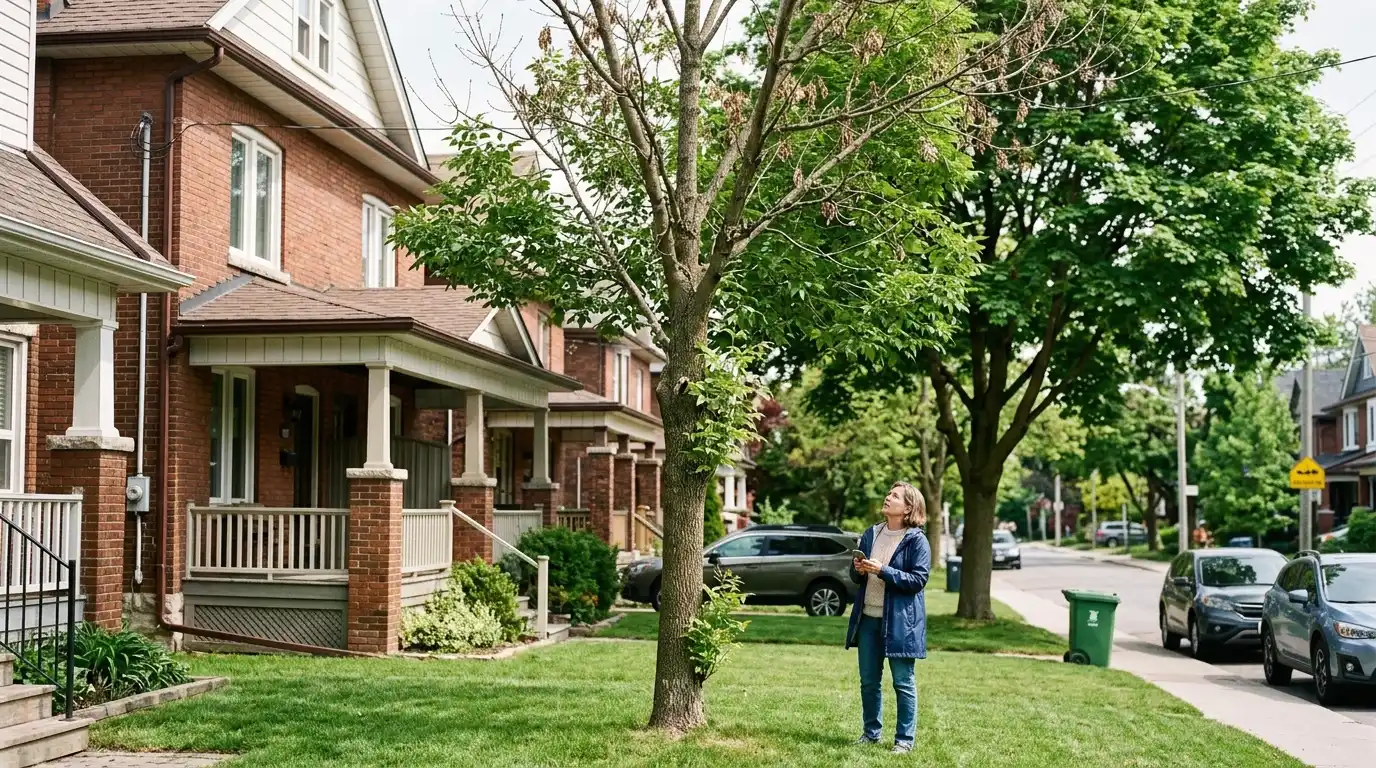
Emerald ash borer in Toronto can affect tree health, structure or long-term survival, so early identification matters. Emerald ash borer has had a major impact on Toronto’s ash trees. The City of Toronto says EAB has been present in Toronto since 2007 and has killed over 800,000 ash trees across the city. If you have a true ash tree on your property, the main questions are whether it is still structurally safe, whether treatment is still worth discussing, whether removal is needed, and what City or CFIA rules may apply before work or wood movement begins.
Emerald Ash Borer in Toronto: What Emerald Ash Borer Actually Does
Emerald ash borer is an invasive beetle that attacks true ash trees in the Fraxinus genus. The visible adult beetle is not the main source of damage. The more serious damage happens under the bark, where larvae feed through the living tissue that moves water and nutrients between the roots and crown.
As larval galleries spread through the cambium, the tree becomes progressively girdled. The upper canopy may begin thinning, major limbs can decline, bark may split, and shoots may appear from the trunk or larger branches as the tree attempts to survive. By the time crown dieback is obvious from the ground, significant internal decline may already be present.
Not every declining ash should be handled the same way. A lightly affected, high-value ash may be worth discussing with a licensed applicator or qualified arborist. A heavily declining or dead ash near a house, driveway, sidewalk, utility line, or neighbour’s property may create a different risk conversation.
How to Identify Possible EAB on a Toronto Ash Tree
D-shaped exit holes
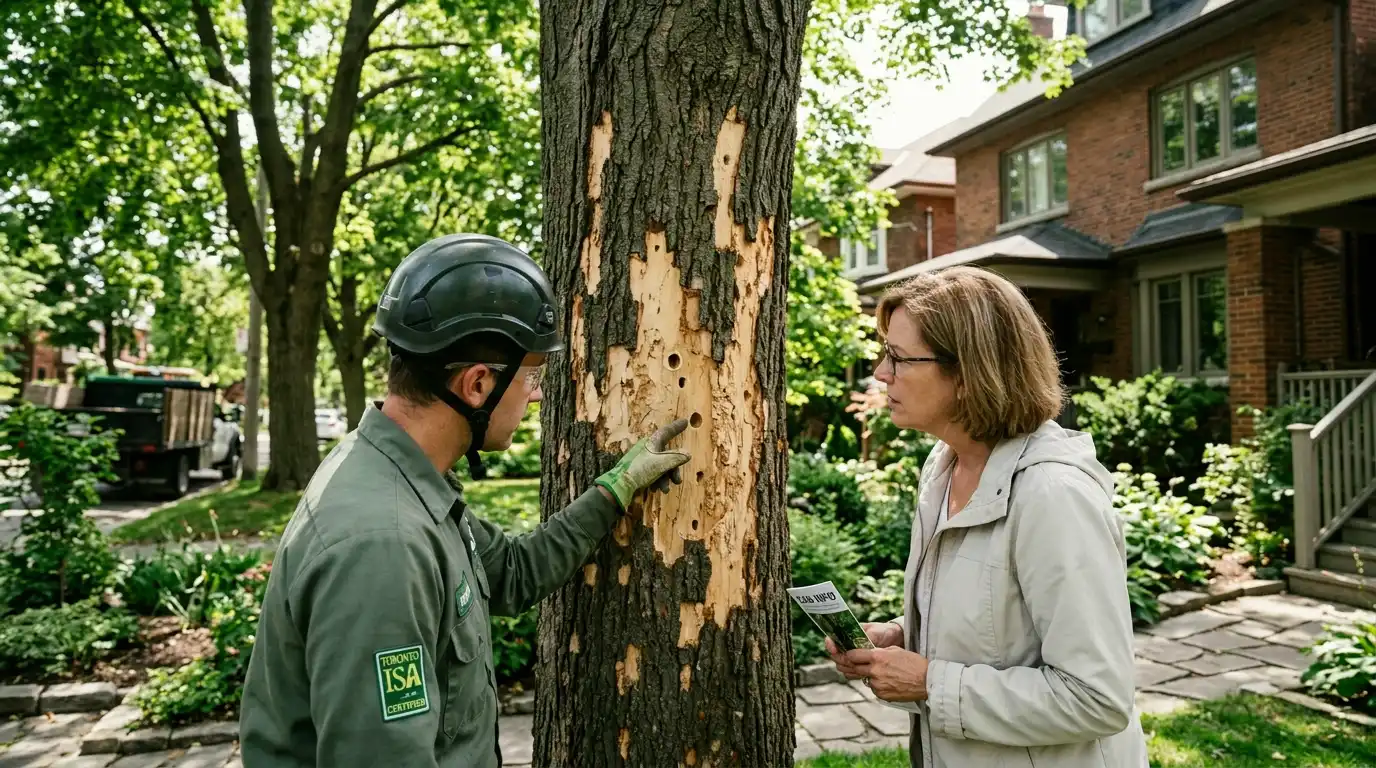
One recognizable sign of EAB is a small D-shaped exit hole in the bark where adult beetles have emerged. These holes are easier to find on exposed bark, upper trunk areas, and larger limbs, but they may be difficult for a homeowner to see clearly from the ground. D-shaped holes suggest EAB activity, but condition and next steps should still be confirmed by a qualified professional.
Serpentine galleries under the bark
Under loose bark, EAB larvae can leave S-shaped galleries. These winding channels may contain frass and can disrupt the tree’s vascular tissue. Do not strip bark aggressively just to inspect the tree. If galleries are suspected, ask a qualified arborist or qualified tree care professional to review the tree safely.
Crown dieback starting from the top
EAB decline often shows as thinning and dieback in the upper crown first. Fine twigs disappear, larger limbs decline, and the canopy can become sparse over time. Other stresses can also affect ash trees, so species confirmation and condition review matter.
Woodpecker activity
Woodpecker activity can increase on infested ash trees because birds feed on larvae under the bark. Flaking bark, light-coloured patches, and repeated pecking on the trunk or major limbs can be a warning sign, especially when combined with crown thinning or D-shaped exit holes.
General EAB decision context:
- Early decline: treatment may be worth discussing with a licensed applicator or qualified arborist if the tree is structurally sound and valuable to retain.
- Moderate decline: treatment viability becomes more site-specific and should be reviewed carefully before spending money on injections.
- Heavy dieback: removal planning may need to be discussed, especially if the tree is near a house, driveway, sidewalk, neighbour’s property, or utility line.
- Dead or brittle ash: the risk and cost of removal can increase as dead ash wood becomes more hazardous to work around.
- Permit context: Toronto rules and 311 exception guidance should be checked before removing a protected ash tree.
- Wood handling: EAB-regulated ash material and firewood should be handled in line with current CFIA rules.
Toronto Permit Context for EAB-Infested Ash Trees
Toronto protects private trees that are 30 cm or larger in diameter, measured at 1.4 m above ground. City-owned trees are protected at any size, and ravine or natural feature areas may involve additional rules. The fact that a tree is an ash tree or may be declining from EAB does not mean the property owner should skip the City process.
Toronto’s EAB guidance says that if an ash tree requires removal and is 30cm or more in diameter, a City tree permit may be needed before removal. Toronto 311 guidance also identifies an exception pathway for ash trees infested with Emerald Ash Borer and says to contact 311 for an exception. Because these details can depend on the tree, documentation, ownership, location, and current City process, property owners should confirm requirements directly with Toronto before work begins.
Can Emerald Ash Borer Be Treated?
Treatment may be possible for selected ash trees, especially when the tree still has enough live canopy, good structure, and a reasonable long-term retention value. Treatment is usually a repeat program, not a one-time permanent fix. The timing, product, injection method, licensing, cost, frequency, and expected result must be discussed directly with a licensed applicator or qualified arborist.
The City of Toronto has treated selected City-owned ash trees with TreeAzin as part of its EAB program. Toronto’s public guidance states that, because of reduced EAB populations, TreeAzin injections for City-owned treated ash trees are moving from a two-year rotation to a three-year rotation starting in 2025. Private-property treatment decisions may be different and should not be assumed from the City’s municipal program.
TreeAzin is a systemic insecticide applied by microinjection into active sapwood. Whether TreeAzin or any other registered treatment option is appropriate for a private ash tree depends on the tree condition, product registration, applicator licensing, timing, cost, and professional judgment.
When Removal Becomes the More Practical Discussion
Removal may become the more practical discussion when an ash tree has heavy dieback, poor structure, major dead limbs, trunk defects, brittle wood, root instability, or is located near high-value targets such as a house, driveway, sidewalk, garage, parked vehicles, utility lines, or neighbouring property.
Dead ash trees can become difficult and dangerous to work on as the wood loses strength. Waiting too long may limit climbing options, increase equipment needs, increase cost, or change the work method. If an ash is already dead or nearly dead, it is better to discuss the situation before the tree becomes more hazardous.
What Happens to EAB-Killed Wood
CFIA regulates emerald ash borer to reduce the spread of this invasive pest. Its regulated-area guidance says moving ash firewood out of a regulated area is prohibited, and other ash material and firewood movement can require authorization or compliance with CFIA rules. Homeowners should not move ash firewood, logs, branches, or wood chips out of regulated areas casually.
Wood handling should be confirmed directly with the qualified tree contractor and current CFIA guidance. Depending on the work and rules, ash material may need to be chipped, processed, disposed of locally, transported only within permitted limits, or handled through an approved process. Do not assume logs can be kept, sold, moved to a cottage, or transported to another municipality without checking the rules.
Concerned About an Ash Tree on Your Toronto Property?
Species Confusion: True Ash vs Mountain Ash
EAB attacks true ash trees in the Fraxinus genus. Common true ash trees can include green ash, white ash, black ash, and related cultivated varieties. Mountain ash is different. Although it has “ash” in the common name, mountain ash belongs to a different genus and is not a true ash affected by EAB in the same way.
Species confusion matters because a homeowner may panic after hearing “ash” without knowing whether the tree is actually susceptible to EAB. Leaf arrangement, bark, buds, branching pattern, seeds, and site context can help identify the tree, but a qualified professional should confirm species if treatment or removal decisions depend on it.
Insurance, Neighbour, and Safety Context
An EAB-infested ash tree can become a neighbour, insurance, or liability issue if it is visibly dead, declining, or hazardous and the property owner ignores it. If the tree is near a neighbour’s property, driveway, sidewalk, structure, or utility line, document the condition, communicate clearly where needed, and speak with your insurer or legal advisor if responsibility is disputed.
If the tree is already split, leaning suddenly, dropping large limbs, resting on a structure, or tangled with wires, keep people away and contact the correct emergency, utility, City, or qualified professional channel. Do not approach downed wires, hanging branches, or unstable trunks.
Official and Helpful Resources
- City of Toronto: Emerald Ash Borer
- 311 Toronto: EAB and Ash Tree Injections
- 311 Toronto: Private Tree and Ravine Protection Questions
- City of Toronto: When to Apply for a Tree or Ravine Permit
- CFIA: Emerald Ash Borer Regulated Areas and Items
- CFIA: Hazards of Moving Firewood
- TreeAzin Product Information
- ISA: Find an Arborist
Related professional service: See the arborist report request information when professional documentation may be needed.
Frequently Asked Questions
What does emerald ash borer damage look like on a Toronto tree?
Emerald ash borer damage may include D-shaped exit holes, S-shaped galleries under loose bark, crown thinning, upper canopy dieback, bark splitting, shoots from the trunk or larger limbs, and increased woodpecker activity. Symptoms should be confirmed by a qualified arborist or qualified tree care professional because other stressors can also affect ash trees.
Do I need a permit to remove an ash tree with emerald ash borer in Toronto?
Toronto protects private trees that are 30 cm or larger in diameter, measured at 1.4 m above ground. Toronto’s EAB guidance says an ash tree 30cm or more may need a City tree permit before removal, while Toronto 311 guidance also identifies an EAB-infested ash-tree exception that requires contacting 311. Property owners should confirm the current process directly with the City before authorizing work.
Can emerald ash borer be treated in Toronto?
Treatment may be possible for selected ash trees, especially where decline is limited and the tree is structurally worth retaining. The City of Toronto has treated selected City-owned ash trees with TreeAzin, and TreeAzin is applied by microinjection into active sapwood. Private-property treatment options, timing, product suitability, licensing, cost, repeat treatment, and expected results must be discussed directly with a licensed applicator or qualified arborist.
How quickly does emerald ash borer kill an ash tree?
The decline timeline can vary by tree size, health, site stress, infestation pressure, crown condition, and whether treatment was started early enough. EAB commonly causes progressive crown thinning, branch dieback, structural decline, and eventual death in untreated susceptible ash trees. Once an ash tree is dead or brittle, removal may become more hazardous and more expensive.
Is every tree called ash susceptible to emerald ash borer?
Emerald ash borer attacks true ash trees in the Fraxinus genus. Mountain ash is not a true ash and is not affected by EAB in the same way. If the species is uncertain, a qualified arborist or qualified tree care professional may help confirm whether the tree is a true ash and whether EAB symptoms are present.
Can EAB-infested ash wood be moved from Toronto?
CFIA regulates the movement of ash material and firewood from emerald ash borer regulated areas. Ash firewood and other regulated ash material should not be moved outside regulated areas unless the required permission or treatment applies. Disposal, chipping, transport, and wood handling should be confirmed directly with the qualified tree contractor and current CFIA guidance.
Related Guides
- Signs Your Tree Is Dead or Dying
- Dangerous Tree Assessment Toronto
- Tree Removal Permit Toronto
- Dead Tree Removal Permit Toronto
- Tree Removal Requests