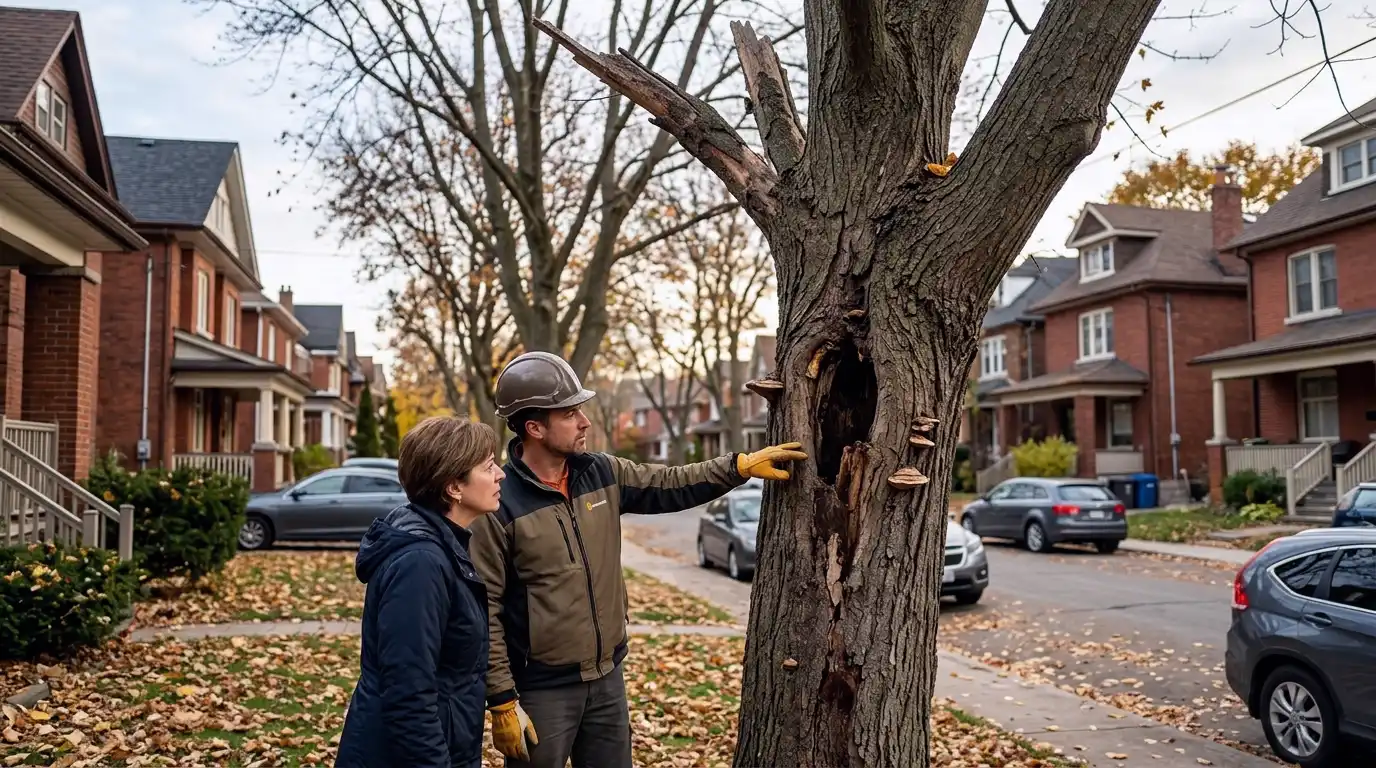
The practical issues around hazardous tree signs in Toronto include tree condition, property context and any rules that affect the work. Fall is one of the best times for Toronto homeowners to look at trees from the ground before winter weather adds extra load. Once the leaves drop in October and November, the branch structure becomes easier to see. Large dead limbs, tight stem unions, cracks, decay, lean and broken branches can stand out more clearly against the sky. Identifying warning signs before ice, snow and wind arrive can help a homeowner decide when to speak with a qualified arborist, contact the City, call the utility provider or restrict access to a risky area.
A tree concern is usually more serious when two things exist together: a visible defect or health issue that may increase the chance of failure, and a target that could be harmed if the tree or limb failed. A declining tree in an open corner of a large lot may create less practical risk than a smaller dead branch over a driveway, walkway, roof, neighbour’s yard or children’s play area.
Common targets include a house, garage, fence, vehicle, driveway, deck, shed, utility line, public sidewalk, road, neighbouring structure or area where people regularly pass underneath. If the potential failure zone includes one of these targets, a homeowner should treat the issue more carefully and avoid standing, parking or storing items below the area until the concern has been reviewed by the proper professional.
Six Structural Warning Signs to Look For This Fall
1. Co-dominant stems with included bark
Co-dominant stems form when two stems of similar size grow from the same point. Some of these unions are stable, but narrow V-shaped unions with bark compressed between the stems can be weaker than rounded branch attachments with visible collar tissue. As both stems grow larger, the tight union may become more vulnerable to splitting under wind, snow or ice load.
From the ground, look for a tight V-shape where the bark appears to disappear into the crotch. Do not climb the tree, cut into the union or try to test the attachment yourself. If a co-dominant stem with a tight union overhangs a roof, driveway, sidewalk, parked vehicle or frequent-use area, an ISA Certified Arborist may be able to review the tree and discuss options directly with you.
2. Cracks and splits in major unions or trunk
Cracks in a trunk or major branch union can be more concerning than ordinary surface texture in older bark. A true structural crack may appear as a gap, split, seam, fresh opening, exposed wood or movement in a major union. It may also be associated with storm damage, heavy lean, decay, bark loss or a branch that appears partly separated from the tree.
Do not probe a crack deeply, pull on the limb or stand under the area to inspect it. Take clear photos from a safe distance. If the cracked area sits above a structure, walkway, driveway, neighbour’s property or public area, the safer next step is to restrict access below it and speak with a qualified arborist or the appropriate authority.
3. Large dead branches
Large dead branches retained in the canopy are among the easiest warning signs for homeowners to notice after leaf drop. Dead branches may appear grey, bleached, brittle, bare, missing fine twigs or visually different from the surrounding live canopy. They may also remain attached even though the living tissue around them has already declined.
A dead limb above a roof, driveway, sidewalk, deck, play area or neighbour’s yard should not be ignored. Deadwood can fall during storms, after freeze-thaw cycles, or sometimes without obvious warning.
4. Recent lean development
Some trees naturally lean as they grow toward light or adapt to site conditions. A long-standing lean is different from a lean that appears to have increased recently. Recent lean can suggest root disturbance, root decay, saturated soil, construction damage or movement in the root plate.
Warning signs near the base may include lifted soil, cracking soil, exposed roots, a raised root plate, gaps around the trunk, fresh soil movement or a lean that has changed after a storm. If a tree appears to be actively shifting, keep people and vehicles away from the likely fall zone and contact the proper professional or authority. If there is immediate danger, blocked public access, utility involvement or public-safety risk, contact emergency services, the utility provider, the municipality or the relevant public authority first.
5. Decay at the root crown or lower trunk
Decay inside a tree is not always visible, but there are external clues. Fungal fruiting bodies, mushrooms, shelf-like conks, soft wood, cavities, loose bark, carpenter-ant activity, water pockets, hollow-sounding areas, old wounds and open cavities near the base can all be worth documenting. Decay near the root crown or lower trunk can matter because that area helps support the entire tree.
Not every mushroom near a tree means the tree is unsafe, and not every cavity means removal is required. The concern depends on species, location, extent of decay, tree size, targets and overall structure. A qualified arborist can discuss whether further review or written documentation is appropriate.
6. Root problems and girdling roots
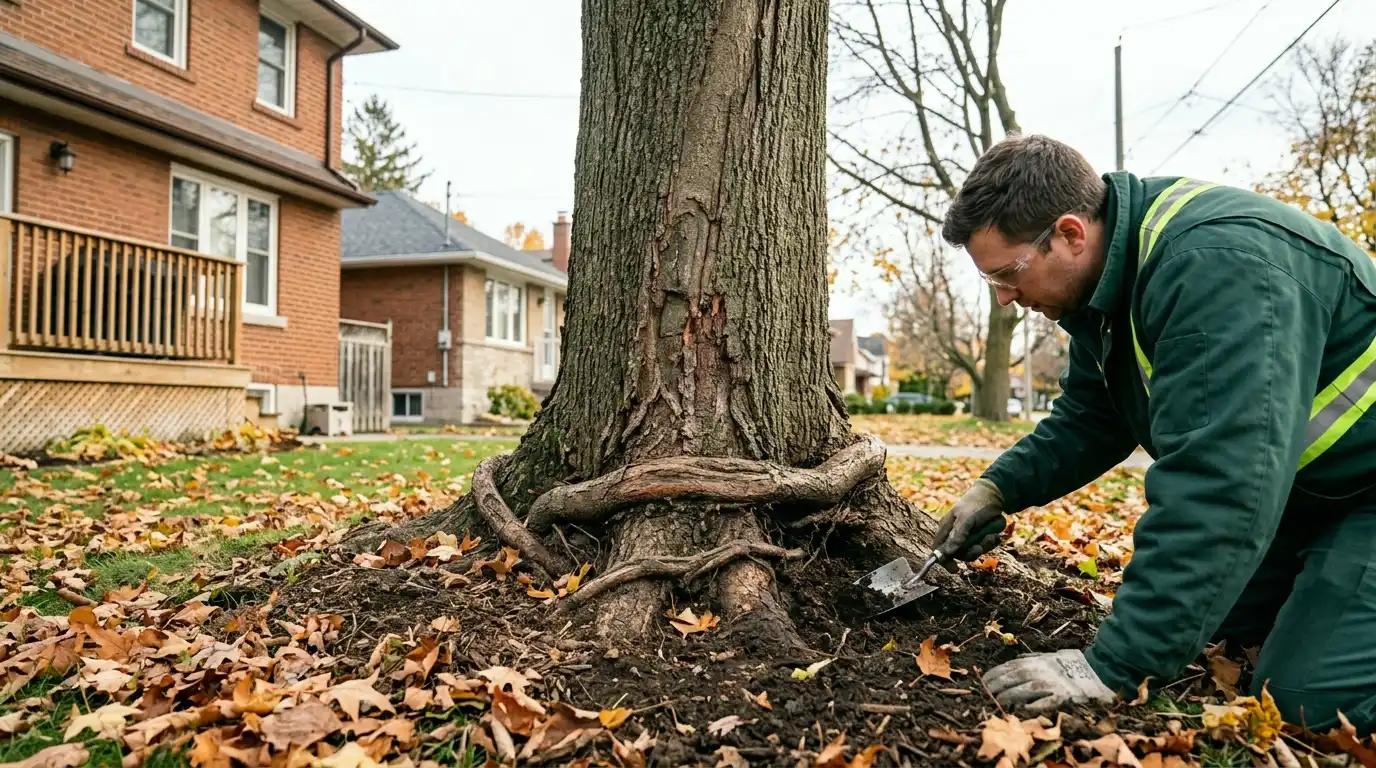
Roots can create structural concerns even when the canopy still looks green. Girdling roots circle or press against the trunk near the base instead of growing outward. Over time, they may restrict movement of water and nutrients or affect trunk flare development. Other root-related warning signs include heaving soil, recent trenching, grade changes, construction damage, severed roots, soil compaction, repeated flooding or sudden canopy decline after site work.
From the ground, look for a missing trunk flare, roots wrapped around the base, indentations in the lower trunk, exposed roots that appear cut, or soil movement around the root plate. Do not cut visible roots yourself. Improper root cutting can destabilize the tree or create new injury. Speak directly with a qualified arborist before arranging any root-related work.
Fall as the Best Time for a Ground-Level Visual Check
October and November are useful months for a basic homeowner visual check because deciduous trees lose their leaves and the branch framework becomes easier to see. Dead limbs, broken branches, rubbing limbs, storm damage, tight unions and unusual lean may be more visible before winter storms arrive. It is also easier to take clear photos for a qualified arborist, insurer, neighbour communication or City inquiry if documentation becomes necessary.
A ground-level check is not a formal risk assessment. It is a way to decide whether the issue deserves professional attention. Do not climb, cut, probe, pull, cable, brace or remove parts of a tree based on a visual check. If the tree is near power lines, keep away and contact the utility provider or the relevant authority first.
What to Do If You Find a Hazardous-Looking Condition
If you notice one of the warning signs described above, start with safety. Keep people, pets and vehicles away from the potential failure zone. Photograph the concern from a safe distance. Note when you first saw it and whether it changed after wind, snow, rain or construction activity. If the tree belongs to a neighbour, keep communication factual and consider sending photos or qualified professional documentation instead of relying on a verbal complaint.
If the tree is on private property and may be protected under Toronto’s tree rules, confirm City requirements before arranging removal or injury. The City of Toronto identifies private trees with a diameter of 30 cm or more, measured 1.4 m above the ground, as protected under the Private Tree By-law. The City also provides 311 reporting options for dangerous private trees. For immediate danger, powerline contact, blocked public access or public-safety risk, contact emergency services, the utility provider, the municipality or the relevant public authority first.
Useful Toronto Resources
For official guidance, homeowners can review the City of Toronto tree and ravine permit information and the City of Toronto dangerous private trees information. These links are provided for general information only. Property owners should confirm current requirements directly with the City or with a qualified professional before arranging work on a protected tree.
Frequently Asked Questions
What makes a tree potentially hazardous in Toronto?
A tree may be a concern when it has a visible defect or health issue that increases the chance of failure and a nearby target that could be harmed. Common warning signs include tight co-dominant unions, cracks, large dead limbs, recent lean, decay near the base and root problems.
How do I check a tree for included bark at a stem attachment?
From the ground, look for two similar-sized stems joining in a tight V-shaped union. A rounded collar or ridge is usually a better sign than bark compressed between stems. Do not climb, cut or test the union yourself. If the union is above a house, driveway, sidewalk or frequent-use area, speak directly with an ISA Certified Arborist.
What are large dead branches and how do I spot them?
Large dead branches may appear grey, bare, brittle or missing fine twig growth after leaf drop. Dead branches over driveways, roofs, sidewalks, play areas or public spaces should be treated seriously.
Does a hazardous tree in Toronto still need City review before removal?
Protected private tree rules may apply to trees measuring 30 cm or more in diameter at breast height, and dangerous private tree concerns may also involve City or 311 review. Confirm current City requirements before arranging removal or injury of a protected tree.
Related Guides and Request Pages
- Signs Your Tree Is Dead or Dying
- My Tree Is Leaning – Is It Dangerous?
- Fall Tree Pruning in Toronto
- ISA Certified Arborist vs General Tree Company
- Emergency Tree Requests
Send Your Tree Request
Concerned about a tree on your Toronto property before winter?