
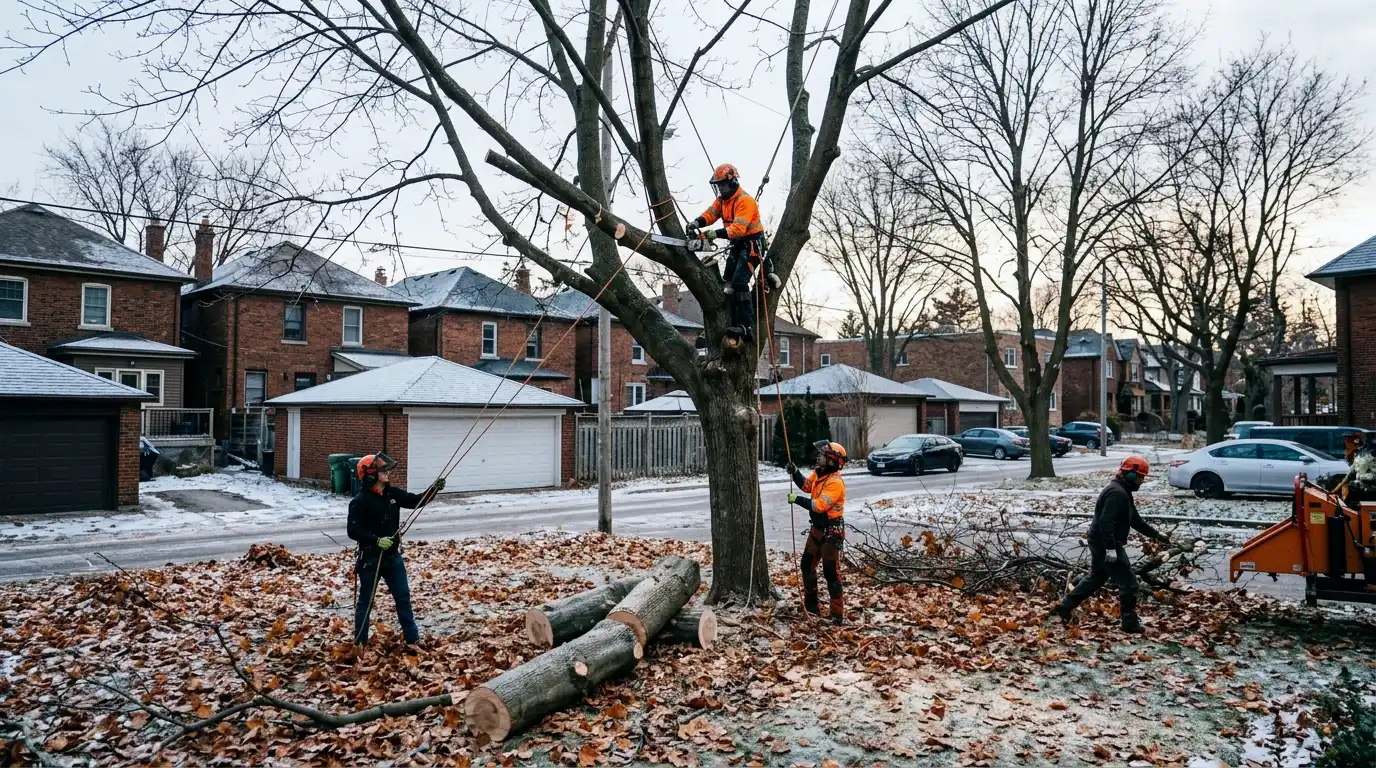
Questions about late fall tree removal in Toronto usually come down to the rules, site conditions, risks and practical options for the property. November and early winter can be a practical time for planned tree removal in Toronto. Leaf drop makes branch structure easier to see, cooler weather can reduce some seasonal pressures, and firmly frozen ground may reduce lawn rutting on certain soft-soil properties. For homeowners planning construction, repairs, access changes or storm-damage cleanup before spring, late fall can also be a useful time to start asking the right questions.
This guide is for general planning only.
Why the Dormant Window Can Work Well for Removal
The bare canopy advantage
After a deciduous tree drops its leaves, the main structure is easier to view from the ground. Branch unions, broken limbs, deadwood, crossing limbs, weak attachments, old storm damage and clearance problems may be more visible than they were during summer. That can help a qualified arborist or qualified tree care professional explain the likely work approach, risk factors and access requirements more clearly.
Bare branches can also reduce leafy debris volume compared with summer. That does not automatically make every job cheaper, faster or simpler. Tree height, trunk diameter, lean, decay, fences, buildings, overhead wires, slope, access width, snow, ice and debris handling can all affect the qualified tree contractor’s price and work plan. Property owners should ask what is included in writing before approving work.
Frozen ground may reduce lawn damage
Toronto yards can be difficult in wet spring or fall conditions, especially where clay soil, poor drainage or shaded lawns keep the surface soft. When the ground is firmly frozen, equipment and foot traffic may be less likely to leave deep ruts. That is one reason some homeowners prefer January or February timing for lawn-sensitive properties.
Frozen ground is not a blanket guarantee. If the soil is only partly frozen, if snow hides obstacles, if ice makes access unsafe, or if the property has slope or drainage issues, the work may still require extra protection or a different plan. Any lawn protection, equipment route, damage risk, cleanup terms and restoration responsibility should be discussed directly with the qualified tree contractor.
Scheduling may be easier than peak summer
Late fall and winter are often less crowded than the spring and summer rush. That can make it easier to discuss timing with qualified tree contractors, especially for non-urgent work. However, weather still matters. High winds, heavy snow, ice loading, extreme cold, unsafe access or utility conflicts can delay work at the qualified tree contractor’s discretion.
Late fall and winter tree removal in Toronto: when it may help and when to be careful
- May help: bare deciduous canopies can make branch structure easier to review.
- May help: firm frozen ground can reduce lawn rutting on some soft-soil properties.
- May help: planned non-urgent work may be easier to discuss outside peak summer demand.
- Needs care: icy driveways, snow-covered obstacles, frozen gates, steep access and short daylight can affect work planning.
- Needs care: stump grinding may be harder in deeply frozen ground and should be discussed directly with the contractor.
- Permit rule: Toronto Chapter 813 applies year-round to protected private trees.
- Oak caution: Toronto and CFIA guidance warn against pruning oaks during the active oak wilt risk period.
What Changes in Winter Removal Operations
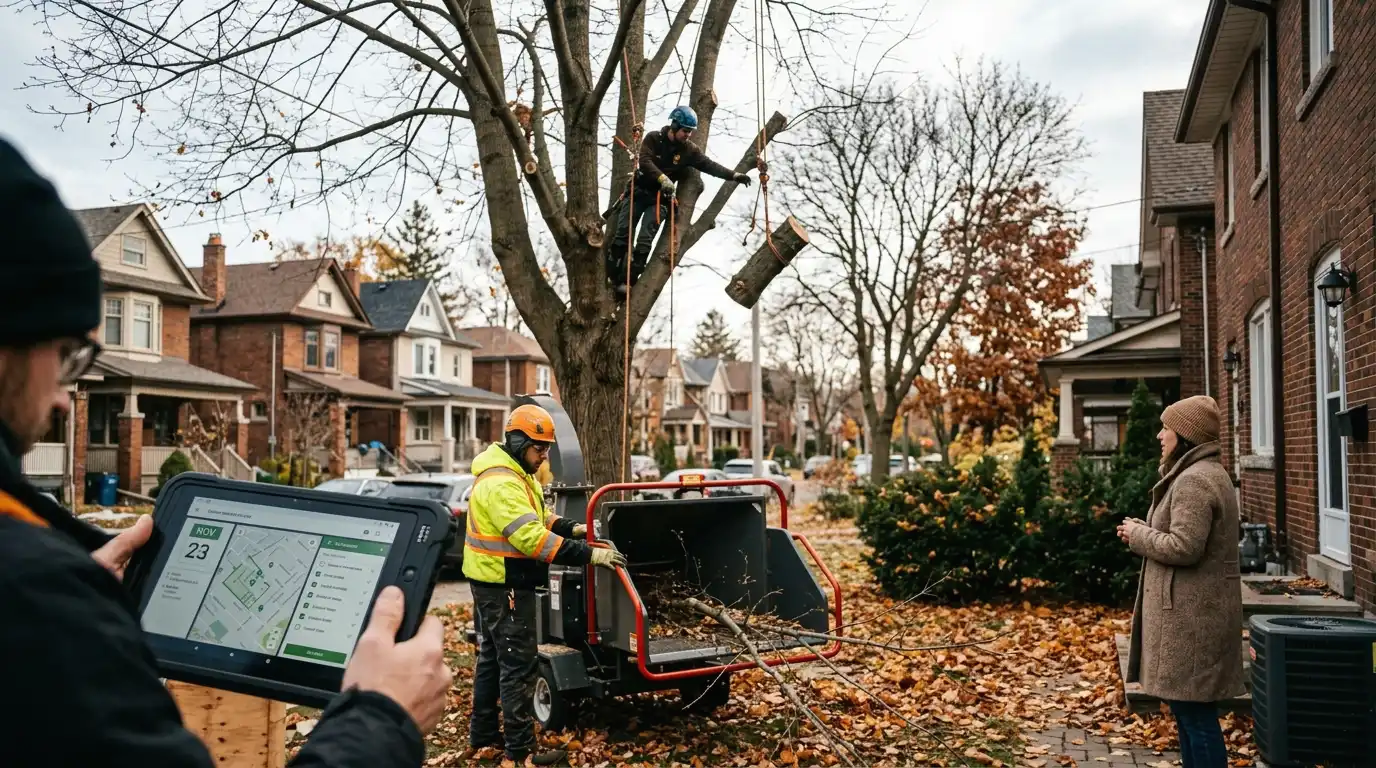
Late fall and winter tree work can involve different safety and access issues from summer work. Cold equipment starts, frozen locks or gates, snow on access routes, icy driveways, shorter daylight, hidden obstacles, wind chill and changing branch weight can all affect a contractor’s approach. The qualified tree contractor should explain whether the job is suitable for the planned day and whether weather may require rescheduling.
Snow or ice on branches can change how sections behave during cutting or lowering. A branch with heavy snow or ice load is not the same as a dry summer branch. If a tree is storm-damaged, hanging over a structure, touching wires or blocking a public road, property owners should keep clear and contact emergency services, the utility provider, the City of Toronto or the relevant public authority first.
Stump grinding in frozen ground may still be possible, but it depends on access, frost depth, snow cover, stump size, nearby hardscaping, underground utilities and the contractor’s equipment. Property owners should ask whether stump grinding is included, when it will be completed, how deep the stump will be ground, whether chips are removed, whether backfill is included and whether utility marking is needed.
Chapter 813 in Fall and Winter
Toronto’s private tree rules apply in every season. The City of Toronto states that where at least one stem measures 30 cm in diameter or greater, the tree is protected under the bylaw. Property owners should review the City’s tree and ravine permit guidance before removing or injuring a protected tree.
Where an arborist report or permit-related document is required, the appropriate qualified professional should meet the City’s current credential and documentation requirements for that application.
If a tree appears dead, diseased, hazardous or storm-damaged, do not assume the permit path disappears. Confirm the correct process directly with the City of Toronto or 311 and use a qualified arborist where professional assessment or documentation is needed. For public trees, boulevard trees, ravine areas, utility conflicts or immediate hazards, contact the proper public authority first.
Late Fall Tree Removal in Toronto: Oak Trees and Late Fall Timing
Oak trees require special attention because of oak wilt risk. Toronto advises avoiding oak pruning during the growing season from April 1 through October 31. If work is necessary because of breakage, safety, storm damage or another urgent issue, follow current City and CFIA guidance and use an appropriately qualified professional for the situation.
Tree removal is different from ordinary pruning, but bark damage, broken branches and fresh wounds can still raise timing questions. Any oak-related assessment, timing decision, report, permit-related document, work method or communication must be handled directly by the qualified arborist or qualified tree contractor.
When Late Fall May Be Better Than Spring
Late fall may be preferable to spring for some planned tree removal work. Spring can bring soft thawing ground, saturated lawns, busy contractor schedules and active construction timelines. November and early winter may offer clearer branch visibility and better planning time before spring projects begin. Mid-winter frozen ground may also reduce rutting on some yards.
The right timing still depends on the actual site. A dry, open yard may be straightforward in several seasons. A tight urban lot with overhead wires, snow, narrow access, clay soil, steep grade or a protected tree may require more planning. Property owners should compare written quotes, ask about permit-related documents, confirm cleanup terms and make sure any work near public trees, utility lines or protected private trees is handled through the correct authority.
Frequently Asked Questions
Is November or December a good time to remove trees in Toronto?
November and December can be practical months for tree removal work in Toronto when a qualified tree contractor determines that weather, access, site conditions and safety are suitable. Bare deciduous canopies can make branch structure easier to see, and late fall may be easier for scheduling than peak summer.
Does frozen ground make tree removal easier or harder in Toronto?
Frozen ground can reduce lawn rutting on some soft-soil properties, but it is not a guarantee. Partially thawed soil, snow, ice, slope, drainage and equipment access can still create site risks. Stump grinding may also be affected by frozen ground. Property owners should discuss access routes, lawn protection, cleanup terms, stump grinding, timing and pricing directly with the qualified tree contractor.
Does Chapter 813 still apply to trees removed in November or December in Toronto?
Yes. Toronto’s private-tree rules apply year-round. Where at least one stem meets the City’s protected-tree diameter threshold, confirm the applicable permit or permit-exception requirements directly with the City of Toronto or 311 before removal or injury.
Are tree removal prices lower in winter in Toronto?
Some qualified tree contractors may quote differently in late fall or winter depending on demand, access, weather, equipment needs and scheduling. Other jobs may cost the same or more if snow, ice, access limits, stump grinding conditions or safety requirements make the work harder. Property owners should request written pricing directly from the qualified tree contractor.
Related Guides and Services
- Fall Tree Pruning in Toronto
- Can Trees Be Removed in Winter in Toronto?
- Prepare Your Trees for a Toronto Winter
- Tree Removal Permit Toronto
- Tree Removal Requests