
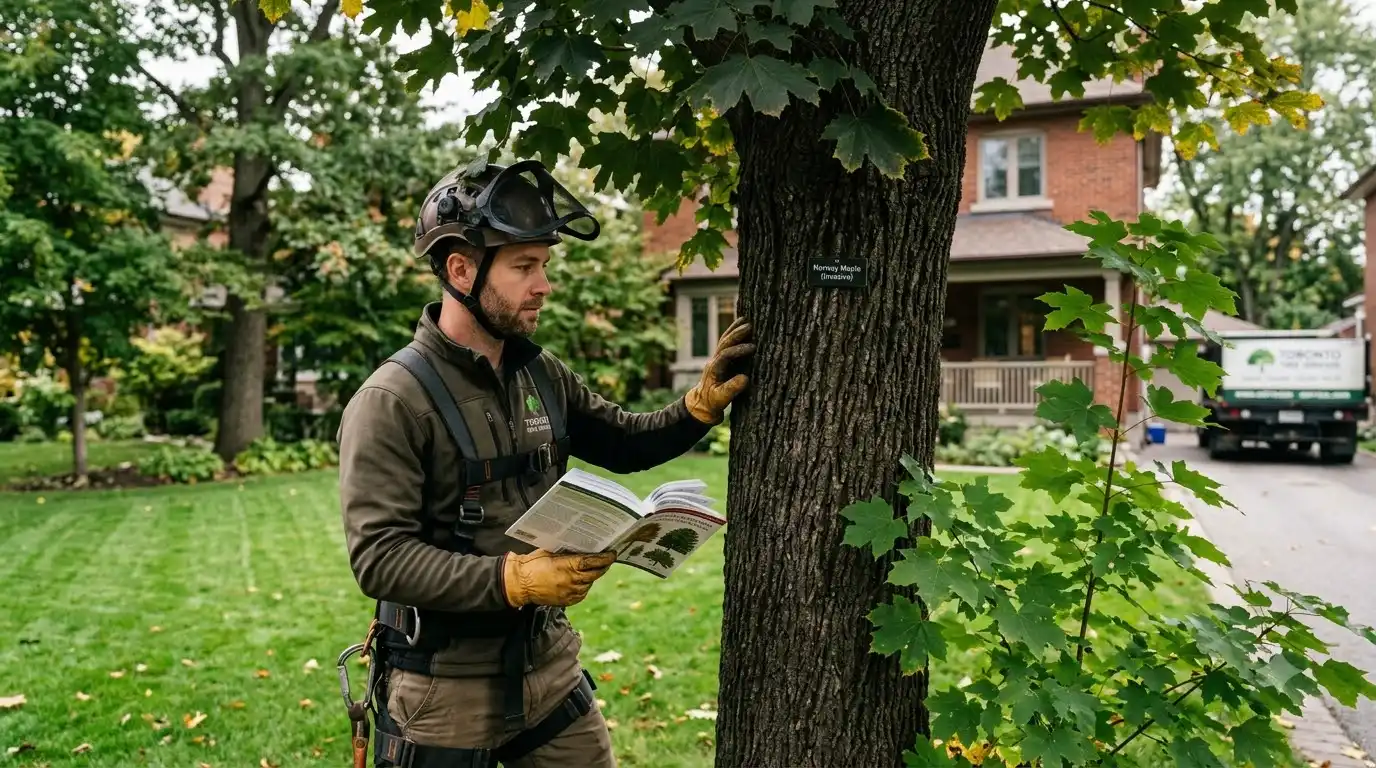
Property owners dealing with invasive tree species in Ontario should first consider tree condition, site constraints and any municipal requirements. Ontario’s urban and natural landscapes have been shaped by several invasive and aggressive tree species that were introduced, planted, or spread beyond their original range. Norway maple is one of the most visible examples in Toronto and the GTA. Tree-of-heaven is a growing concern because of its aggressive spread and its connection to spotted lanternfly risk. Manitoba maple, while native to parts of Canada, is often treated as invasive or problematic across much of Ontario because of how readily it establishes in disturbed urban and riparian areas.
This guide is for general planning only.
Invasive Tree Species in Ontario: Norway Maple: Ontario’s Most Common Urban Invasive Tree
Norway maple (Acer platanoides) is one of the best-known invasive trees in Ontario’s urban forest. The Ontario Invasive Plant Council’s Norway maple information describes it as a shade-tolerant deciduous tree native to Europe and western Asia. It became popular as a street and ornamental tree because it tolerates urban stress, but that same toughness has helped it spread from planted areas into parks, ravines, woodlots, and naturalized spaces.
The issue is not only that Norway maple grows well. It also produces many seeds, casts dense shade, and can make it harder for native understory plants and native tree seedlings to establish. In places like Toronto’s ravine system, old residential neighbourhoods, and urban woodland edges, Norway maple seedlings can gradually change the plant community below the canopy. For homeowners, the tree may appear healthy and attractive while still being ecologically undesirable in the wrong location.
On private residential properties in Toronto, do not assume that invasive status means automatic removal. The City of Toronto states that private trees are protected where at least one stem measures 30 cm or greater in diameter. If a Norway maple may meet that threshold, property owners should review the City’s tree and ravine permit guidance or speak directly with an ISA Certified Arborist before any injury or removal is approved.
Tree-of-Heaven: A Rapidly Spreading Problem
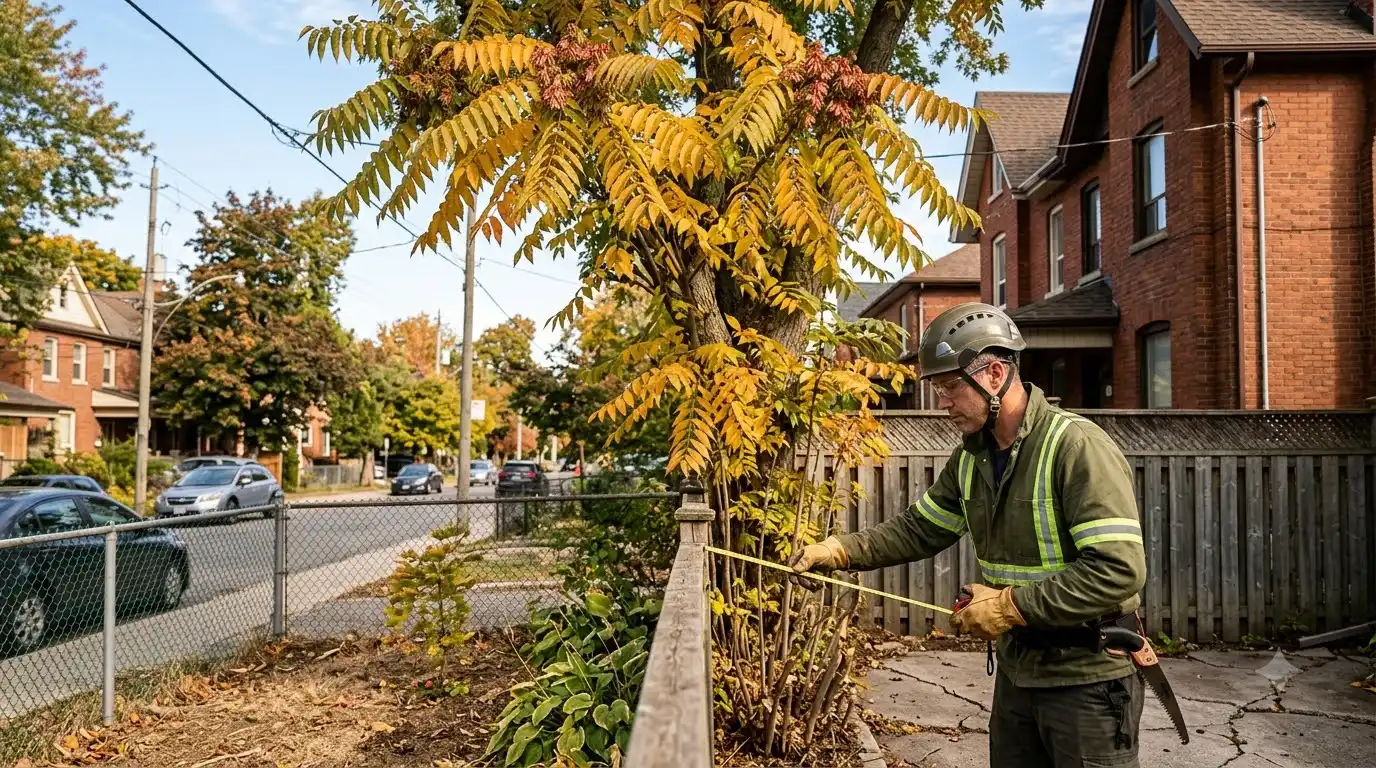
Tree-of-heaven (Ailanthus altissima) is an invasive tree native to China that spreads aggressively through seed and root suckers. Ontario’s tree-of-heaven information notes that the tree’s association with spotted lanternfly has increased the importance of controlling its spread. Spotted lanternfly is an invasive pest of concern because it can feed on many fruit, ornamental, and woody trees.
Tree-of-heaven is common in disturbed areas such as laneways, rail corridors, fence lines, vacant lots, hardscape cracks, alleys, and urban edges. It can grow quickly, return from the root system after cutting, and form recurring patches if the full management plan is not handled properly. For that reason, control decisions should be made directly with a qualified professional. Herbicide treatment, mechanical removal, repeat cutting, disposal, follow-up monitoring, and pesticide compliance must be discussed directly with the qualified tree contractor or other qualified professional.
In Toronto, tree-of-heaven may still be subject to private tree rules if it meets the protected-tree threshold. Property owners should not remove a large tree-of-heaven without checking the bylaw path first.
Ontario invasive and problematic tree species: identification and planning notes
- Norway maple (Acer platanoides): opposite leaves with pointed lobes, dense shade, milky sap from a broken leaf stalk, and many winged seeds. It is widely recognized as invasive in Ontario urban and natural areas.
- Tree-of-heaven (Ailanthus altissima): large compound leaves, many leaflets, fast growth, root suckering, and a strong unpleasant smell when crushed. It is a priority concern because of its invasive behaviour and spotted lanternfly connection.
- Manitoba maple (Acer negundo): opposite compound leaves, fast growth, weak branch structure, and heavy seeding. Ontario notes that Manitoba maple is considered invasive across much of its range.
- White mulberry (Morus alba): variable leaf shapes, small fruit, rapid spread, and concern because it can hybridize with native red mulberry.
- European black alder (Alnus glutinosa): rounded leaves and small woody cone-like structures, often found in wet areas where it can affect native wetland plant communities.
Manitoba Maple: Native in Some Regions, Problematic in Many Ontario Settings
Manitoba maple (Acer negundo), also known as boxelder, is native in parts of Canada, including areas of Northwestern Ontario, but it is often treated as invasive or problematic across much of its range in Ontario. Ontario’s Manitoba maple information notes that it is considered an invasive species across much of its range and can thrive in many urban and riparian landscapes.
On residential properties, Manitoba maple often appears along fence lines, alleys, creek edges, neglected corners, garage walls, and ravine-adjacent yards. It grows quickly and can develop weak branch structure, which may lead to storm or ice damage concerns. That does not automatically mean every Manitoba maple should be removed, but it does mean the tree’s structure, location, health, and bylaw status should be reviewed directly with a qualified arborist or qualified tree care professional where appropriate.
In Toronto, a Manitoba maple below the protected private-tree threshold may not require the same permit path as a protected tree, but homeowners should still confirm before cutting if the tree size is close to 30 cm or if the property is near a ravine, regulated area, shared boundary, or public tree.
Native Replacement Options
Removing an invasive or problematic tree can create an opportunity to plant something with stronger long-term ecological value. The right replacement depends on available space, soil drainage, light level, root space, overhead wires, future canopy size, maintenance tolerance, and any municipal replacement requirement. A small front yard does not need the same replacement tree as a wide ravine-edge property or an open backyard with full sun.
Possible native options in the Toronto and GTA area include serviceberry for smaller spaces, red oak or bur oak where there is room for a larger canopy tree, sugar maple in suitable soil and space, eastern redbud for ornamental value in protected locations, native hawthorn for tougher compact sites, and black cherry where the site can support a larger native tree. Property owners should confirm replacement planting requirements directly with the City of Toronto, an ISA Certified Arborist, or a qualified planting professional before finalizing a species.
Frequently Asked Questions
Is Norway maple invasive in Ontario?
Yes. Norway maple is widely recognized as an invasive tree in Ontario because it can spread from planted areas into ravines, woodlots, parks, and natural areas. It can create dense shade, produce many seedlings, and compete with native trees and understory plants. In Toronto, do not assume invasive status removes permit obligations. A private tree that meets the City of Toronto protected-tree size threshold may still require review or a permit before injury or removal. Property owners should confirm requirements directly with the City of Toronto or an ISA Certified Arborist.
What is tree-of-heaven and why is it a problem in Ontario?
Tree-of-heaven, also called Ailanthus altissima, is an invasive tree that spreads aggressively through seed and root suckers. Ontario also identifies it as a primary host for spotted lanternfly, an invasive pest of concern for agriculture, forestry, fruit trees, ornamental plants, and grape production. Control methods, treatment decisions, herbicide use, disposal, and follow-up monitoring should be discussed directly with a qualified professional and must follow applicable laws and label directions.
Do invasive trees still require Toronto permits before removal?
Possibly, yes. The City of Toronto protects private trees where at least one stem measures 30 cm or greater in diameter. Invasive or problematic species should not be removed on assumption alone if the tree may be protected by bylaw. Property owners should check the City of Toronto’s tree and ravine permit information, call 311 where appropriate, or speak directly with an ISA Certified Arborist before removing or injuring a protected tree.
What should I plant to replace an invasive tree on my Ontario property?
Native species are usually the best replacement direction, but the right tree depends on space, soil, sun, drainage, overhead clearance, root space, local bylaw requirements, and long-term maintenance. Possible native options include serviceberry, sugar maple, red oak, bur oak, eastern redbud, hawthorn, black cherry, and other species suited to the site. Property owners should confirm replacement requirements directly with the City of Toronto, a qualified arborist, or a qualified planting professional where applicable.
Related Guides and Services
- Best Native Trees to Plant in Toronto
- How to Plant a Replacement Tree in Toronto
- Black Walnut Trees in Toronto
- Tree Removal Permit Toronto
- Tree Removal Requests
Send Your Tree Request
Have an invasive or problematic tree on your Toronto or GTA property?