
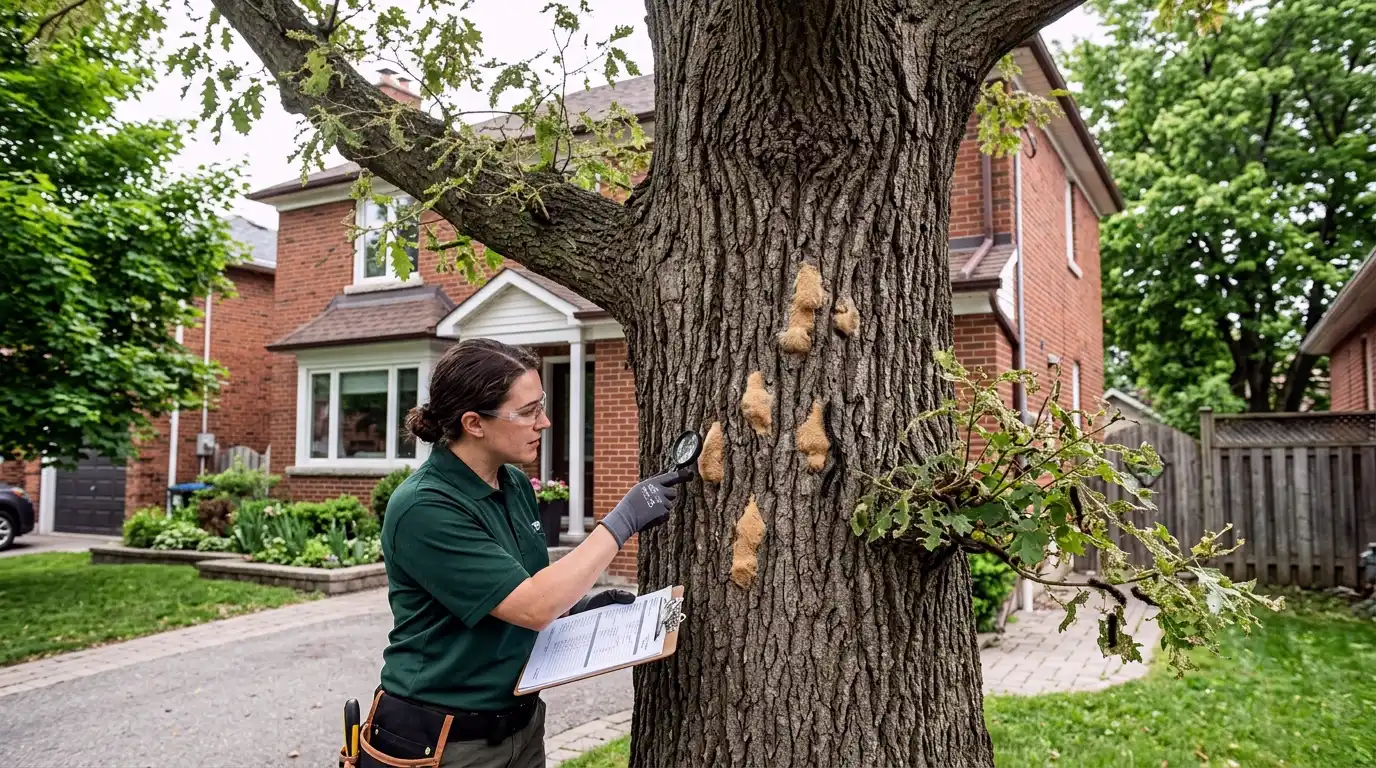
Spongy moth tree damage in Ontario can affect tree health, structure or long-term survival, so early identification matters. Spongy moth damage can look alarming. During a heavy outbreak, mature oaks and other trees that should be in full summer leaf may look bare by June. Caterpillars can appear on trunks, fences, outdoor furniture, and walls, while small droppings may fall from the canopy during active feeding. For a Toronto or GTA property owner, the hard part is knowing whether the tree is likely to recover, whether monitoring is enough, whether treatment should be discussed, or whether the tree has declined enough that removal needs to be considered.
Spongy moth, formerly called gypsy moth, is an invasive defoliating insect established across southern Ontario. Population levels rise and fall in cycles. Some years bring severe local defoliation, while other years show much lower activity because of natural population controls and weather conditions.
What Spongy Moth Does to Trees
Spongy moth caterpillars hatch in spring and feed heavily during the late spring and early summer period. The caterpillars are often associated with oak-dominant areas, but they can also feed on maple, birch, aspen, willow, and other deciduous species. During heavy outbreak pressure, some conifers may also be affected. The City of Toronto provides current public guidance here: City of Toronto spongy moth information.
The main damage is defoliation. Without leaves, a tree cannot photosynthesize normally. Many healthy deciduous trees can produce a second flush of leaves later in the season after caterpillar feeding drops. That second flush uses stored energy, so the tree may be weakened even when it appears to recover visually. A single defoliation event is different from repeated defoliation over consecutive years, especially when drought, soil compaction, root disturbance, decay, construction damage, or other stressors are already present.
Oaks often draw the most attention during outbreak years because they are preferred hosts and their defoliation can be dramatic. A defoliated oak may still recover, but repeated heavy feeding can leave it vulnerable to secondary decline. Homeowners should avoid making a removal decision based only on one bad-looking June canopy. The better question is whether the tree refoliates, whether upper branches remain alive, whether there are signs of decay or structural weakness, and whether the tree has been hit repeatedly in recent seasons.
Spongy moth damage: practical risk signals to watch
- One defoliation year on an otherwise healthy deciduous tree: monitor recovery and water during dry periods
- Repeated defoliation in consecutive years: discuss condition with a qualified arborist
- Defoliation combined with drought, root damage, or construction stress: risk may increase
- Severe conifer defoliation: more concerning than defoliation on many deciduous trees
- Upper crown dieback, fungal growth, weak structure, or major dead limbs: tree condition should be reviewed
- Immediate safety risk, public road hazard, or utility conflict: contact emergency services, the municipality, utility provider, or relevant public authority first
Identifying Spongy Moth: Caterpillars, Egg Masses, and Adults
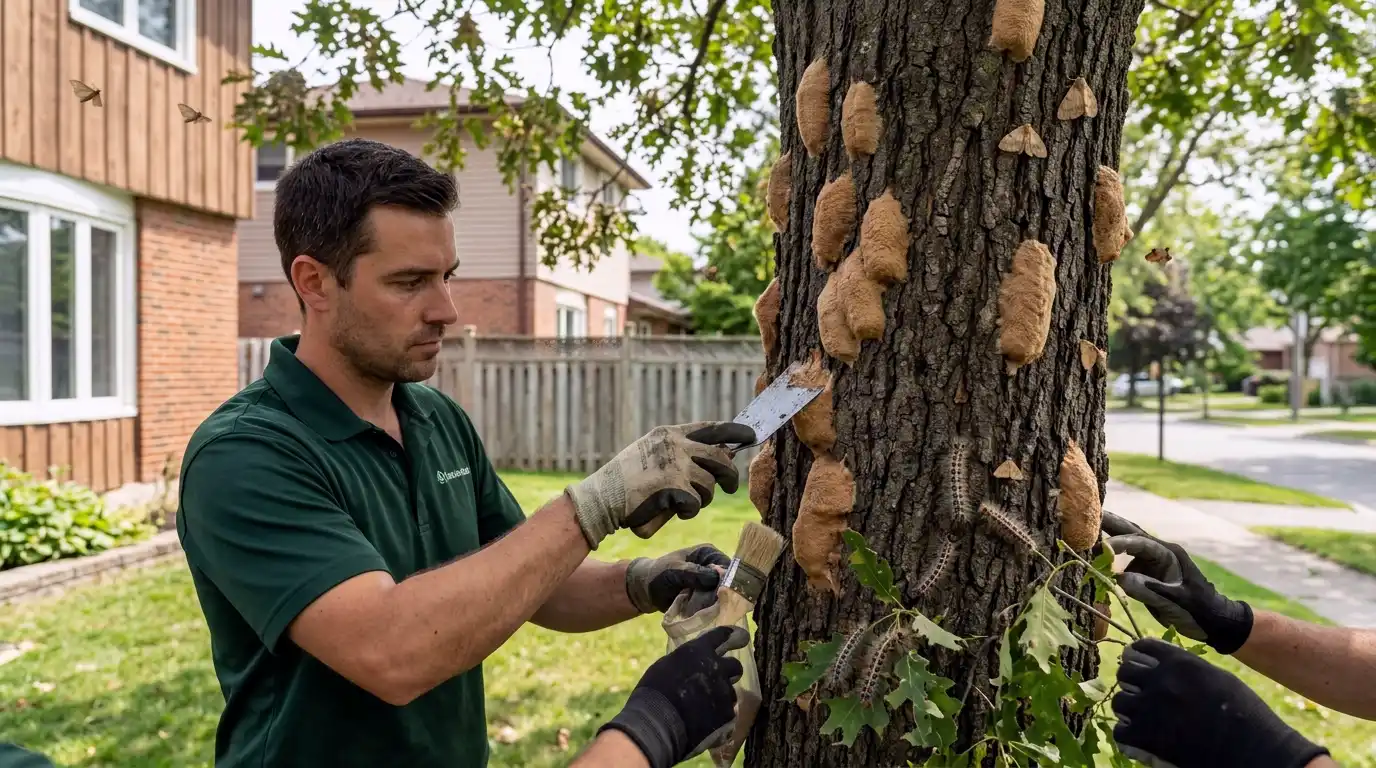
Mature spongy moth caterpillars are hairy and have distinctive coloured dot patterns along the back. Egg masses are often the easiest sign to identify outside the active feeding period. They are tan to buff-coloured, fuzzy or spongy-looking masses found on bark, branches, outdoor furniture, firewood, fences, vehicles, play equipment, and other hard surfaces. Toronto notes that egg masses can contain 100 to 1,000 eggs, which is why egg mass removal can help reduce pressure around an individual property.
Egg masses should not simply be scraped onto the ground. TRCA and several municipal resources recommend scraping egg masses into soapy water and leaving them there before disposal. Wear gloves, avoid direct skin contact with caterpillars or egg mass material, and follow municipal guidance for safe handling. TRCA’s spongy moth information is available here: TRCA spongy moth guidance.
What Property Owners Can Do to Protect Trees
Egg mass removal
Egg mass removal is one of the most practical steps for homeowners. Look for masses on tree trunks, bark crevices, branches within safe reach, firewood, fences, outdoor furniture, play equipment, vehicles, sheds, and other hard surfaces. Scrape egg masses into a container of soapy water, not onto the soil. Do not climb trees or use unsafe ladders to reach high masses. Work only from the ground or from safe, stable access.
Burlap or barrier bands
Some municipal resources describe using burlap bands or other physical trapping methods during the caterpillar stage. These methods can help collect caterpillars moving up and down the trunk, but they need to be checked and managed properly. Bands should not be left in place in a way that damages bark, traps moisture for too long, or creates a hazard. Follow current municipal or conservation authority instructions before using any banding method.
Btk biological treatment discussion
Btk, short for Bacillus thuringiensis var. kurstaki, is commonly discussed as a biological control for certain caterpillars when applied at the correct larval stage. Treatment timing, product selection, application equipment, property access, weather, tree height, and label directions all matter. Large trees usually require professional equipment and a licensed applicator. A qualified arborist or licensed applicator can discuss Btk timing, suitability, pricing, and limitations with the property owner.
Tree health support during and after outbreak years
During dry weather, watering high-value trees can reduce additional stress. Avoid unnecessary root-zone disturbance, heavy pruning, soil compaction, or construction activity around a defoliated tree. A stressed tree needs time to recover its leaf area and energy reserves. If the tree is already showing dieback, fungal growth, cracks, decay, leaning, or branch failure, a qualified arborist or qualified tree care professional may be able to review the condition.
Spongy Moth Tree Damage in Ontario: When to Consider Removal After Spongy Moth Damage
Removal should not be the automatic first response after one defoliation year. Many healthy deciduous trees can refoliate and continue growing. Removal becomes a more serious discussion when there is repeated defoliation combined with visible decline, such as major upper crown dieback, poor refoliation, fungal growth, large dead limbs, trunk decay, bark loss, insect activity linked to decline, structural cracks, or a target risk near a house, driveway, sidewalk, playground, road, or neighbouring property.
a qualified arborist may assess the tree and discuss whether monitoring, treatment, pruning, risk mitigation, or removal is appropriate. If a protected tree is proposed for removal in Toronto, municipal permit rules may still apply even when the tree is dead, diseased, hazardous, or declining. Property owners should confirm City requirements before work begins.
For Toronto permit context, see the official City of Toronto tree and ravine protection permits page. You can also review this related guide: dead tree removal permits in Toronto.
Spongy Moth in Context: Population Cycles
Spongy moth populations are cyclical. Ontario’s public guidance notes past major outbreak peaks and identifies the recent outbreak that peaked in 2021 as the largest on record. After severe years, local populations can drop sharply because of natural controls, disease, weather, and lower survival. This means a badly defoliated tree may not necessarily face the same level of feeding pressure the following year, although local monitoring is still important.
This cycle matters when making tree decisions. A healthy tree that was defoliated once may be worth monitoring and supporting rather than removing. A tree that has experienced repeated defoliation and now shows structural decline is different. The correct next step depends on the actual tree, site conditions, local outbreak pressure, safety risk, municipal permit context, and the property owner’s goals. Official provincial information is available here: Ontario spongy moth information.
Related professional service: See the arborist report request information when professional documentation may be needed.
Frequently Asked Questions
What trees does spongy moth attack in Ontario?
Spongy moth caterpillars feed on many host plants and are commonly associated with oak-dominant areas in Ontario. Oaks, maples, birch, aspen, willow, and other deciduous trees can be affected, and conifers may be damaged during heavier outbreak pressure. Property owners should use official municipal, provincial, or conservation authority guidance for current local outbreak information.
Will my defoliated tree survive spongy moth?
Many healthy deciduous trees can recover after one defoliation event, especially when they are otherwise vigorous and receive adequate moisture. Repeated severe defoliation, drought, root stress, decay, or major structural defects can reduce recovery prospects. A qualified arborist can assess the whole tree rather than treating leaf loss alone as a reason for removal.
What can I do to protect my Toronto trees from spongy moth?
Homeowners can look for egg masses, scrape them into soapy water rather than onto the ground, and monitor caterpillar activity during the spring feeding period. Btk treatment may be discussed with a licensed pesticide applicator or qualified arborist where appropriate. Any pesticide use, timing, product choice, access, pricing, and treatment outcome must be handled directly with the licensed professional and in accordance with label directions and local rules.
When is spongy moth active in Ontario and when should treatment be considered?
Spongy moth egg masses overwinter and hatch in spring. Caterpillar feeding usually occurs through late spring and early summer, while egg masses are visible from late summer through the following spring. Treatment timing depends on local hatch timing, caterpillar stage, product label directions, and site conditions. Property owners should confirm timing with official guidance or a licensed professional.
Related Guides and Services
- Oak Wilt in Ontario
- Signs Your Tree Is Dead or Dying
- Dead Tree Removal Permit Toronto
- Emerald Ash Borer in Toronto
- Tree Removal
Send Your Tree Request
Concerned about spongy moth damage on your property?