
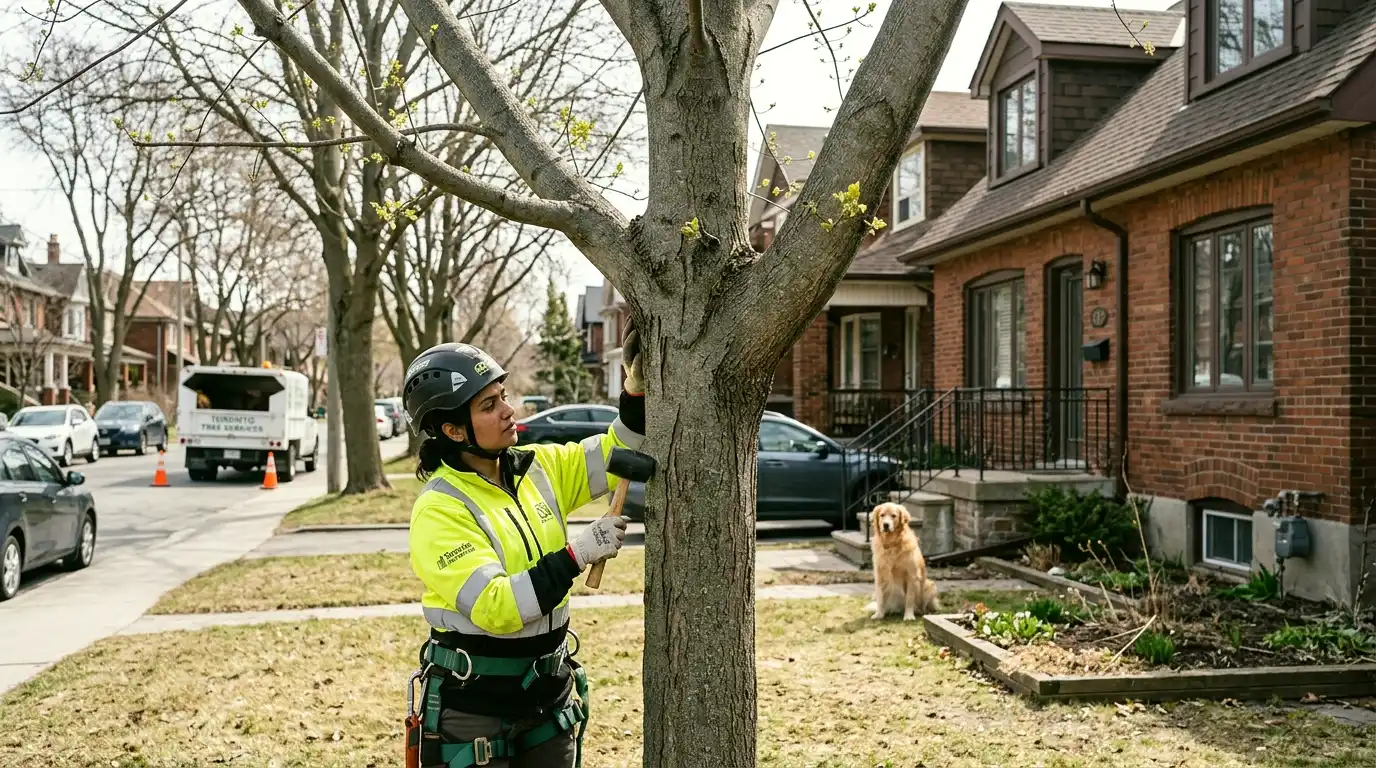
A useful way to approach spring tree care in Toronto is to start with property conditions, safety concerns and any local rules that apply. Spring is the right time to notice winter damage on Toronto trees before small issues become harder to manage. The main things worth checking are dead and hanging branches, frost cracks, co-dominant stems, root heave, Emerald Ash Borer signs, and fungal cankers around branch collars or the trunk base. Most trees come through winter without serious problems. The ones that do not may need review from a qualified arborist or qualified tree care professional before summer storms add more stress.
Why Spring Inspection Matters in Toronto’s Climate
Toronto winters can be hard on trees. Freeze-thaw cycles may split bark, ice can overload weak branches, and salt spray from roads can stress trees along boulevards, driveways, and busy streets. Spring is when many winter issues become visible because healthy trees begin to leaf out while damaged branches, delayed buds, and structural concerns become easier to spot.
The risk is not only cosmetic. A dead branch high in the canopy can be heavy, brittle, and unpredictable. If it hangs over a driveway, fence, sidewalk, roof, laneway, or play area, it should not be ignored. Spotting the issue in April or May gives a property owner more time to request a qualified arborist review before strong winds or summer storms create an urgent situation.
Six Things to Look For on Your Trees This Spring
1. Dead and Hanging Branches
Look for branches with no buds while the rest of the tree is beginning to leaf out. Hanging branches caught in the crown can be especially risky because they may fall without warning and may move in a different direction than expected. If you see a branch suspended in the canopy, keep people and pets away from the area and request review from a qualified tree care professional.
2. Frost Cracks
Frost cracks are vertical splits in the bark that can appear after rapid winter temperature changes. They are often seen on the south or southwest side of the trunk where daytime sun and nighttime cold create stress. Not every frost crack is an emergency, but a crack with decay, oozing, widening, fungal growth, or trunk movement should be looked at by a qualified arborist.
3. Co-Dominant Stems and Included Bark
Co-dominant stems form when two similarly sized leaders grow from the same area. If bark is trapped between them, the connection can become weaker over time. Ice and wind can make that weakness more obvious. In spring, look for fresh cracking, widening gaps, leaning, or changes at the union. A qualified arborist may discuss whether pruning, cabling, monitoring, or another response is appropriate.
4. Root Heave and Soil Upheaval
Freeze-thaw movement can lift soil around a tree’s base. Minor root heave may not be serious, but new leaning, soil cracking, lifted root plates, exposed roots, or sudden movement around the trunk can point to stability concerns. If the tree has shifted after winter, keep distance from the lean side and request professional review.
5. Emerald Ash Borer Signs
Common signs can include D-shaped exit holes, S-shaped galleries under loose bark, crown dieback, bark splitting, woodpecker activity, and shoots growing from the trunk or major branches. Toronto’s current EAB guidance does not provide a blanket no-permit exemption for infestation. A dead or dying private ash over 30 cm may need permit review, while qualifying dead, terminally diseased or imminently hazardous trees may use the City’s permit-exception process.
6. Cankers and Fungal Growth
Cankers are sunken, discoloured, cracked, or wounded areas in bark where tissue has been damaged. Fungal conks or mushrooms at the base of a tree can sometimes indicate internal decay. These signs do not always mean a tree must be removed, but they should be taken seriously, especially when they appear near the trunk base, root flare, large unions, or major limbs.
When to request help now vs when to monitor:
- Request help now: hanging branches, large deadwood over targets, fungal growth at the trunk base, new lean, soil lifting near the roots, suspected Emerald Ash Borer, or cracking at a major stem union
- Monitor and schedule review: small frost cracks with no decay signs, minor root heave with no lean, sparse leaf-out on one section of the canopy, or small dead tips
- Simple homeowner cleanup: raking loose debris, removing small fallen twigs from the lawn, and keeping mulch or soil from piling against the trunk
Spring Pruning: What May Be Worth Discussing
Spring can be a useful time to discuss structural pruning for many deciduous trees because branch structure is easier to see before full leaf-out. Crown cleaning, clearance pruning, and reducing weight on weak limbs may be appropriate in some cases. The right pruning plan depends on species, condition, location, disease risk, branch size, and whether the tree is private, City-owned, or located in a regulated area.
Timing matters. Oaks, elms, maples, fruit trees, conifers, and stressed trees can have different pruning considerations. Over-pruning, topping, or cutting large limbs without a clear reason can weaken a tree and may create future problems. A qualified arborist or qualified tree care professional should explain what work is appropriate, what risks exist, what cleanup is included, and whether City rules may apply before major work begins.
Related service area: See the Service Areas tree service area information for local request coverage.
Request a Spring Tree Review
Trees That May Not Have Made It Through Winter
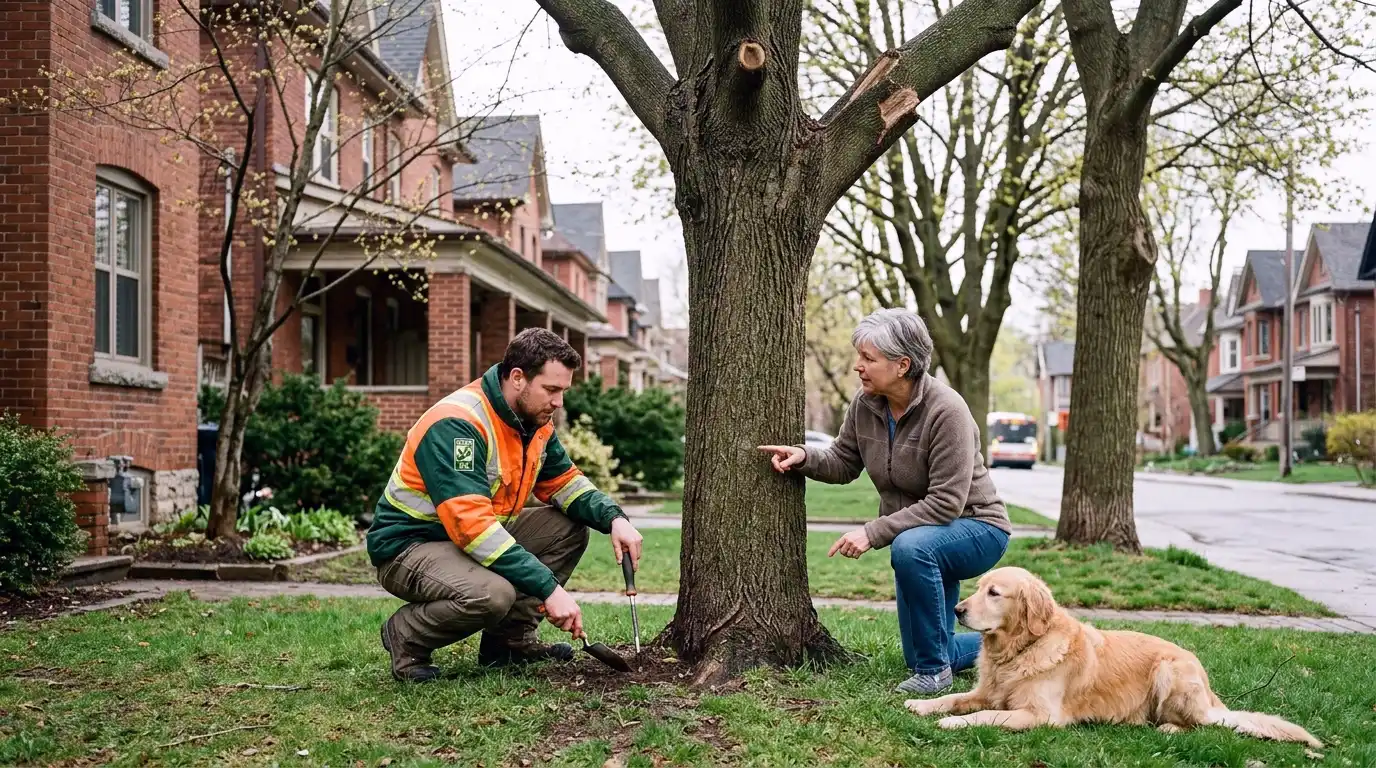
If a tree has no visible leaf buds anywhere by late spring and a careful scratch test shows dry brown tissue throughout, it may be dead. Full failure to leaf out can result from severe root damage, drought stress from the previous season, construction impact, disease, pest damage, or winter injury. A dead tree can become more brittle over time, so it should not be ignored if it is near people, buildings, driveways, fences, sidewalks, or wires.
Toronto’s rules are more nuanced than many homeowners expect. Routine private-tree pruning carried out according to good arboricultural practice does not require a permit. A tree that is 100% dead, terminally diseased or imminently hazardous may qualify for the City’s permit-exception process, while a protected tree that is merely declining or in poor condition may still require a permit. Emerald Ash Borer infestation alone should not be treated as an automatic no-permit rule.
What to Do With Trees You Are Not Sure About
After a spring inspection, many property owners find trees that are not clearly healthy and not clearly dead. A maple may leaf out sparsely. An oak may have one dead section but healthy growth elsewhere. A spruce may show browning at the tips. These are the cases where guessing can be expensive. Removal may be unnecessary, but waiting too long may also create risk.
A qualified arborist may assess crown density, branch structure, trunk defects, root flare condition, insect activity, fungal signs, decay indicators, and site stress. The qualified professional may discuss monitoring, pruning, treatment, risk reduction, or removal options.
The goal of a spring review is not automatically removal. It is triage. Some trees need no work. Some need selective pruning. Some need monitoring. A smaller number may need removal or permit-related review. Getting that picture in spring gives the property owner more time to make informed decisions before storm season.
Spring Tree Care in Toronto: Spring Inspection and Tree Care Costs
Costs can vary widely depending on the property, number of trees, access, tree size, urgency, whether a written report is needed, whether permit-related documents are requested, and whether the visit is only visual or more detailed.
A qualified arborist or tree care professional should explain their own fees, site visit terms, written report costs, work estimates, scheduling, payment terms, insurance, WSIB status, and what is included. Property owners should confirm all costs and service details directly before approving any work.
Official Toronto Resources for Spring Tree Concerns
- City of Toronto: Tree and Ravine Protection
- City of Toronto: When to Apply for a Tree or Ravine Permit
- 311 Toronto: Private Tree and Ravine Permit Exceptions
- 311 Toronto: Hazardous or Dangerous Trees
- City of Toronto: Emerald Ash Borer
- ISA: Find an Arborist
Frequently Asked Questions
When is the best time to prune trees in Toronto?
Late winter to early spring is often a useful window for many deciduous trees in Toronto because structure is easier to see before full leaf-out. Timing can vary by species, disease risk, tree condition, and site conditions. A qualified arborist or qualified tree care professional should confirm the appropriate pruning approach.
How do I know if a branch is dead or just slow to leaf out?
A small scratch test can sometimes help. If the tissue under the bark is green, the branch may still be alive. If it is brown, dry, and brittle, the branch may be dead. Dead, hanging, or cracked branches in the canopy should be reviewed by a qualified tree care professional where safety is a concern.
Does spring pruning need a permit in Toronto?
Routine pruning on a private tree is different from injuring or removing a bylaw-protected tree. City-owned trees, ravine-area trees, protected private trees, and work that may injure a protected tree can involve City rules. Property owners should check official City guidance before major pruning, root work, or removal.
How do I check my ash tree for Emerald Ash Borer?
Common signs can include D-shaped exit holes, S-shaped galleries under loose bark, crown dieback, bark splitting, woodpecker activity, and shoots growing from the trunk or major branches. Emerald Ash Borer infestation does not create a blanket Toronto permit exemption. A protected ash that is dead, terminally diseased or imminently hazardous may qualify for the City’s permit-exception process; otherwise ordinary permit rules can still apply.
Related Guides
- Dead Tree Permit Toronto
- Signs Your Tree Is Dead or Dying
- Tree Removal Permit Toronto
- Tree Pruning Cost Toronto
- Tree Pruning Requests