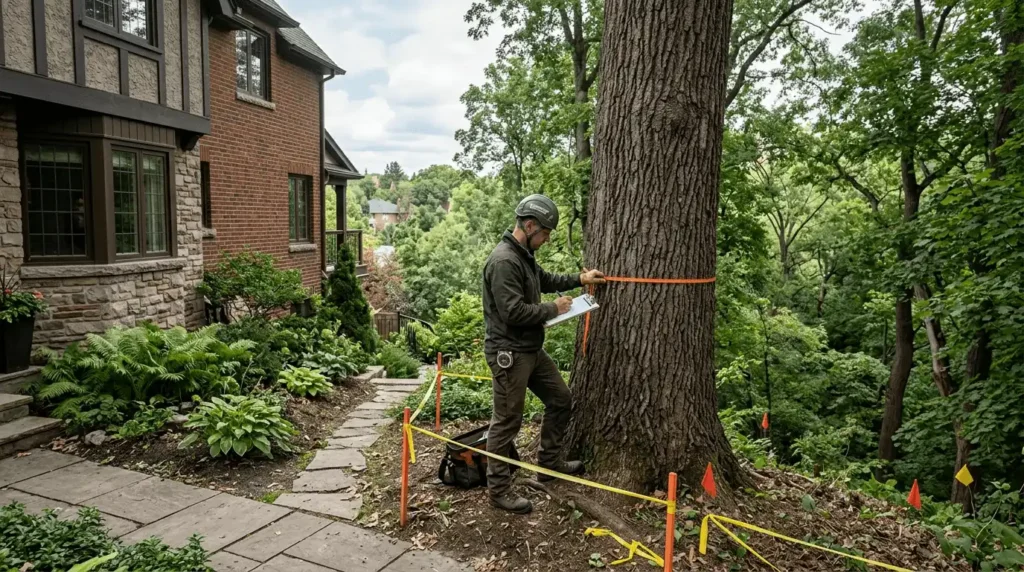
Toronto tree bylaw rules currently protect private trees that are 30 cm or more in diameter at breast height, measured 1.4 metres above the ground. City street trees are protected at any size, and trees in protected ravines and natural features follow separate rules. If work could injure or remove a protected tree, the safest starting point is to confirm ownership, measure the tree correctly and check the City of Toronto permit requirements before work begins.
Quick answer: A permit may be required when a protected private tree will be removed or injured, when work affects a City-owned street tree, or when a property is within a protected ravine or natural feature. Good-practice pruning of a private tree does not normally require a permit, but improper pruning, root cutting, excavation or other work that injures a protected tree can still fall under the bylaw.
Which Toronto trees are protected right now?
The City of Toronto’s current private-tree threshold is 30 cm DBH. DBH means diameter at breast height. For Toronto’s permit rules, the measurement point is 1.4 metres above ground level. A private tree at or above that threshold is protected from injury or removal unless the work is authorized or a valid exception applies.
Multi-stem trees need extra care when measuring. The City says the largest stem is used to determine the size of a multi-stemmed tree. If at least one stem is 30 cm or more in diameter, the tree, including all stems, is protected.
Street trees are different. A tree on a City street or road allowance is protected regardless of its size. A tree that looks as if it sits in a front yard can still be within the public road allowance, so ownership should be confirmed before a contractor is asked to prune or remove it. The City advises homeowners to use a property survey when available or contact 311 when ownership is uncertain.
Ravines and natural features also have broader protection. In a designated Ravine and Natural Feature Protection area, trees of all sizes can be regulated, along with activities such as grading, excavation, dumping fill, building structures or changing the natural topography.
How to measure DBH for the Toronto tree bylaw
You do not need specialized equipment to make a preliminary DBH check. Use a measuring tape and measure 1.4 metres up the trunk from ground level. At that point, wrap the tape around the trunk to get the circumference. Divide the circumference in centimetres by 3.14. The result is the approximate DBH.
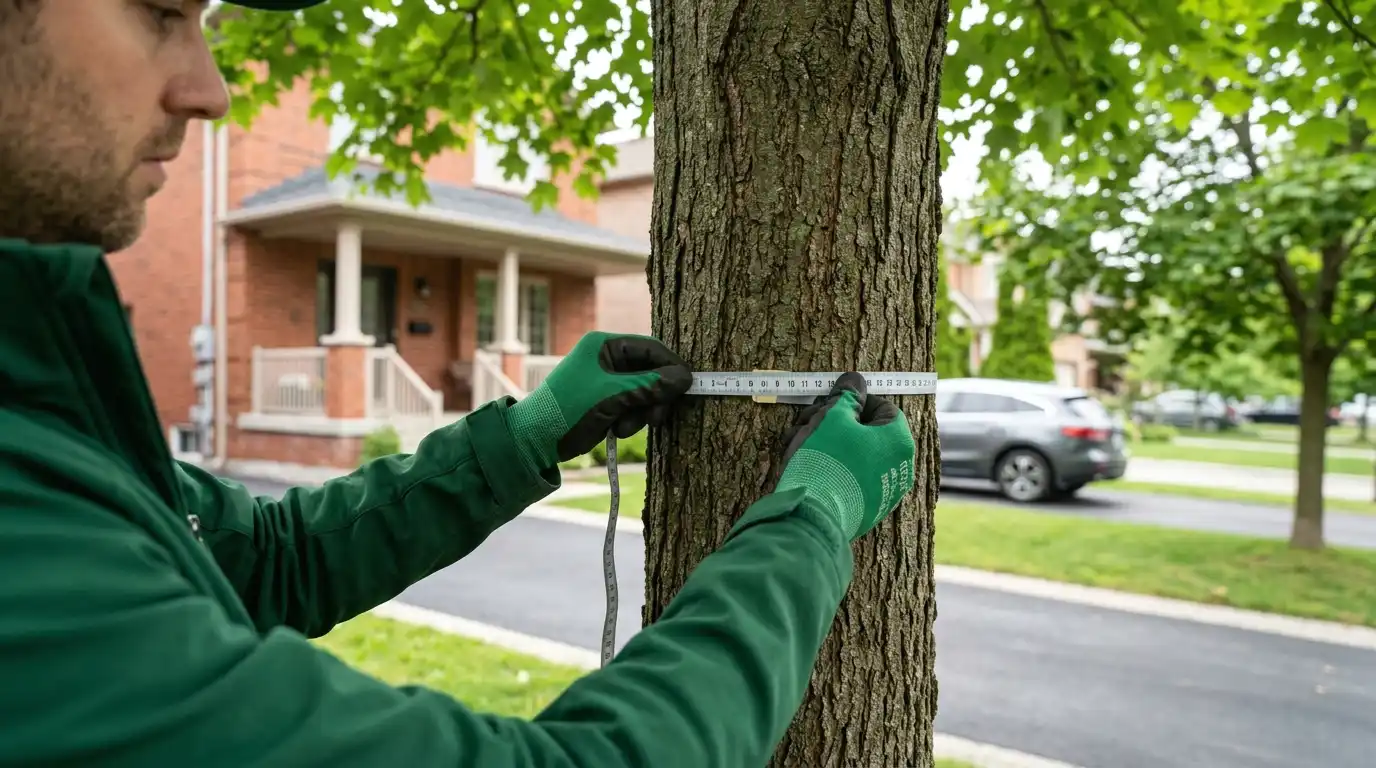
For example, a trunk circumference of about 94.2 cm works out to roughly 30 cm DBH. If your measurement is close to the threshold, do not treat a quick homeowner measurement as the final word for permit planning. An arborist can document the tree size and condition more precisely when a permit, construction project or ownership issue is involved.
The official City instructions for protected trees and DBH measurement are on the When to Apply for a Tree or Ravine Permit page.
The 30 cm threshold is still the current private-tree rule
There has been public discussion about lowering Toronto’s private-tree protection threshold, which can make older summaries confusing. As of August 2026, the current private-tree threshold remains 30 cm DBH.
City Council endorsed in principle a possible reduction from 30 cm to 20 cm in 2027, but that is not the current rule. Council directed staff to report back in 2027 with analysis, an implementation strategy and any proposed amendments. Homeowners should therefore avoid treating the proposed 20 cm threshold as if it is already in force.
A separate change is much closer. The City has announced a new Distinctive Tree category for healthy private trees over 61 cm DBH, effective September 1, 2026. That change is intended to give additional consideration to Toronto’s largest healthy private trees during permit review. Because bylaw details can change, always confirm the current City page before acting on an older article, estimate or social-media post.
Pruning is not the same as injuring a protected tree
Routine pruning done according to good arboricultural practice does not require a private-tree permit simply because a tree is large. That does not mean every cut is automatically allowed. The City identifies excessive canopy removal, improper pruning, root damage and other harmful activity as potential tree injury.
This distinction matters during renovations and landscaping. A project can injure a tree without removing the trunk. Excavation, trenching, grading, equipment traffic, material storage and root cutting within a tree protection zone can all affect a protected tree. If construction will enter a protected tree’s Tree Protection Zone, the City may require a permit or tree-protection documentation even when the tree is intended to remain.
For pruning questions, see the Tree Pruning & Trimming service information. For construction-related documentation, the Arborist Reports page explains the type of professional support a property owner may need.
City street trees, boundary trees and neighbour trees need extra care
Do not assume that a tree is privately owned because its trunk appears close to your lawn, driveway or front walk. Toronto street-tree ownership is based on where the base of the trunk sits in relation to the City road allowance and property line. All work on City-owned trees must be authorized by the City.
Boundary and neighbour trees create a different issue. The City’s permit process does not decide private ownership disputes or give someone permission to enter another person’s property. If a trunk crosses a property line, or if a tree is owned by a neighbour but branches or roots affect your property, consent and civil property rights can matter in addition to municipal tree rules.
Where ownership is unclear, confirm the property line before planning removal. A survey can be important, and the City may require an up-to-date survey in a disputed boundary-tree situation.
When a permit exception may apply
The City distinguishes a permit exception from an ordinary removal permit. The current guidance includes exceptions for an imminently hazardous tree, a terminally diseased tree that is no longer maintainable and a tree that is 100 per cent dead.
For a dead tree, the City states that a permit is not required, but its guidance still explains how to request permit-exception confirmation. For imminently hazardous or terminally diseased trees, the City asks for tree details such as size, species, condition, photographs and general location so Urban Forestry can review the situation.
Immediate danger is different from a routine concern. If work is required right away to eliminate a dangerous situation, safety comes first. Stay clear of unstable trees and branches, keep people away from the hazard and avoid attempting high-risk work yourself. Storm-damaged private trees that are not an imminent hazard can still require a permit when they meet the protected-tree threshold or are in a ravine area.
For urgent private-tree concerns, see Emergency Tree Service. The City’s current storm guidance is available on its Storm Damage to Trees page.
What a Toronto tree permit application can require
A private-tree removal application is more than a short request form. The City says incomplete applications will not be processed. For a protected private tree or City-owned tree, the required package can include an application fee, an arborist report, a landscape and replanting plan and clear colour photographs. Construction-related applications can also require scaled site plans, elevations, tree protection zones and other project drawings.
The arborist report can include the tree’s location, species, size, condition, structural integrity, disease or infestation concerns, health, proposed work and protection measures. The replanting plan identifies where replacement planting is proposed and provides species, size and timing details.
Construction projects can be more involved because the City reviews how work affects nearby protected trees, not just whether a tree is scheduled for removal. Site plans may need to show protected trees on the property and on adjacent properties within the City’s specified distance, together with tree protection zones and hoarding locations.
Current requirements and current fees should be checked directly on the City’s How to Apply for a Tree or Ravine Permit page. The City states that new tree permit applications are submitted through the online application form or in person at a service counter and are no longer accepted by email.
Construction near trees can trigger bylaw issues even when no tree is removed
Home additions, garages, pools, driveways, landscaping, grading and excavation can put roots and soil inside a protected tree’s working area at risk. The City’s Tree Protection Zone is intended to keep damaging activities away from the trunk and root system. Equipment access, stockpiled soil, excavation and temporary construction routes can matter just as much as the final building footprint.
If a project could enter a Tree Protection Zone, involve an arborist early enough to influence the design rather than waiting until construction is ready to start. That gives the property owner a better chance to identify protected trees, adjust access and prepare any tree-protection documents before the project is committed to a layout that conflicts with a mature tree.
What happens if a protected tree is removed without authorization?
Toronto’s tree bylaw has meaningful enforcement consequences. The City’s contravention guidance says a person convicted of an offence can face a minimum fine of $500 per tree and a maximum fine of $100,000 per tree, along with a special fine of $100,000 in applicable circumstances. Courts and City enforcement determine outcomes based on the facts of the case.
The practical lesson is simpler than the penalty schedule: do not remove or injure a tree first and try to sort out the paperwork later. Confirm tree ownership, measure the tree, check ravine status and obtain the appropriate City authorization before non-emergency work begins.
If you are dealing with a possible violation, use the City’s current tree bylaw contravention guidance rather than relying on an old forum post or a neighbour’s recollection.
A practical Toronto homeowner checklist
- Confirm ownership. Determine whether the tree is private, City-owned, a boundary tree or a neighbour tree.
- Measure the trunk. For a private tree, measure DBH at 1.4 metres above ground. If you are close to 30 cm, get a professional measurement before relying on the estimate.
- Check the property location. Ravine and natural-feature protection can apply regardless of tree size.
- Define the proposed work. Removal, root cutting, excavation and heavy construction impacts can be treated differently from normal pruning.
- Document the condition. Clear photographs and an arborist assessment can be important for permit or exception decisions.
- Review current City requirements. Application forms, fees and bylaw details can change.
- Do not start regulated work before authorization. A submitted application is not the same as an issued permit.
When Professional Tree Help Makes Sense
If a protected tree may need pruning, removal or permit-related documentation, confirm the applicable City rules before work begins. For help with the tree-care side of the project, send the property location, a brief description and clear photos through the contact form.
If a protected tree may need removal, see Tree Removal. If you are still trying to understand the permit sequence, the Toronto tree removal permit guide walks through the application process in more detail.
Frequently asked questions about the Toronto tree bylaw
Do I need a permit to remove every private tree in Toronto?
No. The current private-tree size threshold is 30 cm DBH, but other protections can apply based on ownership or location. City street trees are protected at any size, and ravine or natural-feature rules can apply to trees of all sizes in the protected area.
How do I know if my tree is 30 cm DBH?
Measure 1.4 metres up the trunk, measure the circumference at that point and divide the circumference by 3.14. If the result is 30 cm or more, the private tree meets the current protected-tree size threshold.
Is Toronto changing the private-tree threshold to 20 cm?
Not yet. City Council endorsed the idea in principle for 2027 and asked staff for further analysis and an implementation strategy. As of August 2026, the current threshold remains 30 cm DBH.
Do I need a permit to prune a large private tree?
Good-practice pruning intended to maintain tree health does not normally require a permit. Work that excessively removes canopy, damages roots or otherwise injures a protected tree can be regulated.
Can I work on a City street tree in front of my home?
Not without City authorization. The City owns and maintains trees on City property and states that all work on City-owned trees must be authorized.
Does a dead tree need a Toronto tree removal permit?
The City says a permit is not required for a tree that is 100 per cent dead, but it provides a permit-exception confirmation process. Confirm the current City requirements before arranging removal, especially if the tree’s condition or ownership is uncertain.