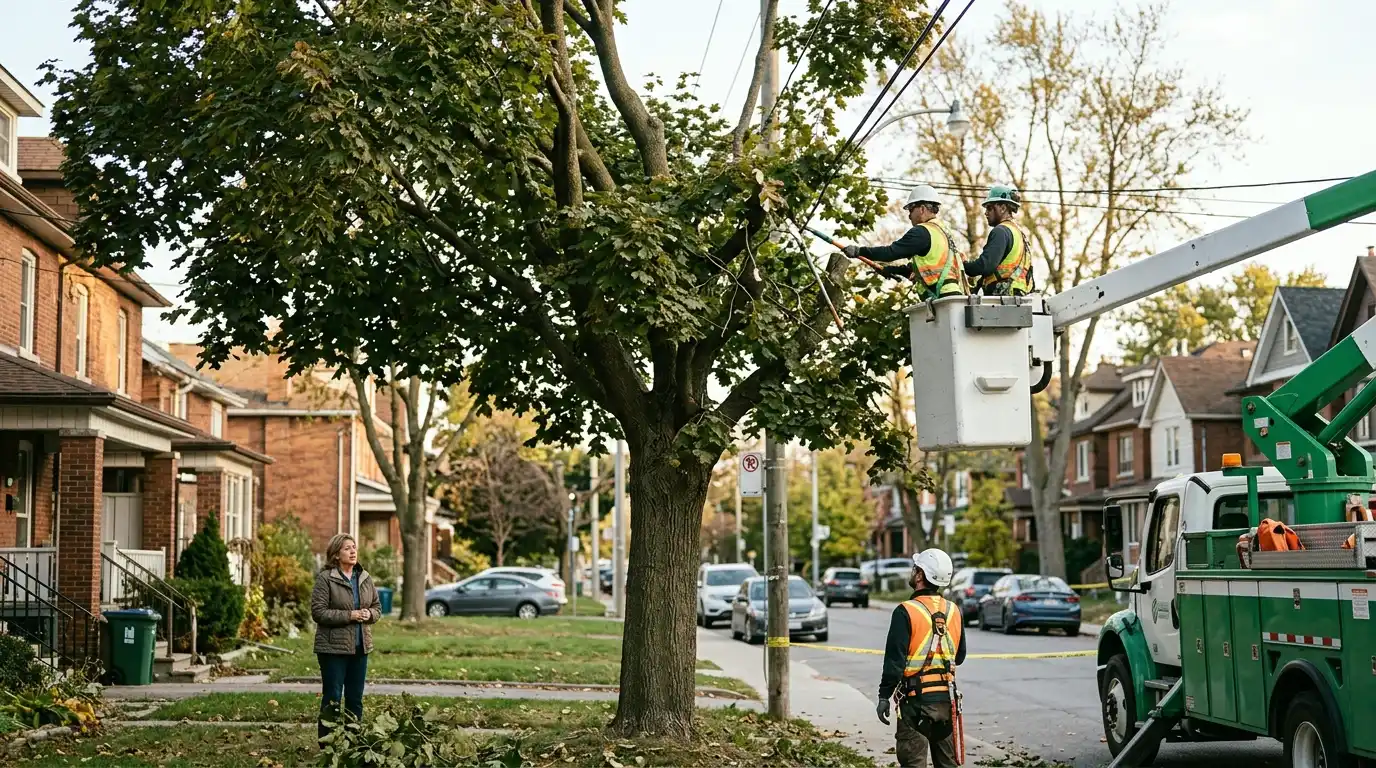
Property owners dealing with tree near power lines in Toronto should first consider tree condition, site constraints and any municipal requirements. Trees touching, leaning toward, or growing close to power lines in Toronto should be handled carefully. Some situations belong with Toronto Hydro or another utility. Some involve a City-owned tree. Some involve a private tree where the homeowner must hire a properly qualified professional. The most important rule is simple: do not prune, pull, climb, or cut any tree or branch near live electrical lines yourself.
Who Owns the Lines: Understanding the System
Most residential power-line issues in Toronto involve local distribution lines. Toronto Hydro operates the local electrical distribution system in the city. Hydro One operates higher-voltage transmission infrastructure and other assets outside the ordinary residential street context.
For a homeowner, the practical question is not only who owns the line. It is also where the tree is rooted, whether the tree is City-owned or private, whether the tree is touching energized equipment, and whether any work would enter a dangerous electrical clearance zone. A tree on private property near a hydro line is not the same as a City boulevard tree touching distribution lines.
If a line is down, sparking, smoking, tangled in a tree, or resting on a branch, keep everyone away and contact the appropriate emergency or utility channel. Toronto Hydro advises staying at least 10 metres away from downed powerlines and treating all downed lines as live.
What Toronto Hydro May and May Not Do
Toronto Hydro manages vegetation around its electrical infrastructure to protect public safety and service reliability. If a tree or branch is touching or threatening distribution equipment, Toronto Hydro may assess the situation and determine the appropriate utility response according to its standards.
That does not mean Toronto Hydro will remove a private tree because a homeowner wants it removed. Utility clearance work is based on electrical safety and infrastructure needs, not general yard preference, shade preference, construction plans, or private landscaping goals.
If the tree is on private property and is near powerlines, Toronto Hydro advises homeowners not to trim it themselves and to hire an arborist to complete that work safely. If the tree is on City property, such as a boulevard or park tree, 311 or the City process may also be involved.
Toronto Hydro’s current responsibility table is more specific: Toronto Hydro handles tree clearance in the public road allowance; on private property, customers are generally responsible around Toronto Hydro-owned lines below 750 V, while Toronto Hydro is responsible around its own lines above 750 V. Customer-owned lines on private property remain the customer’s responsibility. Regardless of ownership, homeowners should not attempt tree work near energized lines themselves.
Never attempt to prune near live power lines yourself. Branches, tools, ladders, ropes, poles, wet ground, fences, and nearby objects can become dangerous around energized lines. Stay back from downed or damaged lines, keep others away, and contact Toronto Hydro, 911, or the appropriate utility channel where immediate danger exists.
Your Responsibility: Trees on Private Property
If a tree is rooted on private property and is growing toward power lines, the property owner may be responsible for managing the tree before it becomes an electrical hazard. The right next step depends on whether the tree is already touching the line, how close the branches are, what type of line is involved, whether the tree is protected by City rules, and whether specialized line-clearance qualifications are required.
Waiting until branches are tangled into live lines can make the situation more dangerous and more complicated. Early review may allow an properly qualified arborist or line-clearance professional to discuss safer options before the issue becomes urgent. However, any work near energized lines must be handled only by properly qualified professionals or under the direction of the relevant utility.
Permit Requirements Still Apply
The presence of power lines does not automatically exempt a tree from Toronto tree permit rules. Toronto identifies private trees with a diameter of 30 cm or more, measured at 1.4 m above ground, as protected. City-owned trees, replacement trees, boundary trees, ravine-area trees, and natural-feature areas may involve additional rules.
If a private tree near lines may be protected, property owners should review official City guidance before removal or major injury to the tree. Proximity to utility infrastructure may be relevant background, but the City decides permit requirements and outcomes.
A qualified arborist may discuss permit-related documents with the property owner.
Need to Send a Tree-Near-Lines Request?
What a Safe Review Should Clarify
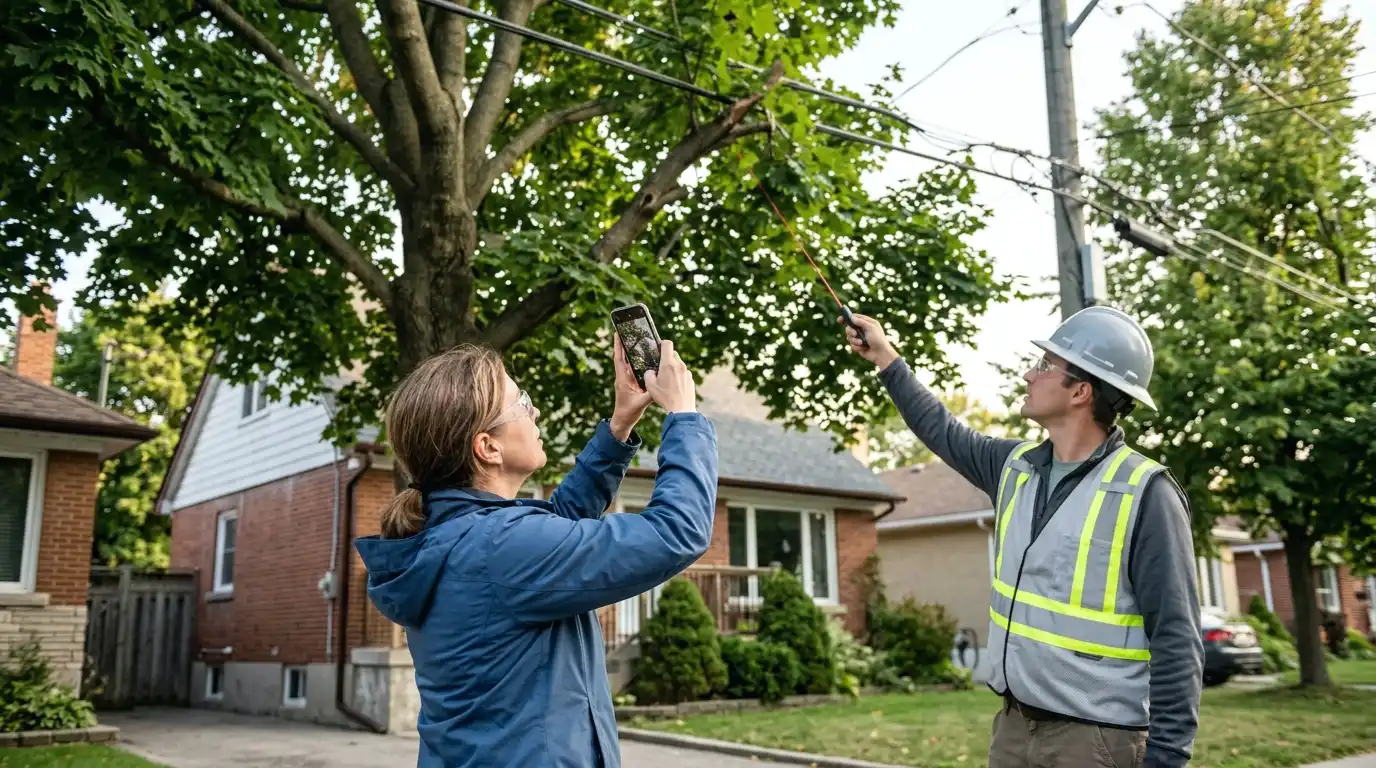
For a private tree near power lines, a proper review should clarify several basic points before any work is approved.
- Line type: whether the concern involves distribution lines, service drops, communication lines, or another utility asset
- Tree ownership: whether the tree is private, City-owned, shared, or near a road allowance
- Electrical clearance: whether the proposed work is within a restricted approach distance or requires utility involvement
- Tree condition: whether the tree can tolerate pruning or whether removal is being considered
- Permit rules: whether the tree may be protected by City tree, ravine, boundary, or replacement-tree rules
- Contractor qualifications: whether the qualified professional is qualified and insured for the exact work being proposed
- Written scope: what work is included, what is excluded, what debris handling is included, and who is responsible for communication with utilities or the City
Property owners should not assume that standard pruning experience is enough for work near energized lines. Ask the qualified professional to explain their qualifications, limits, safety plan, insurance, WSIB status where applicable, and whether the utility must be involved before any work starts.
The Distinction That Matters: Private Tree vs City Tree
Most confusion around power-line trees comes down to location and ownership. A tree rooted on a City boulevard, park, or other City-owned land is not handled the same way as a tree rooted on private property. If the tree is City-owned and damaged, hazardous, or interfering with public infrastructure, the City process or 311 may apply.
A private tree remains the property owner’s responsibility even if branches grow toward the street or utility corridor. Toronto Hydro may trim for electrical clearance where its infrastructure is affected, but that does not convert the tree into a City tree or make Toronto Hydro responsible for all tree care, private removal, stump grinding, cleanup, or landscaping decisions.
If you are unsure where the trunk is located, check your survey, look at property boundaries, or contact the appropriate City or utility channel before approving private work. Do not authorize removal of a tree that may be City-owned or jointly owned without confirming authority first.
Private Lines, Service Drops, and Communication Wires
Not every overhead line is the same. Some wires carry electrical power. Others may be communication lines. A service drop from the street to a house can create different practical concerns than a distribution line along the street. Homeowners should not guess based on appearance.
If a tree is touching any overhead line, treat it cautiously. Keep people away, avoid ladders and tools, and contact the utility or qualified professional before taking action. The qualified professional or utility is responsible for identifying the line type and explaining what work can be done safely and legally.
Cost and Scheduling Factors Near Power Lines
Tree work near lines may cost more than ordinary pruning or removal because the work can involve extra risk, specialized qualifications, utility involvement, limited access, staged work, traffic or sidewalk considerations, permit-related documents, or strict sequencing.
Before approving work, ask whether the price includes pruning only, removal, debris hauling, stump grinding, permit-related documentation, utility communication, cleanup, and any return visit. Get exclusions in writing.
Official Safety and Permit Resources
- Toronto Hydro: Vegetation Management
- Toronto Hydro: Powerline Safety
- Toronto Hydro: Report an Outage or Electrical Emergency
- 311 Toronto: Tree Branches Near Hydro or Utility Wires
- 311 Toronto: Tree and Ravine Permit Applications
- City of Toronto: When to Apply for a Tree or Ravine Permit
- ISA: Find an Arborist
Frequently Asked Questions
Who do I call if a tree is growing into power lines in Toronto?
If a tree or branch is touching or threatening Toronto Hydro lines, contact Toronto Hydro or report the issue through the appropriate utility channel. If the tree is on private property and growing near but not touching lines, Toronto Hydro advises homeowners not to trim it themselves and to hire an arborist.
Will Toronto Hydro remove a tree for free?
Toronto Hydro manages vegetation to protect its electrical system and decides what work is needed based on line safety and utility standards. That is different from a homeowner-requested private tree removal. If the tree is private and removal is wanted for reasons beyond utility clearance, the property owner should confirm responsibility, permits, pricing, and scope directly with the appropriate utility, City, or qualified professional.
Do I need a permit to remove a tree near power lines in Toronto?
Power-line proximity does not automatically remove City tree permit requirements. Toronto protects private trees with a diameter of 30 cm or more, measured at 1.4 m above ground, and City-owned trees have separate rules. Property owners should check official City guidance before removing or injuring a regulated tree.
Is it safe for an arborist to work near live power lines?
Tree work near live power lines requires proper utility-line qualifications, training, equipment, and safe work planning. Standard tree pruning is not the same as line-clearance work. Property owners should confirm directly with the qualified professional, utility, or appropriate authority that any work near energized lines is lawful and safe before proceeding.
Related Guides
- Tree Removal Permit Toronto
- Dead Tree Removal Permit Toronto
- Signs Your Tree Is Dead or Dying
- Emergency Tree Service Requests
- Tree Removal Requests