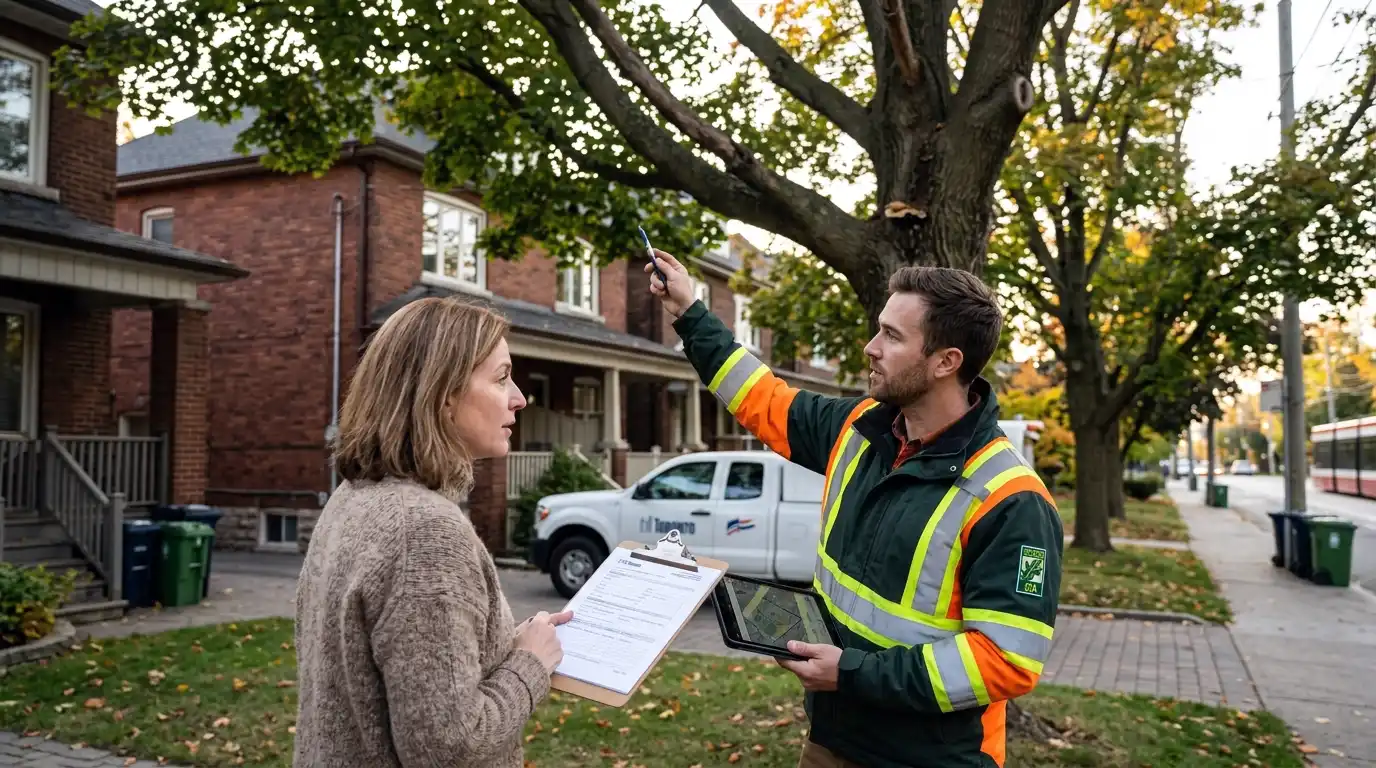
This guide explains the tree removal permit in Toronto, including the approval rules, property conditions and practical steps that can affect the work. To remove or injure a bylaw-protected tree in Toronto, a property owner may need a permit from the City of Toronto. Under Toronto’s private tree rules, a private tree with a diameter of 30 cm or more, measured at 1.4 m above ground level, is protected. The application process can involve an arborist report, photos, replacement planting details, site information, and City review before any work begins.
Toronto Tree Removal Permit: Key Points at a Glance
- Protected private tree threshold: 30 cm diameter measured at 1.4 m above ground
- Governing bylaw: Toronto Municipal Code Chapter 813
- Application items may include an arborist report, photos, replanting details, and site information
- City staff review the application for completeness and may request missing items
- Approved private tree removal permits commonly include replacement planting conditions
- Removing or injuring a bylaw-protected tree without a permit can trigger enforcement action
Does Your Tree Actually Need a Permit?
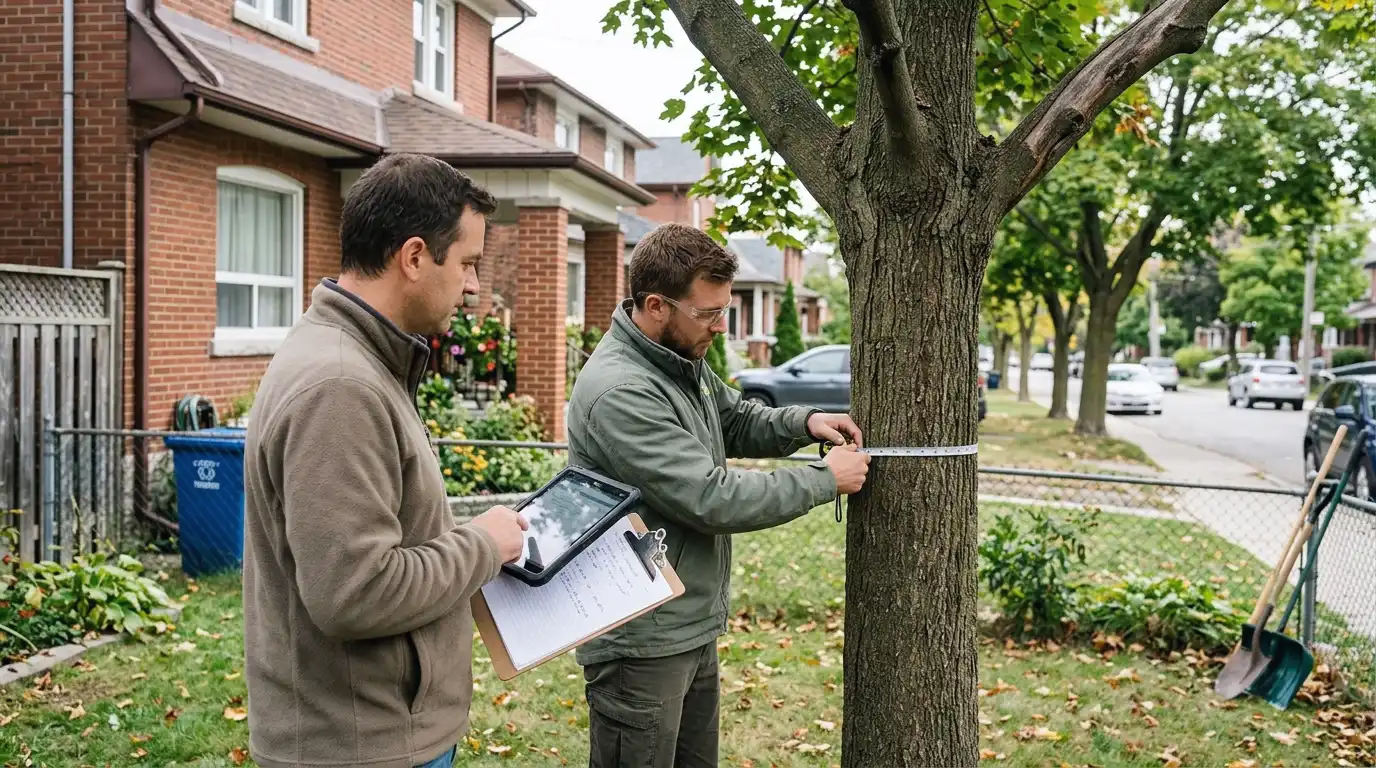
The first thing to figure out is whether the City of Toronto’s tree rules apply to the tree at all. The City identifies private trees with a diameter of 30 cm or more as protected, measured at 1.4 m above ground. This measurement is commonly called DBH, or diameter at breast height.
Many mature trees in established Toronto neighbourhoods such as Leaside, Rosedale, the Annex, Forest Hill, Lawrence Park, the Beaches, East York, High Park, North York, Etobicoke, and Scarborough are over the protected threshold. A tree that looks ordinary from the sidewalk can still measure 30 cm or more when checked properly.
Multi-stem trees require careful measuring. The City provides specific measuring guidance for trees with more than one stem, and where at least one stem measures 30 cm or more, the tree can be protected. Do not rely on a visual guess if the tree is close to the threshold. A qualified arborist may measure and document the tree.
What about street trees and City-owned trees?
Chapter 813 includes rules for City-owned trees as well as private trees. A tree near a sidewalk, curb, boulevard, park, laneway, or road allowance may be City-owned even if it appears to sit close to your lawn. Property owners should not remove, prune, or injure City trees without proper City authorization. If you are concerned about a City-owned tree, contact 311 or follow the City of Toronto’s official process.
Trees near ravines and regulated natural features
If your property is near a ravine, valley corridor, slope, natural feature, or land regulated by a conservation authority, additional requirements may apply. This is common around the Don Valley, Humber River corridor, Highland Creek, Taylor Creek, Rouge-area lands, and other Toronto ravine systems. A property owner should check the City of Toronto’s tree and ravine permit guidance early, especially before construction, excavation, grading, drainage changes, or tree removal.
Step 1: Speak With a Qualified Arborist Early
The City lists an arborist report as one of the required items for many tree removal applications. The report is created by an arborist and can include the tree’s location, species, size, condition, structural integrity, disease, infestations, health, and details related to the proposed work.
A qualified arborist may document why a removal request is being considered, such as serious decline, structural risk, root conflict, construction impact, or property damage concerns. The City decides whether a permit may be issued.
Property owners can search for credentialed arborists through the International Society of Arboriculture Find an Arborist tool. Before hiring an arborist, confirm qualifications, pricing, report scope, site-visit timing, insurance, WSIB status where applicable, and service terms directly with that professional.
Related Services
Step 2: Gather Your Application Documents
A complete Toronto tree removal application can require several items. Missing information can delay review, because City staff may notify the applicant in writing of missing items before the application can move forward.
For a private tree removal request, the City may require the application fee, an arborist report, a landscape and replanting plan, photos, and site information. Construction-related applications may require scaled drawings or additional documents showing existing and proposed structures, driveways, grading, excavation, and trees on or near the property.
If the property is in a ravine-protected area, ravine-specific information may also be required. The applicant is responsible for confirming property boundaries, tree ownership, required documents, fees, and submission requirements with the City. A qualified arborist or qualified consultant may assist, but those services are arranged directly between the property owner and the qualified professional.
Step 3: Submit Your Application Through the City Process
The City of Toronto provides an online application process for permits to injure or remove trees. The City also states that new tree permit applications are no longer accepted by email and must be submitted through the online application form or in person at a service counter.
Before submitting, review the official City application page and check the current application form, current fees, and document requirements. Submission does not guarantee approval. City staff review the package for completeness, may conduct a site visit, and then contact the applicant with next steps.
Keep copies of all submitted material, including the arborist report, photos, drawings, fee confirmation, and City correspondence. Do not schedule removal work until the permit has been issued and all permit conditions have been reviewed.
What the City Looks for When Reviewing Your Application
City staff review whether the application is complete and whether the proposed tree injury or removal may be permitted. They may look at the tree’s location, ownership, size, species, condition, structural integrity, health, surrounding site conditions, replacement planting details, and proposed work.
If the application involves construction, City staff may require additional drawings and site details. If the application involves a boundary or neighbouring tree, notification steps may apply. If the application is denied, the City explains the appeal path through Community Council. Property owners should rely on the City’s current written instructions for exact requirements and timelines.
The City decides whether a permit may be issued. A qualified arborist may provide documentation, but approval is not guaranteed.
Need Help Understanding a Toronto Tree Permit Request?
Replacement Planting: What You May Need to Do
When the City approves a private tree removal permit, replacement planting is commonly part of the permit conditions. The City states that tree removal permits are issued subject to the condition that the applicant plant new trees, and those replacement trees are protected by the bylaw from the time they are planted, regardless of size.
The City application guidance currently references a minimum 50 mm caliper for deciduous replacement trees and a minimum 1.75 to 2.5 m height for coniferous replacement trees. Requirements can change, so applicants should check the City of Toronto page and the permit conditions directly before planting.
If there is not enough space for replacement planting, the City may accept cash-in-lieu of replanting in some cases. The applicant is responsible for confirming current amounts, payment rules, planting requirements, approved species, and deadlines directly with the City.
Dead Trees, Poor-Condition Trees, and Hazardous Trees
Toronto says a permit is not required to remove a tree that is 100% dead, but the City provides a permit-exception confirmation process and advises owners to obtain confirmation before removing or injuring a bylaw-protected tree unless the situation is an emergency. A declining, diseased, partly dead or structurally compromised living tree may still require a permit.
For a completely dead tree, terminally diseased tree, imminently hazardous tree, or ash tree affected by Emerald Ash Borer, property owners should review the City’s permit exception guidance and contact the appropriate City office or 311 where required. The City also states that confirmation should be received before removing or injuring a bylaw-protected tree unless it is an emergency.
Emergency situations: If a tree has fallen, is creating immediate danger, or is near electrical lines, keep people away from the area and contact the proper emergency, utility, or City channel. For dangerous private trees, responsibility generally lies with the property owner, and 311 may create a bylaw enforcement investigation. Any emergency tree work, pricing, documentation, cleanup, and service issues must be handled directly with the qualified tree contractor or qualified arborist.
Common Mistakes That Slow Down or Derail Permit Applications
The most frequent issue is an incomplete application. Missing the arborist report, missing photos, unclear site information, missing replanting details, or confusing tree ownership can cause delays because City staff may request additional information before the application can move forward.
Another common issue is treating a City-owned tree as though it is private. A tree near the curb, sidewalk, front lawn edge, boulevard, park, or road allowance may not belong to the homeowner. If the tree is City-owned, follow the City’s process instead of the private tree process.
Do not assume approval and schedule removal before a permit is issued. Injuring or removing a bylaw-protected tree without a permit can result in enforcement action, including fines of up to $100,000 per tree. City staff may inspect, issue orders, require corrective action, or pursue prosecution.
How Long the Full Process May Take
The full timeline depends on document readiness, arborist availability, whether additional drawings are needed, City completeness review, possible site visits, notification requirements, permit conditions, and contractor scheduling. A simple private tree application may move differently from a construction-related application, boundary-tree issue, ravine-area issue, or City-tree issue.
Start early if tree removal is connected to a renovation, addition, driveway project, landscape project, insurance issue, or sale timeline. Permit-related delays are easier to manage before work starts. Once work has started, a tree bylaw issue can become more expensive and harder to resolve.
More Guides
- Toronto Tree Bylaw Overview
- Tree Removal Cost in Toronto
- Tree Removal Requests
- Arborist Report Requests
Tree Removal Permit in Toronto: Official Toronto Tree Permit Resources
- City of Toronto: Tree and Ravine Protection
- City of Toronto: When to Apply for a Tree or Ravine Permit
- City of Toronto: How to Apply for a Tree or Ravine Permit
- Toronto Municipal Code Chapter 813
- City of Toronto: How to Report a Tree or Ravine Contravention
- ISA: Find an Arborist
Frequently Asked Questions
Do I need a permit to remove a tree on my own property in Toronto?
A permit is generally required to remove or injure a bylaw-protected private tree in Toronto. The City identifies private trees with a diameter of 30 cm or more, measured at 1.4 m above ground, as protected. City-owned trees, ravine-area trees, boundary trees, and replacement trees can involve additional rules.
How long does a tree removal permit take in Toronto?
Permit timing depends on whether the application is complete, whether City staff request missing items, whether a site visit is needed, and whether public or neighbouring-owner notification applies. The City reviews the application, contacts the applicant by email, and issues next steps if the application may proceed. Property owners should check directly with the City for current processing expectations.
Do I need a permit to remove a dead tree in Toronto?
The City states that a permit is not required to remove a 100% dead tree, but property owners should still contact the City or request confirmation before removing a bylaw-protected tree unless there is an emergency. Trees in poor condition are different from completely dead trees and may still require a permit. A qualified arborist may document the tree’s condition.
What happens if I remove a tree without a permit in Toronto?
Injuring or removing a bylaw-protected tree without a permit can result in enforcement action, including fines of up to $100,000 per tree. The City may inspect, issue orders, require corrective action, or pursue prosecution.
Can I get a permit for a tree that is damaging my foundation or house?
Property damage concerns can be part of a permit application, but the City decides whether a permit may be issued. A qualified arborist may document the tree’s species, size, condition, structural issues, and relevant property concerns.
Send Your Toronto Tree Permit Request
Permit Guides for Nearby Cities:
Richmond Hill Tree Services |
Markham Tree Services