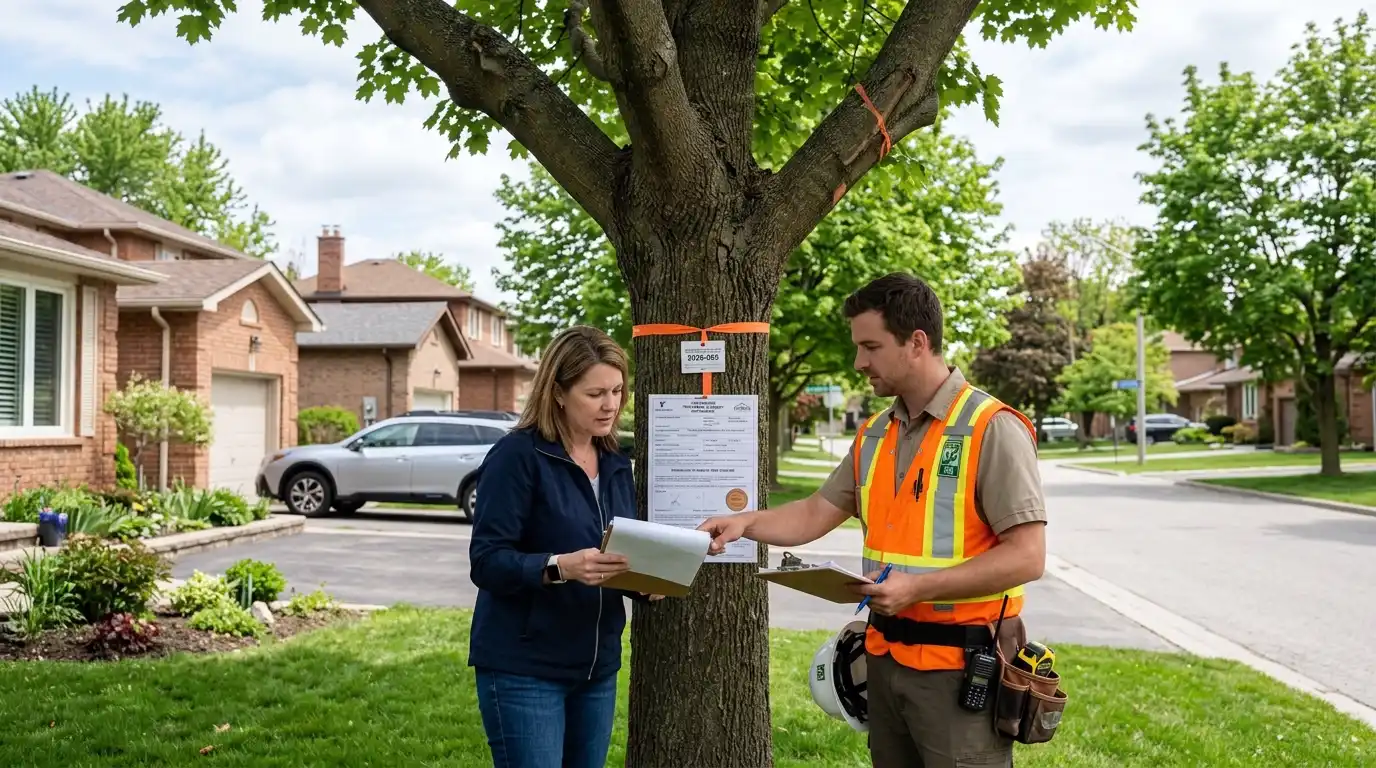
Aurora, Newmarket and York Region each have tree rules that can affect private tree removal, hazardous trees, woodlots, forests, and construction-related work. The important detail is that these rules do not all work the same way. Aurora has its Private Tree Protection By-law, Newmarket has private tree, municipal tree, and woodlot rules, and York Region administers a Forest Conservation By-law for larger treed areas. If you are planning tree removal in Aurora, Newmarket or elsewhere in York Region, you should confirm which layer applies before cutting begins.
For property owners farther north in York Region, the tree services in King City and King Township guide adds local service and property context.
Quick Reference: Tree Permits in Aurora, Newmarket and York Region
- Aurora: Private Tree Protection By-law regulates tree cutting and injury on private property. Aurora allows two trees per 0.25 ha of property to be removed in a 12-month period without a permit, but heritage-tree and heritage-district rules can still apply.
- Newmarket: Private trees greater than 20 cm in diameter, measured at 1.4 m above ground, require a permit before removal.
- York Region: Forest Conservation By-law generally requires a permit before trees are injured or removed from treed areas greater than 0.2 ha, with specific local-municipality notes for Aurora and Newmarket.
- Arborist report: May be required depending on the municipality, tree condition, hazard status, woodlot status, and application type.
- Regional resource: York Region Tree Cutting Permits
Aurora regulates the cutting and injuring of trees on private property through its Private Tree Protection By-law. The Town says the by-law helps preserve Aurora’s urban tree canopy and applies to private-property tree cutting and injury in specific circumstances.
Aurora uses a count-and-size structure rather than one simple diameter threshold. The Town says up to two trees over 20 cm can generally be removed within a 12-month period without a permit on a property under 0.25 ha, with a proportional allowance for larger properties. A permit is required for one or more trees larger than 70 cm DBH, and for a heritage tree or a tree in a designated heritage district.
Aurora’s established communities, including Aurora Village, Aurora Heights, Hunters Glen, Kennedy Street, Bayview, Wellington, and nearby residential pockets, contain mature canopy where tree questions can come up during removal, renovation, lot clearing, or landscaping planning.
How to apply for a tree permit in Aurora
Property owners should contact the Town of Aurora to confirm current application requirements before removing trees. Aurora says the typical processing time for a complete application is 30 days, but the timeline can be affected if extra information is required or if the tree permit application is reviewed with other development applications.
Construction and renovation projects in Aurora
If you are planning a construction, renovation, grading, driveway, pool, deck, or landscaping project near established trees in Aurora, confirm tree requirements early. Tree questions can affect design, timing, access, and permit planning. Do not assume that a building or landscaping project can proceed without checking tree rules first.
A qualified arborist may discuss whether tree-related documentation is needed for a specific project.
Tree Removal Permits in Newmarket
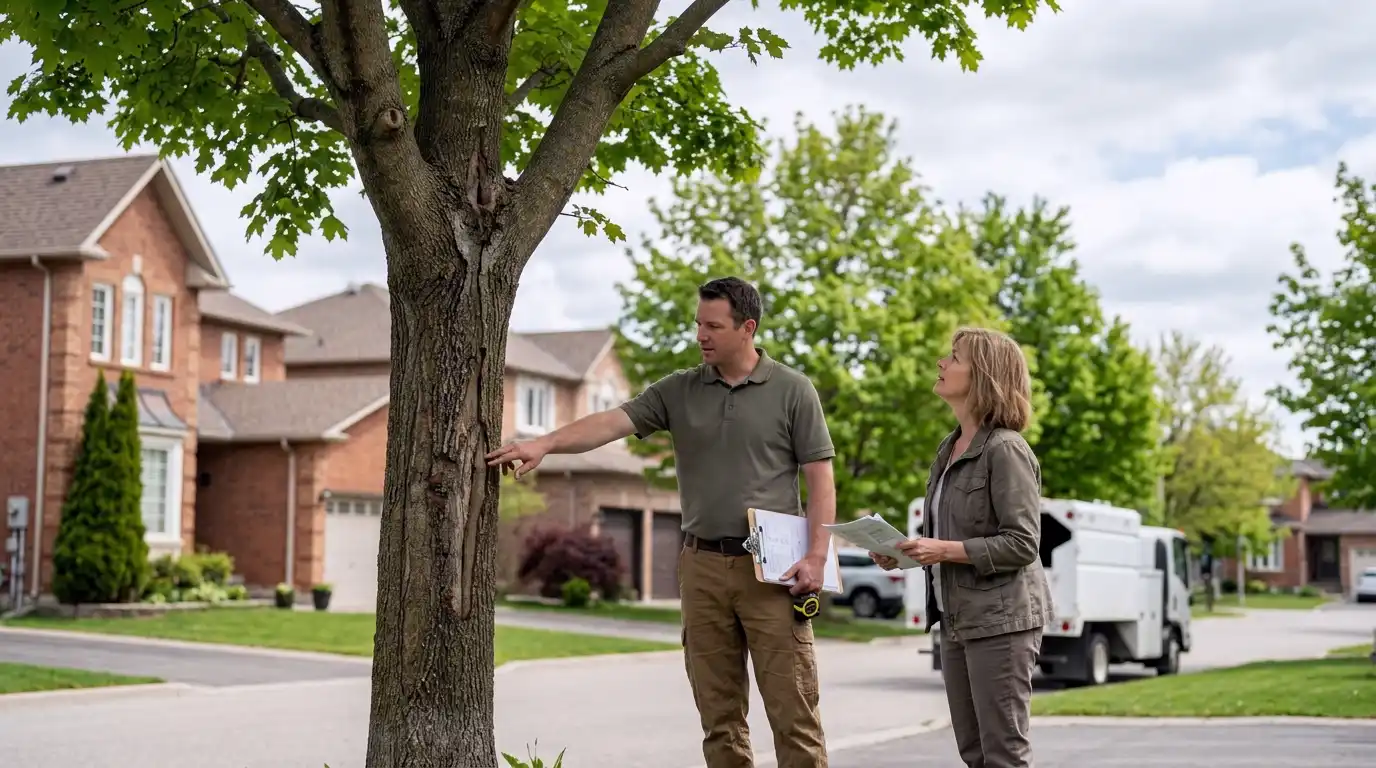
Newmarket has clear private-tree rules. The Town states that property owners are required to obtain a permit to remove trees on private property that have a diameter equal to or greater than 20 cm, or 8 inches, measured at 1.4 m above ground. Removing, destroying, or injuring a private tree without a permit can result in fines, fees, and compensation.
Newmarket communities including Glenway, Bristol-London, Stonehaven, Central Newmarket, Gorham-College Manor, Summerhill, Huron Heights, and neighbourhoods near Yonge Street and Davis Drive can include mature private trees, Town-owned boulevard trees, and regulated woodlot areas. Before cutting, confirm whether the tree is private, Town-owned, hazardous, dead or dying, emergency-related, or part of a regulated woodlot.
How to apply for a tree permit in Newmarket
Newmarket says regulated private trees are trees equal to or greater than 20 cm DBH, measured at 1.4 m above ground. To remove a regulated tree, the Town says property owners need a Private Tree Removal Permit, an arborist report by an ISA or MTCU Certified Arborist, applicable fees, and replacement requirements set by the Town.
Newmarket has separate rules for dead or dying trees, hazardous trees, and emergency trees. The Town says dead or dying trees still need a Private Tree Removal Permit, but they do not require an arborist report, fee payment, or replacement requirements. Hazardous trees require a Private Tree Removal Permit and an arborist report, but the Town says there are no fees or replacement requirements for hazardous trees. Emergency tree cases have a separate urgent-notification process through the Town.
York Region’s Forest Conservation By-law
York Region’s Forest Conservation By-law protects forests in York Region. York Region says landowners require a permit before trees can be removed from treed areas greater than 0.2 ha, or 0.5 acres, and that a permit must be obtained before any trees are injured or removed in those regulated areas.
The regional rule is different from a municipal private-tree by-law. A municipal by-law may regulate a single private tree by diameter, while York Region’s Forest Conservation By-law focuses on treed areas and forest conservation. If your property contains or is near a forested area, woodlot, valley land, rural-residential treed area, or larger natural feature, you should check York Region requirements as well as the local municipality.
York Region also notes an important local distinction: its Forest Conservation By-law does not apply to treed areas less than one hectare in Aurora or Newmarket. However, Aurora and Newmarket both have local by-laws protecting trees in smaller areas and should be contacted before cutting any tree.
Start with York Region’s tree cutting permit page and the relevant local municipality before arranging tree work.
Need to Check Tree Permit Rules in Aurora, Newmarket or York Region?
When Both Municipal and Regional Rules Apply
The complicated situation is when a property has both local municipal tree rules and regional forest or woodlot rules. In Newmarket, for example, private trees equal to or greater than 20 cm DBH may trigger the Private Tree Protection By-law, while certain dense wooded areas may be regulated by Newmarket’s Woodlot By-law. Newmarket says its Woodlot By-law protects small urban woodlots between 0.2 ha and 1.0 ha on privately owned lands, while woodlots greater than 1.0 ha fall under York Region’s Forest Conservation By-law.
In Aurora, local private-tree rules apply, and York Region specifically advises property owners to contact the Town because local by-laws protect trees in areas less than one hectare. For larger treed areas or forest conditions, York Region may also need to be checked.
The safest path is to confirm the local municipal rule first, then check whether York Region’s Forest Conservation By-law or any conservation, moraine, or development-related rules also apply. If multiple reviews are needed, expect a longer timeline.
The Oak Ridges Moraine
Parts of Aurora, King Township, and areas north of Newmarket are within or near the Oak Ridges Moraine. The Moraine is a protected provincial landform with land-use rules that can affect development, grading, drainage, vegetation, and tree-related decisions in certain areas.
If your property is in or near a Moraine designation, rural-residential area, valley corridor, conservation-regulated area, or natural heritage feature, tree removal should not be treated as a simple landscaping decision. Confirm the applicable municipal, regional, conservation authority, and provincial context before work begins.
Planning Your Timeline in Aurora and Newmarket
Application timing depends on the municipality, the tree condition, whether an arborist report is needed, whether the file is complete, whether an inspection is required, and whether municipal, woodlot, or regional rules overlap.
Aurora states that typical processing time for a complete tree permit application is 30 days, but additional information or development-related review can affect the timeline. Newmarket says review timing depends on application complexity. York Region’s Good Forestry Practices Permit application must be sent at least 45 days before the desired harvest date, while Special Permit review depends on the affected area and review path.
Start early if the tree decision affects construction, sale timing, safety work, landscaping, grading, or access. Rushed applications are more likely to run into document gaps and delays.
Replacement Planting in Aurora and Newmarket
Replacement planting requirements depend on the municipality, tree type, reason for removal, hazard status, and permit conditions. Newmarket states that regulated tree removals can require replacement requirements, while dead or dying trees do not require replacement requirements, and hazardous trees have no fees or replacement requirements.
For Aurora, replacement or permit conditions should be confirmed directly with the Town as part of the application review. For York Region, permit conditions depend on the permit type and the affected treed area.
Do not assume replacement planting is optional or identical across municipalities. Read the permit conditions carefully and confirm who is responsible for sourcing, planting, watering, and maintaining any replacement trees.
Dead, Dying, Hazardous and Emergency Trees
Dead, dying, hazardous, and emergency trees are handled differently depending on the municipality. Newmarket specifically distinguishes dead or dying trees, hazardous trees, and emergency trees. Dead or dying trees require a Private Tree Removal Permit but do not require an arborist report, fee payment, or replacement requirements. Hazardous trees require a permit and arborist report, with no fees or replacement requirements. Emergency tree situations have a separate urgent-notification process.
Aurora property owners should contact the Town directly when a tree is dead, dangerous, storm damaged, or structurally compromised. York Region should also be checked if the tree is in a regulated forested area or larger treed area.
A qualified arborist or tree care professional may discuss visible hazards, documentation, timing, and next steps.
Hiring a Qualified Tree Care Professional in Aurora or Newmarket
Before hiring anyone for tree work in Aurora, Newmarket or York Region, ask whether permit status has been checked. A careful qualified tree contractor should be willing to pause until local and regional requirements are clear, especially when the tree is mature, near a lot line, in a woodlot, or tied to construction.
Ask the qualified tree contractor or arborist:
- Which municipal or regional by-law may apply?
- Is the tree private, municipal, part of a woodlot, or part of a larger treed area?
- Is an arborist report required?
- Are fees, replacement planting, or compensation requirements expected?
- Are York Region, conservation authority, or Moraine rules relevant?
- Who is responsible for permits, reports, payment, scheduling, cleanup, insurance, WSIB, and communication?
Frequently Asked Questions
Do you need a tree permit in Aurora?
Aurora regulates private-tree cutting and injury under By-law 5850-16. Its permit structure depends on tree count, property size and special categories: trees larger than 70 cm DBH and heritage trees or trees in a heritage district require permit review, while the Town provides a limited two-tree allowance for certain 20–70 cm trees. Confirm the current Town process before removal.
Do you need a tree permit in Newmarket?
Yes, in many cases. Newmarket requires a permit to remove private trees equal to or greater than 20 cm in diameter, measured at 1.4 m above ground. Dead, dying, hazardous, emergency, Town-owned, and woodlot trees have specific rules, so check the Town’s current process before work begins.
Does York Region have its own tree protection rules?
Yes. York Region’s Forest Conservation By-law protects forests and generally requires a permit before removing trees from treed areas greater than 0.2 ha. York Region also notes that local Aurora and Newmarket rules apply to smaller treed areas under one hectare in those municipalities.
How do I apply for a tree permit in Aurora or Newmarket?
Use the process set by the local town. Requirements may include a completed form, tree details, site information, fees, an arborist report where required, and replacement planting information.
What is York Region’s role in tree protection?
York Region administers the Forest Conservation By-law for regulated forested areas and larger treed areas. Its rules may apply separately from local private-tree by-laws, so property owners should check both the local municipality and York Region where forest or woodlot conditions may be involved.
Related Guides and Services
Aurora, Newmarket and York Region Areas Covered
Other Permit Guides:
Toronto |
Richmond Hill |
Vaughan |
Markham |
Brampton