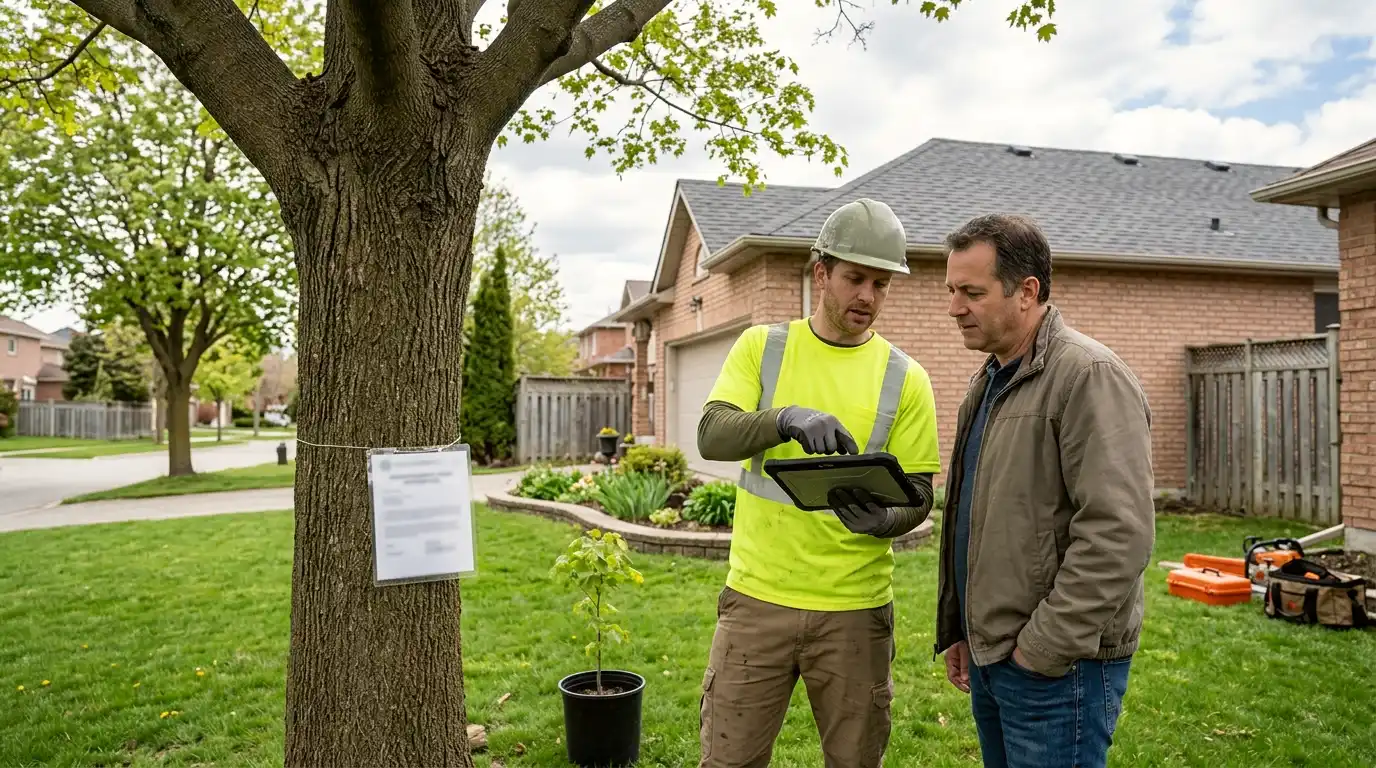
Markham requires property owners to apply for a permit before injuring or destroying any private tree with a trunk diameter of 20 cm or more, measured at 1.37 metres above ground level. This requirement applies regardless of tree health or risk level. York Region forest rules may also apply if the property includes or affects a larger treed area. If you are planning tree removal, heavy pruning, construction, grading, excavation, or work near mature trees in Markham, confirm the current rules before work begins.
Markham Tree Permit – Key Facts
- Current by-law: Markham Tree Preservation By-law 2023-164
- Private tree threshold: 20 cm DBH or greater on private property
- DBH measured at: 1.37 metres above ground level at the base of the tree
- Applies regardless of: Tree health or risk level
- Application fee: Markham states a non-refundable $20.50 processing fee applies to each tree permit application effective January 16, 2026
- Application review: Markham states applications are reviewed within 45 days of payment being received
- Regional forest rule: York Region’s Forest Conservation Bylaw may apply to treed areas greater than 0.2 hectares
- Official resource: City of Markham Tree Permit Application
What DBH Means and How Markham Measures It
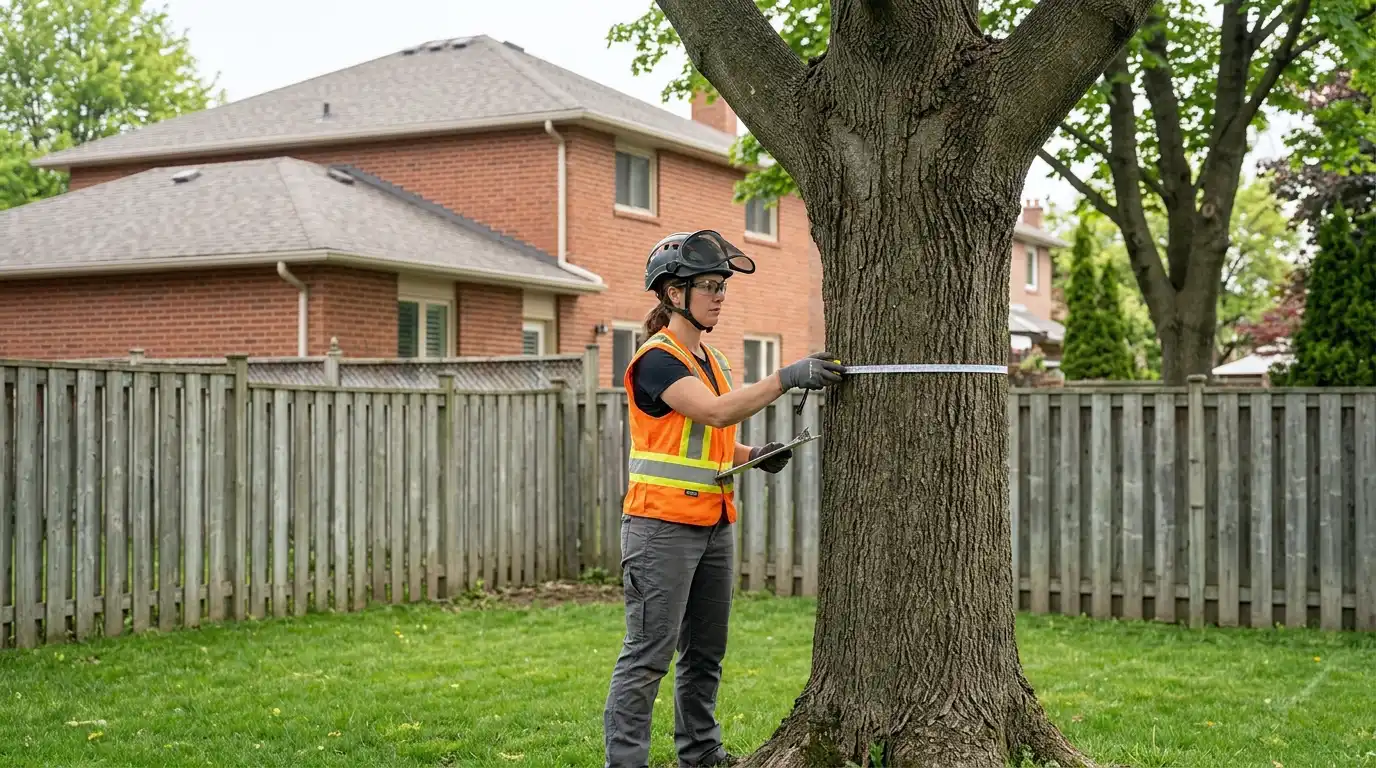
DBH means diameter at breast height. Markham uses this measurement to decide whether a private tree is protected under the Tree Preservation By-law. For Markham tree permit purposes, the City states that the trunk diameter is measured at 1.37 metres above ground level at the base of the tree.
A 20 cm DBH tree is not especially large. Many established trees in Unionville, Cornell, Markham Village, Angus Glen, Berczy Village, Wismer Commons, Cathedraltown, Milliken Mills, Cachet, Raymerville, Greensborough, Box Grove, and Thornhill can exceed this threshold before the homeowner thinks of them as mature canopy trees.
If you are unsure whether a tree meets the 20 cm threshold, do not guess. Measure carefully or speak with a qualified arborist. Getting the measurement wrong can create permit problems, especially if a neighbour reports the removal or the tree is visible from the street.
Markham’s Main Tree Rules
Private trees under the Tree Preservation By-law
Markham’s current public guidance says property owners must apply for a permit before injuring or destroying any private tree with a trunk diameter of 20 cm or more. The City also says this requirement applies regardless of tree health or risk level.
That means dead, dying, hazardous, declining, storm-damaged, and high-risk trees may still require a Markham permit process or supporting documentation. Markham has an expedited review path for high-risk or imminently failing trees, but the City requires a Tree Risk Assessment Report prepared by a Tree Risk Assessment Qualified Arborist for that expedited path.
City-owned trees
City-owned trees are not handled the same way as private trees. A tree on a road allowance, boulevard, park edge, or other municipal land may be a City tree even if it appears close to a private lot. Markham is responsible for City-owned tree maintenance, pruning, and removal. Before cutting or pruning a tree near the front lot line, sidewalk, or road allowance, confirm ownership.
York Region forest rules
Markham is in York Region, and York Region’s Forest Conservation Bylaw can apply to larger treed areas. York Region states that landowners require a permit before removing trees from treed areas greater than 0.2 hectares, or 0.5 acres, and that a permit must be obtained before trees are injured or removed in those regulated areas.
This regional framework is different from Markham’s private-tree threshold. If your property contains or borders a larger forested area, woodlot, valley, natural heritage feature, or dense treed area, check York Region as well as Markham before arranging work.
Forest proximity matters: If your Markham property is near a ravine, creek, forested area, woodland, valley, or natural heritage feature, do not assume only the private-tree permit rule applies. Confirm both Markham and York Region requirements before planning removal, grading, excavation, or construction.
How to Apply for a Tree Removal Permit in Markham
Step 1: Confirm the tree and site details
Start by confirming whether the tree is private or City-owned, whether it is 20 cm DBH or greater, whether it is on or near a property line, and whether the property contains or borders a larger treed area. Trees located on or crossing property lines can require adjacent owner consent under the Forestry Act.
Step 2: Review documentation requirements
Markham’s application may require different supporting documents depending on the tree and reason for removal. The City notes that a Qualified Tree Expert report may be required as a condition of approval. High-risk or imminently failing tree applications require a Tree Risk Assessment Report prepared by a Tree Risk Assessment Qualified Arborist. Construction or development-related projects may require tree-related documents such as a Tree Assessment and Preservation Plan or declaration form prepared by a Qualified Tree Expert.
Step 3: Submit the application and pay on time
Markham says applicants must complete and submit the application form. The City then sends billing information, and payments must be received within 24 hours of the email being received. Applications submitted without timely payment may be cancelled or withdrawn. Markham states that a non-refundable $20.50 processing fee applies to each tree permit application effective January 16, 2026.
Step 4: City review
Markham states that tree permit applications are reviewed within 45 days of payment being received. The City may ask for more information, supporting documents, owner consent, a Qualified Tree Expert report, or additional details depending on the tree, site, risk level, and proposed work.
Step 5: Decision and conditions
After review, the City communicates the application decision using the contact information provided for the property owner. Where a permit is issued and the tree is not classified as a dead or dying tree or hazard tree under the by-law, replacement planting and/or cash-in-lieu may be required. Read the permit conditions before scheduling work.
How Markham Compares to Neighbouring Cities
Markham’s 20 cm private-tree threshold captures more trees than Toronto’s private-tree threshold, which is commonly associated with 30 cm DBH. It captures fewer small trees than some municipalities with lower thresholds. The important point is that Markham uses its own current by-law and measurement height, so homeowners should not apply Toronto, Richmond Hill, Mississauga, Vaughan, or Brampton rules to a Markham property.
Richmond Hill also recently updated its private-tree rules, so older comparison articles can be misleading. If your property is near a municipal boundary, confirm which municipality the tree is actually in before work begins.
The guides for Richmond Hill, Toronto, Mississauga, Vaughan, and Brampton cover those local processes separately.
Need to Check a Markham Tree Permit Request?
Consequences of Removing Without a Permit in Markham
Removing or injuring a protected private tree without a permit can lead to penalties under Markham’s Tree Preservation By-law. City-owned trees, boundary trees, high-risk trees, construction-related tree impacts, and regional forest areas can create additional complications.
Neighbour complaints are a common reason tree removals are investigated. A fresh stump, sudden canopy change, construction disturbance, or visible equipment can attract attention quickly. The property owner should confirm permit status before any qualified tree contractor begins work.
If a violation may have occurred, contact the City and speak with a qualified arborist or qualified professional. Do not try to hide the stump, alter evidence, or rely on verbal assurances from a contractor who did not check the by-law first.
Construction and Renovation Projects in Markham
Construction activity can injure a protected tree even if the tree is not removed. Excavation, trenching, grade changes, driveway work, pool installation, retaining walls, additions, decks, equipment movement, and soil compaction near roots can trigger tree concerns.
Markham notes that tree-related development or construction projects, including certain grading, engineering, housing, demolition, or similar permits, may require a Tree Assessment and Preservation Plan and/or declaration form prepared by a Qualified Tree Expert.
Markham’s Neighbourhoods and Tree Protection in Practice
Markham has a broad mix of older villages, newer subdivisions, commercial corridors, natural heritage systems, and residential streets with maturing canopy. Across Unionville, Markham Village, Cornell, Angus Glen, Berczy Village, Wismer Commons, Cathedraltown, Milliken Mills, Raymerville, Greensborough, Thornhill, Cachet, and Box Grove, many private trees now exceed the 20 cm threshold.
In older areas such as Unionville and Markham Village, trees may be well beyond the threshold and may also have heritage-streetscape, property-line, or construction-access issues. In newer communities, trees planted when subdivisions were built may now be large enough to require a permit even if the homeowner remembers them as young plantings.
Properties near Rouge-connected areas, creek corridors, larger treed blocks, valley lands, and natural heritage features should also check York Region forest rules and other regulatory context before arranging removal.
Replacement Planting and Cash-in-Lieu in Markham
Markham states that where a permit is issued and the tree is not classified as a dead or dying tree or hazard tree under the by-law, replacement planting and/or cash-in-lieu may be required. The exact requirement depends on the tree, application, by-law criteria, and permit conditions.
Do not assume replacement planting is optional. If a permit is issued, review the conditions carefully and confirm who is responsible for sourcing, planting, watering, maintaining, and documenting any replacement trees. If cash-in-lieu applies, confirm the amount and payment process directly with the City.
York Region forest permits can involve separate requirements, including different application types, fees, documentation, and forestry review. If a larger treed area is involved, check York Region’s process before planning removal.
When to Contact a Qualified Arborist for a Markham Project
The right time to contact a qualified arborist is before you finalize project plans. This applies whether you are removing a single private tree, dealing with a hazardous tree, planning excavation near roots, preparing for construction, or reviewing a property with larger treed areas.
A qualified arborist may discuss tree condition, DBH measurement, potential permit requirements, documentation, risk reports, and next steps.
Frequently Asked Questions
Do you need a permit to remove a tree in Markham?
Yes, in many cases. Markham requires property owners to apply for a permit before injuring or destroying any private tree with a trunk diameter of 20 cm or more, measured at 1.37 metres above ground level. The City says this applies regardless of tree health or risk level.
What is the DBH threshold for a tree permit in Markham?
Markham’s private-tree threshold is 20 cm DBH or greater. The City measures this at 1.37 metres above ground level at the base of the tree. City-owned trees and larger treed areas may be handled under separate rules.
How long does a tree permit take in Markham?
Markham states that applications are reviewed within 45 days of payment being received. Timing may be affected by incomplete documents, late payment, extra report requirements, boundary-tree consent, high-risk tree review, construction, or regional forest issues.
Does York Region forest protection affect my Markham property?
It can. York Region’s Forest Conservation Bylaw requires a permit before trees are injured or removed from treed areas greater than 0.2 hectares. If your property contains or borders a larger treed area, check York Region as well as Markham.
What documents are needed for a Markham tree permit application?
Requirements vary by file. Markham may require the application, payment, photos, a Qualified Tree Expert report, Tree Risk Assessment Report for high-risk trees, adjacent owner consent for boundary trees, or tree-related development documents.
Related Guides and Services
- Toronto Permit Guide
- Richmond Hill Permit Guide
- Vaughan Permit Guide
- Brampton Permit Guide
- How Long Does a Permit Take
- Arborist Report Requests
- Markham Tree Requests
Markham Areas Covered by This Guide
Other Permit Guides:
Toronto |
Mississauga |
Vaughan |
Brampton |
Richmond Hill |
Aurora and Newmarket