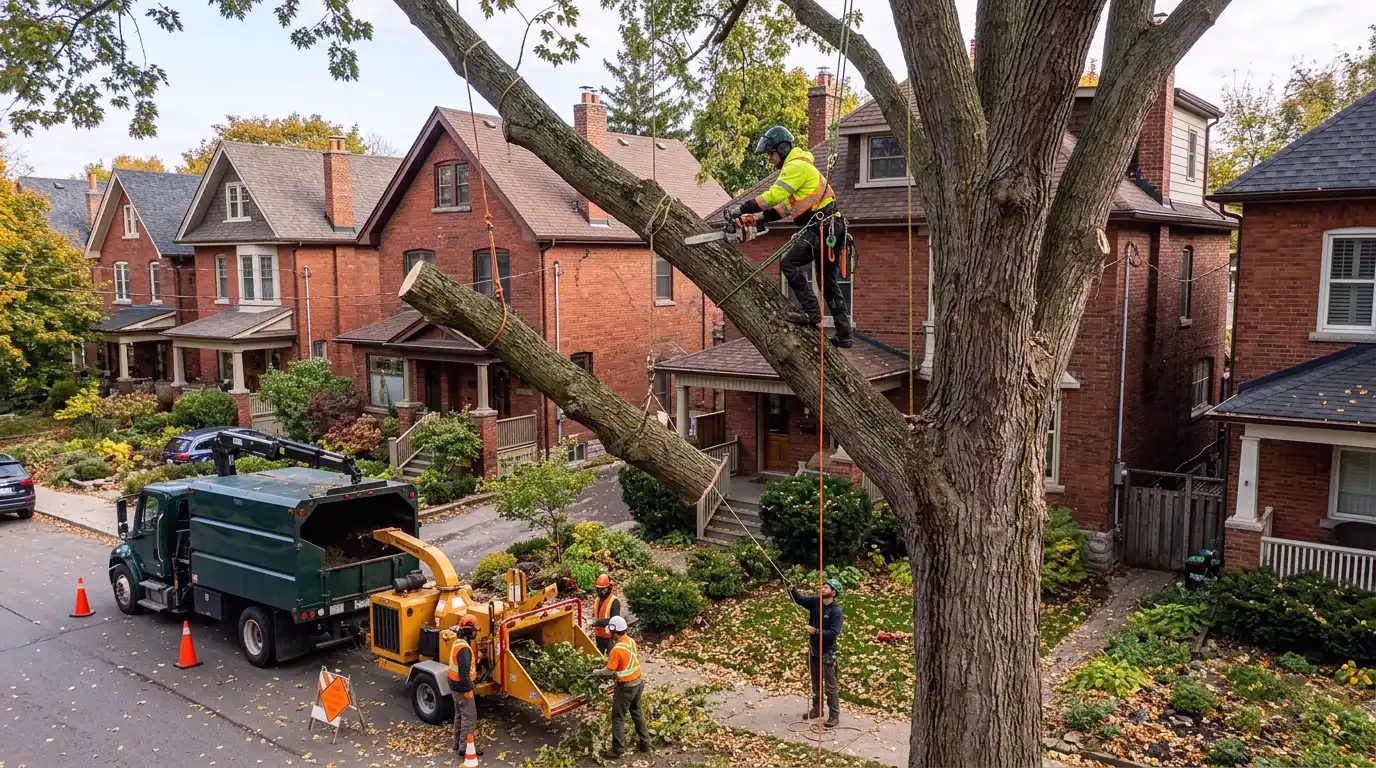
Large tree removal cost in Toronto can vary with tree size, access, risk, required approvals and the exact scope of work. Large tree removal in Toronto commonly falls between about $2,000 and $6,000 for many residential properties, but the final price depends on the qualified tree contractor’s assessment, tree height, access, condition, equipment, risk level, cleanup terms, stump work, and permit-related requirements. Very large trees, trees close to structures, and jobs requiring specialized equipment can cost more.
If the project includes more than one tree, see how multiple tree removal cost in Toronto can differ from a single large-tree removal.
Large Tree Removal Prices in Toronto by Size
Tree removal is priced on a job-by-job basis because no two Toronto properties are identical. A large tree in an open yard is not priced the same way as a large tree over a garage, tight fence line, laneway, hydro service, or neighbouring property. The table below shows general market-style ranges that property owners may encounter when comparing qualified tree contractor quotes.
| Tree Height | Estimated Removal Cost | Notes |
|---|---|---|
| 10 to 15 metres | $1,200 to $2,500 | Often a mid-size to large residential tree |
| 15 to 20 metres | $2,500 to $4,000 | Common large residential hardwood range |
| 20 to 25 metres | $4,000 to $6,500 | Very large maple, oak, ash, or similar tree |
| Over 25 metres | $6,500 to $12,000+ | Exceptional size, difficult access, or high-risk setting |
| Any size, specialized equipment required | Add $1,500 to $3,500+ | May apply to confined yards, crane work, or limited truck access |
These ranges are general estimates only. Stump grinding, debris hauling, log handling, topsoil backfill, replacement planting, permit-related documents, and City or conservation authority fees may be separate. Before approving work, ask the qualified tree contractor to state exactly what is included in writing.
What counts as “large” in Toronto: In removal pricing, a large tree is often one over 15 metres tall or with a trunk over 40 cm in diameter. Many silver maples, Norway maples, oaks, and white ash trees on established Toronto residential lots fall into this range after decades of growth. If your tree shades most of your backyard, it may be in large-tree pricing territory.
Large Tree Removal Cost in Toronto: Why Large Tree Removal Costs More in Toronto
Height takes time
Every extra metre of height can add time, complexity, and debris volume. A climber working high in the canopy may need more rope, more rigging points, and more planned cuts than a smaller tree would require. More height can also mean more branches, heavier trunk sections, and more material to chip, cut, haul, or leave on site depending on the contractor’s quote.
Proximity to structures
This is one of the biggest variables in large-tree pricing. A tree in an open yard is usually less complex than a tree growing over a roof, garage, fence, patio, pool, laneway, neighbour’s yard, or service line. Trees close to structures often require slower sectional work, controlled lowering, and more careful planning by the qualified tree contractor.
Rosedale, Lawrence Park, Forest Hill, Leaside, the Annex, High Park, East York, North York, Etobicoke, and Scarborough all have pockets of mature trees in tight residential settings. The work may be common for experienced tree care professionals, but it is usually more expensive than open-area removal of a similar-sized tree.
Species and wood density
Hardwoods can produce heavier wood than many softwoods of the same height. A large red oak at 20 metres may produce considerably more mass than a similar-height white pine. Heavier wood can mean slower cutting, more careful lowering, more disposal planning, and more time on site.
Root and stump complexity
Large trees usually have large stumps and surface roots. If you want stump grinding after removal, the stump portion may be priced separately. A large stump can cost more than a small stump because grinder access, diameter, root flare, depth, cleanup, and backfill all affect the contractor’s price.
Permit and arborist report considerations
A large tree in Toronto often exceeds the protected private tree threshold. Toronto’s tree rules generally protect private trees that are 30 cm or more in diameter, and City street trees are protected regardless of size. If a tree is protected, City authorization is generally required before injury or removal.
A qualified arborist may discuss whether an arborist report or other permit-related documents are required.
What the Removal Quote Should Cover
A clear written quote from a qualified tree contractor should explain what is included, what is excluded, and what could change the price. For a large tree, ask about these items before approving the job:
- Tree removal scope: felling, sectioning, rigging, lowering, or other methods proposed by the qualified tree contractor
- Debris chipping and hauling: whether brush and branches are removed, chipped, or left on site
- Log handling: whether larger trunk sections are hauled away, left in rounds, or cut into manageable lengths
- Stump grinding: whether it is included or priced separately
- Site cleanup: what level of raking, blowing, debris removal, and yard cleanup is included
- Permit-related items: whether the property owner must arrange reports, City permits, conservation authority review, or replacement planting separately
Watch for quotes that bundle everything into a single lump sum without explaining the scope. If you want to understand what you are paying for and compare options fairly, ask for itemized pricing where possible. The guide on how to read a tree removal quote covers this in more detail.
Large Trees That Commonly Need Removal in Toronto
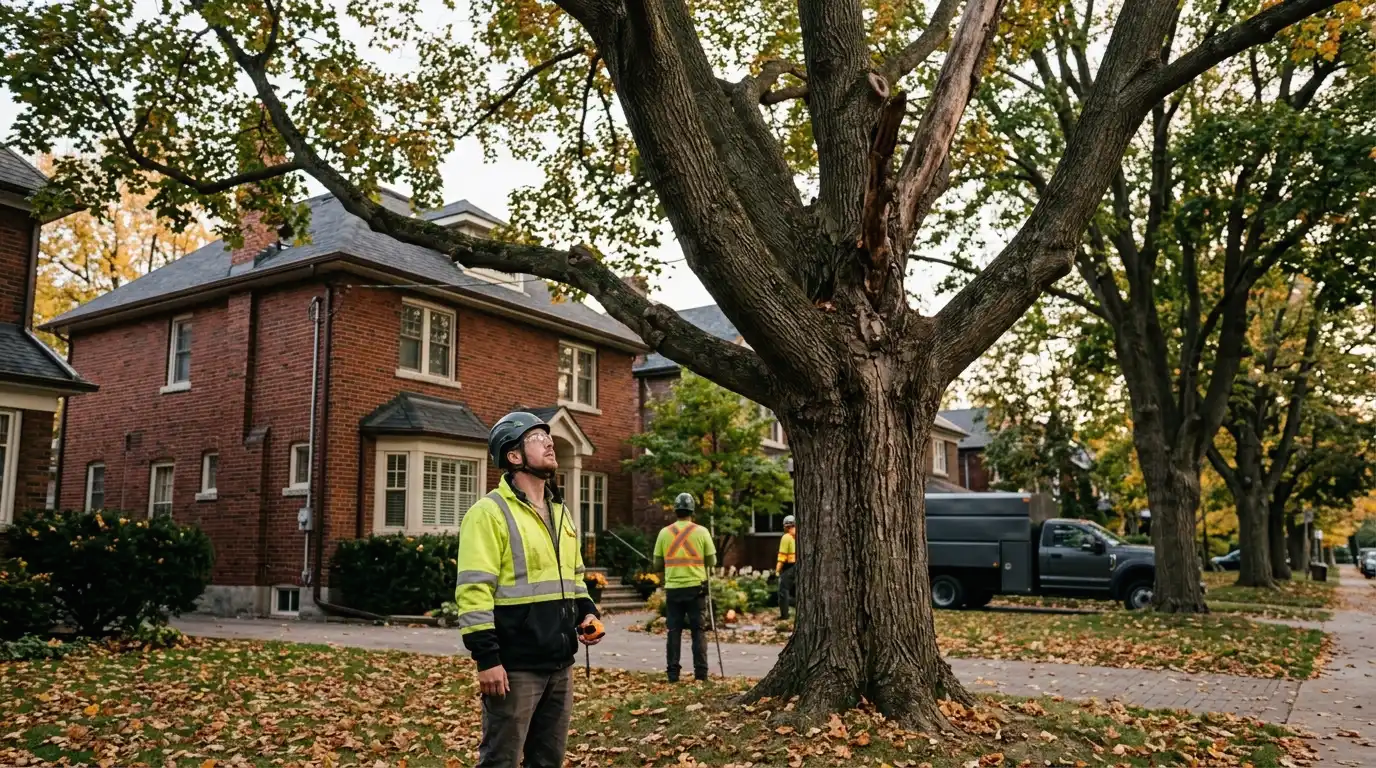
Toronto’s residential tree canopy includes several species that often show up in large-tree removal discussions. The species does not automatically decide whether a tree should be removed, but it can affect weight, decay patterns, brittleness, debris volume, and contractor planning.
Silver maple: Fast-growing and common on older lots. Mature silver maples can develop co-dominant stems, large limbs, decay pockets, or structural concerns over time. Removal can involve multiple large stems and significant debris volume.
Norway maple: Widely planted in past decades and now considered invasive in Ontario. Many Norway maples on residential lots are mature, large, and declining. Property owners should still confirm permit requirements before any removal.
White ash: Many ash trees across Ontario have been affected by Emerald Ash Borer. Dead or declining ash trees can become brittle, which may increase risk and affect how a qualified tree contractor approaches the work.
Manitoba maple: Common in parts of Toronto and often multi-stemmed. Some develop weak branch unions or included bark angles. Multiple stems can increase debris volume and require more careful planning.
Send a Large Tree Removal Request
Does a Large Tree Removal in Toronto Require a Permit?
Often, yes. A tree large enough to fall into large-removal pricing may also be large enough to trigger Toronto’s private tree permit rules. Toronto generally protects private trees that are 30 cm or more in diameter, and City-owned street trees are protected regardless of size. Ravine and natural feature areas can create additional requirements.
If the property is within a TRCA regulated area, related filling, grading, construction or other regulated development activity may require TRCA permission under Ontario Regulation 41/24. That is separate from Toronto’s tree-permit rules, so check the actual proposed activity rather than assuming every tree removal in a regulated area needs a conservation-authority permit.
Removing or injuring a protected tree without proper authorization can result in enforcement, fines, replacement planting requirements, and project delays. The safer approach is to confirm the permit status first, then arrange any removal only after required approvals are clear.
Related Guides:
- Tree Removal Cost in Toronto
- Arborist Report Cost Toronto
- Stump Grinding Cost Toronto
- How to Get a Toronto Tree Permit
- How to Read a Tree Removal Quote
- Tree Removal Requests
Full Budget Breakdown: What to Expect Beyond the Removal Quote
The removal quote may be only part of the total budget when dealing with a large protected tree in Toronto. Depending on the property, tree, permit status, and contractor scope, extra costs may include:
- qualified arborist report: often quoted separately where required
- City of Toronto permit application fee: paid to the City, check the current schedule on toronto.ca
- Tree removal: priced by the qualified tree contractor based on size, access, risk, equipment, and cleanup terms
- Stump grinding: often priced separately for a large stump
- Topsoil or backfill: may be optional or separate after grinding
- Replacement planting: may be required by permit conditions
- Conservation authority review: may be relevant for TRCA regulated areas or ravine-related work
For a large tree, the total all-in cost can be higher than the removal line item alone. Clear written quotes and separate permit-related discussions give property owners the best picture of the real project budget.
Choosing a Qualified Tree Contractor for Large Tree Removal
Large tree removal is high-consequence work. Before hiring anyone, property owners should verify the basics directly with the qualified tree contractor. Do not rely on assumptions, casual promises, or verbal assurances when a large tree is close to a house, garage, fence, wire, neighbour’s property, or public space.
Relevant qualifications: Ask whether an ISA Certified Arborist is involved where assessment, reporting, or tree-risk discussion is needed. Confirm credentials directly with the qualified arborist or contractor.
Liability insurance: Ask the qualified tree contractor for proof of insurance appropriate for tree work.
WSIB status: Ask the qualified tree contractor to confirm WSIB clearance where applicable.
Written quote: Ask for a written, itemized quote that explains removal scope, debris handling, stump grinding, cleanup terms, payment terms, exclusions, and any permit-related assumptions. A vague quote is a weak foundation for a high-risk job.
Frequently Asked Questions
How much does large tree removal cost in Toronto?
Large tree removal in Toronto commonly falls between about $2,000 and $6,000 for many residential jobs, but very large trees, difficult access, tight spaces, or specialized equipment can push the price higher. Confirm all estimates directly with the qualified tree contractor.
What is considered a large tree in Toronto?
For pricing discussion, a large tree is often one over 15 metres tall or with a trunk exceeding 40 cm in diameter. Many mature silver maples, oaks, ash trees, and other established Toronto trees fall into this category after decades of growth.
Does large tree removal in Toronto require a permit?
It often can. Toronto generally protects private trees 30 cm or more in diameter, City-owned street trees regardless of size, and trees or vegetation in ravine and natural feature protected areas. Confirm current requirements directly with the City of Toronto or a qualified arborist before arranging removal.
Why does removing a tree close to a house cost more?
Trees near structures usually require slower sectional work and more careful control around roofs, fences, service lines, landscaping, and neighbouring properties. More time, equipment, risk, and cleanup can increase the qualified tree contractor’s quote.
Is stump grinding included in large tree removal quotes?
Not automatically. Confirm directly with the qualified tree contractor whether stump grinding, debris hauling, log handling, site cleanup, backfill, and replacement planting are included or priced separately.