
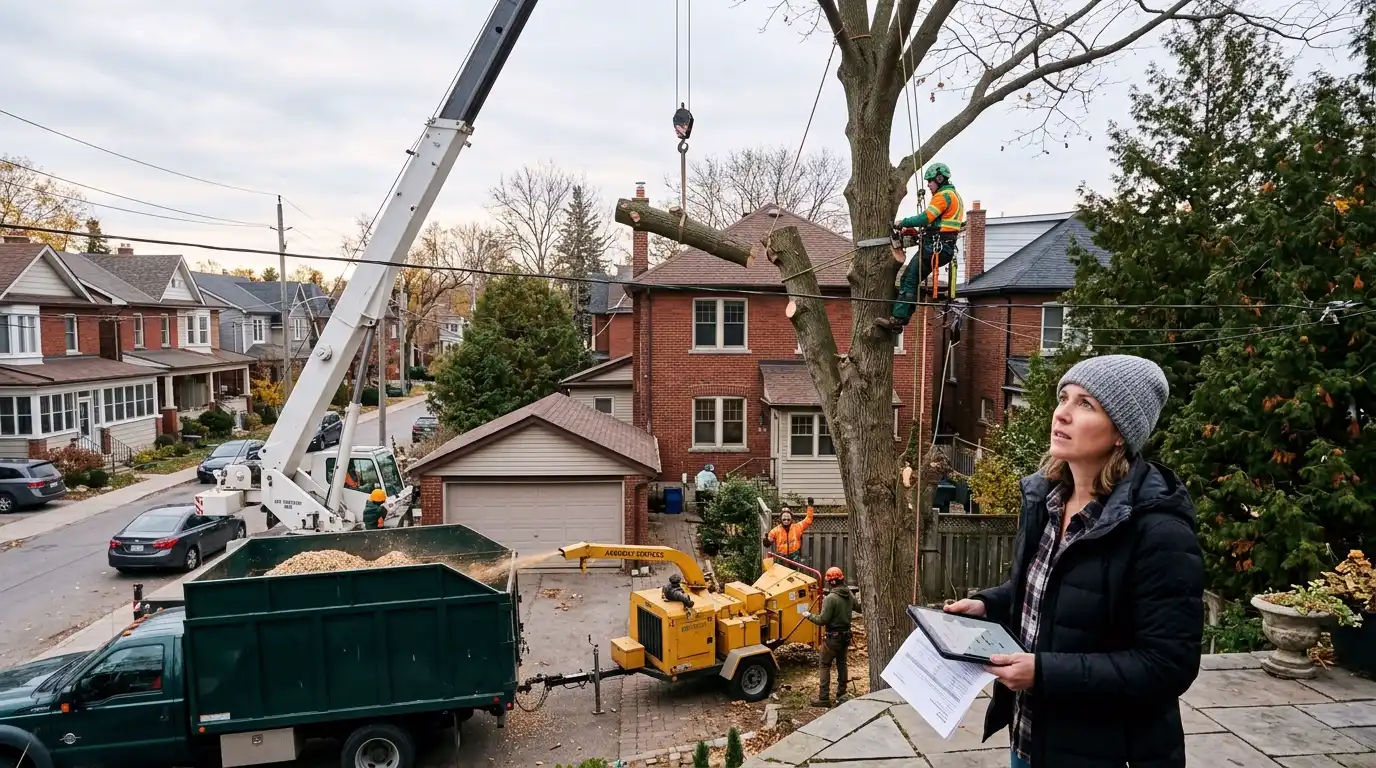
Tree removal cost near a house in Toronto can vary with tree size, access, risk, required approvals and the exact scope of work. Tree removal near a house can cost more than the same tree in an open yard because the work may require controlled rigging, smaller cut sections, limited drop zones, property protection, careful debris movement, and more time from the qualified tree contractor. A tree beside a roof, foundation wall, deck, pool, fence, garage, neighbour’s property, or utility line is not priced only by height. The final cost depends on the actual site, the tree’s condition, access, risk, equipment, stump grinding, permit-related requirements, and qualified tree contractor pricing.
If several trees are involved, the multiple tree removal cost in Toronto guide explains how combined scope can change pricing.
The Core Cost Driver: Rigging Complexity
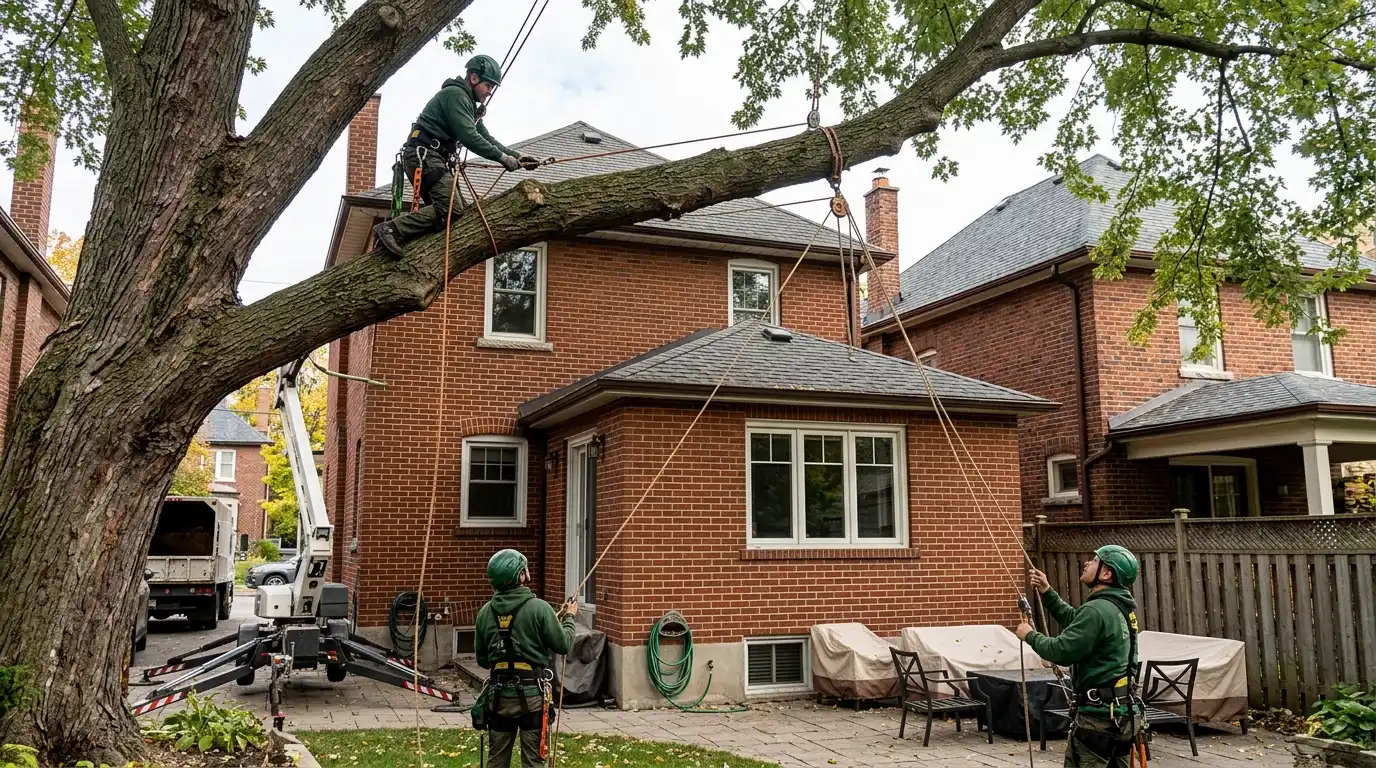
In an open yard, some branches and trunk sections may be cut and dropped into a clear landing area. Near a house, that may not be possible. If the tree overhangs a roof, wall, deck, pool, fence, walkway, or neighbouring yard, the qualified tree contractor may need to secure sections with ropes and lower them in a controlled way.
Controlled rigging takes more time than free-fall cutting. The climber or lift operator may need to set attachment points, secure each branch or log section, communicate with the ground crew, cut smaller pieces, lower material slowly, and reposition ropes multiple times. The tighter the space, the slower the process usually becomes.
That does not mean every close-to-house tree requires the most expensive method. Some trees have enough room on one side for staged lowering or partial drop zones. Others may be over a roof with no usable clearance. The qualified tree contractor should explain the work method, limitations, and pricing directly in the written scope.
The table below is general market-style context only. It is not a fixed quote, price promise, or property-specific estimate. Actual pricing must be confirmed directly with the qualified tree contractor after site review.
| Tree Size | Open Yard Context | Close to House Context | Over or Against Structure Context |
|---|---|---|---|
| Small tree | Usually simpler when access and cleanup are easy | May require extra care around walls, fences, gardens, and service lines | May need controlled lowering and slower cleanup |
| Medium tree | Often priced mainly by access, debris, and crew time | Rigging, roof clearance, and hand-carry distance may increase cost | More sections may need to be secured and lowered |
| Large tree | Can still be significant because of wood volume and equipment needs | Often affected by rigging time, structure protection, and access constraints | May require advanced rigging, lifts, crane review, or staged work |
| Very large tree | Cost depends heavily on access, equipment, and debris handling | May involve longer work windows and more complex property protection | Can require specialized equipment, crane access, street planning, or multiple phases |
These examples are for general comparison only. Actual cost depends on tree size, species, access, condition, site risk, stump grinding, debris handling, permit-related requirements, urgency, and qualified tree contractor pricing.
Other Factors That Increase Cost Near a House
Access to the work area
If the tree is in a backyard and the only access is through a narrow gate, long side yard, stairs, shared driveway, or tight laneway, material may need to be moved by hand or with smaller equipment. If a fence panel can be temporarily removed, access may improve, but that needs to be discussed directly with the qualified tree contractor and property owner before work begins.
Access also affects cleanup. The farther branches and wood must travel from the tree to the truck or chipper, the more labour may be involved. Ask whether debris hauling, logs, chips, stump grindings, and final cleanup are included or excluded.
Underground infrastructure
Trees close to houses may also be close to water lines, gas lines, electrical conduit, communications lines, irrigation, drainage pipes, sump discharge lines, foundation drains, and other underground infrastructure. Ontario One Call locates may be required before stump grinding, root pruning, excavation, root barrier work, driveway repair, or other soil disturbance.
Do not assume the qualified tree contractor, arborist, landscaper, or stump grinder has already requested locates. Confirm who is responsible for the locate request, whether private utilities must be marked separately, and whether the proposed grinding or digging depth is safe.
Adjacent structures
A tree near a house is often also near a deck, fence, pool, shed, pergola, garage, retaining wall, garden bed, neighbouring property, or overhead utility line. Each nearby target can reduce the available work zone and increase the amount of controlled lowering required.
Property owners should move portable items before the job, including furniture, planters, lights, hoses, toys, garden decor, and fragile items. Permanent features such as pools, sheds, fences, decks, and hardscape should be discussed during the site review so the qualified tree contractor can explain realistic protection measures and exclusions.
When a Crane May Be Needed
Not every tree near a house needs a crane. Some close-to-structure removals may be handled through climbing, lift access, controlled rigging, or staged sectioning. A crane may be discussed when the tree is very large, the structure contact is difficult, the drop zone is extremely limited, the tree is unsafe to climb, the anchor wood is poor, or the site layout makes conventional rigging inefficient or riskier.
Crane work can add cost and planning. It may require suitable setup space, street access, parking control, clear overhead space, and sometimes a municipal street occupation or right-of-way permit if the equipment occupies the boulevard, sidewalk, roadway, or public lane.
If a crane is recommended, ask why conventional rigging or lift access is not suitable, where the crane would be placed, whether public property will be occupied, whether permits or traffic control are required, and who is responsible for each part of that process.
How to Get a More Accurate Written Scope
Phone-only pricing for tree removal near a house is usually unreliable because the most important details are site-specific. The exact clearance between the tree and structure, usable drop zones, roof overhangs, utility lines, stump location, underground infrastructure, driveway access, gate width, soil condition, and debris path all affect the final scope.
A useful written scope should identify the tree or trees included, removal method where relevant, debris handling, log handling, cleanup terms, stump grinding status, utility-locate responsibility, permit-related responsibility where applicable, payment terms, exclusions, and how damage or disputes are handled.
For more context, see the tree removal quote guide.
Need to Send a Tree-Near-House Request?
The Toronto Tree Permit and Your Timeline
Many large trees near houses in Toronto may meet the private-tree protection threshold. Toronto protects private trees with a diameter of 30 cm or more, measured at 1.4 m above ground. City-owned trees are protected at any size, and ravine or natural feature areas can involve additional rules.
Proximity to a house does not automatically remove permit requirements. If a protected tree is being removed or injured, the property owner should confirm the correct City process before approving work. Permit timing can vary by application completeness, tree condition, supporting documents, City workload, inspections, neighbour or boundary issues, ravine context, and whether the City requests additional information.
What a Careful Contractor Should Clarify Before the First Cut
Before work starts near a house, the qualified tree contractor should clarify the approved scope, access, work zone, nearby targets, overhead wires, underground utility concerns, debris route, drop zones, and any features the property owner wants protected. This can include roof edges, eaves, gutters, windows, fences, decks, pools, sheds, gardens, lighting, irrigation, and neighbouring property.
The contractor should also explain what is included and what is excluded. Important details include whether brush is chipped, logs are removed or left on site, stump grinding is included or separate, grindings are removed or left, hard surfaces are cleaned, lawn repair is excluded, and what happens if hidden decay, weather, access, or utility issues change the work plan.
If the work appears materially different from the written scope, pause and ask questions before proceeding. Property owners should keep the written scope, photos, payment terms, and any contractor communications for their records.
Stump Grinding Near a Foundation
Stump grinding near a house foundation needs extra care because underground lines, irrigation, drainage, foundation drains, old utilities, private lighting wires, and buried hardscape can be nearby. Grinding depth may also be limited by access, utilities, roots, rocks, concrete, or foundation proximity.
Ask whether stump grinding is included in the tree removal scope or priced separately. Also ask what depth is included, whether visible roots are included, whether grindings are removed or left on site, whether backfill is included, whether lawn repair is included, and who is responsible for locates.
Insurance, Damage, and Contractor Responsibility
Because work near a house can involve roofs, windows, gutters, walls, fences, vehicles, patios, and neighbouring property, property owners should ask the qualified tree contractor for proof of liability insurance and WSIB status where applicable before approving work. Do not rely only on website claims or verbal assurances.
Ask how accidental damage is handled, who documents pre-existing conditions, whether the contractor takes photos before work, how disputes are handled, and whether any limitations or exclusions apply. If the tree is storm-damaged and insurance may be involved, speak with your insurer before authorizing non-life-safety cleanup where possible.
Official and Helpful Resources
- City of Toronto: When to Apply for a Tree or Ravine Permit
- City of Toronto: How to Apply for a Tree or Ravine Permit
- City of Toronto: Street Occupation Permit
- Ontario One Call: Homeowners
- ISA: Find an Arborist
Frequently Asked Questions
How much more does it cost to remove a tree close to a house in Toronto?
Tree removal near a house can cost more than open-yard removal because the qualified tree contractor may need controlled rigging, smaller sections, more labour time, property protection, limited access planning, and careful debris handling. The exact cost depends on tree size, species, condition, access, distance from the structure, nearby targets, stump grinding, permit-related requirements, and qualified tree contractor pricing.
Does removing a tree near a house always require a crane in Toronto?
No. Some close-to-house removals may be handled with climbing and controlled rigging, while others may require crane access because of size, structure contact, poor anchor points, limited drop zones, unsafe climbing conditions, or access constraints. Any crane recommendation, street access, permit requirement, traffic control, cost, and schedule must be confirmed directly with the qualified tree contractor.
What is the biggest cost factor for a tree near a house in Toronto?
Rigging complexity is often one of the biggest cost factors. If branches, trunk sections, or logs cannot be dropped safely, the qualified tree contractor may need to secure and lower each piece under control. This can increase labour time, equipment needs, crew coordination, and overall cost.
Should I be home when a tree near my house is removed?
The property owner should confirm access, parking, gates, pets, vehicles, landscaping concerns, neighbour access, work limits, and the written scope directly with the qualified tree contractor before work begins. Whether the owner must remain on site depends on the contractor’s requirements and the property situation.
How do I protect my garden and landscaping during tree removal near my house?
Move portable items, planters, furniture, garden decor, hoses, lights, toys, and fragile objects before work begins. Discuss garden beds, pool covers, fences, decks, irrigation, lighting, and hardscape protection directly with the qualified tree contractor. Any protection measures, exclusions, cleanup standards, and damage procedures should be included in the written scope.
Do I need a Toronto tree permit for a tree near my house?
Toronto protects private trees with a diameter of 30 cm or more, measured at 1.4 m above ground. City-owned trees are protected at any size, and ravine or natural feature areas may involve additional rules. Proximity to a house does not automatically remove permit requirements.
Related Guides
- Tree Removal Cost Toronto
- Large Tree Removal Cost Toronto
- How Long Does Tree Removal Take
- How to Read a Tree Removal Quote
- Tree Removal Requests