This guide explains the tree removal permit in Ajax, including the approval rules, property conditions and practical steps that can affect the work. Ajax tree removal permit rules are more specific than many homeowners expect. The Town has a Tree Protection By-law, but it is not a citywide private-tree diameter rule. The key questions are where the tree is located, how the land is designated or zoned, whether it is on or near a boulevard, which conservation authority has jurisdiction, and whether Durham Region woodland rules apply.
For broader local context, see tree services in Ajax and the Ajax service area. Nearby Durham permit guides cover Pickering and Oshawa.
For many standard residential lots, a private backyard tree may not require a Town tree removal permit. That should not be treated as a blanket rule. Trees on protected lands, open-space lands, boulevard areas, regulated creek or wetland lands, shoreline areas, woodlands, or properties with development-related conditions can fall under different requirements. The safest first step is to check the exact property, not rely on a general Ajax answer.
Why Ajax Permit Rules Depend So Much on Location
Ajax feels like a straightforward suburban municipality, but its tree rules are tied closely to land category and natural features. The Town of Ajax Tree Protection By-law 137-2006 applies to trees on lands such as Parks, Greenbelt Land, Environmental Protection Land, certain open-space designations, and land zoned Private Open Space. A tree on a standard residential lot may be treated differently from a tree on a lot that backs onto protected open space or has a designated natural feature nearby.
The by-law also includes exemptions, including certain single-dwelling lots under 1.2 hectares, unless the land is zoned Private Open Space. That detail matters. A homeowner with an ordinary interior lot may be in a very different position from a homeowner whose rear yard touches a greenbelt corridor, valley, open-space zone, or regulated feature.
Ajax also has a Boulevard Tree Protection By-law for trees located on, above, or below a street. If the tree is in the road allowance, near the curb, beside a sidewalk, or partly on public land, do not treat it like a private backyard tree. Contact the Town of Ajax before pruning, removing, excavating, changing grade, or working near it.
Conservation Authority Jurisdiction in Ajax
Duffins Creek and Carruthers Creek: TRCA jurisdiction
Ajax’s own planning mapping identifies Duffins Creek and Carruthers Creek as TRCA watersheds and includes a TRCA Regulation Limit layer. Properties near these valleys, tributaries, wetlands or hazard lands should use current TRCA mapping when proposed work may involve regulated development or site disturbance.
Eastern Ajax: CLOCA jurisdiction can also apply
Ajax mapping also identifies CLOCA watersheds, including Lynde Creek, Cranberry and Warbler, along with a CLOCA Regulation Limit. That means some easterly Ajax properties fall under CLOCA rather than TRCA. The applicable authority is determined by the exact address and mapped feature, not by a blanket rule for the Town.
A regulated-area boundary does not automatically create a tree-cutting permit. Under Ontario Regulation 41/24, conservation-authority permission relates to specified development activities and activities that may interfere with wetlands or watercourses. Stump excavation, grading, fill, construction access or other site disturbance can therefore matter even when the tree itself is privately owned.
How to Check Which Conservation Authority Applies
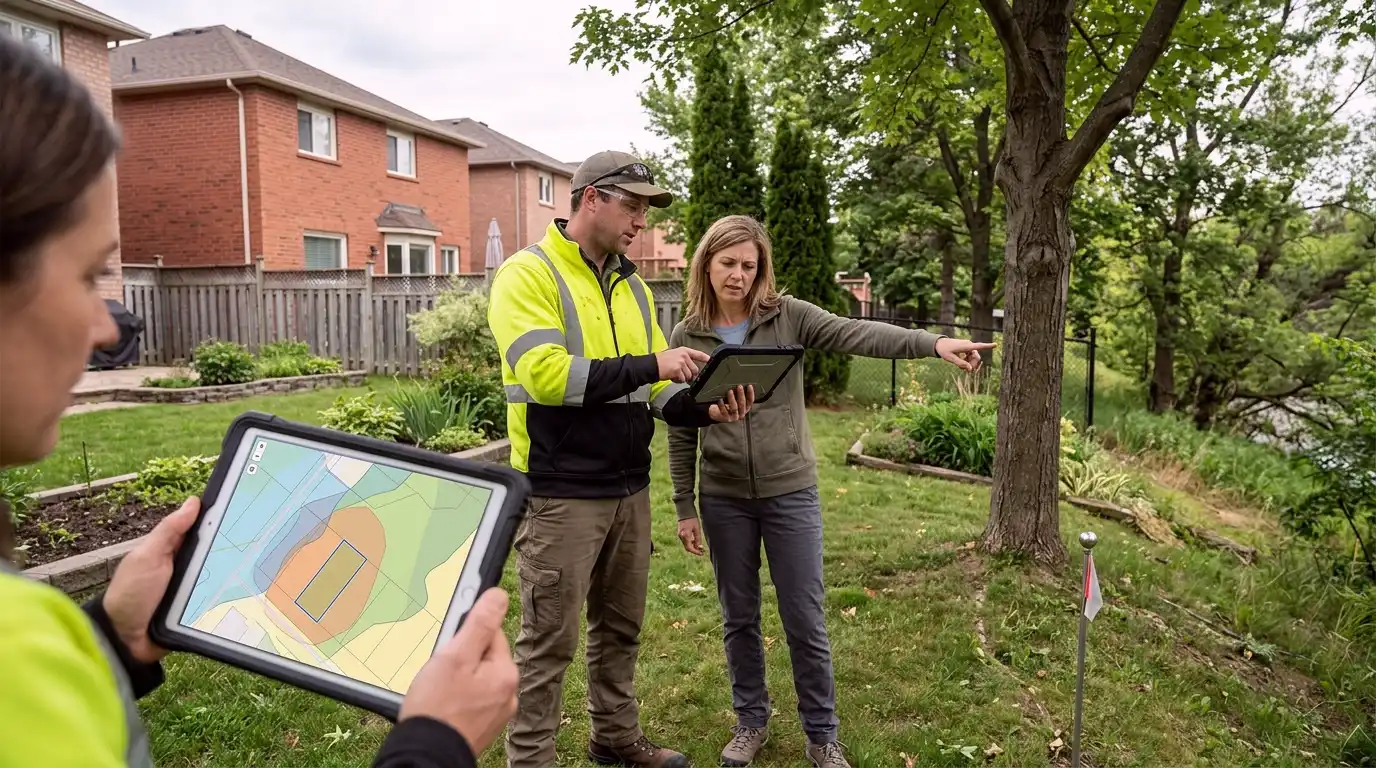
Ajax’s planning map contains both TRCA and CLOCA regulation-limit and watershed layers. Enter the property address, identify the tree location and check which authority’s regulated area, if any, overlaps the proposed work area. If the map is unclear, contact the applicable authority before site disturbance begins.
For conservation-authority purposes, describe the whole activity rather than asking only whether a tree can be cut. Mention stump excavation, grading, fill, access, construction, wetland or watercourse proximity, because those details determine whether Ontario Regulation 41/24 review is relevant.
Also check the Town of Ajax tree-protection rules and Durham Region woodland requirements separately; conservation-authority review does not replace municipal or Regional rules.
What Conservation Authority Review Actually Covers
If the proposed work is in a TRCA- or CLOCA-regulated area, the authority may review regulated development activities or work that could interfere with a wetland or watercourse. Flooding, erosion, slope stability, shorelines, valleys and wetlands can affect that review.
For a tree project, provide the address, tree location and a clear description of associated excavation, grading, fill, access or construction. Do not assume that a mapped regulated area means every private-tree removal needs a conservation-authority permit, and do not assume that absence of a conservation-authority permit removes Town or Regional requirements.
Town, Region and Conservation Authority Checks Are Separate
The Town of Ajax Tree Protection By-law focuses on specified protected lands and municipal authority. The Boulevard Tree Protection By-law addresses trees associated with streets. Durham Region regulates qualifying woodlands. TRCA or CLOCA may regulate associated development or site disturbance in mapped regulated areas.
Because these are separate legal layers, one approval does not automatically replace the others. Check the property and proposed activity against each layer that is actually relevant.
Tree Removal Permit in Ajax
The Ajax Waterfront and Why It Needs Extra Caution
Ajax’s Lake Ontario waterfront contains parks, trails, shoreline hazards and natural features. Carruthers Creek and Duffins Creek are in TRCA watersheds, while some easterly areas fall within CLOCA watersheds. A rear yard can look ordinary while a mapped regulated feature is nearby.
Before work that includes excavation, grading, fill, access or disturbance near the waterfront, a creek, wetland or slope, check the Town map and the applicable conservation authority. If a tree may be on public land, in a boulevard, or near utilities, confirm ownership and authority as a separate step.
Getting a Tree Removed Without Avoidable Delays in Ajax
Check location before scheduling work. Confirm whether the tree is on private or public land, whether the lot falls within a protected land category, whether a TRCA or CLOCA regulated area overlaps any associated site disturbance, whether Durham Region woodland rules apply, and whether boulevard or utility issues exist.
That sequence is more reliable than assuming all Ajax creek or waterfront properties are handled by one conservation authority.
Frequently Asked Questions
Do I need a tree removal permit in Ajax?
It depends on the property. Ajax Tree Protection By-law 137-2006 applies to trees on specified protected lands, and a separate boulevard by-law applies to street-related trees. Durham Region woodland rules and site-specific planning conditions can also apply. A standard private residential tree is not automatically subject to a citywide diameter permit rule.
Which conservation authority covers Duffins Creek and Carruthers Creek in Ajax?
Ajax’s current planning map identifies Duffins Creek and Carruthers Creek as TRCA watersheds. The same map also shows CLOCA watersheds and regulation limits in easterly parts of Ajax, including Lynde Creek, Cranberry and Warbler. Check the exact address.
Does a conservation-authority regulated area automatically require a tree-removal permit?
No. TRCA and CLOCA regulate specified development activities and interference with wetlands or watercourses under Ontario Regulation 41/24. Tree work may require review when it includes regulated excavation, grading, fill, access, construction or similar disturbance. Ask about the full proposed activity.
What should I check for a tree near the Ajax waterfront?
Check tree ownership, Town boulevard or protected-land rules, Durham woodland status where relevant, and the applicable TRCA or CLOCA mapping for associated site work. Utility and public-safety issues are separate.
What information should I have ready when asking about permit requirements?
Have the address, tree location, photos and a short description of the proposed work, including whether stump excavation, grading, fill, equipment access or construction is involved.