
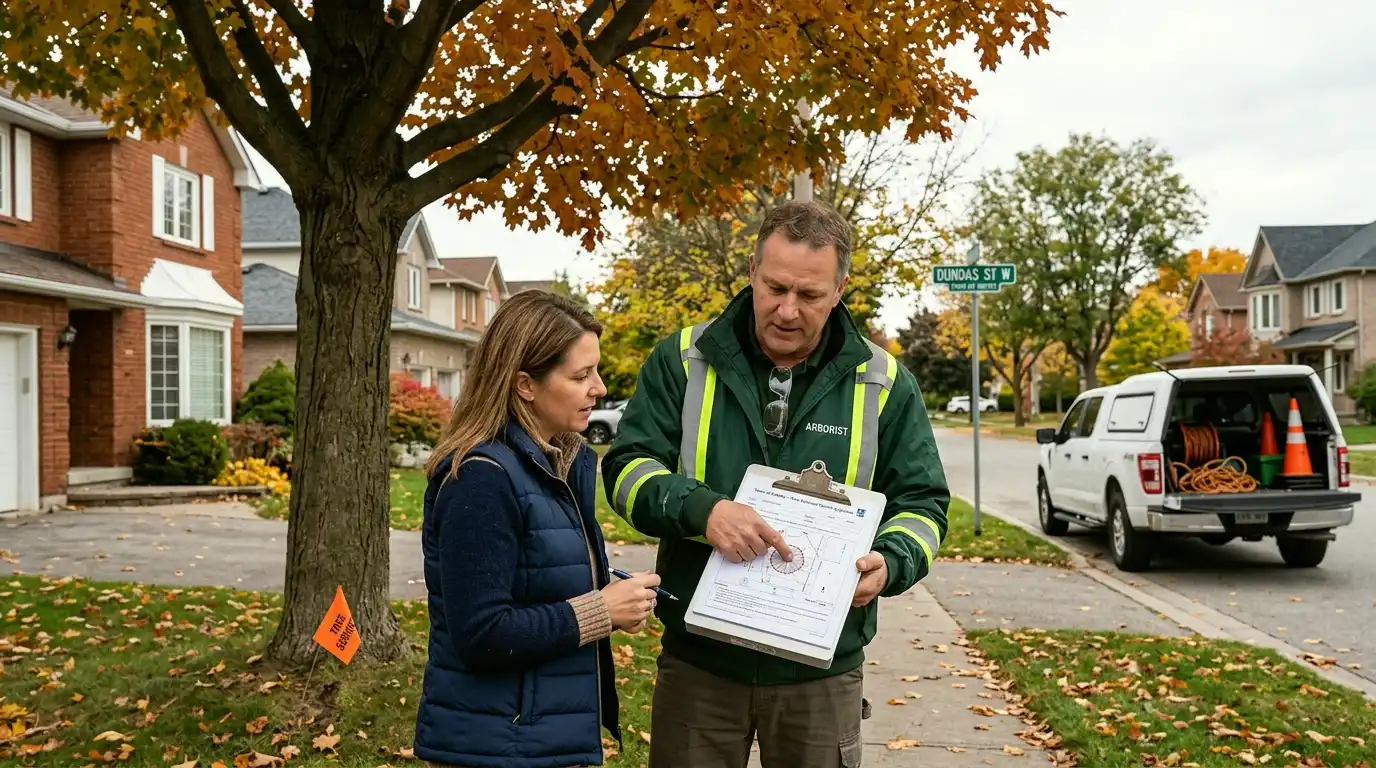
This guide explains the tree removal permit in Whitby, including the approval rules, property conditions and practical steps that can affect the work. Whitby tree removal permit rules are not as simple as “permit” or “no permit.” The Town has specific permit triggers for private property trees based on wooded area size, land designation, heritage districts, large residential lands, and development-related tree retention conditions. CLOCA and Durham Region may also have separate authority depending on whether the tree is near a regulated natural feature or located within a woodland.
For a homeowner, the practical question is property-specific. A tree on a small interior residential lot may be treated very differently from a tree in a woodlot, heritage district, conservation land, hazard land, mature woodland, environmentally sensitive area, or property close to Lynde Creek, Pringle Creek, Corbett Creek, Heber Down, or the Lake Ontario shoreline.
How Whitby Approaches Tree Removal Permits
The Town of Whitby states that a tree removal permit is required for private property trees in several defined situations. These include woodlots between 0.2 and 1.0 hectares, Major Open Space or Hazard Lands shown in Whitby’s Official Plan, Environmental Protection, Conservation Lands, Greenbelt or Oak Ridges Moraine lands, Mature Woodlands or Environmentally Sensitive Areas, residential lands 2.02 hectares or larger, and designated heritage districts such as Werden’s Plan Heritage Conservation District and Brooklin Heritage Conservation District.
The Town also notes that a tree removal permit may not be required where the total wooded area is less than 0.2 hectares, the property is not in a designated heritage district, the tree is not tied to a registered development-related tree condition, and no other agency, such as Durham Region or CLOCA, requires approval. That final point is important because a property can be simple under one rule but still affected by another authority.
Useful starting points include the Town of Whitby tree policies and by-laws page, the CLOCA inquiries and permits page, and the Durham Region Regional Woodland By-law page.
CLOCA-Regulated Areas in Whitby
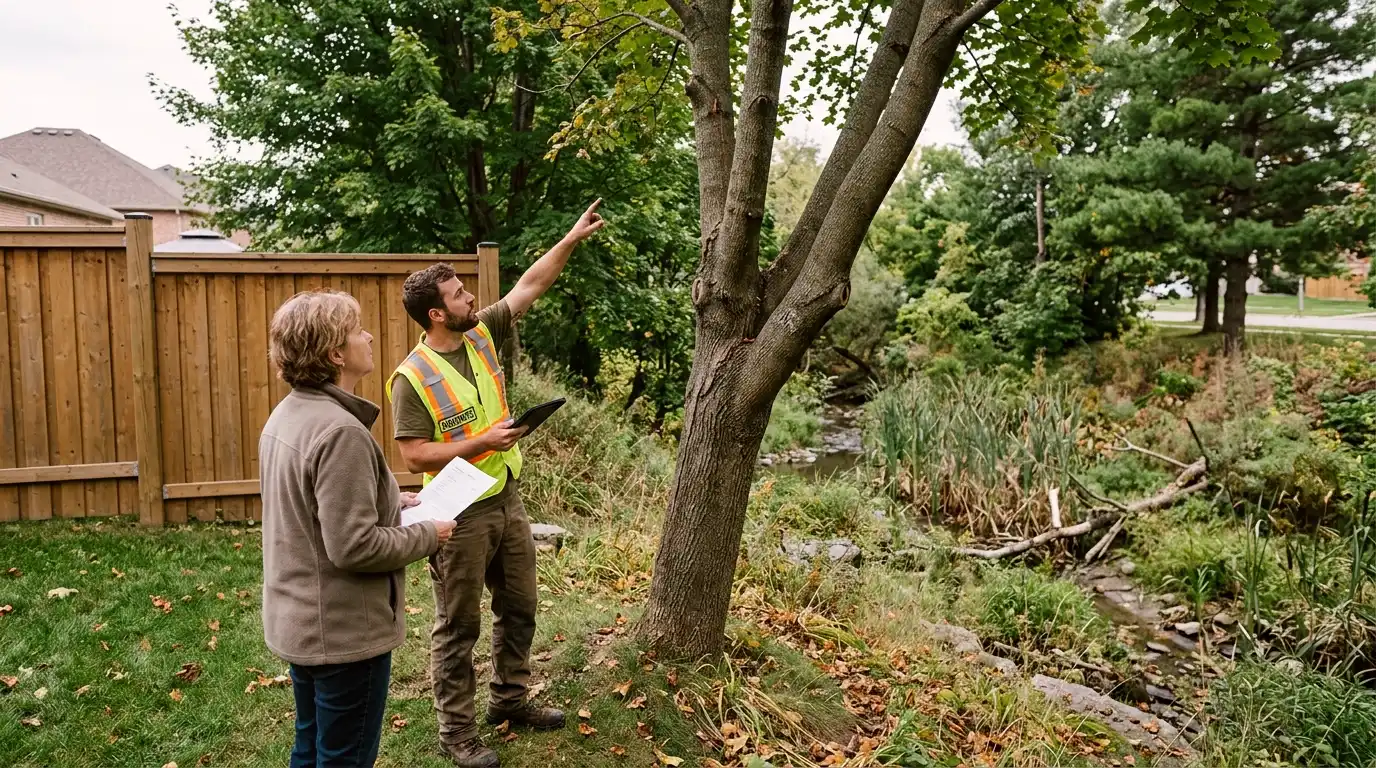
Whitby has several natural features where CLOCA review can become relevant. Under Ontario Regulation 41/24, the relevant question is whether the proposed project includes regulated development or activity that may interfere with a wetland or watercourse. Tree cutting by itself is not a blanket conservation-authority permit trigger, although stump excavation, grading, fill, access or construction can make review necessary.
Lynde Creek and Lynde Creek Marsh
Lynde Creek and Lynde Creek Marsh are major natural features in Whitby. Properties near Lynde Shores, Whitby Harbour, Port Whitby, the lower Lynde Creek corridor, and connected wetlands or drainage features should be checked carefully before tree removal or site disturbance. A tree may be located in a rear yard but still be near a mapped regulated feature, especially where the lot backs onto naturalized land, valleyland, marsh, floodplain, or shoreline-influenced terrain.
Pringle Creek, Corbett Creek, Heber Down, and shoreline areas
Pringle Creek, Corbett Creek, Heber Down Conservation Area, and the Lake Ontario shoreline can also create regulated-area questions. Properties near creek corridors, conservation lands, slopes, flood hazards, wetlands or shoreline features should be checked against current CLOCA mapping when the proposed work includes regulated site disturbance. Ask about the full activity, not simply whether a tree can be cut.
How to check your Whitby property before tree removal:
- Review the Town of Whitby tree policies and by-laws page for private tree removal permit triggers.
- Check whether the property is in a woodlot, Major Open Space, Hazard Lands, Environmental Protection, Conservation Lands, Greenbelt, Oak Ridges Moraine, Mature Woodland, Environmentally Sensitive Area, or designated heritage district.
- Use CLOCA’s regulated area mapping if the tree is near Lynde Creek, Pringle Creek, Corbett Creek, Heber Down, a wetland, a valley, a stream, or the Lake Ontario shoreline.
- Check Durham Region’s Regional Woodland By-law if the property includes a woodland one hectare or larger.
- For newer subdivisions or recently developed lands, review registered development documents or ask a lawyer, title insurer, or the Town about tree-related conditions.
Brooklin: Heritage Districts, Newer Subdivisions, and Property Conditions
Brooklin deserves special attention because it includes older heritage areas, newer subdivisions, expansion lands, and properties near natural features. The Brooklin Heritage Conservation District is one of the areas where Whitby specifically tells property owners to check whether a tree removal permit is required. That means Brooklin homeowners should not assume the rules are the same as a standard interior residential lot elsewhere in Whitby.
Newer Brooklin subdivisions can also have registered development conditions affecting trees, grading, landscaping, natural features, or retained vegetation. These conditions may not be obvious from walking around the yard. If the home was recently built, backs onto open space, contains a mature retained tree, or sits near a natural corridor, review title-related documents and contact the Town of Whitby before removal.
The Heber Down Area and Whitby’s Rural North
Properties around Heber Down Conservation Area, Cochrane Street, Columbus Road East, rural north Whitby, and lands close to the Oshawa-Whitby boundary can have multiple layers of review. These properties may include woodlots, natural corridors, agricultural land, wetlands, valleylands, conservation-adjacent land, or larger tree stands. A tree removal on this type of property should be checked against Town of Whitby permit triggers, CLOCA regulated area mapping, and Durham Region woodland rules.
Durham Region’s Regional Woodland By-law applies to woodlands within the region that are one hectare, or 2.5 acres, in size and greater. If you plan to cut or remove trees within a woodland or sensitive natural area, Durham Region says you may need a permit. For larger rural, estate, wooded, or agricultural properties in Whitby, this should be checked before clearing trees.
Tree Removal Permit in Whitby
Lynde Creek Marsh: Why This Area Needs Extra Caution
Lynde Creek Marsh and the surrounding natural lands are among the most sensitive areas for Whitby tree removal questions. Homes near Lynde Shores, Port Whitby, the harbour, marsh-edge streets, and connected natural corridors should be checked carefully before removing trees or disturbing soil. The visible edge of a marsh, creek, or natural area is not always the same as the regulated boundary.
This is where property-specific checking matters. A tree several streets back from a visible natural feature may still be close enough to a mapped area to require extra caution. If the property is near the marsh, shoreline, a drainage feature, or a creek corridor, use CLOCA’s regulated area mapping or contact CLOCA directly before work begins.
What to Do Before Considering a Tree Removal in Whitby
Start with the Town of Whitby’s private tree removal permit triggers. Confirm whether the property is in a listed land category, heritage district, woodlot, large residential property, or development-related tree condition. Then check CLOCA mapping if the property is near a stream, wetland, shoreline, valley, slope, floodplain, or conservation area. If the property contains a woodland one hectare or larger, check Durham Region rules as well.
If the tree is near a road allowance, sidewalk, boulevard, park, public land, utility line, or shared boundary, confirm ownership and authority before removal. For powerline contact, blocked public roads, immediate danger, active storm damage, or public safety risks, contact emergency services, the utility provider, the municipality, or the relevant public authority first.
Important note: Tree by-laws, conservation authority mapping, fees, forms, heritage district boundaries, and property-specific conditions can change. This guide is general information only. Before removing a significant tree in Whitby, confirm current requirements directly with the Town of Whitby, CLOCA, Durham Region, a utility provider, or another applicable public authority where relevant.
Frequently Asked Questions
Does Whitby require a permit to remove a tree on private property?
Sometimes. Whitby states that a private property tree removal permit is required in several situations, including woodlots between 0.2 and 1.0 hectares, Major Open Space or Hazard Lands, Environmental Protection, Conservation Lands, Greenbelt or Oak Ridges Moraine lands, Mature Woodlands or Environmentally Sensitive Areas, residential lands 2.02 hectares or larger, designated heritage districts such as Werden’s Plan Heritage Conservation District and Brooklin Heritage Conservation District, and certain approved development-related tree retention situations. A permit may not be required where the total wooded area is less than 0.2 hectares, the property is not in a designated heritage district, the tree is not tied to a registered development-related tree condition, and no other agency such as Durham Region or CLOCA requires one. Property owners should confirm directly with the Town of Whitby before removal.
Which Whitby neighbourhoods are most likely to have CLOCA-regulated trees?
CLOCA-regulated areas are more common near Lynde Creek, Pringle Creek, Corbett Creek, the Lake Ontario shoreline, Whitby Harbour, Port Whitby, Lynde Shores, Heber Down Conservation Area, wetlands, valleylands, floodplains and stream corridors. If proposed tree work also involves excavation, grading, fill, access, construction or other site disturbance, check CLOCA’s current mapping and permit guidance for the exact property.
I live in Brooklin. Does development history affect tree rules?
It can. Brooklin includes older lots, heritage district areas, newer subdivisions, and expansion lands. A property in the Brooklin Heritage Conservation District may require extra checking. Newer subdivision properties may also have registered development conditions that affect retained trees, grading, landscaping, or natural features. If the home is newer, was recently developed, backs onto open space, or contains a mature retained tree, the owner should review title documents, subdivision documents, and Town of Whitby requirements before removal.
Does Durham Region’s woodland by-law affect Whitby properties?
It can, especially for larger wooded, rural, agricultural, estate, institutional, or natural-area properties. Durham Region’s Regional Woodland By-law applies to woodlands within the region that are one hectare, or 2.5 acres, in size and greater. If you plan to cut or remove trees within a woodland or sensitive natural area, you may need a permit from Durham Region. Standard small urban residential lots are less likely to trigger this rule, but wooded properties should be checked before clearing trees.
Who can confirm Whitby permit status or help with an application?
Related Guides
- Tree Removal Permit in Ajax
- Tree Removal Permit in Oshawa
- Tree Removal Cost Durham Region
- What Is an Arborist Report
- Tree Removal Requests