Tree Removal Rules in Milton: What Halton Region Homeowners Need to Know (2026)
This guide explains the tree removal permit in Milton, including the approval rules, property conditions and practical steps that can affect the work. Tree removal in Milton can be simple on some private residential lots and much more complicated on others. The first question is not just the size of the tree. It is ownership, location, and regulatory setting. A tree may be entirely private, partly on a boundary, located on Town land, inside or near a Conservation Halton regulated area, within the Niagara Escarpment Plan Area, or part of a larger woodland or development site. Each situation can change what the property owner needs to confirm before removal.
This guide explains the main Milton tree removal checks for homeowners in 2026, including private-tree ownership, Town-owned trees, boundary trees, Conservation Halton regulated areas, Niagara Escarpment considerations, and Halton Region woodland rules.
Start With the Ownership Question
Before arranging tree removal in Milton, confirm whether the tree is entirely on your property. Milton’s public tree guidance tells property owners to make sure the tree is entirely private before removal and recommends consulting a certified arborist if removal is necessary. That is a different situation from a tree on a boulevard, street allowance, park, public woodlot, or other Town-owned land.
Town-owned trees should not be treated as private trees. If a street tree, park tree, boulevard tree, or woodlot tree appears dead, damaged, stressed, or hazardous, the safer step is to contact the Town of Milton rather than arranging private removal. Town engineering standards also indicate that trimming or removing Town-owned trees requires written approval. If there is uncertainty about ownership, do not guess. Confirm the location first.
Boundary trees are another issue. If the trunk crosses a property line or the tree is shared with a neighbour, written neighbour permission or legal review may be needed before injury or removal. A qualified arborist may be able to help identify the tree location and condition, but ownership, permission, and legal responsibility remain matters for the property owner to confirm directly.
Milton tree removal checks for 2026
- Confirm whether the tree is entirely on private property.
- Contact the Town of Milton before touching a street, boulevard, park, or Town woodlot tree.
- Check whether the trunk or root zone crosses a property boundary.
- Confirm whether the property is near a creek, valley, wetland, flood hazard, or other Conservation Halton regulated feature.
- Check whether western Milton, Campbellville, Kilbride, Kelso, or rural Escarpment-area properties fall within the Niagara Escarpment Plan Area or Area of Development Control.
- For larger treed areas, confirm whether Halton Region woodland rules may apply.
- For development, grading, construction, or site alteration, confirm whether separate municipal, conservation authority, or NEC approvals are needed.
- Where professional advice is needed, speak directly with a qualified arborist or qualified tree care professional.
Private Residential Trees in Milton
For a tree that is clearly and entirely on a private residential lot, Milton’s public guidance is straightforward: confirm that the tree is on your property and consult a qualified arborist before removal where professional input is needed. A private homeowner should still be careful because private-tree removal can overlap with other rules. The tree may be close to a property line, part of a development approval condition, near a regulated natural feature, inside a rural woodland, or in a Niagara Escarpment-controlled area.
This is why a simple backyard tree in a newer subdivision is different from a large tree on a rural estate near Campbellville or a lot backing onto a creek corridor. In urban Milton areas such as Hawthorne Village, Beaty, Clarke, Coates, Ford, Dempsey, Timberlea, and Old Milton, the main concerns are often ownership, safety, utilities, access, and whether the tree is connected to a subdivision, boundary, or neighbouring-property issue. In rural and Escarpment-adjacent areas, regulatory review can be more layered.
Useful Milton, Halton, and Escarpment Authority Links
Official resources to check before planning tree removal:
- Town of Milton: Trees
- Town of Milton Engineering Standards: Right-of-Ways
- Conservation Halton: Permitting
- Conservation Halton: Permitting and Planning
- Niagara Escarpment Commission: Development Permits
- Halton Region: Tree By-Law for Woodlands and Greenlands
- Milton Hydro: Tree Trimming Near Power Lines
These links are informational only. Property owners should confirm requirements directly with the relevant authority before arranging work.
The Niagara Escarpment in Milton
Milton is not a uniform tree-removal market. Western Milton has a regulatory landscape that differs sharply from many urban GTA neighbourhoods because the Niagara Escarpment runs through or near parts of the municipality. Properties in and around Campbellville, Kilbride, Kelso, the rural west side, and Escarpment-facing estate lots may require additional review before vegetation removal or site alteration.
The Niagara Escarpment Commission administers development permits for certain activities within the Niagara Escarpment Plan Area and the Area of Development Control. The NEC provides mapping and permit guidance so landowners can check whether their property falls within the regulated area and whether an activity is exempt or requires a development permit. If your property is in the Escarpment area, confirm NEC requirements before arranging significant tree removal, clearing, grading, driveway work, or construction-related vegetation removal.
Conservation Halton and Milton Watercourses
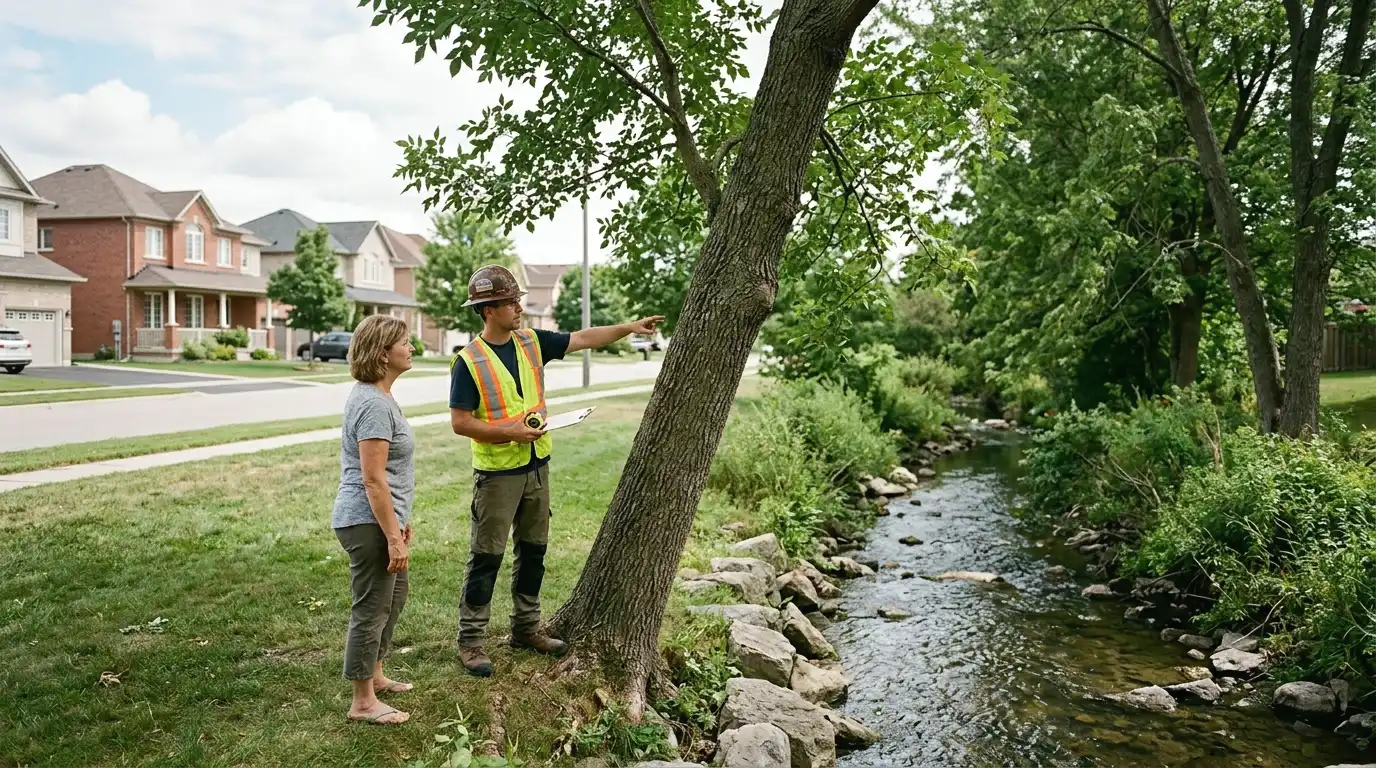
Conservation Halton may apply where a Milton property is within or near a regulated feature such as a creek, valley, wetland, floodplain, slope, or other regulated natural area. This can matter in both urban and rural parts of Milton. Properties near Bronte Creek, Sixteen Mile Creek, Derry Creek, tributaries, stormwater-linked natural corridors, valleylands, and conservation lands may require extra review before excavation, grading, tree work, or removal near the regulated area.
The key issue is not simply whether the tree is on private property. If the work is inside a regulated area, Conservation Halton permission may be needed before development or site alteration. A homeowner planning tree removal near a ravine edge, creek corridor, wetland buffer, or steep slope should check the property status directly with Conservation Halton before scheduling work.
In newer Milton subdivisions, lots backing onto stormwater ponds, creek corridors, open-space blocks, or valley buffers can have restrictions that are not obvious from the driveway. In rural Milton, regulated features can extend through larger properties in ways that require mapping review. A qualified arborist or qualified tree contractor may be able to discuss site conditions, but Conservation Halton requirements must be confirmed with Conservation Halton.
Halton Region Woodland Rules
Milton homeowners with a single residential yard tree are usually dealing with a different question than landowners with a larger treed area. Halton Region has a tree by-law framework for woodlands and greenlands, including criteria related to treed area, tree spacing, and tree diameter. This is more relevant for rural, estate, agricultural, or larger properties than for a typical small urban lot.
If your property contains a larger wooded area rather than one isolated yard tree, check Halton Region’s woodland and greenlands rules before arranging cutting. The rules may apply even if the land is privately owned. For landowners in rural Milton, this can overlap with NEC review, Conservation Halton review, municipal site alteration rules, or other land-use constraints.
Power Lines, Utilities, and Public Safety
Tree work near power lines should never be treated as routine yard work. Milton Hydro provides guidance for tree trimming near electrical infrastructure and notes that work near customer-owned power lines is the property owner’s responsibility and should meet electrical safety standards. If a tree is touching, leaning toward, or interfering with utility lines, contact the utility provider or the proper authority before arranging private work.
If a tree or limb creates an immediate danger, blocks a public road, affects a public sidewalk, contacts overhead wires, or creates a public-safety issue, contact emergency services, the utility provider, the municipality, or the relevant public authority first.
Tree Removal Permit in Milton
Tree removal cost in Milton depends on the qualified tree contractor’s assessment of the tree, access, height, trunk diameter, species, condition, lean, obstacles, utility proximity, rigging needs, stump work, disposal, cleanup terms, and whether separate documentation or authority review is needed. A small accessible backyard tree in a newer subdivision is very different from a large mature tree on a rural or Escarpment-area property.
Firm pricing depends on the contractor’s site assessment, scope, equipment, access, risk, and cleanup requirements.
Milton Neighbourhoods and Rural Areas
Milton includes several very different property types. Old Milton, Timberlea, Dorset Park, Bronte Meadows, Dempsey, Clarke, Coates, Beaty, Ford, Harrison, Willmott, Scott, and Hawthorne Village often involve smaller residential lots, subdivision trees, driveways, fences, and neighbouring-property concerns. Rural Milton, Campbellville, Kilbride, Kelso, Moffat, Nassagaweya-area properties, and Escarpment-facing estates can involve larger trees, woodlands, long access routes, conservation features, and NEC review.
For urban lots, the main starting point is usually ownership, access, safety, and whether the tree is private, shared, or Town-owned. For rural and Escarpment properties, the starting point is broader: NEC mapping, Conservation Halton regulated-area status, Halton woodland rules, and any development or site-alteration conditions. That is why Milton tree removal questions should not be treated with a one-size-fits-all answer.
Planning the Next Step
Frequently Asked Questions
Does Milton require a permit before removing a private tree?
Milton homeowners should first confirm that the tree is entirely on private property and not a Town-owned tree. The Town recommends consulting a certified arborist before private tree removal. Additional permissions may apply for Town-owned trees, boundary trees, woodlands, regulated natural areas, Niagara Escarpment lands, development sites, or utility-related situations.
Does Conservation Halton apply in Milton?
Yes, Conservation Halton can apply where a property is within or near a regulated area such as a creek, valley, wetland, flood hazard, slope, or other natural feature. Property owners should confirm regulated-area status directly with Conservation Halton before arranging tree work near these features.
How does the Niagara Escarpment affect tree removal in Milton?
Parts of western Milton may fall within the Niagara Escarpment Plan Area or Area of Development Control. In those areas, certain development, land-use changes, vegetation removal, or site alteration may require NEC review or a development permit. Check NEC mapping and confirm requirements directly with the Commission before proceeding.
Is Campbellville a separate municipality or part of Milton?
Campbellville is part of the Town of Milton. Properties in and around Campbellville may still require extra checks because of Escarpment, rural, conservation, woodland, utility, or property-boundary considerations.
Who can prepare Milton permit documentation or an arborist report?
Related Guides and Services
- Tree Removal Permit in Burlington
- Tree Services in Georgetown and Halton Hills
- Tree Removal Cost Burlington Guide
- Arborist Reports
- Tree Removal Requests
Send Your Tree Request
Have a tree removal question in Milton, Campbellville, Kilbride, Old Milton, Hawthorne Village, Beaty, Coates, Clarke, Dempsey, Ford, Timberlea, or a rural Escarpment-area property?