
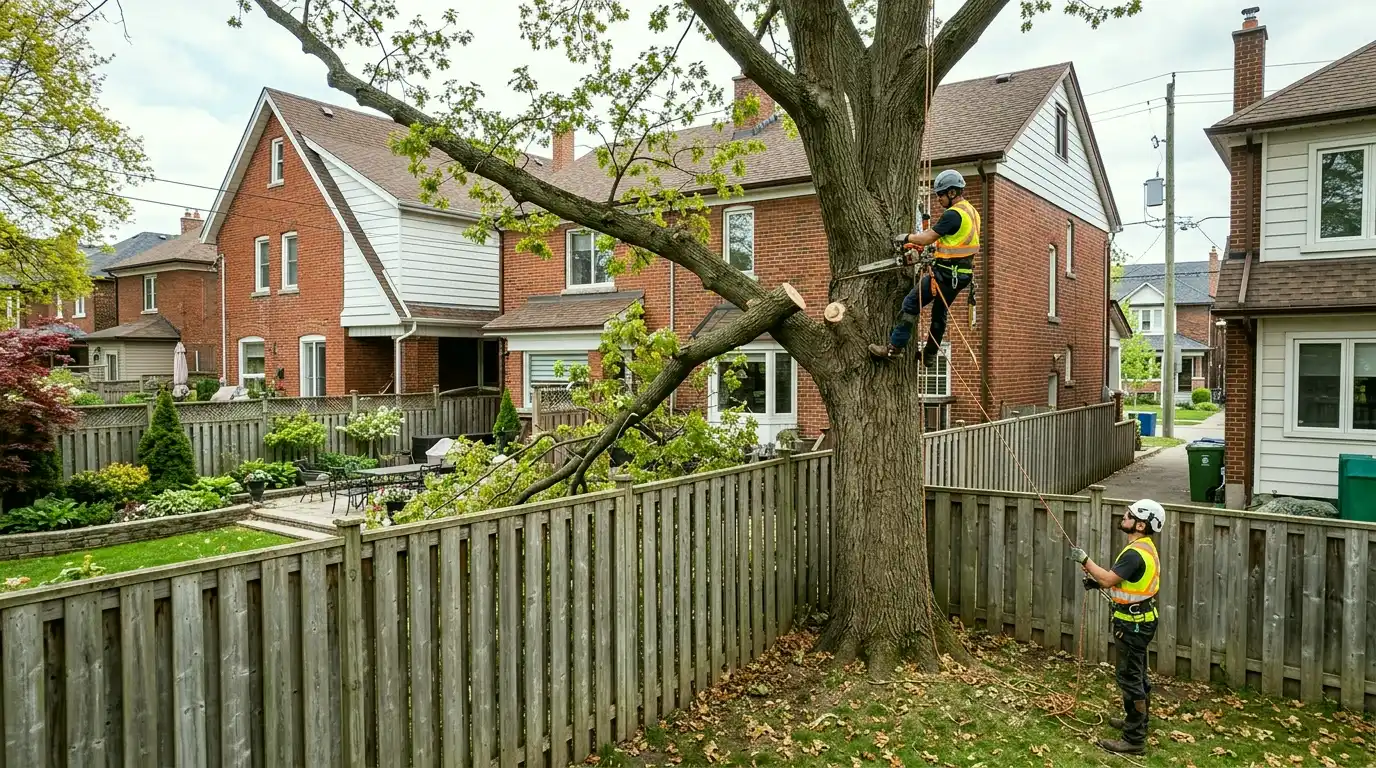
Property owners dealing with tree removal near a fence in Toronto should first consider tree condition, site constraints and any municipal requirements. Tree removal near a fence is a common Toronto backyard issue, especially on narrow lots, older properties, laneway homes, townhome yards and shared side-yard spaces. A fence changes the work area, but it also raises other questions: Who owns the tree? Is it a boundary tree? Is the fence on the property line? Could the tree be protected under Chapter 813? Who is responsible if a fence panel, post or gate is damaged?
This guide is for general planning only.
How Fence Proximity Changes the Removal Approach
A tree growing beside a cedar fence, chain-link fence, privacy fence, retaining wall, gate or neighbour’s yard usually cannot be handled like a tree in an open lawn. The work area may be tight, the drop zone may be limited, and the contractor may need to work around fence panels, posts, sheds, gardens, patios, overhead wires, garages or neighbouring structures.
For many fence-adjacent removals, a qualified tree contractor may use sectional cutting and controlled lowering rather than conventional felling. That kind of work can require slower cutting, more setup time, careful debris handling and more discussion about where branches, wood and equipment can safely go. The exact method is decided by the qualified tree contractor based on the tree, access, site conditions, weather and safety.
Access matters just as much as tree size. A rear-yard tree with only a narrow side gate may require hand-carrying branches and wood. A removable fence panel might make access easier, but that requires owner permission and, if it affects the neighbour’s side, neighbour communication. Property owners should ask the qualified tree contractor to explain access needs, fence-panel handling, cleanup terms and damage responsibility in writing before approving the work.
Neighbour Communication Before the Work
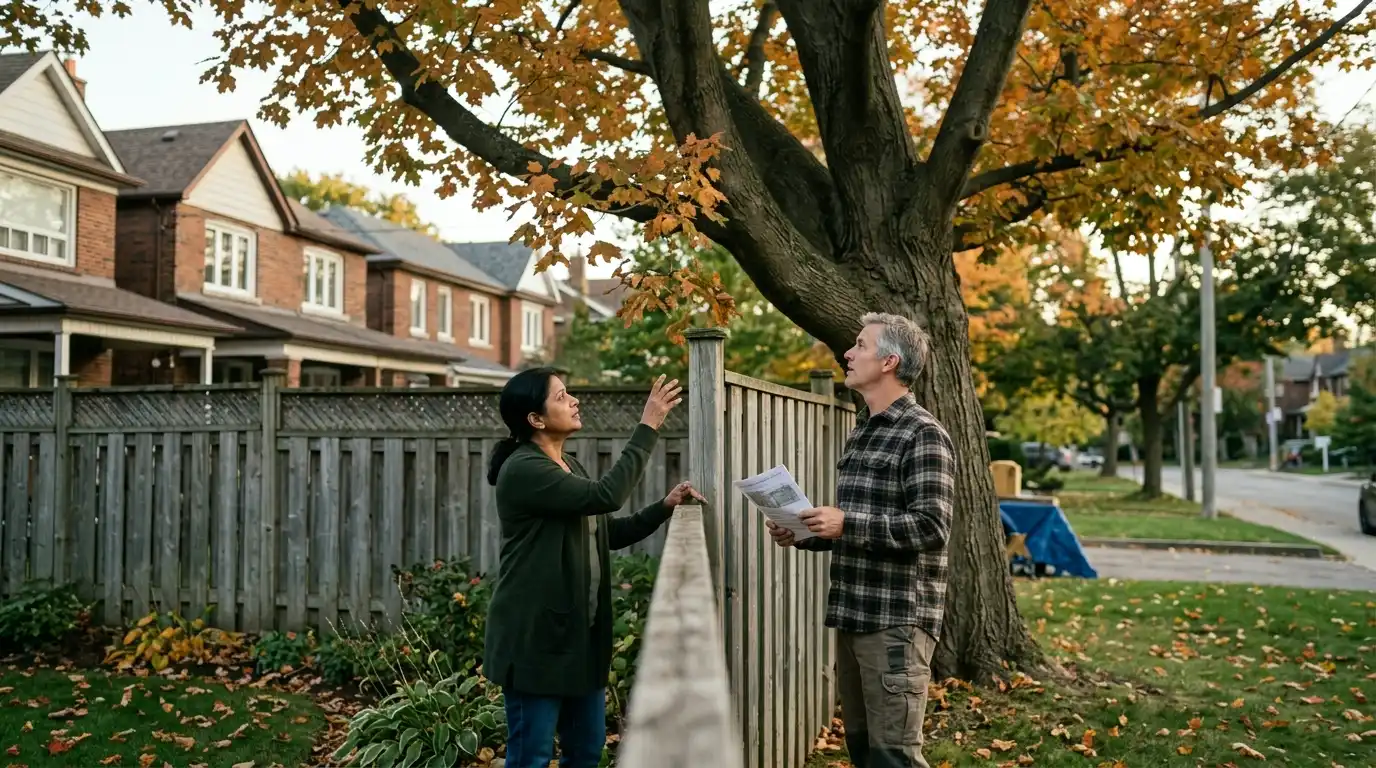
If the tree is near the property line, close to a shared fence or leaning into a neighbouring yard, early neighbour communication is usually wise. Even when the trunk is entirely on one property, noise, debris handling, temporary access, fence-panel removal, dust, sawdust and scheduling can affect the neighbouring property.
For boundary trees, the issue is more serious. Ontario’s Forestry Act says every tree whose trunk is growing on the boundary between adjoining lands is the common property of the owners of the adjoining lands. The same section also states that injuring or destroying a boundary tree without consent of the land owners is an offence under the Act. Property owners dealing with a property-line tree should confirm ownership with a current survey and get legal advice where there is disagreement.
Tree removal near a fence in Toronto: key considerations
- Fence proximity can affect access, rigging, debris handling, equipment choice and contractor pricing.
- Gate width, side-yard access and removable fence panels should be discussed before work is approved.
- Toronto Chapter 813 applies based on protected-tree status, not on fence proximity alone.
- Boundary trees may require consent from adjoining landowners under Ontario law.
- Property owners should request proof of current insurance directly from the qualified tree contractor.
- Fence damage responsibility should be clarified in writing before work begins.
- Public trees, ravine areas, utility conflicts and shared ownership issues require extra review.
Chapter 813 and Fence-Adjacent Trees
Toronto’s private tree rules apply whether the tree is beside a fence, in the middle of the yard or close to a house. The City of Toronto’s tree and ravine permit guidance states that where at least one stem measures 30 cm in diameter or greater, the tree is protected under the bylaw. Fence proximity does not remove that requirement.
Fence proximity may still be relevant to the discussion. A tree may be damaging a fence, preventing fence maintenance, pushing posts out of alignment or creating neighbour concerns. Those facts may help explain why a homeowner is asking about removal, but property owners should not assume they are automatically enough for permit approval. Any arborist report, permit-related document, City submission, timing, approval condition or replacement requirement must be handled directly by the property owner, the City, a qualified arborist or a qualified tree contractor.
If the tree may be on the property line, the property owner should be careful before moving forward. A municipal permit, if required and obtained, does not automatically resolve private ownership or consent issues between neighbours. Property owners should confirm boundary status with a survey and obtain proper advice where there is disagreement.
Fence Damage: Prevention and Responsibility
Fence damage prevention starts with a clear written work plan from the qualified tree contractor. Property owners should ask how branches and wood will be controlled, whether fence panels need to be removed, who removes and reinstalls them, whether the neighbour’s side is involved, how existing fence condition will be documented and who is responsible if damage occurs.
Before approving work beside a fence, property owners should request proof of current commercial general liability insurance directly from the qualified tree contractor and confirm that the certificate is active. Insurance coverage, exclusions, deductibles and claim handling are matters between the property owner, contractor, insurer and any affected neighbour.
Photos can help reduce conflict. Before work begins, photograph the fence, gate, posts, panels, latch, ground conditions, tree position and any existing damage from both relevant sides where access is allowed. Those records are useful if there is disagreement after the work.
Cost of Tree Removal Near a Fence in Toronto
Fence-adjacent tree removal often costs more than open-lot work because access is tighter and the contractor may need more controlled cutting, slower debris handling, extra labour or special equipment. The same tree can be priced differently depending on whether it is in an open backyard, against a fence, over a neighbour’s garage, beside a pool, close to wires or trapped behind a narrow gate.
Property owners should treat online price ranges as planning information only. Actual pricing must come directly from the qualified tree contractor after reviewing the tree, access, site risks, cleanup expectations, stump grinding status, permit-related documents and neighbour or fence constraints.
For trees on or near the property line, neighbours sometimes agree to share costs, especially where both properties benefit. That arrangement is private. The cost split, consent, timing, access and responsibility should be discussed and documented between the neighbours before work is scheduled.
Frequently Asked Questions
Who pays for tree removal if the tree is on or near the property line in Toronto?
If the trunk is entirely on one private property, cost responsibility is usually handled by that property owner. If the trunk grows on the boundary between adjoining lands, Ontario law treats the tree as common property of the adjoining owners, and consent issues may apply before injury or removal. Cost sharing is a private matter between neighbours and may require legal advice.
Does Chapter 813 require a permit to remove a tree near but not touching a fence?
Fence proximity does not decide whether a Toronto private tree permit is required. The City of Toronto states that where at least one stem measures 30 cm in diameter or greater, the tree is protected under the bylaw. Public trees, ravine areas, boundary trees, and replacement trees may involve additional rules. Property owners should confirm requirements directly with the City of Toronto, 311, a surveyor, or an ISA Certified Arborist where applicable.
What happens if a contractor damages my fence during tree removal?
Fence damage is a private matter between the property owner, neighbour where applicable, and the qualified tree contractor. Before approving work, property owners should ask the qualified tree contractor for written scope details, proof of current commercial general liability insurance, fence-protection expectations, access requirements, and who is responsible if damage occurs.
Can I remove a tree near my Toronto fence without a permit if it is under 30 cm DBH?
A private tree below the City of Toronto’s protected-tree diameter threshold may not require a private tree removal permit, but property owners should not rely on size alone if the tree may be City-owned, in a ravine-protected area, planted as a replacement tree, shared with a neighbour, or located on a boundary. Measurements and ownership should be confirmed before work begins.
Related Guides and Services
- How to Get a Tree Removal Permit in Toronto
- My Neighbour’s Tree on My Property
- Tree on Property Line Toronto
- ISA Certified Arborist Toronto
- Tree Removal Requests