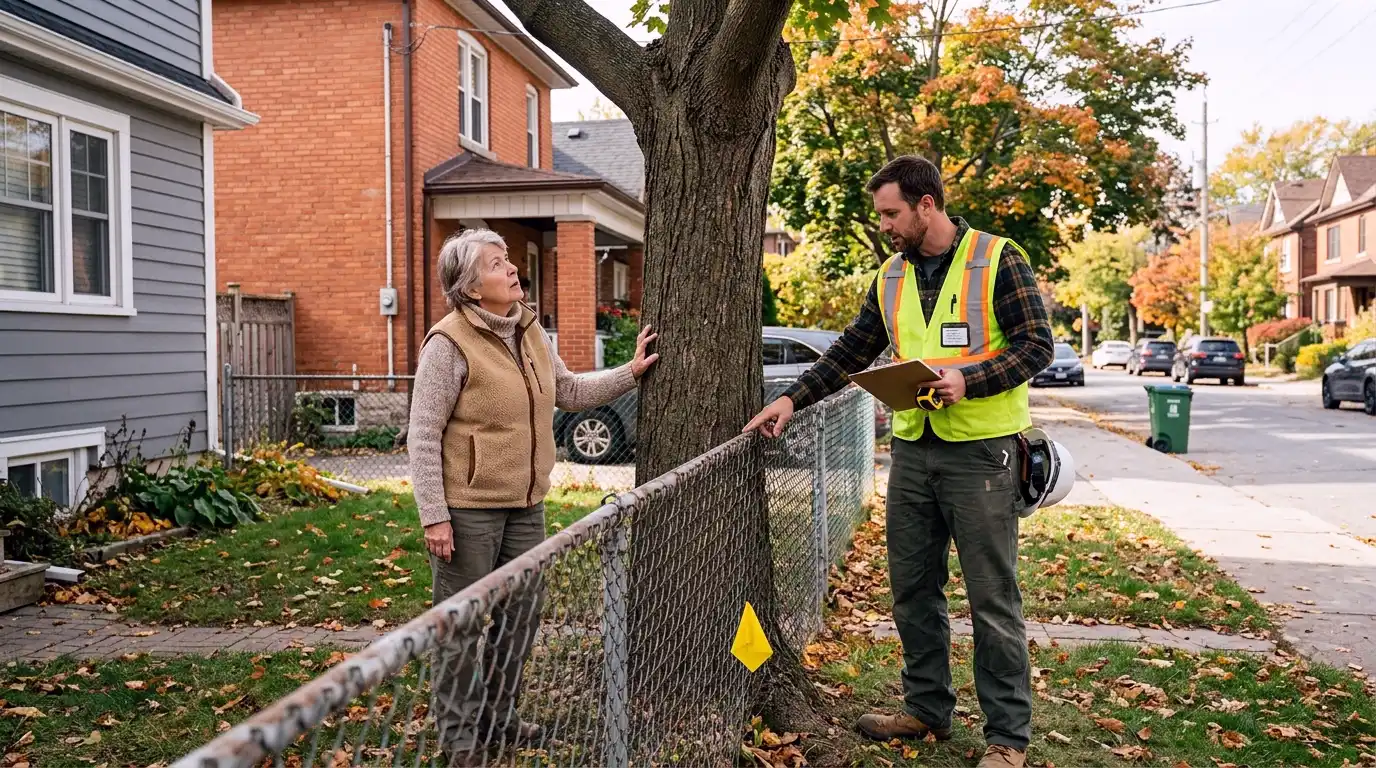
The practical issues around tree on a property line in Toronto include tree condition, property context and any rules that affect the work. A tree growing on or very close to a property line can raise ownership, consent, permit, neighbour, insurance, and legal questions. The main issue is not where the branches hang or where the roots travel. The main issue is where the trunk grows in relation to the boundary. Section 10 of Ontario’s Forestry Act says every tree whose trunk is growing on the boundary between adjoining lands is common property of the adjoining owners, and injuring or destroying that boundary tree without the owners’ consent is an offence under the Act.
This guide is general information for Toronto property owners. It is not legal advice. If ownership, consent, damage, liability, or neighbour rights are disputed, speak with a lawyer or other qualified legal advisor.
For Toronto tree permit background, see the City’s Tree and Ravine Protection resources.
What Makes a Tree a Property Line Tree?
The key question is where the trunk is located. A tree whose trunk is entirely on one property generally belongs to that property owner, even if branches or roots cross the property line. Under Ontario’s Forestry Act, a tree whose trunk is growing on the boundary between adjoining lands is common property of the adjoining owners.
In practice, the hard part is knowing where the boundary actually runs. Many Toronto homeowners rely on a fence line, hedge line, driveway edge, or old assumption, but those may not match the surveyed property line. Before anyone cuts, removes, or authorizes work on a valuable tree near the boundary, it may be necessary to confirm the property line through a survey or qualified boundary review.
If the tree is large enough to be protected under Toronto’s private tree by-law, municipal permission may also be needed before injury or removal. Toronto generally protects private trees with a diameter at breast height of 30 cm or more. City-owned trees, ravine trees, natural feature areas, and replacement trees can raise separate requirements.
Toronto Permit Issues for Boundary Trees
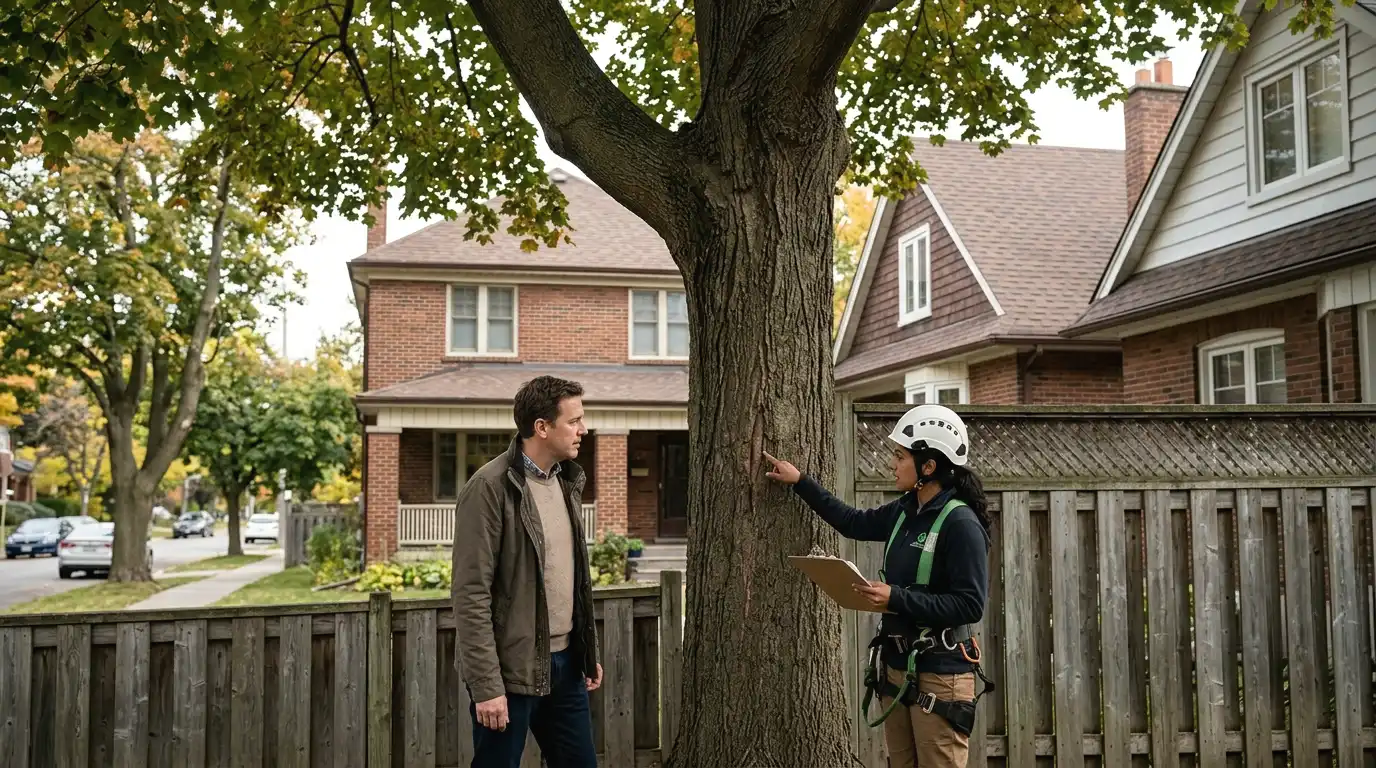
If a property line tree is protected by Toronto’s private tree rules, permit requirements should be confirmed before any removal or injury. A boundary-tree situation can be more complicated than a normal private-tree application because more than one owner may have an interest in the tree.
Where both neighbours agree, the cleaner approach is to document the agreement before submitting anything or hiring anyone. The application and supporting materials should make the ownership and consent situation clear. If only one owner proceeds without the other owner’s knowledge, the matter can turn into a dispute and may delay or complicate City review.
Property line tree: Which situation are you in?
- Trunk entirely on your side: The tree may be yours, but Toronto permit rules may still apply if it is protected. Neighbour rights and overhanging branches can still create civil issues.
- Trunk straddles the boundary: The tree may be a boundary tree. Confirm consent, ownership, permit requirements, and legal rights before injury or removal.
- Trunk entirely on the neighbour’s side: The neighbour may own the tree. Branches or roots crossing the line are usually a civil/private-property issue, and legal advice may be needed if rights are unclear.
- Tree appears dangerous: Keep people away from the target area, document the concern, notify the property owner, and contact 311 if the tree appears to present an immediate danger.
When Neighbours Agree
When both neighbours agree that a boundary tree should be reviewed, pruned, or removed, the process is usually more manageable. The neighbours can discuss access, documentation, cost-sharing, cleanup, replacement planting, and municipal permit requirements before work begins.
If a qualified arborist is retained, the arborist may discuss tree condition, DBH, visible defects, pruning risk, removal considerations, and documentation options with the property owner. If the tree is protected, the required City process should be confirmed before scheduling work.
Any agreement between neighbours should be written down, even if it is simple. A short email confirming who approved the work, who is contacting the qualified arborist, how costs will be handled, who will receive documents, and who is responsible for cleanup can reduce disputes later.
When Neighbours Disagree
Neighbour disagreement is the difficult part. If one owner wants removal and the other refuses, the issue may become a legal dispute, especially if the tree is a boundary tree. A tree contractor cannot force consent, settle ownership disputes, decide property rights, or resolve neighbour conflict.
Practical options include documenting the concern, writing to the neighbour, requesting a professional tree assessment, using mediation or dispute-resolution options where appropriate, contacting 311 if the tree appears to present an immediate danger, and getting legal advice if the dispute cannot be resolved.
If the concern is safety-related, document visible defects from your own property where it is safe to do so. Examples include major trunk cracks, a new lean, large dead limbs, root plate movement, fungal growth at the base, major storm damage, or hanging branches over a high-use area. If there is immediate danger to life, call 911. If the tree or branches are near power lines, stay away and contact the appropriate electrical utility.
Cost Splitting and Practical Arrangements
Cost sharing for a property line tree is usually a private matter between the neighbours unless a legal agreement, insurance issue, court order, or other formal arrangement applies. Some neighbours split costs evenly. Others agree that the person requesting the work pays more. The right arrangement depends on the facts, the reason for the work, ownership, risk, property impact, and the neighbours’ agreement.
Before work begins, confirm in writing who is paying for assessment, documents, municipal fees where applicable, pruning or removal, stump grinding, cleanup, replacement planting, disposal, and any follow-up work. Do not rely on vague verbal agreement when the tree is valuable, large, hazardous, protected, or close to structures.
Tree on a Property Line in Toronto
Can You Trim Branches or Roots on Your Side?
Toronto says pruning trees on neighbouring private property affects private property rights and is a civil issue between private property owners. The City recommends that owners try to reach agreement between themselves, and that a property owner who is unsure of their legal rights should contact a lawyer.
That is especially important with boundary trees. Cutting roots or major limbs can seriously injure or destabilize a tree. Even if the branch or root is on your side, the work may still create legal, safety, by-law, or neighbour problems if it injures a protected or jointly owned tree.
Before cutting roots, large branches, branches under tension, or anything near structures or wires, speak with a qualified arborist or tree care professional and seek legal advice if property rights are unclear.
Documentation Checklist Before Any Work
Boundary-tree issues can become disputes later, so documentation matters. Keep records before pruning, removal, assessment, or 311 reporting begins.
- Dated photos showing the trunk, boundary area, canopy, defects, and surrounding property
- Survey, site plan, or property information showing the boundary
- Written neighbour communication and consent where provided
- 311 reference number if the City is contacted
- qualified arborist notes or report where provided
- Permit-related correspondence where applicable
- Written cost-sharing agreement before work begins
- Insurance instructions if damage has already occurred
Insurance and Damage From a Property Line Tree
If a property line tree or large branch has already caused damage, document the scene before cleanup where it is safe. Take photos from several angles showing the tree, the break point, the trunk location, the damaged structure, vehicle, fence, driveway, shed, garage, or neighbour area. Contact your insurer directly and ask what documents they need before major cleanup begins.
Frequently Asked Questions
Who owns a tree that grows on the property line in Toronto?
In Ontario, a tree whose trunk grows on the boundary between adjoining lands can be treated as common property of the adjoining owners under the Forestry Act. Property owners should confirm the actual boundary, tree ownership, permit rules, and legal rights before pruning, injuring, or removing the tree.
Do both neighbours need to agree before removing a property line tree?
A boundary tree can require consent from adjoining owners before injury or removal. If the tree is protected under Toronto’s private tree rules, a City permit may also be required. Confirm consent, municipal requirements, and legal rights before arranging work.
My neighbour will not agree to remove a shared property line tree. What can I do?
Document the concern, communicate in writing, consider a qualified arborist assessment, contact 311 if the tree appears to present an immediate danger, and seek legal advice if the dispute continues. A tree contractor cannot force neighbour consent or decide legal rights.
Can I trim the part of a property line tree that is on my side?
Toronto treats neighbour-tree pruning as a civil/private-property issue and recommends agreement or legal advice where rights are unclear. Cutting roots or major limbs can injure or destabilize a tree, so qualified arborist input may be useful before any significant cutting.
What happens to the property line tree if I sell my Toronto home?
Boundary-tree concerns, known disputes, damage, or condition issues may be relevant during a sale. Sellers and buyers should discuss disclosure, liability, and property-line issues with their real estate professional or legal advisor.
Related Guides