
For property owners researching winter tree care in Toronto, the key issues are the applicable rules, site conditions and realistic next steps. Winter in Toronto creates tree care situations that are different from spring, summer, and fall. Snow load, ice, frozen soil, bare canopies, shorter daylight, and dormant-season timing all affect what a homeowner should do, what should be left alone, and when a qualified arborist or qualified tree care professional should be contacted.
This guide is for general planning only.
What Homeowners Can Consider in Winter
Dormant season pruning discussions
Late fall through winter can be a useful time to discuss pruning needs for many deciduous trees. After leaf drop, branch structure, deadwood, rubbing limbs, included bark, old storm damage, broken branches, and clearance concerns can be easier to see. A qualified arborist or qualified tree care professional may use this dormant-season visibility to explain whether pruning, monitoring, cabling, removal, or no immediate action is appropriate.
Oak trees require extra care. The City of Toronto advises against pruning oak trees during the growing season from April 1 to October 31 to help reduce oak wilt risk. The Canadian Food Inspection Agency also advises avoiding oak pruning between April and November. If an oak tree appears damaged, dead, declining, or unsafe, the timing and next steps should be discussed directly with an ISA Certified Arborist or the relevant public authority where applicable.
Urgent safety steps after ice storms
Toronto ice storms can create hazardous conditions quickly. Hanging limbs over homes, cracked stems, trees resting on structures, blocked access routes, and branches near wires should be treated carefully. Homeowners should not pull hanging limbs, climb ladders, shake ice-loaded branches, cut large limbs themselves, or stand under damaged trees.
If a tree or branch is touching wires, blocking a public road, affecting public property, or creating immediate danger, contact emergency services, the utility provider, the City of Toronto, or the relevant public authority first. Once the scene is safe and the proper authority has been contacted where needed, a private tree request may be sent to a qualified tree care professional.
Snow management for cedars and evergreens
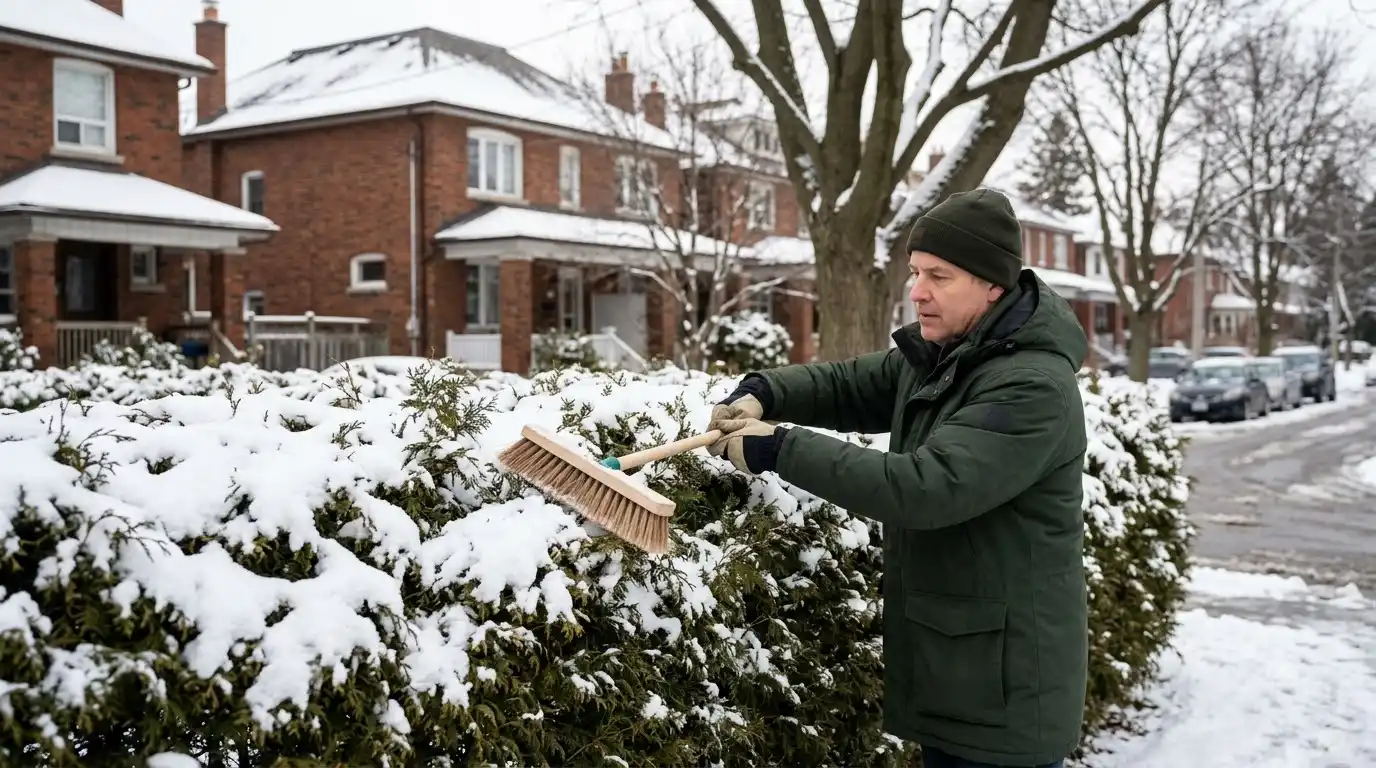
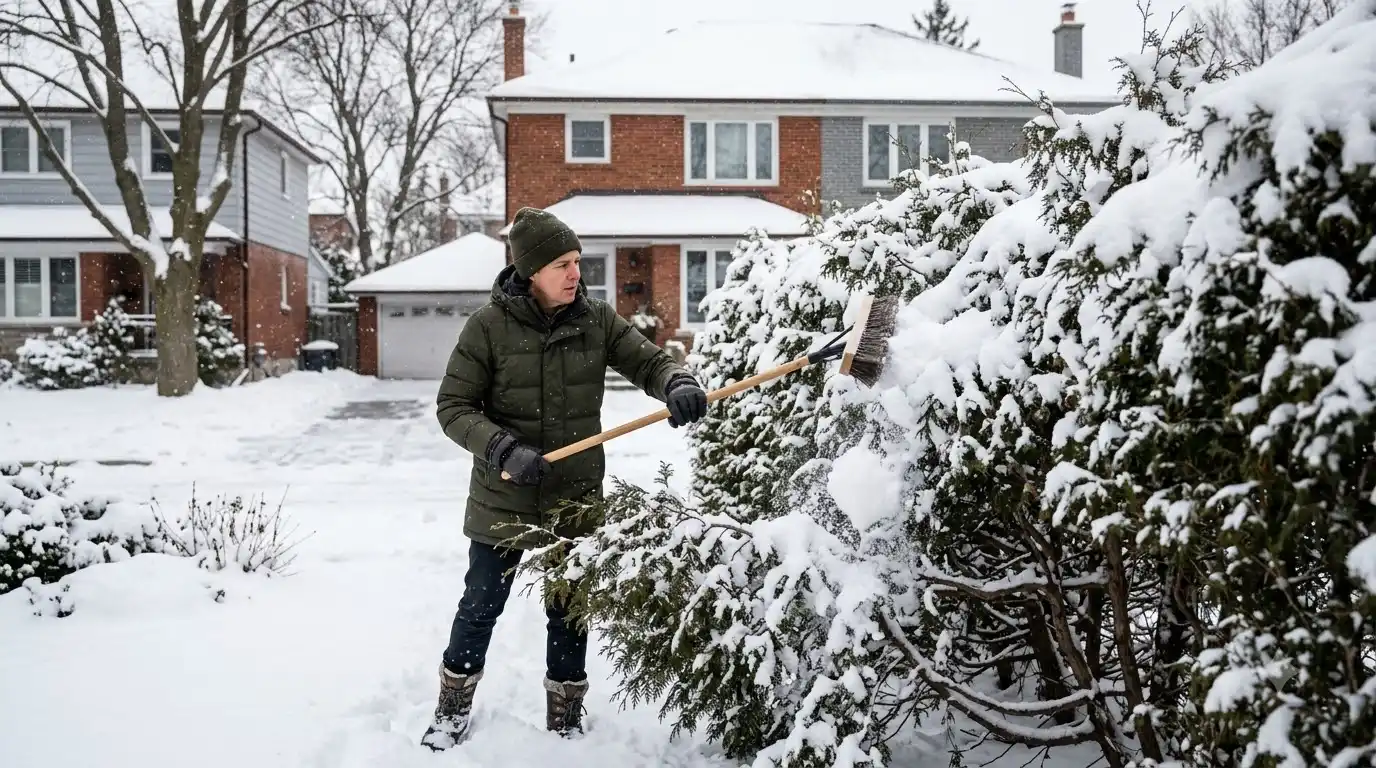
After heavy wet snow, cedar hedges, upright evergreens, and columnar trees may bend under the weight. If branches are reachable from the ground, gently brushing reachable wet snow from branches may help before it freezes into ice. Use a soft broom and sweep upward from below the branch instead of striking or shaking the tree.
Do not try to remove ice from branches. Ice-covered branches are already under stress, and hitting or shaking them can cause breakage. If branches are high, close to wires, split, cracked, or heavily loaded, keep clear and ask a qualified arborist or qualified tree care professional for guidance where appropriate.
Toronto winter tree care: what to consider and what to avoid
- Consider: dormant-season pruning discussions for many deciduous trees after leaf drop.
- Consider: qualified arborist review for deadwood, weak branch unions, decay signs, or storm damage.
- Consider: oak pruning only outside the active oak wilt risk period, unless a qualified arborist advises otherwise for safety reasons.
- Consider: gently brushing wet snow from reachable cedar hedges and columnar evergreens before it freezes.
- Consider: contacting public authorities first for wires, public-road hazards, public trees, or immediate danger.
- Consider: checking Toronto permit rules before removing or injuring a protected private tree.
- Avoid: removing ice from frozen branches by hitting or shaking them.
- Avoid: climbing ladders near damaged trees, hanging limbs, icy branches, or overhead wires.
- Avoid: cutting large storm-damaged limbs without proper training, equipment, and authority where required.
- Avoid: heavy salt use around tree root zones where safer de-icing practices are possible.
Ice Storm Response: What Not to Do
After a significant ice storm, the instinct to do something right away is understandable. In many cases, the safer response is to stay back, document the condition from a safe distance, and contact the correct authority or a qualified professional. Striking ice-covered branches, shaking limbs, or pulling branches with ropes can make a stressed limb fail suddenly.
Large hanging limbs can weigh far more than they appear, especially when loaded with ice or snow. A branch that appears stuck may release suddenly when disturbed. Keep children, pets, vehicles, and foot traffic away from the area until the hazard has been reviewed. If there are wires nearby, do not approach the tree or branch. Contact the utility provider or emergency services first.
After the ice melts, look for obvious warning signs from the ground: split unions, cracked limbs, hanging branches, lifted soil near the root plate, new trunk cracks, fungal growth near the base, or a tree that now leans differently than before. These signs do not automatically mean a tree must be removed, but they do justify a direct discussion with a qualified arborist or qualified tree care professional.
Salt Management Around Trees
Road salt and sidewalk de-icing products can accumulate in the root zones of boulevard trees and private trees near driveways, walkways, and roads. Salt stress may show later as leaf scorch, browning, thinning canopy, twig dieback, or general decline. The impact can be worse where snowmelt repeatedly drains into the same planting bed or tree pit.
Homeowners can reduce winter salt pressure by using the smallest effective amount of de-icer, keeping salty snow piles away from tree trunks where possible, improving drainage away from root zones, and using mulch to help moderate soil conditions. For city-owned boulevard trees or trees near public sidewalks and roads, contact the City of Toronto or 311 where municipal maintenance, public safety, or public property issues are involved.
Winter Assessment Walks
A winter assessment walk can help homeowners spot problems that were hidden by leaves in summer. Walk slowly around each tree from a safe distance and look for dead limbs, broken branches, tight V-shaped unions, mushrooms near the trunk base, bark cracks, cavities, soil lifting, hanging limbs, and branches over roofs, driveways, walkways, or neighbouring property.
Photograph concerns from the ground and avoid touching, climbing, cutting, or pulling damaged branches. Photos can help a qualified arborist or qualified tree care professional understand the situation before a direct review. If the concern involves powerlines, a public road, a city tree, a ravine area, or immediate risk to people or property, contact the utility provider, City of Toronto, emergency services, or the relevant public authority first.
Winter Tree Care in Toronto: Chapter 813 and Winter Tree Work
Toronto’s private tree rules apply in winter just as they apply in other seasons. The City of Toronto explains that private trees measuring 30 cm or more in diameter are protected from injury or removal unless authorized with a permit. The City also states that an application to remove a protected private tree may require items such as an application fee and an arborist report.
Property owners should review the City’s tree and ravine permit guidance and tree permit application information before removing or injuring a protected tree.
Related information: use the service-area pages to find location-specific tree-care and permit guidance.
Frequently Asked Questions
What tree care work is appropriate during Toronto winters?
Winter can be a useful time for dormant season pruning discussions, deadwood review, structural review, and storm-damage planning, especially for deciduous trees after leaf drop. However, actual work should be assessed by a qualified arborist or qualified tree care professional based on species, site conditions, weather, safety, and Toronto bylaw requirements.
Should I brush snow off my trees after a snowstorm in Toronto?
For cedar hedges, columnar evergreens, and small reachable branches, gently brushing reachable wet snow from branches may help before it freezes into ice. Use a soft upward sweeping motion from the ground and do not strike branches. Do not attempt to remove ice from branches, climb ladders, pull hanging limbs, or approach trees near wires. For powerline contact, public-road hazards, or immediate danger, contact emergency services, the utility provider, the City of Toronto, or the relevant public authority first.
Are ice storms more damaging to some tree species than others in Toronto?
Yes. Trees with co-dominant stems, included bark, prior storm damage, decay, dense crowns, or weak branch unions may be more vulnerable to ice loading. Silver maple, ornamental cherries, columnar trees, and previously compromised trees can be affected more severely depending on their structure and condition. Homeowners should stay clear of cracked, hanging, or ice-loaded limbs and request a qualified arborist review where appropriate.
Does Chapter 813 apply to trees damaged in an ice storm in Toronto?
Toronto’s private tree rules can still apply to protected trees damaged during winter storms. The City has rules for bylaw-protected private trees and exceptions may apply for terminally diseased, dead, or imminently hazardous trees when certified as such by an arborist. Property owners should confirm the correct process directly with the City of Toronto, 311, or an ISA Certified Arborist.
Related Guides and Services
- Prepare Your Trees for a Toronto Winter
- Fall Tree Pruning in Toronto
- Hazardous Tree Identification Toronto
- Storm Damaged Tree Toronto
- Urgent Tree Requests