
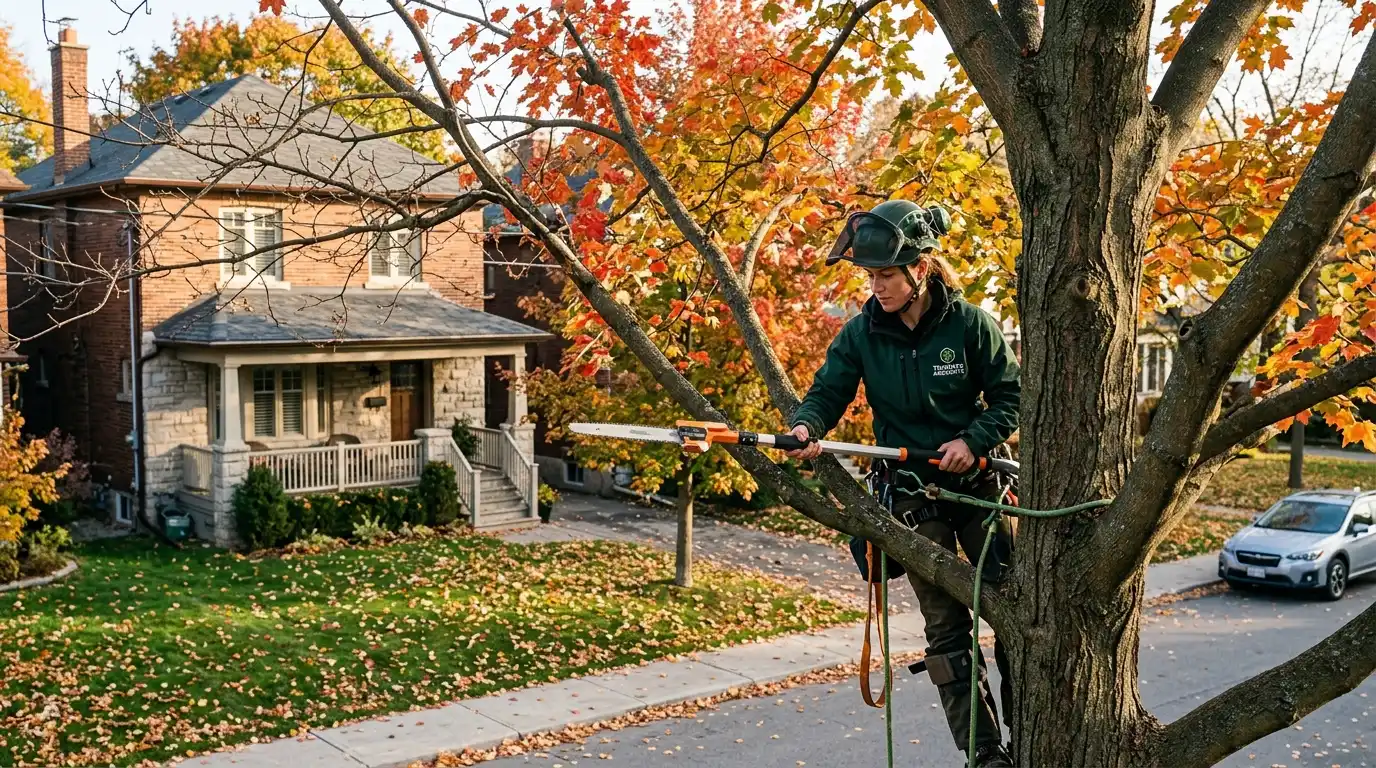
Questions about fall tree care in Toronto usually come down to the rules, site conditions, risks and practical options for the property. Fall is a practical season for Toronto and GTA homeowners to review tree condition before snow, ice, freeze-thaw cycles, and winter winds arrive. Once leaves begin to drop, structural concerns such as deadwood, weak unions, trunk cracks, fungal growth, and poor branch spacing can become easier to see from the ground. A careful fall walkaround can help you decide what needs urgent attention, what may need a qualified arborist assessment, and what can often wait until spring.
For post-winter inspection and recovery, see the spring tree care checklist for Toronto.
1. Walk your property after major leaf drop
Late October through November is often a useful time to review deciduous trees because the canopy is more open and the branch structure is easier to see. Look from the ground only. Do not climb the tree or stand under damaged limbs. Check for large dead branches, cracked unions, hanging limbs, trunk splits, new lean, fungal growth, and signs of root movement.
2. Identify deadwood before snow and ice add weight
Dead branches can become more dangerous in winter because ice and snow add load to already brittle wood. A large dead branch above a driveway, walkway, roof, deck, vehicle, play area, or neighbour’s property should be treated as more urgent than small dead tips in a low-use area. A qualified arborist or qualified tree care professional may assess the tree and discuss whether pruning is appropriate.
3. Assess co-dominant stems and included bark
Co-dominant stems are similarly sized stems growing from the same area. When bark is included between them, the union may be weaker and more prone to splitting under wind, snow, or ice load. Walk around significant trees and look for fresh cracks, bark separation, oozing, widening gaps, or visible movement at major unions. A large tree with a cracked union over a high-use area should be reviewed promptly by a qualified arborist.
4. Check for new fungal growth
Fall can make mushrooms, shelf fungi, and conks easier to notice at the trunk, root flare, or major branches. Fungal growth does not automatically mean a tree must be removed, but it can indicate decay or root issues that need closer review. Trees with significant fungal growth near homes, sidewalks, driveways, decks, fences, or neighbour areas should be assessed by a qualified arborist or qualified tree professional.
5. Refresh mulch around the root zone
A moderate mulch ring can help protect roots, improve soil conditions, conserve moisture, and reduce competition from turf. Keep mulch away from the trunk flare. Do not pile mulch or wet leaves against the bark. A thin, even layer over the root zone is usually safer than a deep mound against the trunk.
Fall tree care: what may need attention first
- Request qualified arborist review soon: Large deadwood, cracked co-dominant unions, fungal growth at the base, visible root heave, a new lean, or storm-damaged limbs over high-use areas
- Plan before winter: Pruning needs, hazard assessments, replacement planting questions, and planned removals where permit status may need to be checked
- Often reasonable to monitor: Small dead twigs, minor leaf-drop differences, low-risk deadwood in unused areas, or minor bark cracks without decay signs
- Do now: Pull mulch away from the trunk, water newly planted trees if fall is dry, and check whether planned removals may require municipal approval
- Do not DIY: Large dead limbs, high canopy work, branches near wires, branches over structures, or cutting under tension
Oak and Elm: Why Timing Matters
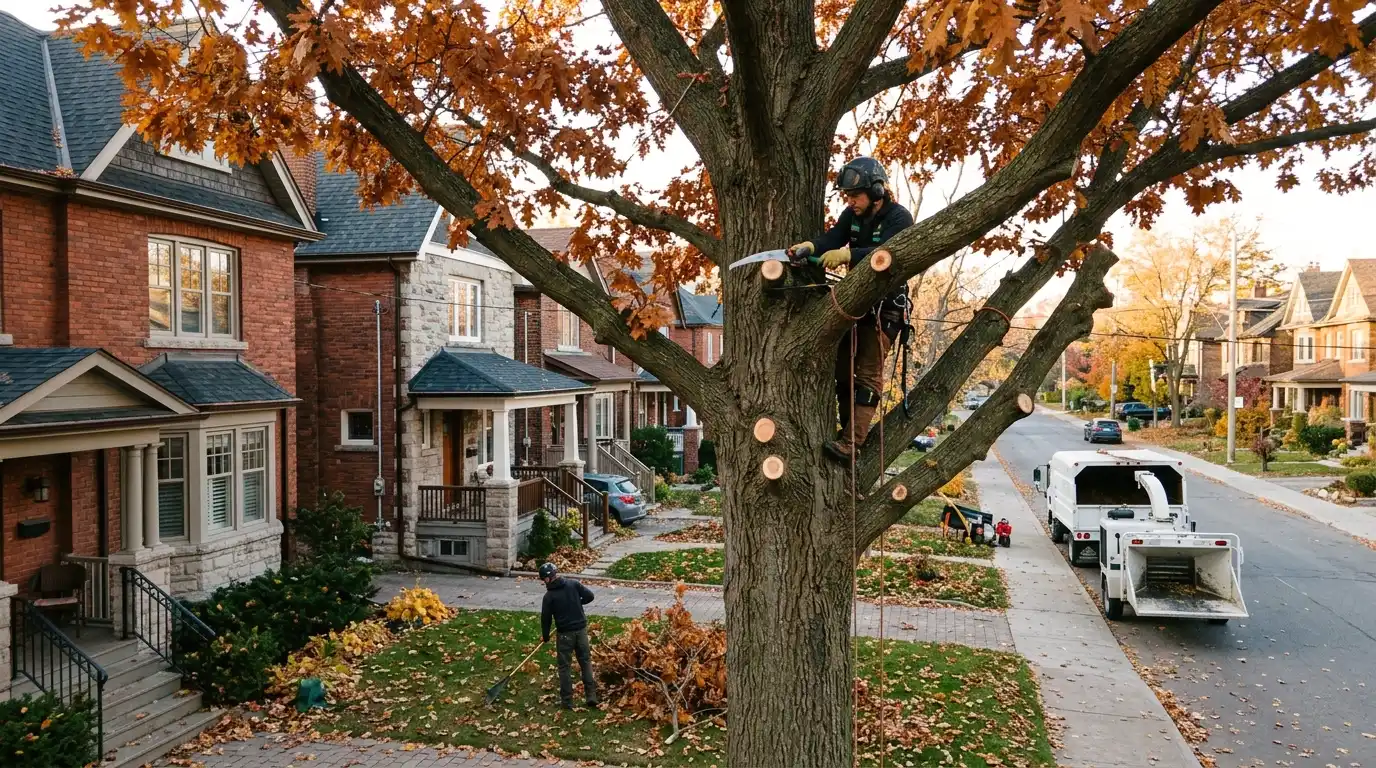
Oak pruning deserves special caution because oak wilt has been found in Ontario. Ontario advises not pruning or wounding oaks from the beginning of April to the end of July, which is the high-risk period. Ideally, oaks should not be pruned or wounded from April through November while sap beetles that spread oak wilt are active.
That makes late fall and winter an important period to discuss non-urgent oak pruning where appropriate. If an oak has storm damage, broken branches, or an urgent hazard outside the preferred window, a qualified arborist should discuss the safest next step with the property owner. In some cases, wound treatment may be discussed for cuts made during higher-risk periods.
Elm trees and other species can also have species-specific timing concerns. The right pruning time should be based on species, tree condition, disease risk, safety concerns, and the purpose of the work.
Planning Permit-Required Work Before Winter
If a fall assessment suggests that a tree may need removal, root work, construction-related disturbance, or pruning that could injure a protected tree, confirm requirements before work begins. Toronto says routine private-tree pruning performed according to good arboricultural practice does not require a permit. Removal or injury of a protected private tree, work on City trees, and ravine or natural-feature work can follow different rules.
Permit timing depends on the municipality, application completeness, documentation, site conditions, inspection needs, and current review volume. For Toronto, the City states that incomplete applications will not be processed. If you want planned work completed during winter, start permit-related checks early and confirm current requirements directly with the City, the relevant municipality, or a qualified arborist.
For more background, see the Toronto tree removal permit guide and the guide on when the best time may be to remove a tree in Ontario.
Evergreens in Fall
Evergreens do not drop all their foliage like deciduous trees, but fall care still matters. A deep watering before freeze-up may help newly planted evergreens, stressed evergreens, and broad-leaved evergreens enter winter with better soil moisture, especially after a dry fall. Water near the root zone rather than directly against the trunk.
Evergreens with browning on one side, thinning, interior dieback, pest symptoms, or sudden decline may need closer review. Salt exposure, poor drainage, winter burn, root damage, compacted soil, and construction stress can all affect evergreen condition. A qualified arborist or qualified tree care professional may discuss visible symptoms and possible next steps.
Fall Tree Concern?
Fall Soil, Leaf, and Root-Zone Care
Leaves are not automatically a problem. A thin layer of shredded leaves can add organic matter and support soil health, but a thick wet mat piled against the trunk can trap moisture against bark and create pest or decay concerns. Keep leaves and mulch pulled back from the trunk flare.
Fall is also a good time to check whether soil has become compacted around the root zone. Vehicles, foot traffic, construction materials, soil piles, and repeated equipment movement can damage roots and reduce oxygen in the soil. Avoid storing materials or parking vehicles over major root areas.
If the fall has been dry, newly planted trees may need deep watering before the ground freezes. Established healthy deciduous trees may not need extra watering unless drought or stress is present. Evergreens can be more sensitive to winter moisture stress because they continue losing moisture through foliage during cold months.
Fall Tree Care and Insurance Documentation
If fall storm damage affects a roof, fence, vehicle, garage, shed, neighbour property, driveway, or public access, document the scene before cleanup where it is safe. Take photos from several angles and contact your insurer directly to confirm documentation requirements.
Frequently Asked Questions
When should I request fall tree care in Toronto?
Many homeowners start fall tree reviews in September or October so visible hazards, deadwood, weak unions, and planned winter work can be discussed before snow and ice arrive. Timing depends on species, tree condition, site risk, contractor availability, and whether permit-related issues apply.
Is fall a good time to remove a tree in the GTA?
Fall and early winter can be practical windows for planned tree removal because many trees are entering dormancy and access conditions may be clearer before deep winter weather. If the tree is protected, permit requirements must be confirmed before work begins.
Can I prune my maple tree in fall in Toronto?
Maples are often reviewed for pruning during dormant or lower-stress periods, but the right timing depends on tree condition, pruning objective, weather, and site risk. Discuss the specific tree and pruning scope directly with a qualified arborist or qualified tree care professional.
What should I do with leaves around my trees in fall?
A thin layer of leaves or mulch around the root zone can support soil health, but material should not be piled against the trunk. Keep mulch or leaf buildup away from the trunk flare to reduce moisture problems, bark decay risk, and pest shelter.
Do trees need watering before the ground freezes in Toronto?
Newly planted trees, stressed trees, and evergreens may benefit from deep watering in fall before the ground freezes, especially after a dry autumn. Healthy established deciduous trees may not need extra watering unless drought or site stress is present.
Related Guides
- Best Time to Remove a Tree in Ontario
- Spring Tree Care Checklist Toronto
- Tree Removal Permit Toronto
- Dangerous Tree Assessment Toronto
- Tree Pruning Requests