
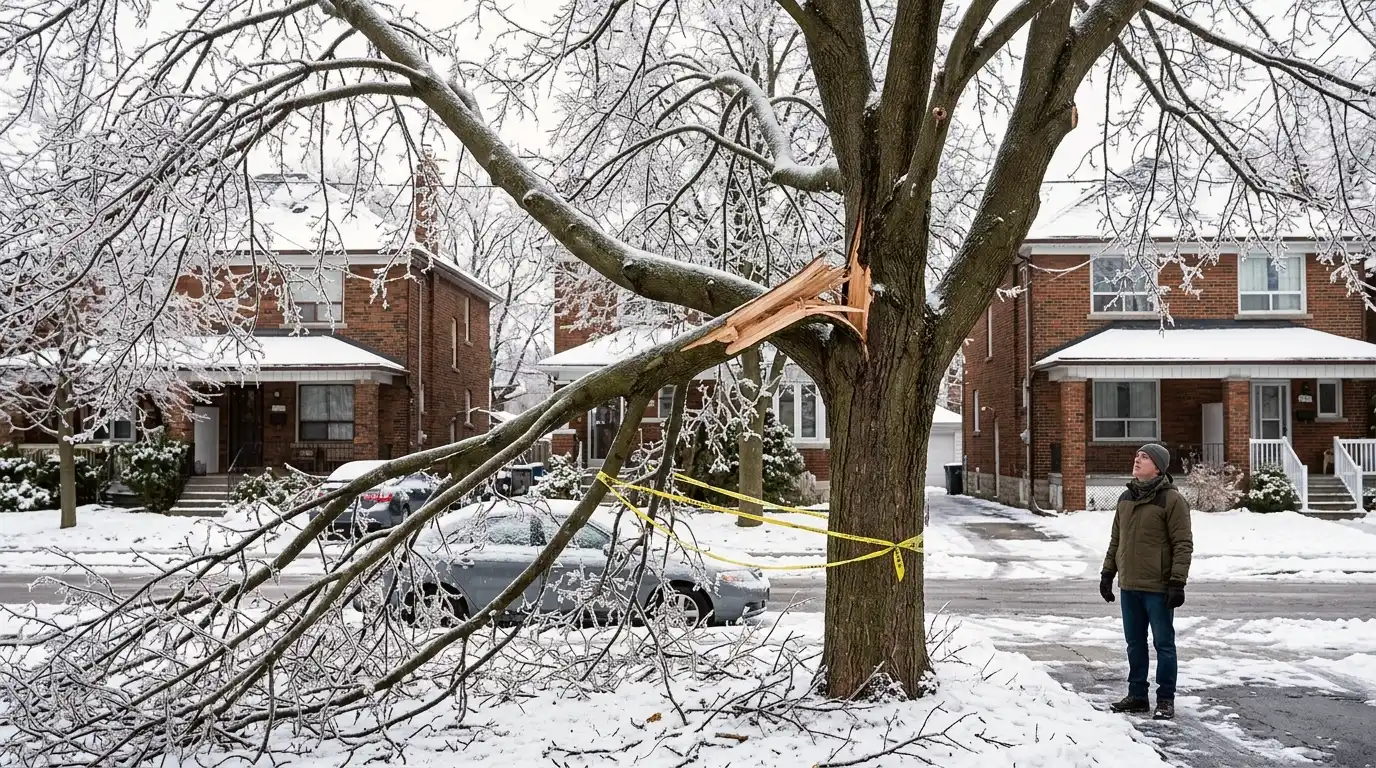
The practical issues around ice storm tree damage in Toronto include tree condition, property context and any rules that affect the work. Ice storms can create serious tree hazards across Toronto because freezing rain adds weight to every branch, stem, and weak attachment point at the same time. A tree that looks stable during ordinary wind can split, bend, or drop limbs under ice load. After an ice storm, the safest first step is to stay away from loaded branches, check for power-line or structural hazards from a distance, document damage where safe, and request professional guidance before anyone starts cutting.
If storm damage involves overhead conductors, review the safety guidance for a tree near power lines in Toronto.
Why Ice Storms Are Uniquely Destructive
During freezing rain, water lands on branches and freezes into a heavy coating. That weight does not only affect one exposed side of the tree. It loads small twigs, lateral limbs, scaffold branches, co-dominant stems, old pruning wounds, weak unions, and root systems across the entire canopy.
Ice storm damage is different from ordinary wind damage. Wind produces movement and directional force. Ice adds static weight that keeps building until a weak point fails. Failures can also happen later as ice melts, shifts, and refreezes. A tree that appears quiet in the morning may still drop large limbs later in the day, especially when temperatures rise, wind returns, or the branch begins to shed ice unevenly.
What to Do Immediately After the Storm
Stay away from heavily ice-loaded trees. Do not walk under the canopy, park below damaged limbs, or let children and pets near the drip line. If a branch is hanging, cracked, or partially attached, assume it can fall without warning.
If a tree or branch is touching or near power lines, stay back and contact the appropriate electrical utility. If there is immediate danger to life, call 911 first. Do not shake the tree, pull branches, climb the tree, use a ladder, or try to cut ice-loaded limbs yourself. A branch under ice load can release suddenly and move in a direction that is difficult to predict.
If the issue involves a City-owned tree, a blocked public sidewalk, or a road, contact 311. For a dangerous private tree, keep clear of the area and arrange assessment by a qualified arborist; 311 can investigate dangerous private-tree concerns, but private-tree maintenance remains the property owner’s responsibility.
Priority sequence after a Toronto ice storm:
- Immediate: Stay away from ice-loaded trees and call 911 if there is danger to life.
- Power-line concern: Stay back and contact the electrical utility before anyone approaches the tree.
- Public hazard: Contact 311 for City-owned trees, blocked roads, blocked sidewalks, or immediate public hazards.
- Private-property hazard: Keep people clear, advise the property owner where relevant, and arrange qualified arborist assessment. Toronto also accepts 311 reports for dangerous private-tree concerns.
- Follow-up: Once immediate hazards are handled, review remaining trees for cracks, hanging branches, trunk splits, and root movement.
- Do not: Shake ice off branches, walk under damaged canopies, or attempt DIY cutting under ice-loaded limbs.
Assessing What Can Be Saved
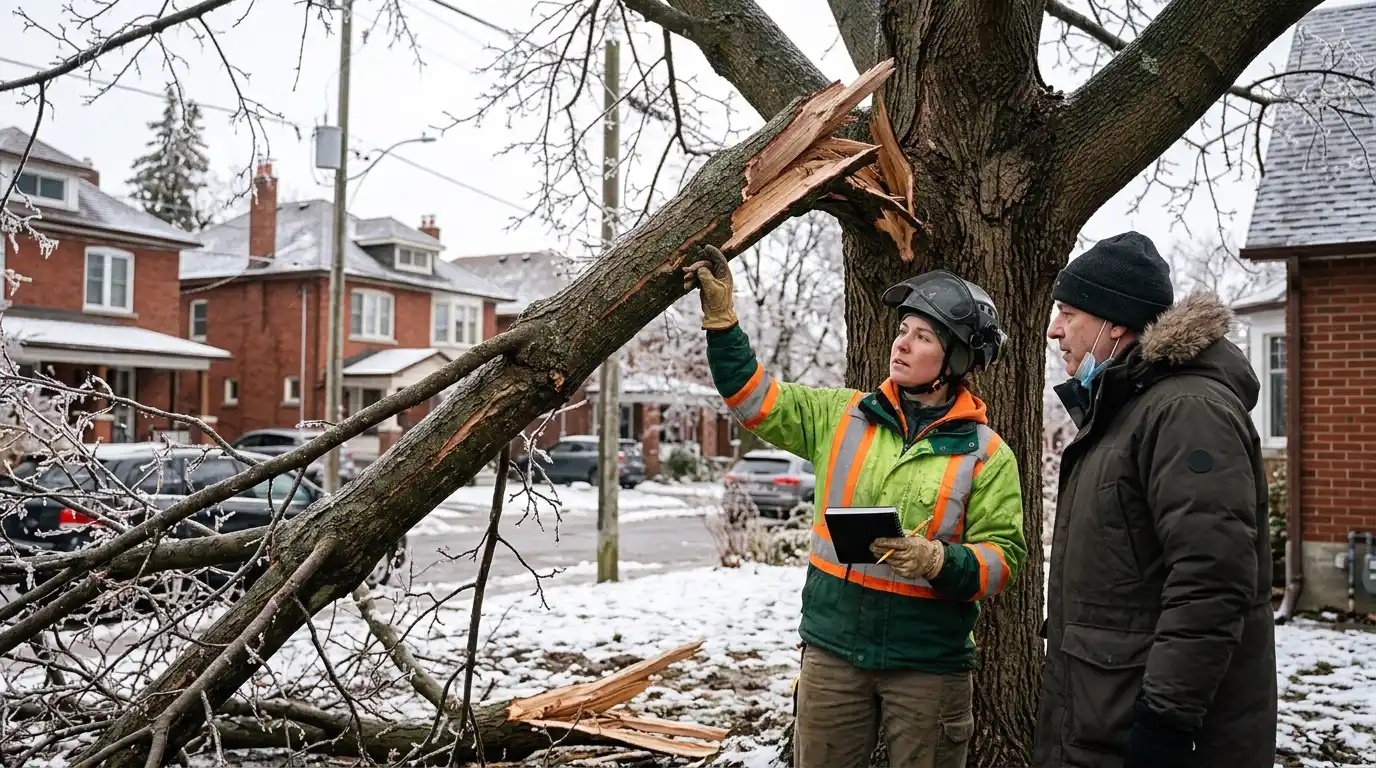
The key question after ice damage is whether the tree’s main structure is still sound. A tree may recover if the trunk is intact, the root plate has not lifted, most scaffold branches are still attached, and the damage is mostly limited to smaller limbs, outer canopy, or branch tips.
Recovery is less likely when there is a vertical split through the trunk, major scaffold branches are torn from their unions, the root plate has shifted, the tree has a new lean, or a large portion of the live crown is gone. A tree can still be alive but no longer structurally reasonable to retain if the remaining canopy and branch architecture are too compromised.
A qualified arborist may assess species, trunk condition, scaffold branches, wound size, root stability, canopy loss, decay, nearby targets, and possible pruning or removal options.
Corrective Pruning After Ice Damage
If the tree is salvageable, corrective pruning usually focuses on removing broken branches, cracked limbs, torn stubs, and hanging sections while preserving as much healthy canopy as possible. The goal is not to make the tree look perfectly symmetrical immediately after the storm. The goal is to remove hazards and help the remaining structure recover.
Over-pruning after ice damage can harm a tree that might otherwise survive. The remaining canopy helps the tree produce energy, close wounds, and rebuild structure during the next growing seasons. Heavy topping, stripping, or unnecessary live-branch removal can create more stress and future defects.
Timing depends on species, severity, hazard level, and weather. Because ice storms often happen in winter or early spring, corrective pruning may occur close to the growing season. Species-specific issues still matter. For example, oak pruning has added timing concerns because of oak wilt risk in Ontario. A qualified arborist may discuss the correct timing and pruning approach with the property owner.
The Permit Question After Ice Storm Removal
Toronto’s storm-damage guidance says an imminently hazardous private tree may be removed without a standard permit and asks owners or arborists to take photos and advise 311. The City’s general permit page also uses a permit-exception confirmation process, with confirmation expected before work unless immediate tree work is required to eliminate a dangerous situation. If the tree is damaged but not an imminent hazard, normal tree and ravine requirements may still apply.
If the damaged tree is not an imminent hazard, normal tree and ravine permit requirements may still apply. Toronto generally requires a permit to injure or remove a bylaw-protected tree, ravine, or natural feature. A tree in or near a ravine or natural feature area may also raise restoration or authorization issues beyond ordinary private-tree removal.
Ice Storm Tree Damage in Toronto: Ice Storm Damage Concern
Documentation and Insurance After Ice Storm Damage
If ice storm damage affects a roof, vehicle, garage, shed, fence, neighbour’s property, driveway, or public access, document the scene before cleanup where it is safe. Take photos from several angles, showing the full tree, broken branches, trunk or root failure, and all visible property damage.
Contact your insurer directly to confirm what they need before major cleanup begins. If there is structural damage, your insurer may want photos, invoices, contractor notes, or an adjuster review.
Should You Shake Ice Off Tree Branches?
No. Shaking ice-loaded branches can cause sudden branch failure, bark damage, splitting, or injury. The branch is already under stress, and the added movement can trigger a break that may not have happened on its own.
Even if the tree looks flexible, loaded branches can snap or spring back unpredictably. Stay back and allow ice to melt naturally. If a branch is bending severely over a walkway, driveway, roof, service line, or public area, keep the area clear and speak with a qualified arborist or tree care professional.
What Happens After the Immediate Hazard Is Cleared
Once the immediate hazard is addressed, review the remaining tree and the rest of the property. Ice storms often create secondary damage that is less obvious, such as cracked unions, hanging branches higher in the canopy, bark tearing, limb fractures, or new leans.
If a stump remains after lawful removal, stump grinding may be discussed later once the area is safe and any utility-locate issues are clear. If a major shade tree is lost, replacement planting may also be worth considering. Replacement requirements depend on City rules, hazard status, property location, ravine context, permit conditions, and whether the tree was protected.
For more general storm response steps, see the emergency tree removal Toronto guide. For pruning versus removal decisions after storm damage, see the storm tree damage guide.
Frequently Asked Questions
When should I contact an arborist after an ice storm in Toronto?
Contact a qualified arborist or qualified tree care professional the same day if there are large hanging branches, a tree leaning against a structure, a partial uprooting, or branches near wires. For visible damage that is not an active hazard, assessment within a few days may be reasonable. Stay away from heavily ice-loaded trees because delayed branch failure can happen after the storm.
Can ice-damaged trees recover in Toronto?
Many can recover if the main trunk, roots, and major scaffold structure remain stable. Trees with mostly smaller branch breaks may be candidates for corrective pruning. Trees with trunk splits, lifted roots, major scaffold failure, or severe crown loss may need removal discussed with a qualified arborist or tree care professional.
Does ice storm damage to a Toronto tree require a permit?
For a true imminent hazard, Toronto’s storm guidance says the tree may be removed without a standard permit and asks owners or arborists to take photos and advise 311. The City’s general permit page also provides a permit-exception confirmation process and expects confirmation before work unless immediate action is necessary to eliminate a dangerous situation.
Why do ice storms cause more tree damage than regular winter storms?
Ice accumulation adds heavy static weight across branches and branch unions. This can expose structural weaknesses such as included bark, co-dominant stems, decay, weak attachments, and old storm wounds. Failures can continue as ice melts, shifts, and refreezes.
Should I shake ice off my trees after a Toronto ice storm?
No. Shaking ice-loaded branches can trigger sudden failure and cause injury or additional tree damage. Stay away from loaded branches, avoid standing under the canopy, and speak with a qualified arborist or tree care professional if the tree appears damaged or hazardous.
Related Guides
- Emergency Tree Removal Toronto
- Storm Tree Damage: Pruning vs Removal
- Dangerous Tree Assessment Toronto
- Signs Your Tree Is Dead or Dying
- Urgent Tree Requests