Start With Safety Before Choosing Pruning or Removal
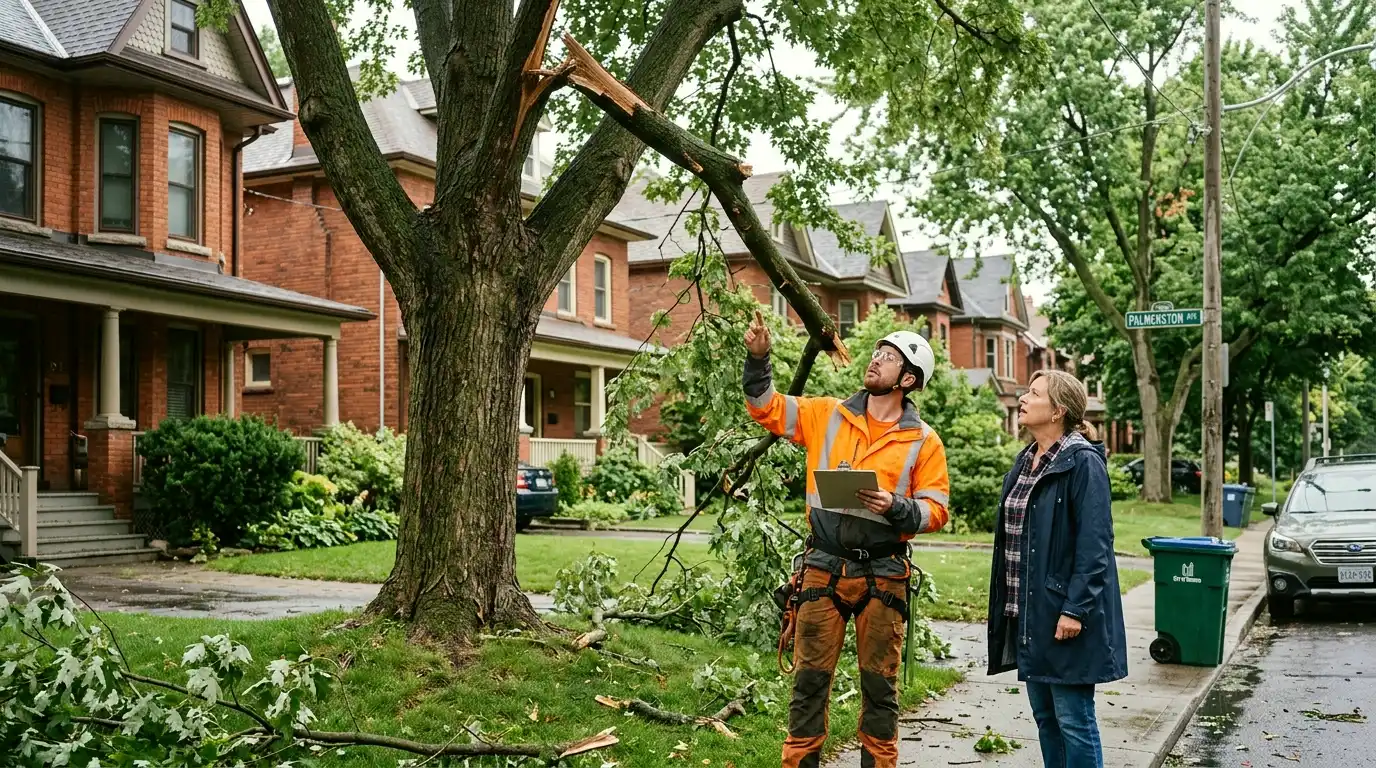
Questions about storm tree damage in Toronto usually come down to the rules, site conditions, risks and practical options for the property. After a storm, the first question is usually whether the damaged tree can be stabilized with pruning or whether removal needs to be discussed. Some trees lose branches but keep a sound trunk, stable roots, and enough live canopy to recover. Others suffer trunk splits, lifted roots, major scaffold failure, or hanging limbs that create a serious hazard. The safest first step is to keep people away from the damaged area, identify any immediate danger, and get proper guidance before cutting or moving heavy branches.
For cold-weather damage specifically, see what to do after ice storm tree damage in Toronto.
Step One: Assess the Immediate Hazard
Before thinking about pruning or removal, look at whether the tree or any part of it is touching a structure, blocking access, leaning suddenly, resting on wires, or holding large hanging limbs. A branch resting on a roof can create structural and water-entry concerns. A branch in contact with wires is a serious safety issue. A tree that has partially uprooted and is leaning after saturated soil may continue moving.
Keep family members, visitors, pets, and vehicles away from the damaged area. Do not walk under hanging limbs. Do not climb the tree. Do not try to pull branches off wires, roofs, fences, sheds, or vehicles. If a City-owned tree has fallen or creates a hazard to pedestrians or traffic, contact 311. If a privately owned tree presents an immediate danger, Toronto also directs residents to contact 311 so a service request can be created.
For private-property tree damage, a qualified arborist or qualified tree care professional may assess the visible hazard, discuss pruning or removal options, provide an estimate, and handle work with the property owner.
What Can Often Be Saved: Signs a Tree May Be Recoverable
A storm-damaged tree may be recoverable when the main trunk is still intact, the root plate has not lifted, the primary scaffold structure remains sound, and the broken branches are mostly smaller limbs or outer canopy branches. Trees that keep most of their live crown and do not show major structural failure may respond well to corrective pruning.
Hardwood trees such as maples, oaks, and elms can sometimes recover from branch loss when the pruning cuts are made properly and the remaining canopy is not over-thinned. The goal is usually to remove broken stubs, hanging limbs, cracked branches, and unstable pieces while keeping enough healthy canopy for recovery.
A qualified arborist may assess species, branch attachment, wound size, decay, trunk condition, root stability, remaining crown, and nearby targets.
What May Not Be Safe to Retain
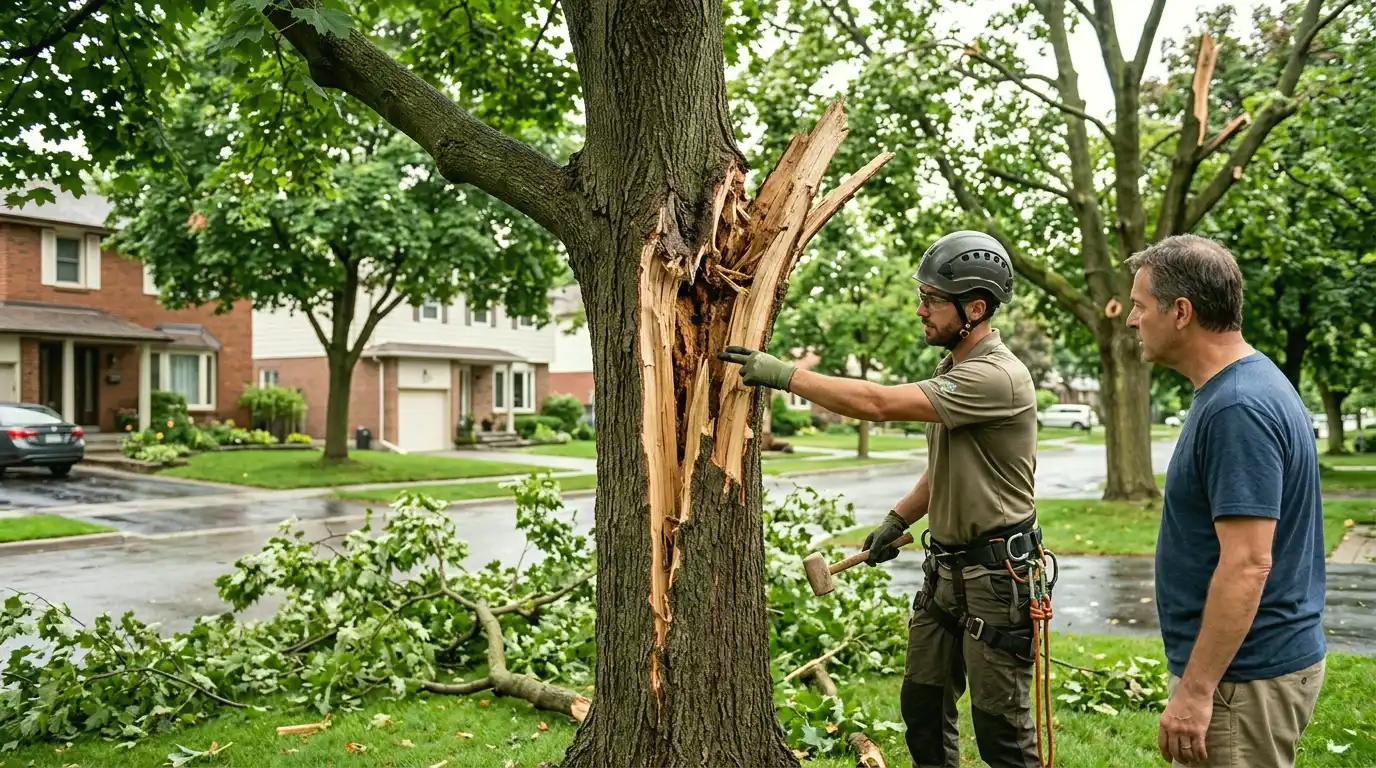
Some storm failures leave a tree too compromised to reasonably retain. Serious warning signs include a vertical split in the main trunk, root plate movement, soil cracking at the base, a sudden new lean, multiple large scaffold failures, or major wounds where large limbs tore out of the trunk.
A tree that has lost most of its canopy may still be alive, but that does not always mean it is safe or worth preserving. A few surviving branches on an unstable trunk are not the same as a recoverable structure. The decision depends on the tree’s species, size, health, remaining architecture, targets below it, and whether the remaining defects create unacceptable risk.
If a tree is near a house, garage, driveway, sidewalk, road, utility line, neighbour’s property, or public area, the threshold for caution should be higher. Do not rely on a quick visual guess from the ground if the tree has major damage.
Quick field assessment after a storm:
- Trunk intact with smaller branch breaks: May be salvageable with corrective pruning.
- Large scaffold branch torn at the union: Needs careful assessment, especially if the wound is large.
- Vertical split in the main trunk or co-dominant stem: Serious structural concern that may make removal more likely.
- Root plate movement or soil cracking at the base: Treat as urgent and keep away from the tree.
- Large hanging limbs: Do not stand underneath or attempt removal without proper equipment.
- Major canopy loss: Recovery depends on remaining structure, species, health, and site risk.
Corrective Pruning After a Storm
When a tree is considered salvageable, corrective pruning usually focuses on removing broken branches, loose hangers, cracked limbs, and torn stubs while preserving as much healthy live canopy as possible. Good storm pruning is targeted. It is not topping, stripping, or cutting back the entire canopy to make the tree look even.
Over-pruning after a storm can make a stressed tree worse. The remaining canopy is what the tree uses to produce energy and recover. Removing too much live material can reduce the tree’s ability to compartmentalize wounds, rebuild strength, and survive the next growing season.
Species and timing matter. For example, oak pruning has additional disease-timing concerns in Ontario because of oak wilt risk. A qualified arborist may discuss species-specific timing, pruning approach, and safety considerations with the property owner.
The Permit Question After a Storm
Toronto’s current permit guidance treats an imminently hazardous private tree as a permit-exception situation. The owner must request and receive exception confirmation before removal or injury unless immediate tree work is required to eliminate a dangerous situation. If a storm-damaged protected tree is not an imminent hazard, the ordinary tree or ravine permit process may still apply.
That does not mean every storm-damaged protected tree can be removed without checking. If the tree is damaged but not an imminent hazard, Toronto’s standard tree and ravine permit rules may still apply. Toronto requires a permit to injure or remove a bylaw-protected tree, ravine, or natural feature. Private trees, City-owned trees, ravine or natural feature areas, and neighbouring or boundary trees can all raise different issues.
Storm Tree Damage in Toronto: Storm Damage Concern
After the Storm: Planning for Replacement
If a storm-damaged tree is removed, replacement planting may still need to be considered. The details depend on whether the tree was protected, whether a permit or City record applies, whether the tree was imminently hazardous, and whether any City conditions are issued. If the tree was in a ravine or natural feature area, restoration or additional rules may also be relevant.
Replacement planting is also practical. A large storm-damaged tree can leave a property exposed, hotter, less private, and more vulnerable to wind and runoff. Choosing a suitable replacement species, planting it in the right location, and giving it enough soil and space can help rebuild canopy over time.
For general background on Toronto’s canopy goals and replacement planting context, see the guide to Toronto’s urban tree canopy and what homeowners need to know.
Insurance and Storm-Damaged Trees
If a storm-damaged tree affects a roof, vehicle, fence, shed, garage, neighbour’s property, or public access, contact your insurer directly to confirm documentation requirements before cleanup where it is safe to do so. Photos, dates, visible damage notes, and contractor invoices may matter for an insurance file.
Who Handles Debris After a Storm?
Debris responsibility depends on tree ownership, where the debris landed, and whether it creates a public hazard. If a City-owned tree or large branch has fallen or is posing a hazard to pedestrians or traffic, report it through 311. If a private tree presents an immediate danger, contact 311 to create a service request and arrange private help where needed.
For private-property storm debris, the property owner generally needs to arrange cleanup directly with a qualified tree contractor or tree care professional. If debris is blocking a road, sidewalk, shared driveway, or public access, report the hazard promptly and keep people away until the situation is addressed.
Frequently Asked Questions
After a storm, how quickly should a damaged tree be checked in Toronto?
Immediately if the tree is touching a structure, blocking access, leaning suddenly, resting on wires, or holding large hanging limbs. Keep people and vehicles away from the area. Contact 311 for City-owned trees, public hazards, or privately owned trees that present an immediate danger. For private tree work, speak directly with a qualified arborist or tree care professional.
Do I need a permit to remove a storm-damaged tree in Toronto?
An imminently hazardous private tree may qualify for Toronto’s permit-exception process rather than a standard permit. The City says exception confirmation is required before work unless immediate tree work is necessary to eliminate a dangerous situation. If the damage is not an imminent hazard, standard tree or ravine permit requirements may still apply.
How do I know if a storm-damaged tree can be saved or needs removal?
Key factors include live crown loss, trunk splits, major scaffold branch failure, wound size, root plate movement, sudden lean, decay, species, and nearby targets. A qualified arborist may assess the tree with the property owner.
My tree split down the middle in the storm. Can it be saved?
A vertical split through the main trunk or a major co-dominant stem union is a serious structural concern. Some split trees may not be safe to retain, but the answer depends on species, size, remaining structure, location, and risk. Get an in-person assessment from a qualified arborist.
Who is responsible for storm debris from my tree?
Responsibility depends on ownership, debris location, and whether there is a public hazard. City-owned tree hazards and public right-of-way hazards should be reported through 311.
Related Guides
- Signs Your Tree Is Dead or Dying
- Dangerous Tree Assessment Toronto
- Tree Removal Permit Toronto
- Home Insurance Tree Removal Toronto
- Urgent Tree Requests
- Tree Pruning Requests