
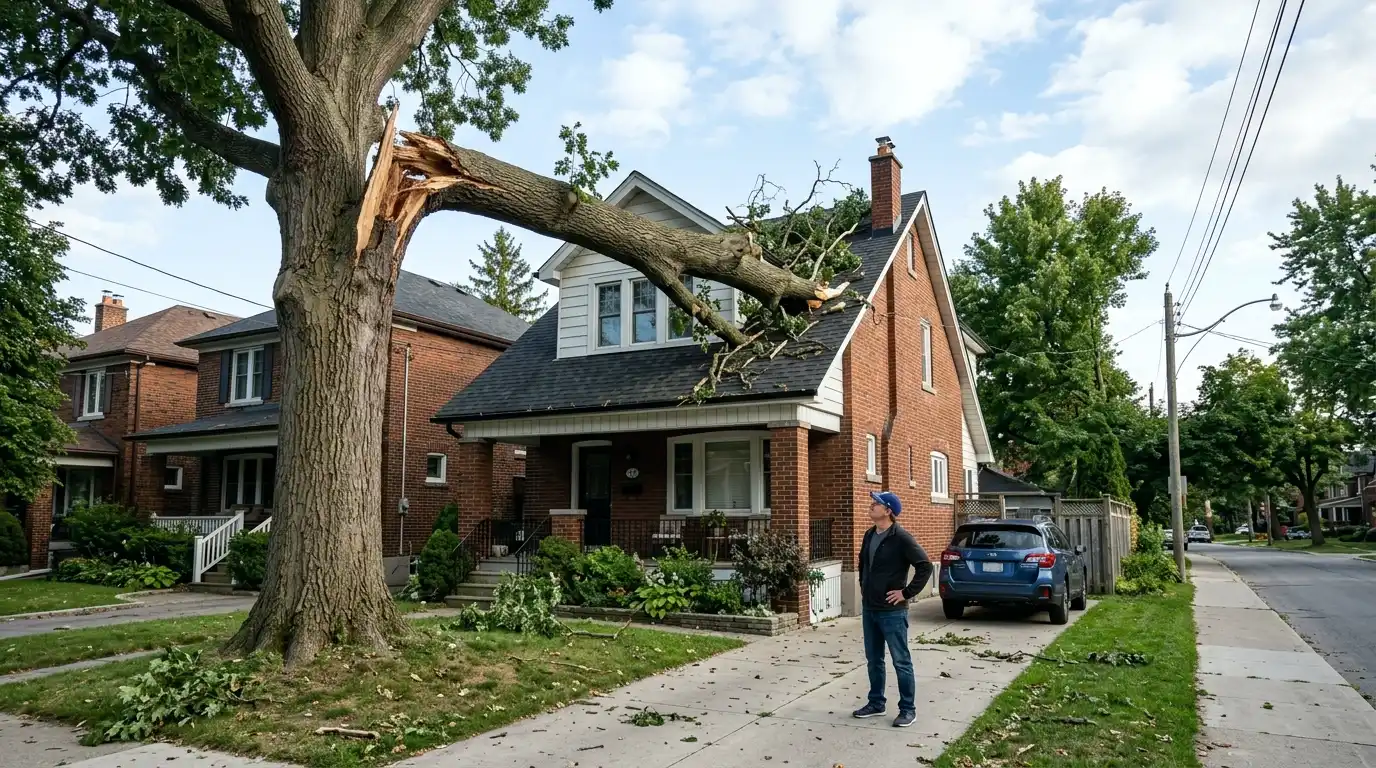
A useful way to approach storm-damaged tree in Toronto is to start with property conditions, safety concerns and any local rules that apply. A storm can leave behind several urgent problems at once: immediate life safety concerns, property damage, insurance documentation, tree removal or pruning decisions, and possible Chapter 813 reporting obligations if a protected Toronto tree is involved. Most homeowners dealing with storm tree damage for the first time are not sure what to do first. The safest sequence is simple: stay clear of danger, rule out powerline involvement, document the damage, contact your insurer where needed, and then request help from a qualified tree care professional.
Current City source: City of Toronto — Storm Damage to Trees.
Step One: Power Lines First, Always
If any fallen tree or branch is in contact with, draped over, or close to overhead power lines, treat the area as energized and dangerous until a utility professional confirms otherwise. Call Toronto Hydro at 416-542-8000 for distribution-line concerns in Toronto. Do not attempt to judge whether a downed or sagging line is safe. Do not touch any wire, tree, fence, vehicle, branch, or object that may be touching a wire. Do not drive over a wire on the ground. When utility contact is possible, the first call should be to the utility provider or the appropriate emergency authority, not to a tree worker.
Once powerline contact has been ruled out or handled by the proper authority, the matter may become a tree-related emergency.
Step Two: Document Before Cleanup
Before any cleanup or tree work begins, photograph the damage from a safe distance. Take photos from multiple angles showing the tree’s position, the failed limb or trunk, any contact with buildings, fences, vehicles, garages, sheds, or neighbouring property, and any visible pre-existing defects such as decay, dead wood, cracking, or old storm damage. Dated photographs can be useful for insurance discussions, municipal questions, and any later review of what happened.
Do not climb onto roofs, stand under suspended branches, or enter unstable areas just to get a better photo. Documentation matters, but personal safety matters more. If the tree is resting on a structure, leaning heavily, split through the trunk, or suspended under tension, stay back and wait for a qualified professional to assess the situation.
Step Three: Secure the Scene
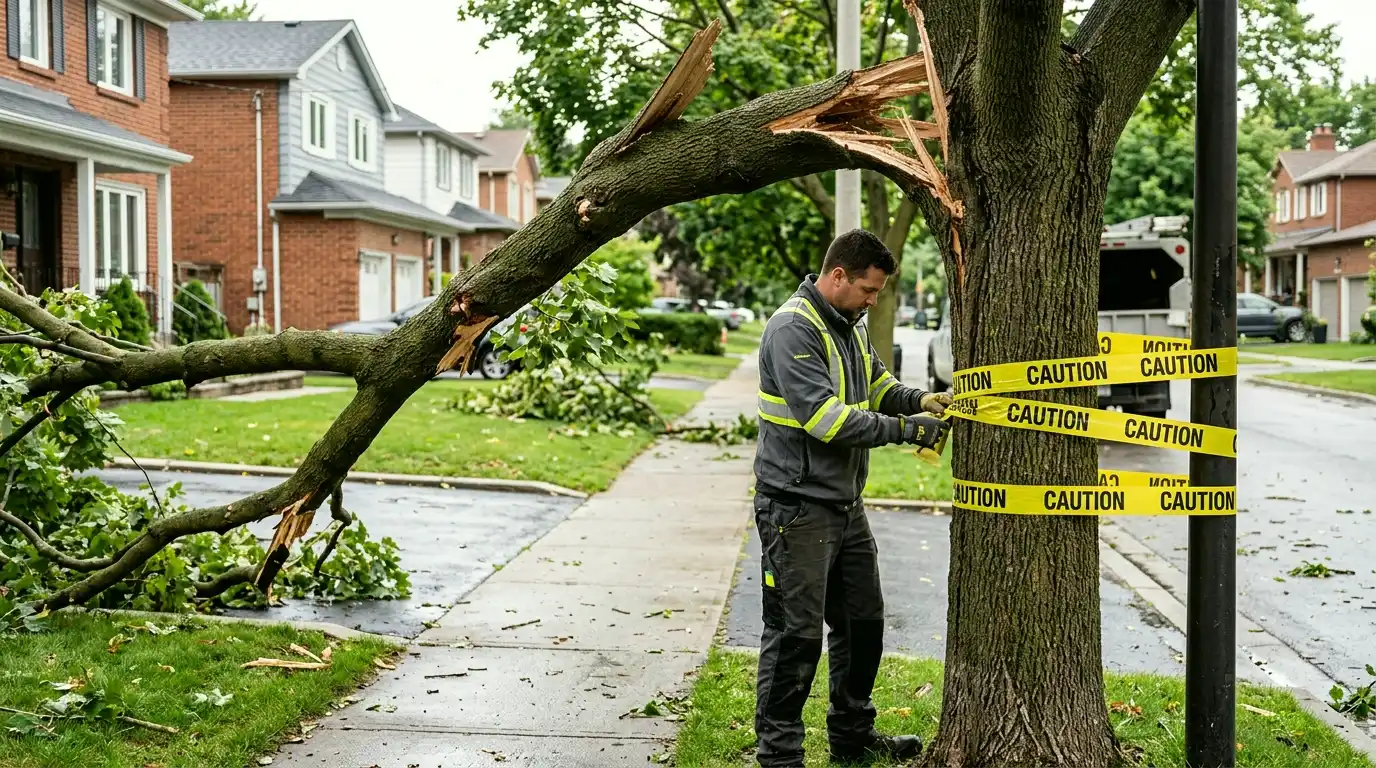
For hanging limbs that have partially failed but remain suspended in the canopy, the area below should be treated as unsafe. A large broken limb can weigh hundreds of kilograms and may fall without warning, especially as wind shifts, wood dries, or the remaining fibres continue to tear. Keep children, pets, tenants, neighbours, and visitors out of the drop zone.
If you can do so without entering the danger area, use barrier tape, cones, outdoor furniture, or another visible marker to discourage entry. Do not pull on the limb, cut the limb yourself, shake the tree, park underneath it, or attempt to move any part of the tree that appears loaded, suspended, or under tension.
Chapter 813 and Imminent-Hazard Storm Work
Toronto’s private-tree rules still matter after storms, but an imminently hazardous tree is treated differently from routine planned removal. The City’s current storm guidance says a permit is not required to remove a private tree that an arborist deems an imminent hazard, even when the tree would otherwise be protected.
The City asks property owners and arborists to photograph the hazardous condition and advise the City through 311 so there is a record of the tree loss. If a tree is storm-damaged but is not an imminent hazard, normal permit or permit-exception requirements may still apply. Current City guidance should be checked before non-urgent protected-tree work.
What Emergency Storm Work Typically Involves
Large storm-damaged trees are not handled like ordinary yard debris. A tree resting on a roof, fence, garage, vehicle, or neighbouring structure may be under compression, tension, or shifting load. Removing the wrong section first can make damage worse or create a new hazard. A qualified tree contractor may need to establish a safe work zone, review the load path, determine whether rigging is needed, and decide how the tree or limb can be sectioned safely.
For a fallen tree on a structure, the work often involves reducing weight in a controlled order instead of cutting everything at once. For hanging limbs, the immediate priority is usually removing the suspended hazard before evaluating the remaining tree. For split trunks, uprooted trees, storm-bent leaders, or major canopy failures, a qualified arborist or contractor may discuss whether pruning, partial removal, full removal, or follow-up assessment is appropriate.
Storm-damaged Tree in Toronto: Insurance and Storm Tree Damage
Insurance questions should be handled carefully. Some homeowners assume every fallen tree is automatically covered, while others assume nothing is covered unless the tree came from their own yard. In reality, coverage depends on your specific policy, the damaged property, the cause of loss, exclusions, deductible, debris removal wording, and insurer documentation requirements.
Before cleanup begins, contact your insurer where appropriate and ask what photos, invoices, reports, or records they need. Property owners should confirm documentation requirements directly with their insurer.
After the Emergency: What Comes Next
Once the immediate hazard has been addressed, the next steps depend on what happened to the tree and what the City, insurer or qualified professional requires. If a protected tree was removed as an imminent hazard, retain photographs and the arborist’s assessment and follow the City’s current 311 record guidance. If the tree was retained after emergency pruning, a later review during the growing season may be useful to check for decline, canopy dieback, root disturbance, cracking or structural weakness that was not obvious immediately after the storm.
If replacement planting, stump grinding, additional pruning, or follow-up documentation is needed, those items should be quoted and handled directly by the qualified professional.
Frequently Asked Questions
What should I do immediately after a storm damages a tree in Toronto?
Rule out powerline contact first. Call Toronto Hydro or the proper utility provider if any wire is involved. Stay clear of hanging limbs, split trunks, and unstable trees. Photograph the damage from a safe distance before cleanup.
Does Chapter 813 apply to emergency tree work after a storm in Toronto?
Toronto’s tree rules still matter after a storm, but the City currently states that a permit is not required to remove a private tree deemed an imminent hazard by an arborist, even if the tree is otherwise protected. Photograph the hazardous condition and notify 311 to create a record. If the tree is not an imminent hazard, confirm the normal permit or permit-exception process before protected-tree work.
Will my homeowner’s insurance cover storm tree damage in Toronto?
Coverage depends on your policy, deductible, exclusions, damaged property, and insurer requirements. Contact your insurer directly and ask what documentation they need before cleanup begins where possible.
How quickly can a storm-damaged tree request be handled in Toronto?
Timing depends on storm severity, contractor availability, access, weather, and safety conditions. For immediate danger, powerline contact, blocked public roads, or public-safety concerns, contact emergency services, the utility provider, the municipality, or the relevant public authority first.
Related Guides and Request Pages
- How to Identify a Hazardous Tree Before Winter
- Emergency Tree Requests
- Neighbour Dangerous Tree Toronto
- Tree Removal Permit Toronto
- Fallen Tree Requests