
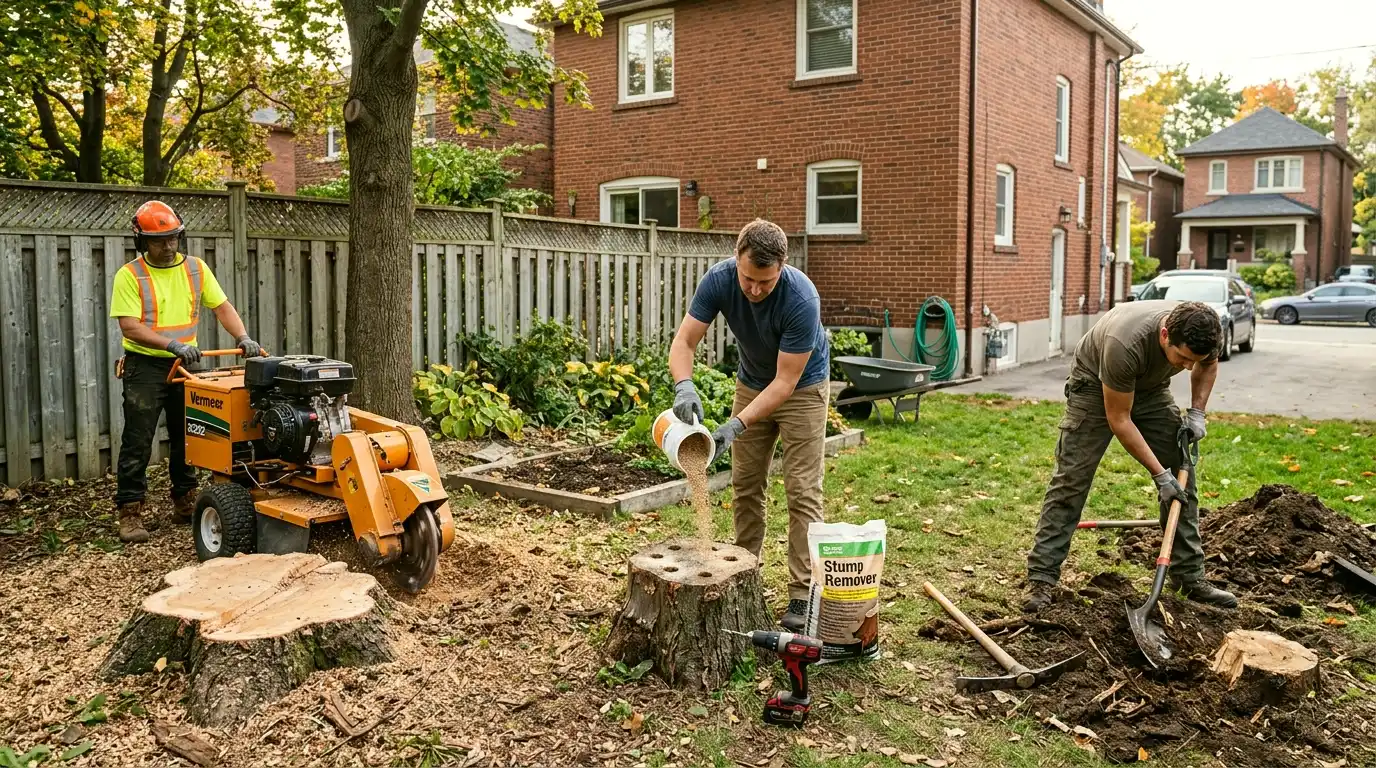
For property owners researching stump removal methods in Toronto, the key issues are the applicable rules, site conditions and realistic next steps. Most guides about stump removal focus on grinding and skip the alternatives. Three common approaches compared here are stump grinding, chemical decomposition, and manual digging. Each has different costs, timelines, access requirements, physical demands, and practical use cases. Grinding is often the right fit when a faster result is needed and machine access is available, but chemical treatment or manual removal can make sense in specific situations.
Method 1: Stump Grinding
Stump grinding is the common professional approach for many residential stump removal requests in Toronto. A rotating cutting wheel with carbide-tipped teeth grinds the stump down below the surrounding soil level. The final result is usually a below-grade depression filled with wood chips, rather than a visible stump above the lawn or garden bed. The exact grinding depth, cleanup level, and whether chips are removed or left in place should be confirmed directly with the qualified provider before work begins.
Cost
Stump grinding in Toronto commonly ranges from about $150 to $400 per stump for many standard residential situations, but larger stumps, difficult access, deeper grinding, root flare work, chip removal, or multiple setup constraints can increase the price. Smaller stumps under 30 cm may fall closer to the lower end, medium stumps from 30 to 60 cm may sit in the middle range, and large stumps over 60 cm can cost more. Some tree care providers also have a minimum visit charge, which can make multiple stumps more cost-efficient per stump when handled in one visit.
Access requirements
Machine access is one of the biggest practical issues. Some larger stump grinders need wide gate access, while compact machines may fit through narrower side yards. Access across soft lawns, slopes, tight fences, steps, retaining walls, utilities, irrigation lines, and nearby hardscape can all affect the equipment choice. Property owners should measure gate openings, photograph the stump and access path, and discuss underground infrastructure concerns directly with the qualified provider before approving the work.
Before ground-disturbing work, utility locate requirements should be discussed carefully. In Ontario, locate requests are handled through Ontario One Call. Any required locate request, timing, site markings, utility-related communication, and work decision must be handled directly by the property owner and/or the qualified tree contractor, depending on the project and applicable requirements.
When grinding is the right choice
Grinding is often a strong fit when the stump is in an accessible location and the area needs to be used again soon for lawn repair, garden bed preparation, or general yard cleanup. It is usually more practical than hand digging for medium and large stumps. It is also faster than chemical treatment, which may require many months before the stump becomes soft enough to break apart. The qualified provider should confirm whether grinding is appropriate based on stump size, root flare, access, utility concerns, intended use of the area, and cleanup expectations.
Toronto stump removal: Method comparison at a glance
| Factor | Grinding | Chemical | Manual Digging |
|---|---|---|---|
| Cost, typical | About $150-$500 per stump, depending on scope | About $20-$60 in materials, plus later removal effort | Often $200-$600+ in labour for suitable small stumps |
| Timeline | Often completed in one visit where access and locates allow | Usually 6-18 months | Can be same day for small stumps |
| Result | Stump ground below grade | Softened stump that still needs removal later | More complete root ball removal when feasible |
| Machine access needed? | Yes, access width depends on equipment | No machine access needed | No machine access needed, but heavy labour |
| Best for | Most accessible residential stumps | Inaccessible spots with no timeline pressure | Small stumps where fuller root removal is needed |
Stump Removal Methods in Toronto: Method 2: Chemical Stump Removal
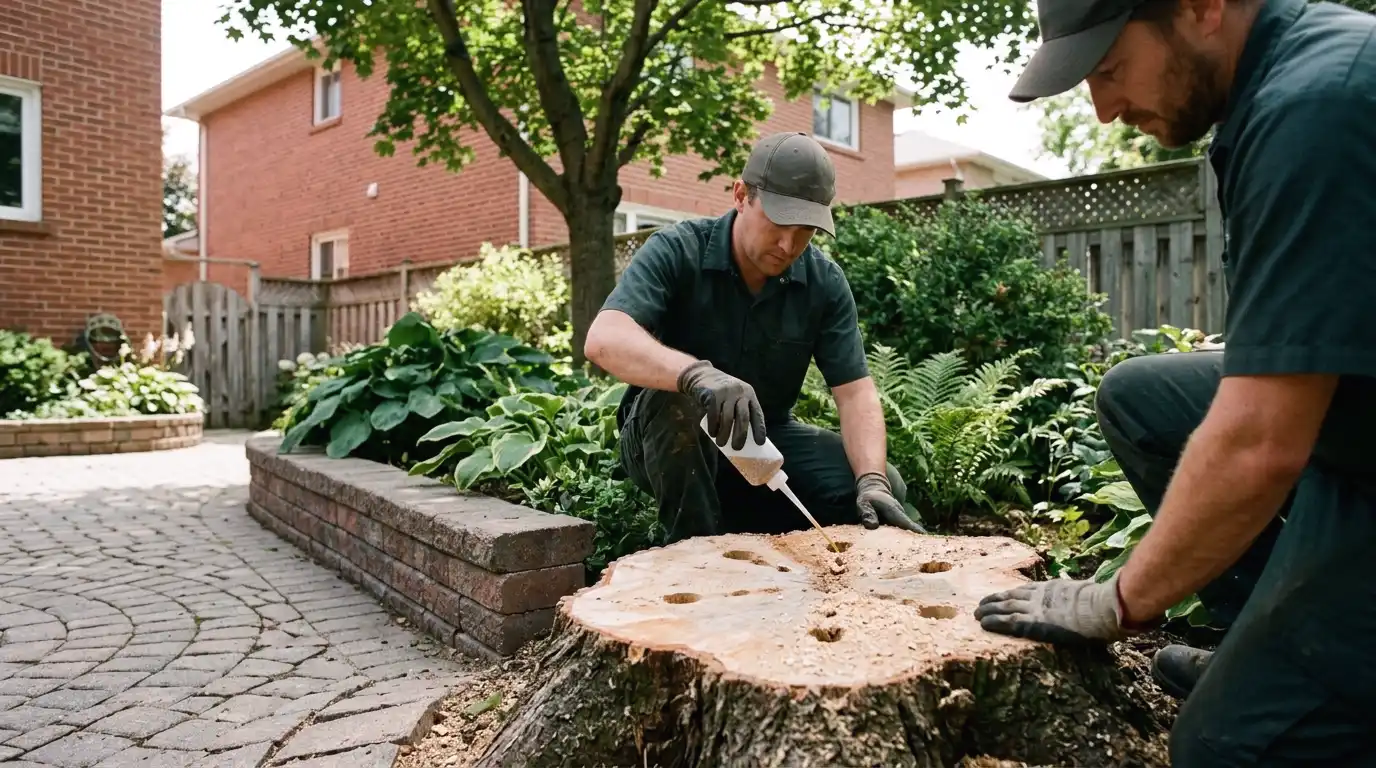
Chemical stump treatment typically uses a decomposition accelerant, often a potassium nitrate-based product, to speed up natural rotting. Holes are drilled into the stump, the product is placed according to the label directions, water is added where required, and the stump is left to break down over time. This is not immediate stump removal. It is a slow treatment process that may eventually make the stump soft enough to break apart manually.
In Toronto’s climate, chemical treatment can take many months because decomposition depends on moisture, temperature, stump size, species, and how much living or dead wood remains. The root system usually remains in the ground and continues decomposing over time. Property owners should follow product labels, avoid unsafe burning practices, and consider whether children, pets, garden beds, nearby plants, and drainage conditions make chemical treatment inappropriate for the site.
When chemical treatment makes sense
Chemical treatment may make sense when machine access is genuinely impossible, the stump is small enough to break apart later, and the area does not need to be restored quickly. A stump behind a narrow gate, inside a garden bed, or in a low-priority corner of the property may be a reasonable candidate if the homeowner accepts the long timeline. It is usually not a good fit for high-visibility lawn areas, urgent landscaping projects, patio preparation, driveway work, or large stumps that would still require heavy labour after softening.
Method 3: Manual Digging and Root Extraction
Manual stump removal involves digging around the stump with tools such as a mattock, spade, root saw, or reciprocating saw to expose and cut the roots before levering the stump from the ground. For small stumps under about 20 cm diameter, this may be possible for a capable homeowner or a qualified tree contractor. For larger stumps, compacted soil, deep roots, or species with wide lateral root systems, manual digging can become extremely labour-intensive and may not be worth the cost compared with grinding.
The main advantage of manual removal is that more of the root ball can be physically removed, rather than leaving ground wood and deeper roots to decompose in place. That can matter when the area is being prepared for a new planting hole, a garden bed, or a small hardscape project. The drawback is labour. Manual removal is usually slow, physically demanding, and difficult around buried utilities, irrigation, fences, patios, or retaining walls. The qualified provider should explain whether manual removal is realistic and what damage risks or restoration needs may be involved.
Choosing the Right Method for Your Toronto Property
For many Toronto residential properties where machine access is available, stump grinding is usually the most practical choice because it is faster than chemical treatment and less labour-heavy than digging. Chemical treatment should be reserved for stumps that are not time-sensitive and cannot be reached by equipment. Manual digging should usually be limited to smaller stumps where fuller root removal is specifically needed.
For more pricing context across the GTA, see the stump grinding cost guide for Toronto.
Stump Grinding Across the GTA
After Grinding: Topsoil vs Leaving the Chips
After stump grinding, the ground-out area is usually filled with a mixture of wood chips, soil, and remaining fine debris. For lawn restoration, many property owners prefer to remove excess chip material, backfill with clean topsoil, and then seed or sod the area. Wood chips can compress and settle as they decompose, which may create a shallow depression in the lawn after one or more seasons. Clean topsoil usually gives a better base for immediate lawn repair.
For a mulched garden bed, leaving some chip material can be acceptable because organic matter may be useful and surface evenness is less critical. The right choice depends on whether the area will become lawn, garden bed, patio base, walkway, new planting site, or another landscape feature. Chip removal, topsoil backfill, seeding, sodding, disposal, and final grading should be discussed directly with the qualified tree contractor before the work is approved.
Frequently Asked Questions
What is the cheapest way to remove a stump in Toronto?
Stump grinding is often the most cost-effective option for many Toronto residential stumps when machine access is available. A standard residential stump may cost about $150 to $400 to grind, depending on diameter, access, depth, cleanup, and the qualified provider’s pricing. Chemical stump removal is cheaper in materials but can take 6 to 18 months and still requires later manual removal. Manual digging is usually only practical for very small stumps or locations where machine access is not possible.
How long does chemical stump removal take in Toronto?
Chemical stump treatment may take roughly 6 to 18 months in Toronto’s climate, depending on stump size, species, moisture, temperature, and product use. Potassium nitrate-based products are commonly applied into drilled holes to accelerate decomposition, but the softened stump still has to be broken apart or removed later. Property owners should follow product labels and discuss site-specific concerns directly with a qualified professional where needed.
Can I grind a stump myself in Toronto?
Some equipment rental locations offer consumer-grade stump grinders, but safe operation, depth control, underground utilities, slope, rocks, nearby structures, and machine access all matter. Rental machines may be slower and less powerful than commercial equipment. For larger stumps, tight access, deep grinding, or work near utilities or hardscape, property owners should consider speaking with a qualified tree care professional before deciding.
What depth should a stump be ground to in Toronto?
For lawn restoration, many stump grinding scopes target roughly 15 to 20 centimetres below surrounding grade. For replanting or hardscape work, deeper grinding or additional root and chip removal may be discussed. The right depth depends on the intended use of the area, stump species, root structure, soil conditions, and the qualified provider’s equipment and scope. Property owners should confirm the grinding depth in writing before approving the work.
After stump grinding in Toronto, should I fill with topsoil or leave the chips?
For lawn restoration, removing excess wood chips and backfilling with clean topsoil often produces a smoother result because wood chips can settle as they decompose. For garden beds, leaving some chip material may be acceptable if organic decomposition is not a problem. Cleanup, chip removal, topsoil backfill, seeding, sodding, and disposal should be confirmed directly with the qualified tree contractor before the work begins.
Related Guides