
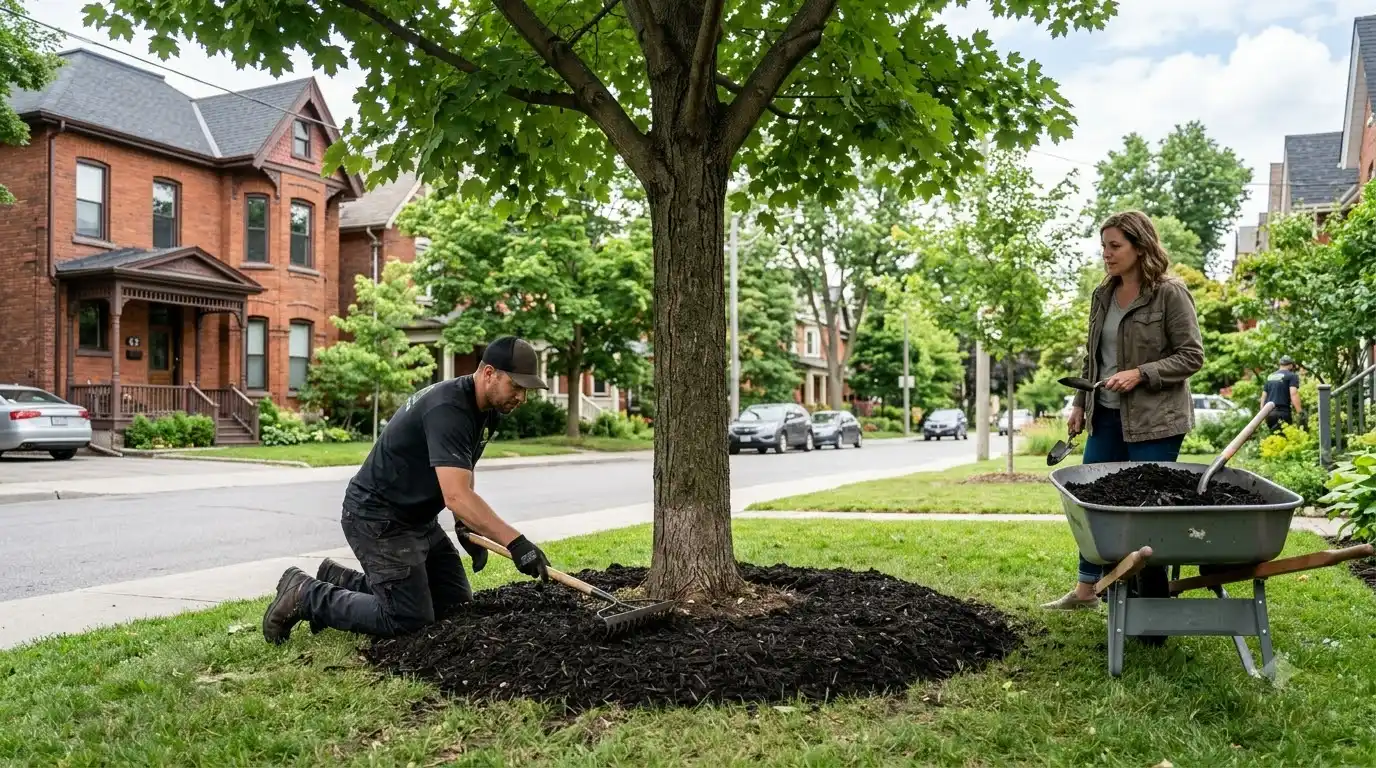
Property owners dealing with mulching trees in Toronto should first consider tree condition, site constraints and any municipal requirements. Proper mulching is a useful low-cost tree-care practice for many Toronto yards, while mulch piled against the trunk can create long-term problems. A correctly sized mulch ring can conserve soil moisture, moderate temperature, reduce turf competition and protect the root zone from mower damage. The goal is a broad, relatively shallow layer kept away from direct contact with the trunk and root flare.
Urban trees in Toronto face growing conditions fundamentally different from their forest counterparts. Forest soil is covered in decomposing leaf litter that continuously adds organic matter, supports mycorrhizal fungi networks, maintains moisture, insulates roots from temperature extremes, and prevents compaction from rainfall impact. Toronto residential trees, by contrast, typically grow in compacted clay or modified fill soils surrounded by grass that is mowed repeatedly, competing for the same water and nutrients, and receiving no organic matter input except what the tree itself drops.
A properly applied mulch ring replicates several of the forest floor’s functions in a residential setting. It conserves moisture by reducing evaporation from the soil surface, which is particularly important during Toronto’s periodic summer droughts. It moderates soil temperature, keeping roots cooler in summer heat and providing insulation from hard spring frosts. It suppresses grass competition within the ring, which eliminates a significant competitor for water and nutrients. And as it decomposes, it adds organic matter to the soil and supports the mycorrhizal fungi that help tree roots access nutrients. For newly planted trees, a mulch ring can make the difference between successful establishment and failure in Toronto’s challenging urban soils.
The Correct Mulch Application
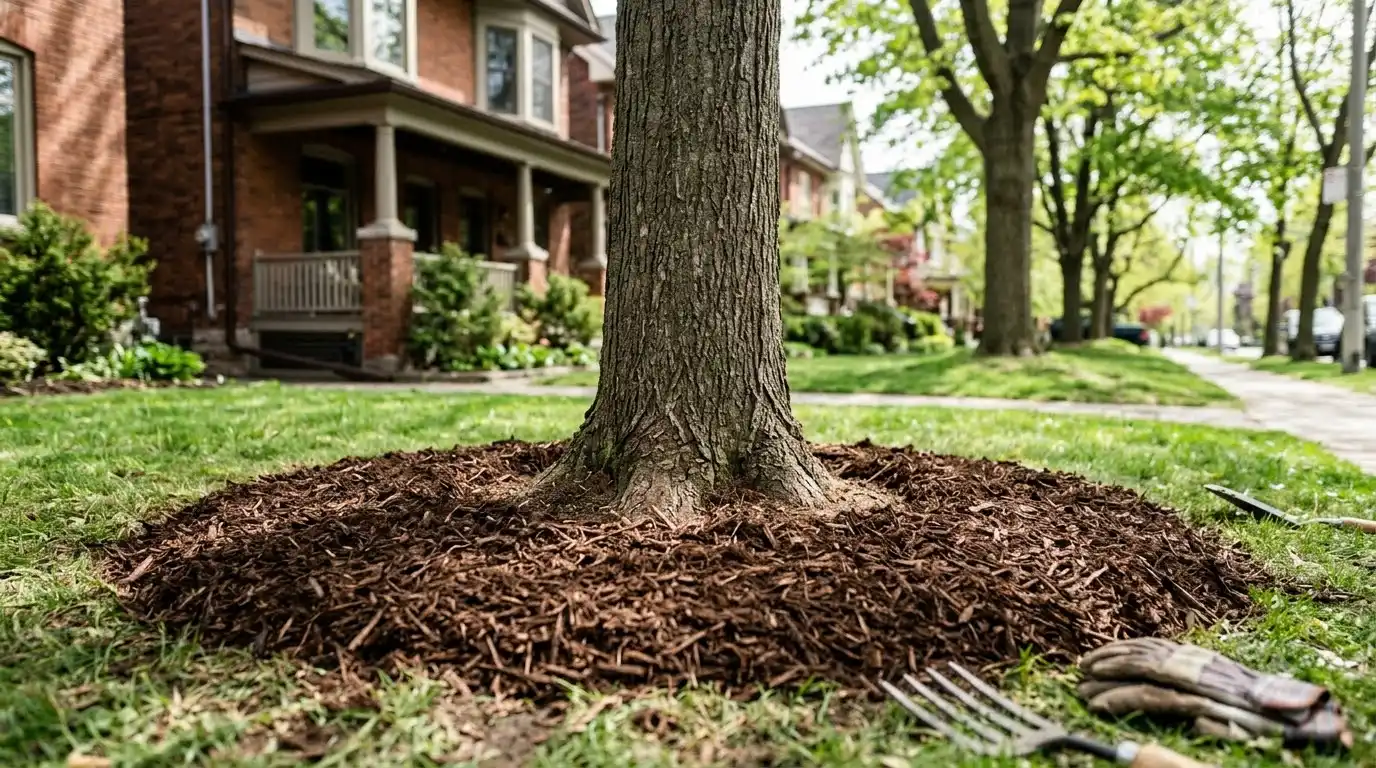
Correct mulching creates a flat ring extending from the root flare outward, not a mound against the trunk. The critical rules are: never touch the trunk with mulch, maintain 10 to 15 centimetres of clear space between the inner mulch edge and the bark, keep mulch depth at 7 to 10 centimetres maximum, and extend the ring as far outward as practical given the landscape, ideally to the drip line of the tree or at least 1 to 1.5 metres in radius for established trees.
The mulch surface should be level or slightly concave in the centre of the ring, gently sloping outward. This shape directs rainwater into the root zone rather than away from it, and prevents the mulch from compacting against the bark by gravity during rainfall. Refresh the mulch annually by adding a thin top layer to maintain the 7 to 10 centimetre depth as the existing mulch decomposes. Do not rake out old mulch and replace it with fresh: the decomposing material at the bottom of the ring is biologically active and beneficial.
Volcano Mulching: Why It Kills Trees
Volcano mulching, the cone-shaped pile of mulch against the trunk that is ubiquitous in Toronto residential landscaping and commercial properties, causes harm through several mechanisms that operate simultaneously and progressively. The sustained moisture contact between the deep mulch pile and the bark creates conditions for bark decay, creating entry points for fungi and insects that then attack the living tissue beneath the bark. The same moist conditions that favour bark decay also encourage adventitious roots to emerge from the trunk into the mulch pile: these aerial roots find the mulch conditions suitable and grow, but as the tree expands in girth they begin to encircle the trunk, eventually girdling it from the outside as surely as a girdling root from the soil below.
The visual effect of volcano mulching is initially appealing: the piled mulch looks tidy and substantial against a clean-mulched trunk. The damage is happening invisibly below the mulch surface. By the time crown dieback, reduced leaf size and the classic thin, stressed crown of a girdled tree become apparent, the damage has typically been accumulating for 10 to 15 years and may be irreversible. In Toronto’s residential neighbourhoods, qualified arborists regularly see trees in severe decline specifically from decade-old volcano mulching that the homeowner did not know was harmful.
Choosing the Right Mulch for Toronto Trees
Arborist wood chips, the chipped material from tree work including wood, bark and leaf, are the most biologically beneficial mulch for Toronto residential trees. Fresh arborist chips decompose to directly feed the mycorrhizal communities in the soil. Many arborists and tree services will deliver fresh chips at low or no cost when working in your neighbourhood: ask. Aged wood chips and shredded bark from garden centres are also appropriate. Avoid: dyed mulch (may contain chemicals that inhibit soil biology), rubber or gravel mulch (does not decompose, provides no biological benefit), peat moss (compacts and becomes hydrophobic), and landscape fabric barriers (prevents the organic benefit of decomposition reaching the soil).
When to Refresh Mulch Rings in Toronto
Mulch rings on Toronto trees should be refreshed once annually, typically in late April after the spring frost risk has passed. The target is 7 to 10 centimetres of fresh chip material, applied in the donut pattern that leaves a 10-centimetre gap between the inner mulch edge and the trunk base. If the ring from the previous year has compacted below 5 centimetres, add fresh material on top rather than removing the old layer first. The decomposing base layer contributes organic matter to the soil and supports the soil biology that fresh chips alone do not provide as effectively.
Frequently Asked Questions
What is the correct way to mulch around a tree in Toronto?
Create a flat donut ring extending 1 to 3 metres from the trunk depending on tree size. Mulch depth 7 to 10 centimetres. Leave 10 to 15 centimetres of clear gap between the inner mulch edge and the bark. Level or slightly concave surface directing water toward the root zone. Never pile mulch against the trunk.
What is volcano mulching and why is it harmful to Toronto trees?
Volcano mulching piles mulch in a cone against the trunk, promoting bark decay, encouraging adventitious roots that girdle the tree, and creating conditions for insect and fungal attack. Many Toronto residential trees are in decline specifically from decade-old volcano mulching. The damage accumulates invisibly for 10 to 15 years before crown symptoms appear.
What type of mulch is best for Toronto trees?
Arborist wood chips (the chipped material from tree work) are the most biologically beneficial. Aged wood chips and shredded bark from garden centres are also appropriate. Avoid dyed mulch, rubber mulch, gravel mulch, peat moss and landscape fabric barriers under the mulch.
Should I mulch new trees differently from established trees in Toronto?
Apply immediately at planting using the same donut method. Extend the ring to the full drip line if possible to suppress grass competition, which is the largest impediment to new tree establishment in Toronto. Maintaining the mulch ring through the first three to five years dramatically improves establishment and survival rates.
Related Guides and Services
- How to Plant a Replacement Tree in Toronto
- Best Native Trees to Plant in Toronto
- Tree Root Depth in Toronto
- Spring Tree Care Toronto
- Tree Pruning Requests
Send Your Tree Request
Need help deciding what to do next? Send your tree request with your location, a brief description and clear photos of the tree or affected area.