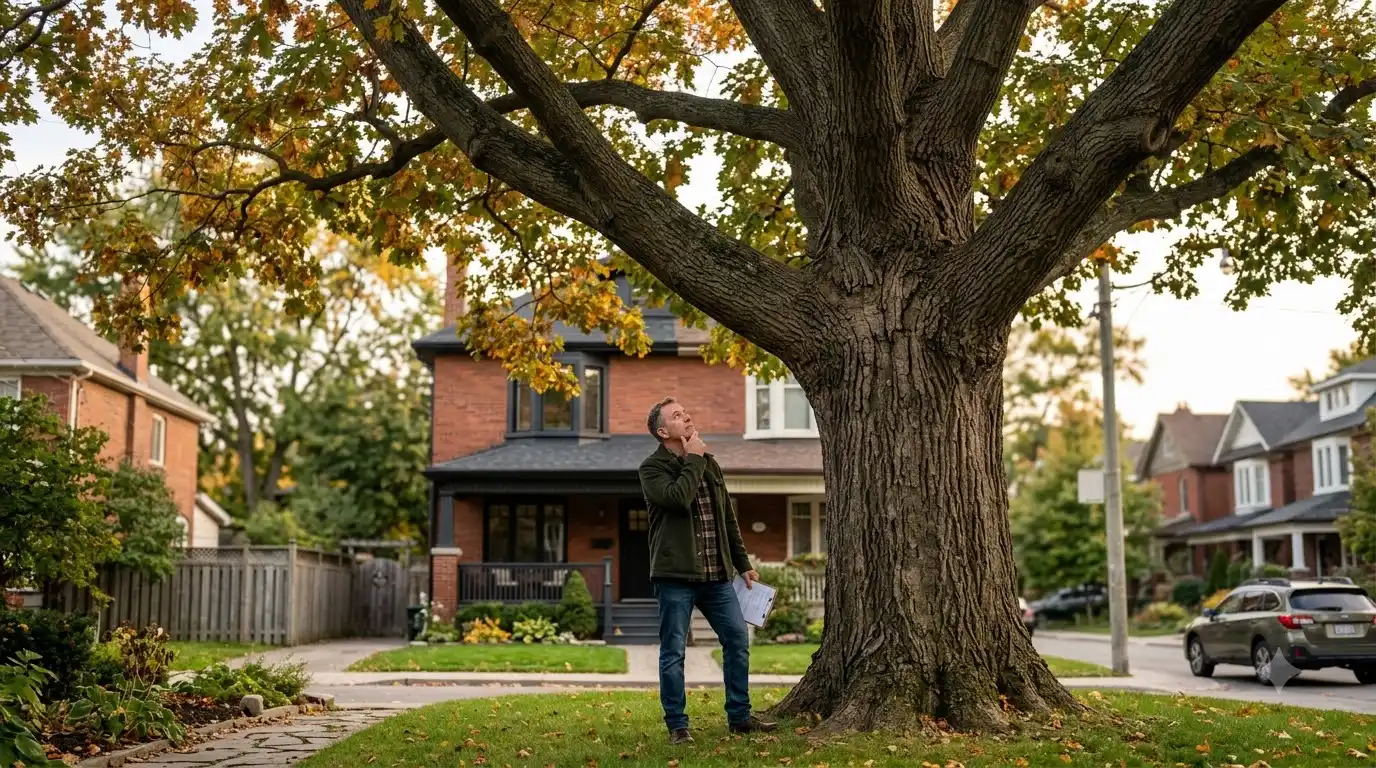
A useful way to approach tree preservation vs tree removal in Toronto is to start with property conditions, safety concerns and any local rules that apply. Deciding whether to preserve or remove a tree on a Toronto property can be significant and irreversible. Removing a tree that could reasonably be retained loses years of established canopy and site benefits; retaining a tree whose condition or risk cannot be acceptably managed can create ongoing exposure and cost. Many real cases are judgment calls that benefit from a documented assessment of condition, targets, mitigation options and applicable City requirements.
The Five-Factor Assessment Framework
Qualified arborists assess several factors together, including structural condition, health trajectory, risk context, tree value and feasible mitigation. No single factor determines the outcome. A tree with a significant defect may still be retainable if the defect can be managed and the remaining benefits justify ongoing monitoring; another tree may warrant removal because multiple defects, decline or high-consequence targets make retention unreasonable.
Structural condition
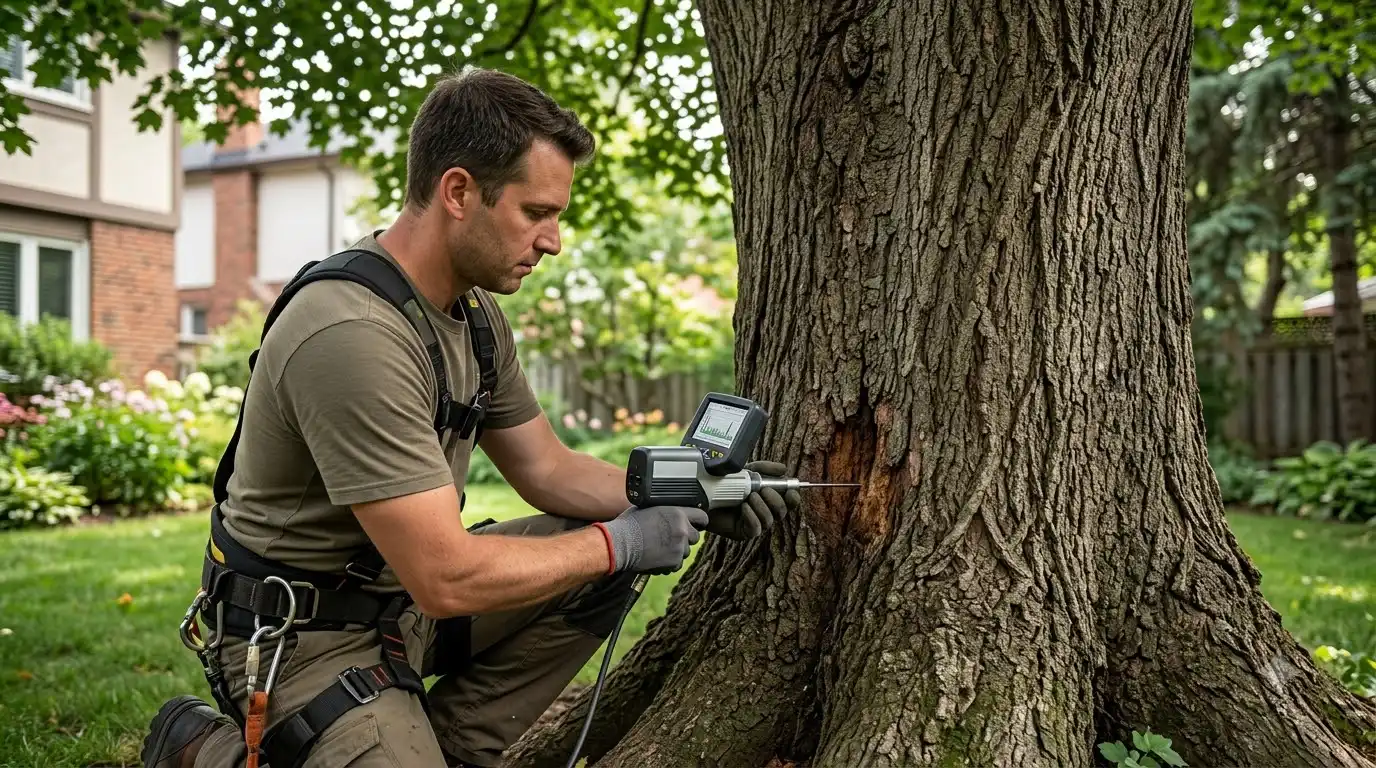
Structural assessment looks at the tree’s physical architecture for defects that affect failure probability. Co-dominant stems with included bark, visible cracks in major unions, large deadwood, cavities and decay at the trunk base or root crown, and significant lean are the primary structural concerns. The severity of each defect is assessed relative to the tree’s overall size and the proportion of the crown or trunk that is compromised. A small cavity in a large healthy trunk is a very different finding from a large cavity that occupies more than a third of the trunk’s cross-sectional area.
Health trajectory
A tree’s health trajectory matters as much as its current condition. A tree that was showing significant crown dieback five years ago but has recovered strongly through appropriate pruning and soil care is a very different management prospect than a tree that continues to decline despite intervention. Where a tree is in decline due to an untreatable condition such as advanced armillaria root disease or extensive vascular wilt infection, preservation efforts are extending management of a tree without a meaningful future. The honest arborist assessment identifies not just the current condition but the direction of travel.
Preservation vs removal: the decision factors at a glance
- Favour preservation when: sound structure or manageable with cabling, health stable or improving, risk acceptable with mitigation, high value to property or ecosystem, and effective mitigation options available
- Favour removal when: structural defects beyond mitigation, irreversible health decline, high risk with high consequence target, invasive species with low ecological value, ongoing infrastructure conflict
- Seek a second opinion when: two qualified arborists disagree, the decision is irreversible and significant, or the financial or safety stakes are high
- Commission a TRAQ assessment when: the tree is over a house or other high consequence target, insurance or legal documentation is needed, or the disagreement between two assessments cannot be resolved by standard assessment
The Value Dimension
Tree value is not simply aesthetic preference. In Toronto’s residential property market, mature trees in good condition add measurable property value. A certified arborist assessment at the international tree valuation standard (Council of Tree and Landscape Appraisers Guide for Plant Appraisal) can assign a formal dollar value to a significant tree that reflects its size, species, condition, location and functional contribution. For large specimens in Toronto’s established neighbourhoods, this value can range from $15,000 to $60,000 or more. Understanding this figure contextualizes the decision: spending $1,800 on a cable installation to preserve a tree with a professional appraised value of $35,000 is not a difficult economic calculation.
Ecological value adds another dimension that property value alone does not capture. Native oaks, sugar maples and basswoods in Toronto support insect communities, bird populations and soil biology that Norway maples and Manitoba maples do not. For homeowners on properties adjacent to Toronto’s ravine system, preserving a native oak or sugar maple is a contribution to the ecological corridor that the ravine supports. This is not a sentimental consideration: it is a documented ecological reality that ISA arborists apply in their preservation recommendations.
When Preservation Fails
Preservation is not always the right answer, and arborists who recommend cabling or pruning on every assessed tree regardless of the tree’s actual condition are not serving their clients well. Preservation fails as a strategy when the structural defect has already progressed to the point where cabling cannot provide meaningful risk reduction, when the tree is in terminal health decline that treatment cannot reverse, or when the tree’s location creates ongoing and unresolvable conflicts with infrastructure, structures or safety. The honest assessment names these situations clearly and recommends removal without equivocation, while also preparing the Chapter 813 documentation needed to make that removal authorized and compliant.
Tree Preservation vs Tree Removal in Toronto: Making the Final Call on a Toronto Tree
Most Toronto homeowners facing the retention versus removal decision benefit from a second opinion where the first assessment is not definitive. If one arborist recommends removal and another recommends preservation with monitoring, the difference in professional judgment is worth understanding before committing to either outcome. A second opinion from a qualified arborist can help homeowners understand the reasoning behind a major recommendation before accepting the most recent advice they received.
The decision framework is ultimately about what the realistic alternative to removal is. A tree that can be structurally improved and maintained safely is worth preserving. A tree with progressive internal decay, a failing root plate, or a structural defect that cannot be adequately mitigated is a liability that will require removal regardless of when the decision is made, and earlier removal is generally less risky and less expensive than waiting for a failure event to force the decision.
Related professional service: Review the Toronto tree removal service information if removal may be part of the next step.
Frequently Asked Questions
How do Toronto arborists decide between tree preservation and removal?
Through a five-factor framework: structural condition, health trajectory, risk level given the specific target, tree value, and available mitigation options. No single factor determines the outcome. A tree with structural defects can be preserved if health is good, risk is manageable with cabling, and value is significant. A declining tree with no effective treatment options warrants removal even without visible defects.
What tree characteristics make preservation more viable in Toronto?
Single dominant trunk, sound wood confirmed by probe and sounding, full density foliage, no significant pest or disease, intact root zone, and appropriate species and size for the growing space. Native species like red oak and sugar maple are generally prioritized over invasive Norway maple in preservation decisions.
Does Toronto’s Chapter 813 influence the preservation vs removal decision?
Chapter 813 does not require preservation of hazardous trees. Safety concerns are recognized through both the standard permit process and the faster permit-exception pathway. The 30-day permit processing time means planned removal requires six weeks of advance planning, but genuine hazards are not held up by the permit process when properly documented.
Can a Toronto tree be preserved after significant storm damage?
Sometimes. A tree with a sound trunk, adequate crown volume remaining, and intact root system may recover with professional pruning of the storm damage. A tree with a split primary trunk, major root plate disturbance, or loss of more than half its crown has a much more uncertain recovery prospect. The assessment focuses on whether the remaining structure and root system can form a stable basis for regrowth.
Related Guides and Services
- Tree Removal vs Cabling Toronto
- Hazardous Tree Identification Toronto
- Arborist Tree Inspection Toronto
- Tree Pruning Requests
Send Your Tree Request
Need help deciding what to do next? Send your tree request with your location, a brief description and clear photos of the tree or affected area.