Mississauga requires a permit to remove any tree on private residential property with a trunk diameter of 15cm or more at 1.4 metres above ground. That threshold is lower than Toronto's 30cm rule, which means more trees on Mississauga properties are protected than many homeowners expect. Skipping the permit can result in fines and a mandatory replacement order from the City. Here is exactly how the Mississauga tree permit process works, what you need to apply, and how long it takes.
Mississauga Tree Permit - Key Facts
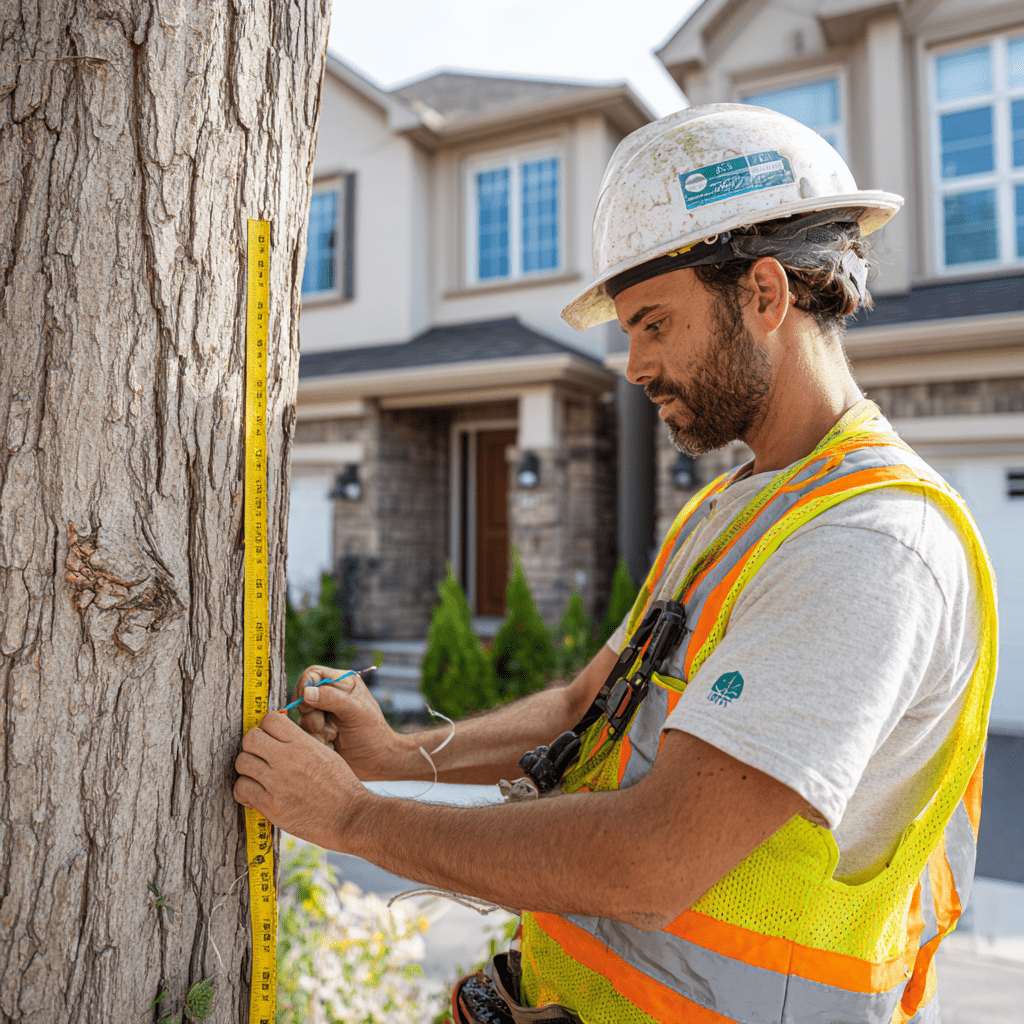
The key measurement is DBH, diameter at breast height, taken at 1.4 metres above the ground. If the trunk of your tree is 15cm or more in diameter at that point, it is a protected tree under Mississauga's Private Tree By-law and you need a permit before it can be removed.
To put 15cm in perspective: it is roughly the diameter of a large grapefruit. Most established trees in Mississauga neighbourhoods like Port Credit, Lorne Park, Streetsville, Erin Mills, Meadowvale, Clarkson, Cooksville and Malton will easily exceed this threshold. A tree that appears modest in size can still be well above 15cm DBH if it has had several years to grow.
The lower threshold compared to Toronto means that trees you might assume are too small to need a permit often do require one in Mississauga. When in doubt, have an ISA certified arborist measure the trunk before any work is planned. That measurement takes five minutes and can save you from a violation that costs significantly more.
The Private Tree By-law is Mississauga's framework for protecting trees on residential private property. It sets out which trees are protected, what activities require a permit, what the application process involves, and what happens when protected trees are removed without authorization.
The by-law covers tree removal as well as injurious activities that damage or destroy a protected tree's root system or canopy without necessarily cutting it down. This is particularly relevant during construction projects, where excavation, compaction and trenching near a protected tree can cause harm that the by-law treats the same way as removal. If you're planning a renovation, addition, deck or landscaping project near a tree, the by-law may apply even if the tree itself is not being touched.
For the most current version of the by-law and any amendments, visit the City of Mississauga's tree removal permits page. By-laws are subject to amendment and the City's page will always reflect the current requirements.
Before you submit anything to the City, engage an ISA certified arborist to assess the tree and determine whether removal is justified. The arborist will measure the DBH, evaluate the tree's health and structure, document any hazard conditions, and prepare a written report or letter that supports your application. This report is a required part of the application.
The arborist's assessment needs to be thorough. Mississauga's application reviewers will evaluate whether the stated reason for removal aligns with the condition they observe when they inspect the tree. A vague or superficial report is one of the most common reasons applications are returned or delayed.
You need the completed application form (available through the City's online portal), the arborist report, and a site plan or sketch showing the location of the tree relative to property boundaries, the house and other structures. The site sketch does not need to be professionally drafted but it does need to be accurate enough for a City officer to locate the tree without ambiguity.
Mississauga accepts tree removal permit applications online. Submit your complete package through the City's portal. You'll receive a confirmation and a reference number for your application. Keep this for your records.
The City will review your application for completeness and then schedule an on-site inspection. A City officer will attend your property to assess the tree directly. Their findings are weighed against your arborist's assessment and the criteria in the by-law.
The City issues an approval, an approval with conditions, or a denial. Approvals typically come with replacement planting conditions. Understand those conditions before scheduling the removal so you are prepared to comply.
If you're familiar with Toronto's Chapter 813 permit process, there are a few important differences to understand when working in Mississauga.
The DBH threshold is lower. Toronto protects trees 30cm DBH or more. Mississauga protects trees 15cm DBH or more. This means roughly twice as many trees on a typical residential lot require a permit in Mississauga compared to Toronto. Trees you could remove in Toronto without a permit may well require one in Mississauga.
The review timeline also differs. Toronto has a 30-business-day statutory review period. Mississauga typically processes complete applications in approximately 20 business days. In practice, both depend heavily on application completeness and the City's current workload.
Both cities require an ISA certified arborist report, both require a site plan, and both apply replacement planting conditions to approvals. The fundamentals of the process are similar. What changes is who the application goes to and the specific thresholds and criteria that govern it.
Our ISA certified arborist prepares complete permit applications for Mississauga properties. We handle the arborist assessment, written report and application submission so you don't have to navigate the City's requirements alone.
Removing a protected tree without a permit in Mississauga is a by-law violation. The City can issue a fine and order mandatory replacement planting at your expense. The replacement requirement can exceed the standard one-for-one ratio for significant violations, meaning you may be required to plant multiple trees to compensate for one that was removed without authorization.
As with Toronto, the property owner is responsible even if a contractor performed the work. If you hired a tree service that removed a protected tree without confirming permit status, the fine and replacement order land on you as the owner. Any reputable tree service operating in Mississauga will ask about permit status before removing a tree that could fall under the by-law threshold.
If you're undertaking a construction project, the by-law may require a tree preservation plan before the City issues a building permit. Excavation, grading and construction activity within a tree's root zone can cause permanent damage, and the City takes this seriously. Engage an arborist early in your planning process if trees are anywhere near your construction zone.
Dead trees still require a permit in Mississauga if they meet the 15cm DBH threshold. A tree being dead is not an exemption from the by-law. However, demonstrating a genuine hazard condition in your arborist's report strengthens the application significantly and the City typically processes hazard tree applications with appropriate urgency.
Trees with roots or canopy extending across a property line may involve obligations to adjacent landowners. Your arborist can advise on this as part of their assessment.
Tree protection rules feel abstract until you are standing in your backyard looking at a tree you want gone. In Mississauga, the reality is that most established residential neighbourhoods have significant mature tree cover and the 15cm DBH threshold captures the vast majority of it.
In Port Credit and Lorne Park, older neighbourhoods with large lots tend to have trees that have been growing for fifty years or more. DBH measurements of 40cm, 60cm or even higher are common. In Streetsville, the mature treed streetscapes include many specimens well above the threshold. In newer areas like Erin Mills, Meadowvale and Lisgar, subdivision trees planted in the 1980s and 1990s have now grown to protected sizes that many homeowners are not expecting.
Clarkson and Cooksville sit on older Mississauga land where trees were often part of the original landscape before development. Malton and the areas near Pearson Airport have more mixed land use but residential pockets with significant mature cover still exist. In every one of these communities, the 15cm DBH rule is actively applied.
When Mississauga approves a tree removal permit, the approval typically comes with replacement planting conditions attached. These conditions specify how many trees must be planted, what sizes are acceptable, and in some cases what species are preferred. The City calculates replacement requirements based on the size and species of the tree being removed.
A small tree just above the 15cm DBH threshold might require a single replacement. A large mature specimen, a 60cm DBH sugar maple for instance, will require substantially more. Replacement trees must typically meet a minimum caliper size and be planted within a specified timeframe, often by the end of the planting season following the removal.
Do not treat replacement conditions as optional. The City follows up on permit conditions and failure to comply can result in additional enforcement action. Talk to your arborist about the replacement requirements before scheduling the removal so you can source the trees and plan the planting without scrambling at the last minute.
The right time to call an arborist in Mississauga is before you make any firm plans about a tree. Not after you have already committed to a contractor, not after you have started clearing around the base, and not after the contractor has already asked about the permit status. Before any of that.
An arborist visit for a permit assessment typically takes less than an hour. You come away from it knowing exactly whether the tree requires a permit, what the application will need, what the likely outcome is, and what replacement conditions to expect. That information makes every subsequent decision easier and faster. The assessment fee is small relative to the cost of a fine or a rejected application that delays your project by two months.
Do you need a permit to remove a tree in Mississauga?
Yes. Mississauga's Private Tree By-law protects trees on private residential property with a trunk diameter of 15cm or more measured at 1.4m above ground. Removing any such tree without a permit is a violation that can result in fines and mandatory replacement planting orders.
What is the DBH threshold for a tree permit in Mississauga?
Mississauga's Private Tree By-law protects trees with a diameter at breast height of 15cm or more, measured at 1.4 metres above ground level. This threshold is lower than Toronto's 30cm threshold, meaning more trees require a permit.
How long does a tree permit take in Mississauga?
Mississauga processes complete tree removal permit applications in approximately 20 business days. The timeline begins when the City receives a complete application. Incomplete submissions cause delays.
What documents are needed for a Mississauga tree removal permit?
You need a completed application form, an arborist report from an ISA certified arborist, and a site plan showing the tree's location. Additional documentation may be required near property boundaries or where construction is involved.
What is the fine for removing a tree without a permit in Mississauga?
Removing a protected tree without a permit in Mississauga can result in fines under the Private Tree By-law plus a mandatory replacement planting order. Check the City of Mississauga's current by-law for the most up-to-date fine amounts.
Related Guides and Services
We handle tree removal permit applications across Mississauga including Port Credit, Lorne Park, Streetsville, Erin Mills, Meadowvale, Clarkson, Cooksville and surrounding areas. Call us to book an arborist assessment.