
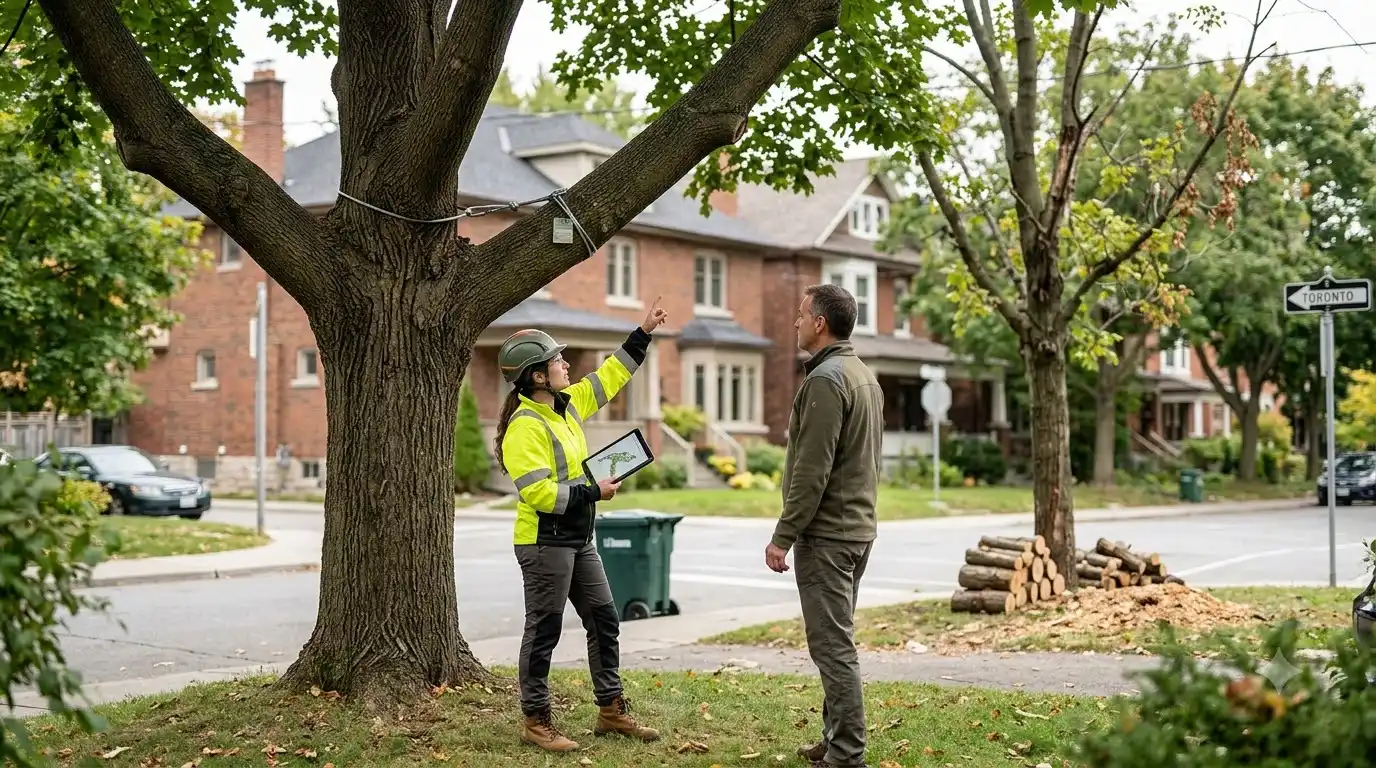
For property owners researching tree removal vs tree cabling in Toronto, the key issues are the applicable rules, site conditions and realistic next steps. When a tree assessment reveals a significant structural defect, cabling and removal are very different management options. Cabling may reduce movement at a weak union and help retain an otherwise valuable tree, but it does not repair the defect or guarantee a particular remaining lifespan. Removal eliminates the specific tree-failure exposure but also removes the benefits of the tree. The right choice depends on condition, defect severity, targets, available mitigation and the homeowner’s tolerance for ongoing inspection and management.
Tree cabling installs a flexible steel or synthetic support system in the upper crown to limit the movement between two co-dominant stems or between a compromised attachment and a sound anchor point. The cable acts as a brake on the relative movement of the stems during wind loading, reducing the peak bending stress at the weak attachment below. This is not a repair: the structural weakness remains and continues to develop. What cabling does is reduce the probability of failure under normal wind and ice loading conditions, buying time and reducing risk while the homeowner continues to monitor the situation.
The key limitation is that cabling addresses the mechanical consequence of the defect without addressing the defect itself. Included bark at a co-dominant union continues to be present and the wood fibers at the union continue to be uninterlocked whether or not a cable is installed above it. What the cable changes is the loading pattern: instead of the full wind load being transferred to the weak union, some of the load is carried by the cable to the anchor point. This reduction in peak stress at the defect reduces failure probability in normal conditions but does not bring it to zero, and does not prevent failure in extreme loading events like a significant ice storm.
When Cabling Is the Right Choice
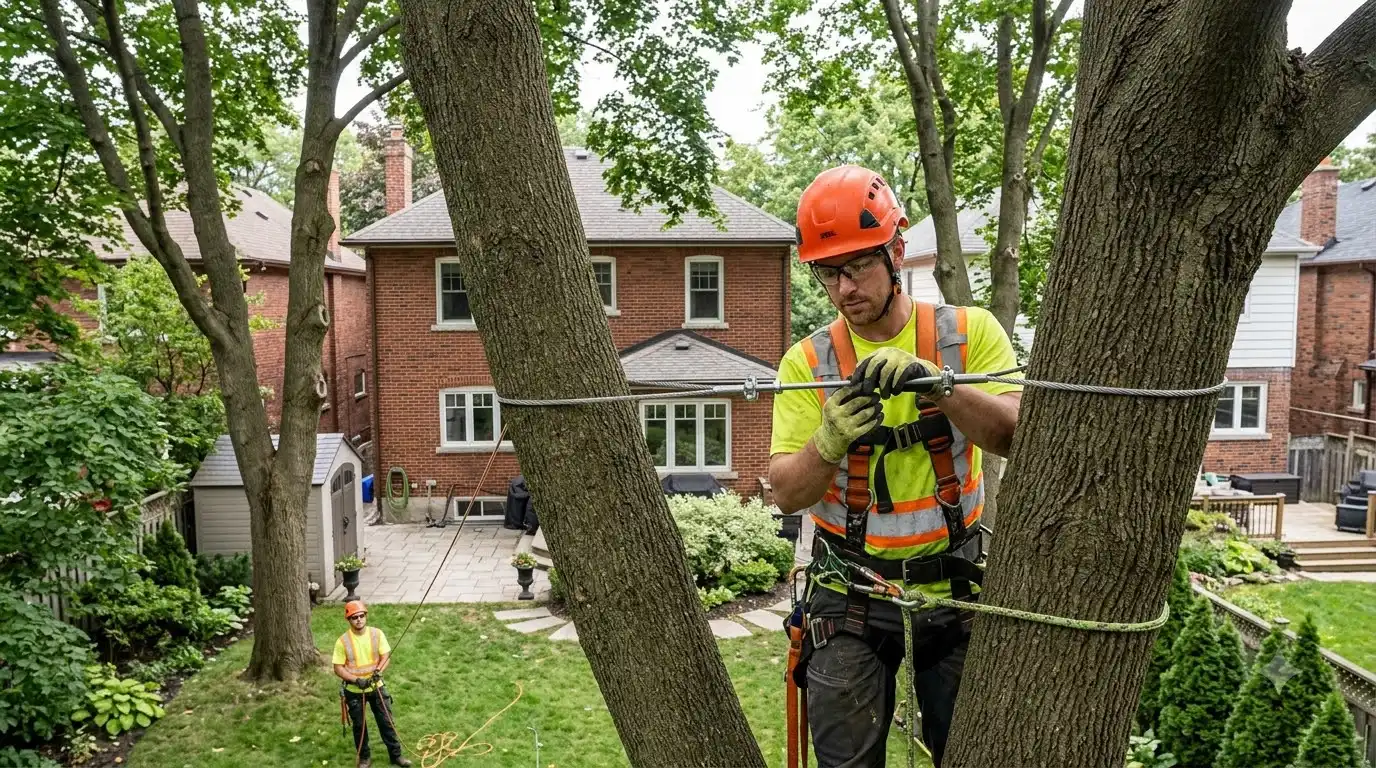
Cabling can be considered when the tree is otherwise suitable for retention, the defect can be meaningfully mitigated by a support system, and the homeowner understands that periodic inspection is part of long-term management. Inspection frequency and any replacement schedule should be set by the arborist and system manufacturer for the specific installation rather than assumed from a universal interval.
The trees that most commonly benefit from cabling in Toronto’s residential landscape are large silver maples with co-dominant stems over houses and driveways in established Etobicoke, North York and Scarborough neighbourhoods, multi-stemmed estate oaks in Bayview, Rosedale and Forest Hill, and significant heritage specimens in older Toronto neighbourhoods where the tree’s value to the property is genuinely irreplaceable on any reasonable timeline.
Cabling vs removal in Toronto: the decision framework
- Favour cabling when: tree is otherwise healthy, defect is significant but not yet cracked, target consequence is high but acceptable with reduced risk, homeowner committed to ongoing monitoring
- Favour removal when: defect involves existing cracking or separation, tree health is declining independently of the structural issue, multiple defects compound the risk, tree is not providing value that justifies ongoing management cost
- TRAQ assessment recommended for: any high or extreme consequence target (over house, play area, public space), decisions where significant money or risk is at stake
- Chapter 813 applies regardless of choice: cabling does not require a permit, but eventual removal of a cabled tree still does
When Removal Is the Right Choice
Removal becomes the appropriate decision when the structural defect has progressed to a point where cabling cannot meaningfully reduce the failure probability to an acceptable level. Active cracking at a co-dominant union, bark separation visible in the crotch, multiple compounding defects on the same tree, or a tree in declining health due to disease or root damage that makes cabling a temporary measure on a tree without a long future: these are situations where the honest professional recommendation is removal. An arborist who recommends cabling on every tree showing a structural defect, regardless of the severity or the tree’s overall condition, is not giving you the full picture.
The consequence of the failure target also matters in the removal decision. A tree with a moderate structural defect over a children’s play area, a frequently-used driveway, or directly over a sleeping area is in a different risk category than the same defect on a tree in an area of the yard that is never occupied. For high-consequence targets, the probability of failure threshold for recommending removal is lower than for low-consequence targets.
Costs and Long-Term Economics
Cabling cost varies with tree size, number and type of supports, climbing access, installation method and follow-up inspection needs. Removal cost also varies substantially. Compare the written cost and risk-management implications of each option for the actual tree instead of relying on a fixed lifespan, recabling interval or generic property-value estimate.
Frequently Asked Questions
What is tree cabling and when is it used in Toronto?
Tree cabling installs a flexible support system in the upper crown to limit movement at a weak co-dominant stem attachment or compromised union. It is used when the defect is significant but the tree is otherwise healthy, the defect has not yet cracked, and the tree’s value justifies the ongoing management. Cabling reduces failure probability but does not eliminate the structural weakness.
How much does tree cabling cost in Toronto?
There is no single Toronto price for cabling. Ask for a written quote that identifies the support system, number of attachment points, installation scope, inspection expectations and any future replacement or adjustment needs.
How long does tree cabling last and is it a permanent solution?
Cabling is not a permanent repair. Support systems require periodic inspection and may need adjustment or replacement depending on the hardware, tree growth and condition. The underlying structural defect remains, so future assessments may eventually favour additional mitigation or removal.
Does a cabled Toronto tree still need a Chapter 813 permit if eventually removed?
Cabling history does not remove Toronto’s tree-protection requirements. If a protected tree is proposed for removal later, the current Chapter 813 rules and any applicable permit or permit-exception process still apply. Prior inspection and cabling records may be useful supporting history, but the City makes the permit decision on the current application and evidence.
Related Guides and Services
- Hazardous Tree Identification Toronto
- Tree Removal vs Preservation Toronto
- Arborist Tree Inspection Toronto
- Tree Removal Permit Toronto
- Tree Pruning Requests
Send Your Tree Request
Need help deciding what to do next? Send your tree request with your location, a brief description and clear photos of the tree or affected area.