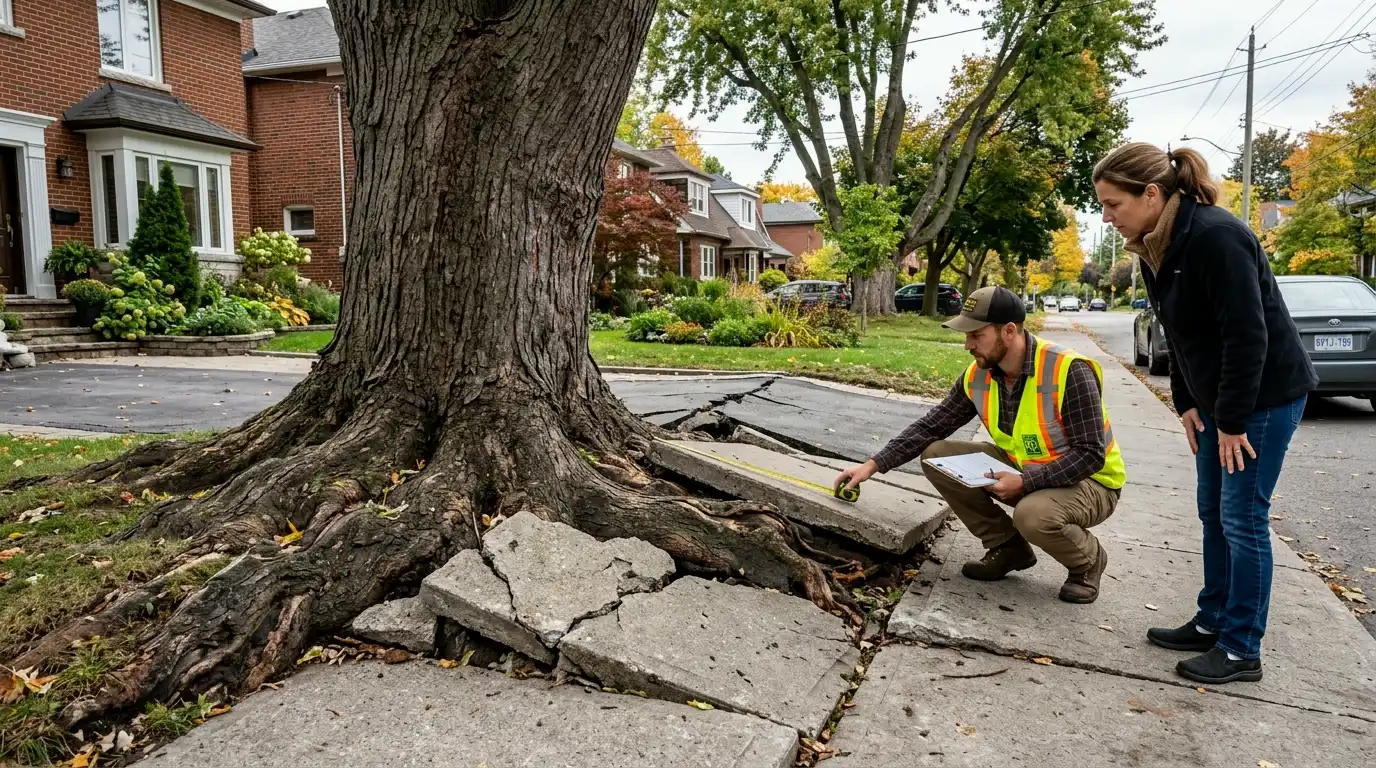
The practical issues around tree root damage to driveways in Toronto include tree condition, property context and any rules that affect the work. Tree root damage to Toronto driveways and sidewalks is a common issue on older residential lots, especially where large maples and other mature trees were planted close to pavement decades ago. Roots can lift concrete panels, crack asphalt, shift patio stones, and create uneven walking surfaces. The difficult part is that the same tree causing the surface conflict may also be protected under Toronto Municipal Code Chapter 813.
This guide explains the main options homeowners usually consider when tree roots are damaging a driveway or sidewalk: root pruning, root barriers, permeable paving, surface repair, and tree removal.
Why Tree Roots Damage Driveways
Tree roots grow where they can find moisture, oxygen, space, and suitable soil conditions. In Toronto’s compacted urban yards, roots often stay close to the surface because deeper soil may be poorly aerated or difficult to penetrate. Driveway edges, sidewalk joints, and patio borders can also trap water and warmth, which can make nearby root growth more noticeable over time.
As roots increase in diameter, they can push against hard surfaces. Asphalt may buckle because it has some flexibility. Concrete may crack along weak points, panel joints, or areas where the base has shifted. Interlocking stones may rise unevenly as roots thicken below them. The damage usually appears slowly, but once a root has displaced the base material, simple patching often does not solve the underlying conflict.
Large silver maples, Norway maples, and other mature urban trees can be especially challenging around driveways because they may have wide, shallow root systems. That does not automatically mean the tree is unsafe or unhealthy. It means the property owner needs to think carefully before cutting roots, replacing pavement, or applying for removal. Cutting the wrong roots can injure a protected tree or affect stability.
Useful official Toronto resources:
- City of Toronto Tree & Ravine Protection
- When to Apply for a Tree or Ravine Permit
- How to Apply for a Tree or Ravine Permit
- Toronto Municipal Code Chapter 813, Trees
Before cutting roots, excavating, rebuilding a driveway, or removing a tree, confirm whether the tree is protected and whether the proposed work could be considered injury under City rules.
Option 1: Root Pruning
Root pruning means cutting specific roots that are contributing to pavement movement while trying to keep the tree in place. In theory, this can reduce the immediate conflict. In practice, it is one of the riskiest options if the cuts are close to the trunk, affect large roots, or involve a protected tree. Roots are not just nutrient channels. They also help anchor the tree.
The most important issue is distance from the trunk and the size of the roots being cut. A small surface root near the outer edge of a driveway is different from a major structural root close to the base of a large tree. Cutting roots close to the trunk can reduce stability, create decay entry points, and increase the chance of tree decline. That risk becomes more serious with large trees, trees leaning toward structures, trees in compacted soil, and trees already stressed by construction or drought.
For protected trees in Toronto, root pruning may require City review because injury to a protected tree can be regulated under Chapter 813. Homeowners should not assume that root cutting is allowed simply because the root is under a private driveway.
Root damage options compared: Toronto residential driveways
| Option | Often considered when | Permit caution | Who confirms details |
|---|---|---|---|
| Root pruning | Roots appear to be affecting a specific pavement edge or panel | May be treated as injury if a protected tree is affected | City of Toronto and a qualified arborist |
| Root barrier installation | The goal is to reduce future root movement toward a surface | Excavation near protected roots may need review | qualified tree contractor, qualified arborist, and City where needed |
| Permeable paving replacement | The owner wants a surface that may work better around tree roots | Excavation in a protected root zone may require City guidance | Qualified paving contractor and City where needed |
| Driveway repair only | The owner wants to address the surface without tree work | Permit issues can still arise if roots are cut during repair | qualified tree contractor and City where protected roots may be affected |
| Tree removal | The conflict is severe and other options may not be practical | Generally requires a permit if the tree is protected | City of Toronto and a qualified arborist |
Option 2: Root Barriers
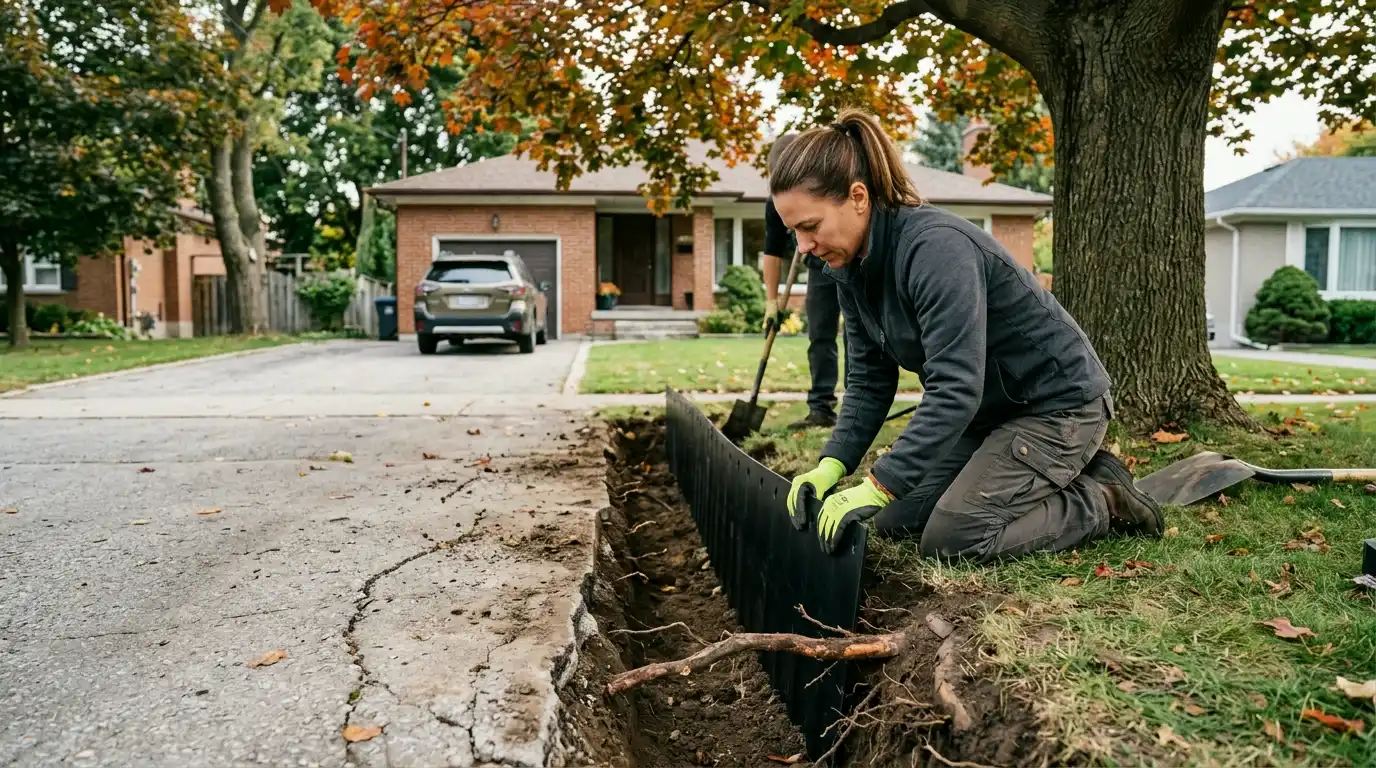
A root barrier is a vertical underground barrier installed between a tree’s root zone and the surface being protected. It is intended to redirect roots away from the driveway, sidewalk, patio, or foundation edge. Root barriers are usually more useful before major heaving has occurred. Once large roots are already under the driveway, a barrier beside the driveway may not correct the damage that already exists.
Root barriers can still create risk if installation requires trenching through important roots. The closer the trench is to the trunk, the more careful the property owner needs to be. For a protected Toronto tree, excavation in the root zone may need City guidance or professional review before work begins.
Option 3: Permeable Paving
Permeable paving can be considered when a homeowner wants to rebuild a driveway or walkway in a way that may be more compatible with nearby roots. Depending on the design, permeable pavers, gravel-based systems, and other permeable surfaces can allow more water and air movement than standard concrete or asphalt. Some systems can also be reset more easily than poured concrete if movement occurs later.
This does not mean permeable paving is automatically approved near a protected tree. Excavation depth, base preparation, grading, drainage, root impacts, and proximity to the trunk all matter. A paving project that cuts major roots can still create tree injury concerns even if the finished surface is more root-friendly than conventional asphalt.
Where driveway reconstruction is being considered near a protected tree, the property owner should confirm the City’s requirements before excavation starts. A qualified paving contractor, qualified arborist, or City staff may need to be involved depending on the tree, location, and scope of work.
Option 4: Surface Repair Only
Some homeowners choose to repair the driveway or sidewalk surface without cutting roots or removing the tree. This may include resetting pavers, patching asphalt, grinding or replacing a raised concrete panel, or changing the grade slightly. This can be a practical short-term step where the immediate concern is a tripping hazard or vehicle access issue.
The limitation is obvious: if the same roots continue to expand below the surface, the damage may return. Surface repair is usually most realistic when the tree is valuable, healthy, protected, or difficult to remove, and the owner accepts that future maintenance may be needed. If a contractor exposes or cuts roots during surface repair, permit and injury concerns may still apply.
Option 5: Tree Removal
Tree removal is the most permanent way to stop a root conflict, but it is also the option most likely to require formal City review. In Toronto, private trees with a DBH of 30 cm or more are protected. City trees are protected regardless of size. Driveway damage does not automatically exempt a protected tree from permit requirements.
If removal is being considered, the property owner should confirm requirements directly with Toronto Urban Forestry. A qualified arborist may be able to discuss whether a report is appropriate. Questions about arborist report, site visit, photographs, root-zone observations, application support, submission support, timing, pricing, and communication should be confirmed in writing with the relevant qualified professional before work begins.
Insurance, Safety, and Public Property Issues
If the damaged surface creates an immediate safety hazard, take reasonable steps to keep people away from the area and contact the proper authority where needed. If roots affect a public sidewalk, boulevard, roadway, utility corridor, or City tree, contact the City of Toronto or the relevant public authority before arranging private work. If utility lines, buried services, or public infrastructure may be involved, confirm requirements before excavation.
Property owners should confirm documentation requirements directly with their insurer if they plan to make an insurance inquiry.
Related professional service: See the stump grinding service information for stump and root-related requests.
Frequently Asked Questions
Can I cut tree roots that are damaging my Toronto driveway?
Root cutting near a protected Toronto tree can be treated as tree injury and may require a permit. Private trees at 30 cm DBH or greater are protected, and City-owned trees are protected regardless of size. Before cutting roots, confirm requirements directly with Toronto Urban Forestry or discuss the issue with a qualified arborist.
What is a root barrier and does it work?
A root barrier is an underground barrier used to redirect roots away from a surface such as a driveway or sidewalk. It is usually more useful before major heaving occurs. If installation may cut roots near a protected tree, confirm City requirements before work begins.
Do I need a Chapter 813 permit to remove a tree damaging my driveway?
If the tree is a protected private tree at 30 cm DBH or greater, a permit is generally required before removal or injury. Driveway damage does not automatically remove the permit requirement.
What is permeable paving and how can it help around tree roots?
Permeable paving allows more water and air movement through the surface than standard concrete or asphalt. It may be useful in some root-conflict situations, but suitability depends on drainage, excavation depth, root impacts, tree location, and municipal requirements. Confirm requirements before excavating near a protected tree.
Related Guides and Services
- Tree Removal Permit for a Driveway in Toronto
- How to Get a Tree Removal Permit in Toronto
- Tree Growing Into My House or Foundation
- Tree Root Pipe Intrusion
- Tree Removal Requests
Send Your Tree Request
Dealing with tree root damage near a Toronto driveway, sidewalk, or patio?