
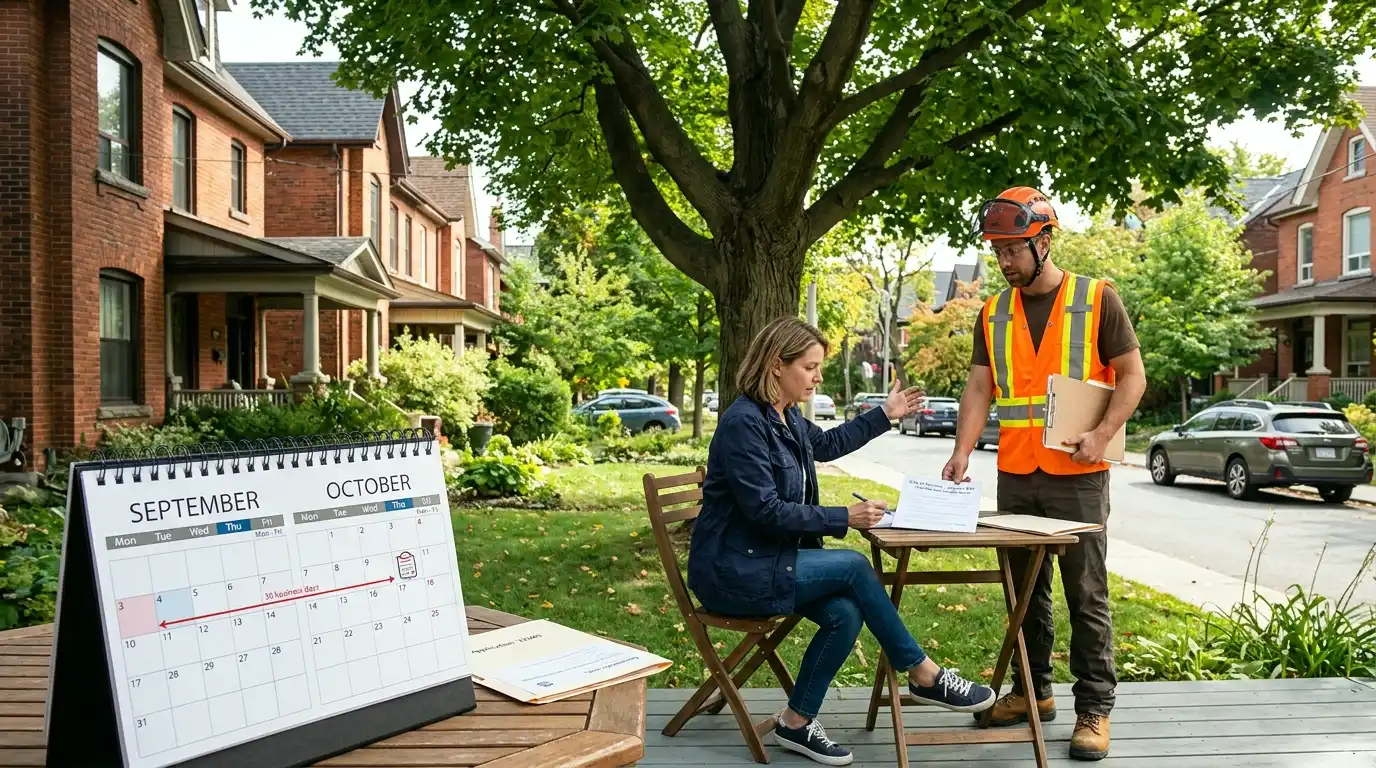
Homeowners often ask, “How long does a tree permit take in Toronto?” The practical answer depends on the property, tree condition and the rules that apply. A Toronto tree permit timeline depends on the completeness of the application, the quality of the supporting documents, whether a City inspection or additional information is required, and Urban Forestry’s current workload. Many property owners should plan for several weeks at minimum, and longer if the application is tied to construction, a boundary tree, a ravine-regulated area, or missing documentation. The most important rule is simple: incomplete applications are not processed.
Toronto Tree Permit Timeline at a Glance
- qualified arborist assessment and report preparation: Often 1 to 2 weeks, depending on availability and complexity
- Application submission to City: Online through the City of Toronto permit system
- Completeness review: Timing depends on document quality and City workload
- City review or inspection: May be required depending on the application
- Common delay triggers: Missing arborist report, unclear site plan, missing photos, missing replanting plan, boundary tree issues, or construction-related drawings
- Best planning approach: Start early and confirm current requirements directly with the City
What the Timeline Actually Means
Toronto’s tree permit process is not only about waiting for a date on a calendar. The real issue is whether the City has enough information to review the file. If the application is incomplete, unclear, or missing supporting documents, it can be returned or delayed before meaningful review begins.
The City of Toronto requires property owners to prepare the correct materials before applying to remove a protected private tree or City-owned tree. For private property, trees measuring 30 centimetres or more in diameter are protected. For City street trees, trees of any size are protected. Ravine and natural feature areas have their own additional rules.
This distinction catches many property owners. You may think the process started when the application was first submitted, but if the City later asks for a missing arborist report, clearer photos, a better site plan, a replanting plan, or additional construction information, your practical timeline stretches. The safer assumption is that the process only moves efficiently once the City receives a complete and clear package.
What a Complete Application May Include
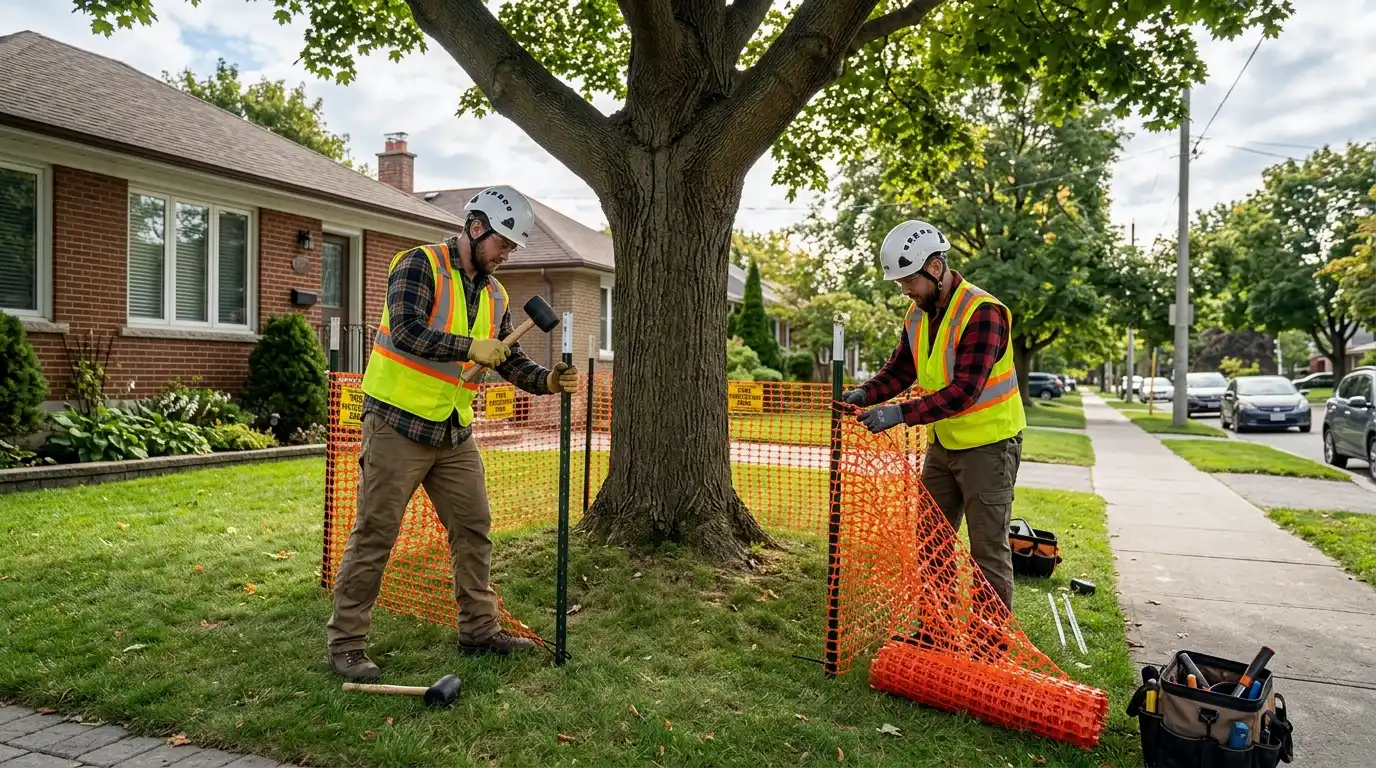
Toronto Urban Forestry will not process incomplete applications. For an application to remove a protected private tree or City-owned tree, the required materials can include a completed application, the applicable fee, an arborist report, a landscape and replanting plan, clear colour photos, and a site plan where construction is involved.
For construction-related applications, the City may require scale drawings, elevations, tree locations, tree protection information, and other details showing how the proposed work affects protected trees. If the property is in or near a ravine-regulated area, additional ravine-related drawings or documents may be required.
a qualified arborist may discuss the documentation needed for a Toronto tree permit application.
The Typical Timeline Step by Step
Step 1: Qualified Arborist Assessment
Before submitting a permit application, many property owners speak with a qualified arborist to assess the tree and prepare any report required by the City. Booking the visit, completing the inspection, and receiving the written report can take time, especially in busy spring and fall periods.
Step 2: Application preparation
The application package should be checked before submission. A rushed package is often what causes delays. The applicant should confirm the correct tree, ownership, property boundaries, required photos, replanting details, and any construction-related documents before submitting.
Step 3: City submission
Tree and ravine permit applications can be submitted through the City of Toronto’s online permit system. The applicant should keep copies of submitted documents, payment confirmation, and any City reference number.
Step 4: City review
Urban Forestry reviews the application and may request additional information, conduct an inspection, or evaluate whether the application meets the applicable by-law criteria. Chapter 813 allows the City to consider factors such as the application form, required fees, tree condition, tree location, environmental sensitivity, ecological systems, erosion and flood control, heritage value, arborist report, tree protection plan, and replanting information.
Step 5: Decision or further direction
The City may issue a permit, issue a permit with conditions, refuse the permit, or ask for additional information. If a permit is issued, it may include conditions such as replacement planting, posting the permit before approved work begins, and complying with approved plans. Do not arrange tree injury or removal until proper authorization is confirmed.
What Causes Delays
Understanding the most common reasons applications slow down helps you avoid them. These are the situations that often add time to the process.
Incomplete arborist report
If an arborist report is required and it does not contain enough technical detail, the City may ask for clarification or additional information. A strong report usually identifies the tree location, species, size, condition, structural concerns, health, proposed work, and any relevant protection or replanting information.
Missing site plan or inaccurate sketch
Urban Forestry must be able to identify the exact tree from the submitted documents. If the site plan is vague, hard to read, missing property context, or unclear about which tree is proposed for injury or removal, the application can be delayed.
Spring and fall volume spikes
Tree-related requests often increase during spring and fall. Spring storms, construction planning, landscaping projects, and fall cleanup can increase demand for qualified arborists and tree care professionals. City review times can also feel longer when application volumes are high.
Holiday periods
Calendar time and business-day time are not the same. Long weekends and statutory holidays can stretch how long the process feels from the applicant’s perspective, even when the City is processing files normally.
Slow response to City requests
If the City asks for more information and the applicant waits days or weeks to respond, the project timeline grows. Treat City requests as urgent, and confirm any unclear requirement directly with the City or the qualified arborist.
Want to Avoid Permit Application Delays?
How Long Does a Tree Permit Take in Toronto?
There is no guaranteed shortcut that makes a private tree permit automatically move ahead of the normal City review process. The practical way to avoid delay is to submit a complete and clear application from the start.
That usually means confirming whether the tree is protected, preparing accurate tree and property information, using clear photos, submitting a complete replanting plan where required, and working with a qualified arborist who meets the City’s current requirements where a report is needed.
Beyond that, responsiveness matters. Check the email address connected to the application regularly. If the City requests clarification, respond quickly. Every delay on the applicant’s side can add time to the total process.
What to Do While Waiting for Your Permit
Do not injure, cut, or remove a regulated tree while the application is under review unless the City has confirmed an applicable exemption or authorization. Removing or injuring a protected tree without proper authorization can create serious by-law problems.
Use the waiting period productively. You can review replacement planting expectations, gather contractor questions, confirm access issues, and clarify any insurance or documentation needs. Property owners should confirm documentation requirements directly with their insurer.
Important: Do not assume a permit has been approved simply because time has passed. If you have not received a decision or clear authorization, contact Toronto Urban Forestry or 311 before allowing any work to proceed.
How Toronto’s Timeline Compares to Other GTA Municipalities
Toronto has its own tree protection rules, and neighbouring municipalities have their own permit thresholds, documents, and review processes. Mississauga, Vaughan, Markham, Brampton, and Richmond Hill do not all follow the same rules.
If your property is near a municipal boundary or your project involves more than one property, confirm which municipality’s by-law applies before planning the work. See the individual guides for Mississauga, Markham, and Richmond Hill for municipality-specific context.
Planning Around the Permit Timeline
The practical takeaway for Toronto property owners is this: start earlier than you think you need to. A tree permit application can become slower if the report is incomplete, the tree is near a property boundary, construction drawings are involved, the property is near a ravine-regulated area, or the City requests more information.
If a renovation, fence, driveway, addition, pool, or landscaping project depends on the tree decision, build extra time into the schedule. It is better to start the permit discussion early than to have a contractor ready to work while the required tree authorization is still unresolved.
Related Guides and Services
- How to Get a Tree Removal Permit in Toronto
- What Happens If You Remove Without a Permit
- Toronto Tree Bylaws Overview
- Arborist Report Requests
- Tree Removal Requests
Frequently Asked Questions
How long does a tree removal permit take in Toronto?
Toronto publishes customer-service standards of 10 business days for investigation of a non-construction permit application and 15 business days for a construction permit application. Those figures are investigation standards, not guaranteed permit-issuance dates; the City lists a much longer completion standard and a file can take longer when documents, inspections, notice, revisions or other approvals are required.
What slows down a tree permit application in Toronto?
Common causes include incomplete forms, missing arborist reports, unclear photos, inaccurate site plans, missing replanting information, boundary tree issues, construction-related documents, and slow responses to City requests.
Can you speed up a tree permit in Toronto?
There is no guaranteed shortcut for a private tree permit. The practical way to avoid delay is to submit a complete, clear application from the start and respond quickly to any City request for more information.
When does the permit review timeline start for a Toronto tree permit?
The practical review timeline depends on the City receiving a complete application. Toronto’s application page states that incomplete applications will not be processed, so missing documents can delay meaningful review.
What happens if Toronto does not respond quickly to a tree permit application?
Do not assume approval just because time has passed. Contact Toronto Urban Forestry or 311 to follow up, and do not injure or remove a protected tree until proper authorization is confirmed.
Ready to Start Your Permit Request?
This may include requests from North York, Etobicoke, Scarborough, East York, Forest Hill, Rosedale, the Annex, Leaside, the Beaches, and nearby Toronto neighbourhoods.
Also Helpful:
Toronto Permit Guide |
Mississauga Permit Guide |
Markham Permit Guide |
Richmond Hill Permit Guide