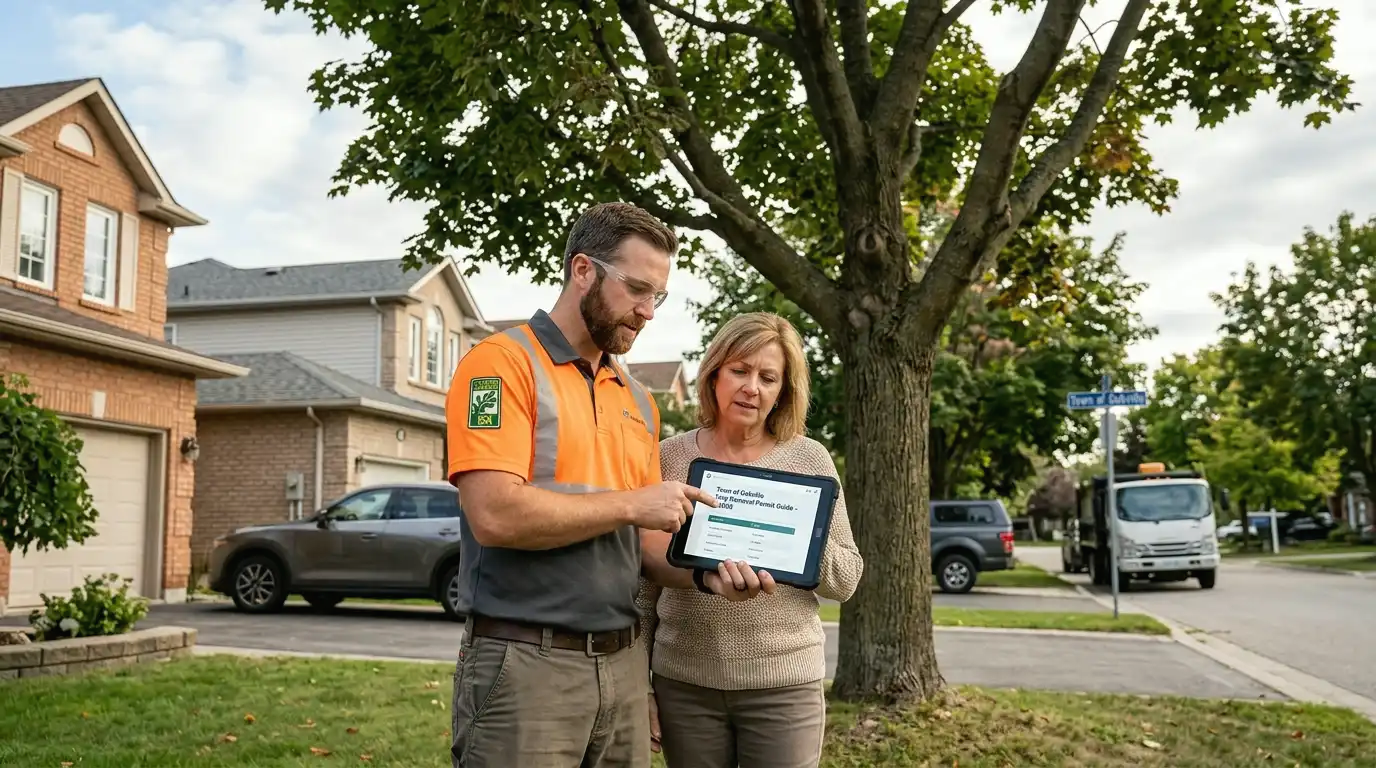
This guide explains the tree removal permit in Oakville, including the approval rules, property conditions and practical steps that can affect the work. Oakville requires a private tree removal permit for many trees on private property. The Town says a permit is required when removing any tree with a diameter of 15 cm or more at breast height. Oakville explains DBH as a standard tree-size measurement taken at 137 cm above ground level, and a trunk circumference of more than 47 cm at that height generally means the tree is at or above the 15 cm DBH threshold.
Oakville’s Private Tree Rules: Overview
Oakville’s current public guidance identifies Private Tree Protection By-law 2017-038 as the by-law that provides established rules for removing trees on private property. The by-law applies to private property within Oakville and regulates the injury or destruction of trees that meet the protected threshold or are otherwise required to be retained or planted through certain approvals.
For most homeowners, the first question is simple: does the tree meet or exceed 15 cm DBH? If yes, the Town’s private tree removal permit process may apply. This can include an online application, supporting documents where required, an on-site consultation, fees where applicable, replacement planting conditions, and a permit that must be posted before removal.
Oakville also notes that its private tree by-law does not apply to woodlands or greenlands governed by Halton Region Tree By-law 121-05. That matters for larger properties, wooded areas, natural heritage areas, and land that is not a typical residential lot.
Oakville private tree permit points to check first:
- Private tree threshold: Oakville says a permit is required for any tree 15 cm DBH or more
- Measurement height: Oakville describes DBH measurement at 137 cm above ground level
- Dead and high-risk trees: Oakville says they still require a permit, but are exempt from fees
- Emergency removals: Oakville says no permit is required where there is immediate risk of serious injury or damage, but the Town must be notified as soon as possible
- Arborist report: may be required for high-risk trees or development-related removals
- Replacement planting: may be a condition of permit approval
Which Trees Are Protected in Oakville?
Oakville says private tree removal permits are required when removing any tree with a diameter of 15 cm or more at DBH. The Town also identifies trees 15 cm or more being removed as part of a development application, and hedges with stems that measure 15 cm or more in diameter, as situations requiring a permit.
The 15 cm threshold is stricter than Toronto’s 30 cm private-tree threshold, and it means many more moderate-size residential trees can require Town review before removal. A tree does not need to be huge to trigger the process. A small-looking backyard maple, spruce, cedar, birch, ash, locust, oak, or ornamental tree may still meet the threshold when measured properly.
If the tree is near a shared property line, additional consent may be required. Oakville’s application process may ask whether any tree trunks are on the property line and may require a signed declaration from the adjacent property owner. Property owners should confirm boundaries and consent requirements before approving work.
Trees That May Not Require the Standard Permit Process
Oakville says permits are not required for trees below 15 cm DBH. The Town also says emergency tree removal does not require a permit where there is immediate risk for the tree to cause serious injury or damage to people or property. In an emergency removal situation, the Town must still be notified as soon as possible.
Dead trees, high-risk trees, ash trees, and buckthorn are treated differently from ordinary healthy-tree removals for fees. Oakville says these categories require a permit, but are exempt from fees. That means property owners should not assume that a dead or high-risk tree can be removed without any Town record or permit step unless it qualifies as an immediate emergency under the Town’s instructions.
If the tree is dangerous, document the condition with clear photos before any work begins where it is safe to do so. If immediate safety is involved, follow emergency, utility, or Town instructions first.
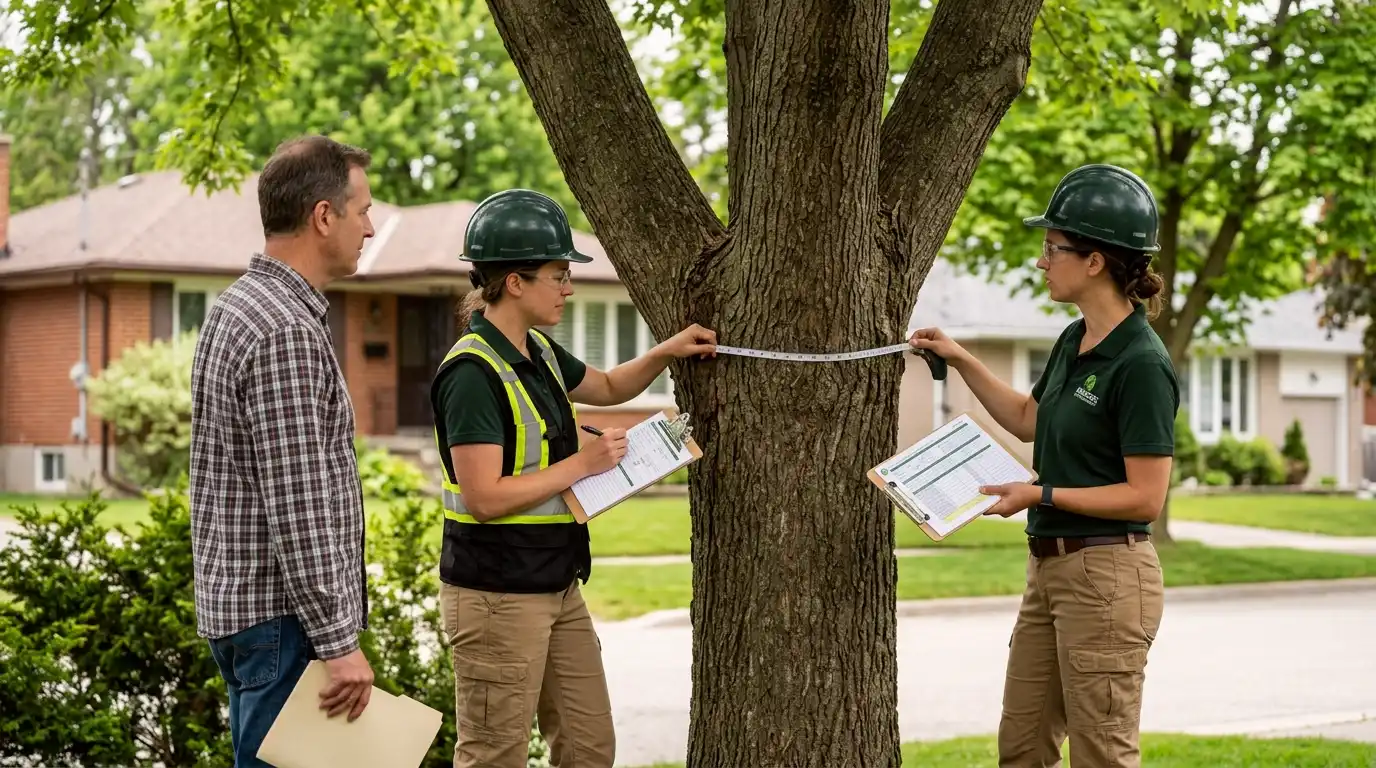
Oakville accepts private tree removal permit applications through its online process. The Town asks applicants to confirm whether a permit is required, provide property details, explain the reason for removal, identify the tree location and species where known, upload required documents, and sign the application electronically.
Depending on the reason for removal, Oakville may require an arborist report from a certified arborist. The Town’s current application guidance lists an arborist report as a required document if the tree is being identified as high-risk or if removal is connected to a development application, such as pools, landscaping, or other property construction projects.
If a qualified arborist assists, that professional is responsible for explaining report scope, timing, fee, credentials, limitations, and any submission support they offer directly to the property owner.
Oakville Permit Fees and Fee Exemptions
Oakville’s current private tree permit page lists non-refundable permit fees by tree size and application type. The Town currently lists a lower fee for the first tree removed in a 12-month period where the tree is 15 to 24 cm DBH, a higher fee for each additional tree and trees larger than 24 cm DBH, and a separate higher fee structure where removal is the result of a development application.
Oakville also says there is no fee for dead and high-risk trees, ash trees, and buckthorn, although a permit is still required. Fees can change, so property owners should confirm current amounts directly through Oakville’s official permit page or Rates and Fees page before applying.
Replacement Tree Requirements
Oakville says tree replacement and a security deposit may be a condition of removal. The Town currently states that one tree must be planted for every 10 cm DBH of healthy tree removed, and that a security deposit is required for each replacement tree to be planted. The deposit is refunded after a final inspection of the replacement planting is complete.
Oakville also states that trees are now required to be replanted on the same private property where trees are removed, and cash-in-lieu will only be accepted where there is not enough space to replant on the subject property. Replacement tree size, species, and site suitability should be reviewed directly with the Town’s permit conditions.
Do not assume replacement planting is included in a tree removal estimate. Ask the qualified tree contractor or arborist whether replacement tree supply, installation, watering, maintenance, proof of planting, failed-tree replacement, or final inspection support is included or excluded.
Conservation Halton, Halton Region, and Natural Area Considerations
Oakville tree removal may involve more than the Town’s private tree process when a property is near a creek, valley, wetland, floodplain, slope, woodland, greenland, or natural heritage feature. Oakville’s public policy materials note that Halton Region Tree By-law 121-05 applies to certain Greenlands or Woodlands, and Conservation Halton may be relevant for regulated-area development or site alteration.
Oakville properties near systems such as Sixteen Mile Creek, Bronte Creek, Fourteen Mile Creek, Morrison Creek, Joshua Creek, and nearby valley or floodplain areas may require extra review before grading, filling, construction, retaining-wall work, drainage changes, or other site alteration. Tree removal itself may also be connected to these broader site activities.
Need to Send an Oakville Tree Permit Request?
What Happens Without a Permit?
Removing or injuring a regulated private tree in Oakville without the required permit can create by-law risk for the property owner. Oakville’s private tree by-law page says non-compliance may result in fees and charges under the Administrative Penalty By-law. Depending on the facts, consequences may also include replacement planting, enforcement steps, delays, or problems during property due diligence.
Unpermitted removal can be especially risky where neighbours can see the tree, where construction is underway, where the tree is close to a property line, or where the removal affects a mature canopy tree. A fresh stump, sawdust, and changed canopy can make an unpermitted removal easy to notice.
If a regulated tree is removed without the required approval, payment disputes, responsibility, insurance, fines, replacement planting, documentation and property damage can become separate issues. Confirm permit responsibility and the written work scope before removal, and direct legal or insurance disputes to the appropriate professional rather than assuming the tree contractor or Town process decides private liability.
Timing Your Application
The best time to begin the Oakville permit process is before you need the tree work done. If the tree removal is connected to landscaping, a pool, drainage work, construction, a sale timeline, or a contractor schedule, start early. Permit-related delays are much easier to handle before a project is already underway.
Oakville says a tree inspector from the Forestry Section will contact the applicant within five business days after submission to arrange an on-site consultation. That does not guarantee full approval within five business days. The total timeline can still vary based on application completeness, the reason for removal, required documents, inspection scheduling, fee payment, replacement planting conditions, and whether the tree is high-risk, dead, ash, development-related, or near a regulated area.
Once a permit is issued, Oakville’s current instructions require it to be posted in a location visible from the road for five days before and including the day of removal.
If the tree creates an immediate safety issue, contact the proper emergency, utility, or Town channel first. If a qualified arborist or tree care professional assists, that professional is responsible for explaining their own timing, emergency availability, report timing, and service limits directly to the property owner.
Hiring a Qualified Arborist for Oakville Permit Questions
Oakville’s permit process is specific to the Town. It is not identical to Toronto, Mississauga, Brampton, Vaughan, Markham, or Richmond Hill. A property owner should ask any qualified arborist or tree care professional whether they understand Oakville’s current 15 cm DBH threshold, fee exemptions, replacement planting expectations, high-risk tree documentation, property-line consent issues, and development-related arborist report requirements.
Property owners should confirm the qualified professional’s credentials, insurance, WSIB status where applicable, report fee, site visit fee, timeline, cancellation terms, written scope, and what is included or excluded. If permit-related support is offered, ask whether the professional only provides an arborist report or also assists with the application process.
Comparing Oakville’s Rules to Nearby Municipalities
Oakville’s private tree threshold is 15 cm DBH, which is more restrictive than Toronto’s 30 cm private-tree threshold and similar to Mississauga’s 15 cm threshold. Other GTA municipalities can use different measurements, exemptions, forms, fees, replacement planting rules, and report requirements.
That means a tree that might not require a permit in one municipality may require one in Oakville. If you recently moved to Oakville, own properties in multiple municipalities, or are comparing contractor advice from another area, do not assume the same rules apply.
For related permit context, see the guides to Toronto, Mississauga, Vaughan, and Brampton tree removal permits.
Official Oakville and Regional Resources
- Town of Oakville: Private Tree Removal Permit Application Process
- Town of Oakville: Private Tree Protection By-law
- Town of Oakville: Private Tree Protection
- Town of Oakville: Tree Protection and Tree Canopy Preservation Policy
- Conservation Halton: Permitting and Planning
- Conservation Halton: Mapping and Studies
- Halton Region: Tree By-law
- ISA: Find an Arborist
Frequently Asked Questions
What is the minimum tree size requiring a permit in Oakville?
Oakville says a private tree removal permit is required for any tree with a diameter of 15 cm or more at breast height. The Town explains DBH as a standard measurement taken at 137 cm above ground level. Property owners should confirm current requirements directly with the Town before removing a tree.
How long does an Oakville tree removal permit take?
Oakville says a tree inspector will contact the applicant within five business days to arrange an on-site consultation after the application is submitted. Full permit timing can vary by application completeness, tree condition, inspection scheduling, replacement planting requirements, high-risk status, development involvement, and Town review.
Do I need a permit to remove a dead tree in Oakville?
Oakville says dead and high-risk trees and ash trees require a permit, but are exempt from permit fees. Emergency tree removal is different: where there is an immediate risk of serious injury or damage, Oakville says a permit is not required, but the Town must be notified as soon as possible. Property owners should confirm current instructions directly with the Town.
Does Oakville require replacement planting after tree removal?
Replacement planting and security deposits may be conditions of an Oakville private tree removal permit. Oakville currently states that one tree must be planted for every 10 cm DBH of healthy tree removed, and a security deposit may be required for each replacement tree. The final requirement should be confirmed directly in the Town’s permit conditions.
My Oakville property is near a creek. Does Conservation Halton apply?
Possibly. Some Oakville properties near creeks, valleys, wetlands, floodplains, slopes, or regulated natural areas may require Conservation Halton review for development, grading, filling, construction, or other site alteration. Halton Region woodland or greenlands rules may also apply in some areas. Property owners should confirm jurisdiction directly with the relevant authority before work begins.
Related Guides
- Tree Removal Permit Toronto
- Tree Removal Permit Mississauga
- Tree Removal Permit Vaughan
- Tree Removal Permit Brampton
- Arborist Report Requests
- Tree Removal Requests