
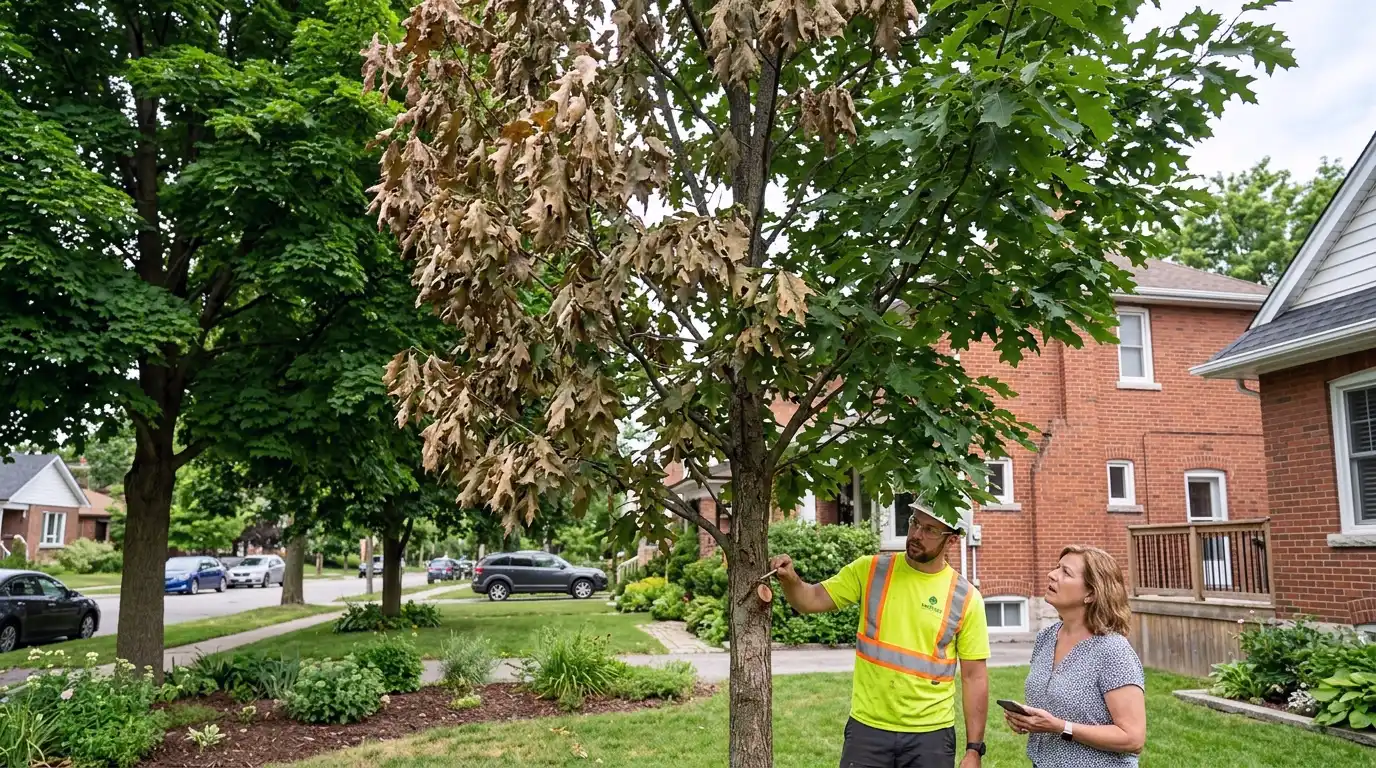
Oak wilt in Ontario can affect tree health, structure or long-term survival, so early identification matters. Oak wilt is a serious vascular disease of oak trees caused by the fungus Bretziella fagacearum. It disrupts water movement inside the tree and can lead to rapid decline, especially in red oak group trees. Ontario states that oak wilt has been found in southern Ontario, and the Canadian Food Inspection Agency advises property owners to avoid pruning oaks between April and November, avoid moving firewood, check oak trees for signs of oak wilt, and report suspected signs.
Not every canopy problem is oak wilt. The spongy moth tree damage in Ontario guide covers a different cause of severe defoliation.
What Oak Wilt Is and How It Kills Trees
Oak wilt affects the xylem, the water-conducting tissue of the tree. Once the disease is active, water movement inside the tree can be blocked, leading to wilting, browning, dieback, and in some cases rapid tree death. Red oak group trees are generally considered more vulnerable to fast decline than white oak group trees, although all oaks should be treated seriously when suspicious symptoms appear.
The disease can spread in two important ways. One route is above ground, when insects carry spores from infected material to fresh wounds on healthy oaks. This is why pruning timing matters. Fresh wounds during the active beetle period can increase risk. The second route is below ground through root grafts between nearby oaks. Where oaks are close together, root connections can allow disease movement from one tree to another without a new pruning wound.
Oak wilt: practical points for Ontario homeowners
- Avoid pruning or wounding oaks between April and November unless an emergency makes work unavoidable
- The highest-risk period is commonly identified as spring into mid-summer, when insect vectors are most active
- Do not move oak firewood or potentially infected oak wood from a suspected site without checking official guidance
- Red oak group trees can decline quickly, so summer browning should not be ignored
- Oak wilt can spread through root grafts between nearby oaks
- If oak wilt is suspected, check Ontario and CFIA guidance and report suspected signs as directed
- discuss the tree with a qualified arborist before authorizing pruning, removal, sampling, or major site disturbance
Oak Wilt in Ontario: Symptoms of Oak Wilt
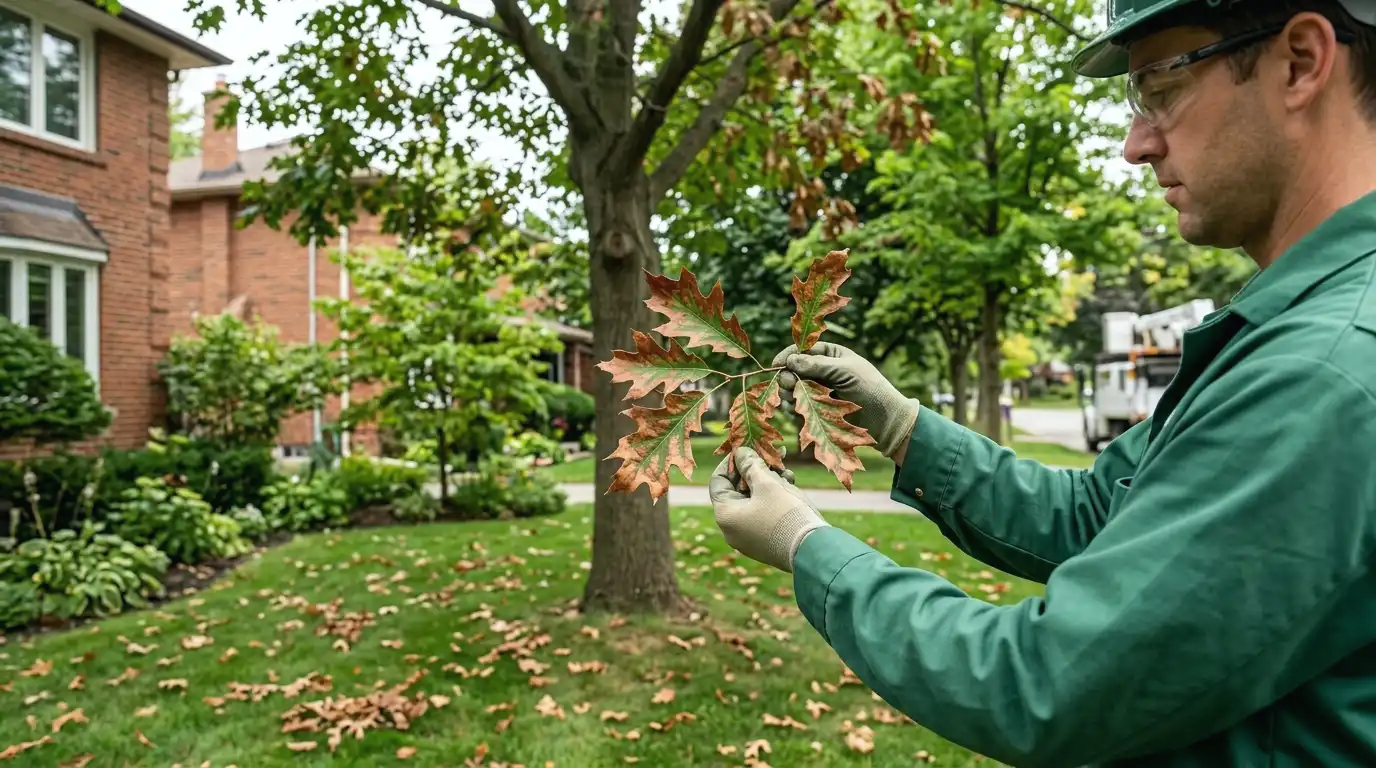
Symptoms can include wilting, bronzing or browning leaves, leaf discoloration that begins at the margins, premature leaf drop, thinning crown, branch dieback, and rapid decline during the growing season. The Invasive Species Centre describes symptoms such as bronzing that starts from the top of the tree and moves downward, discoloration progressing from the leaf margin toward the midrib, premature leaf fall, and vertical bark cracks associated with fungal spore mats.
Red oak group trees may show dramatic symptoms in summer, including sudden crown browning well before normal fall colour. White oak group trees may decline more slowly and can show more subtle symptoms over a longer period. Drought, construction injury, root damage, other diseases, insect damage, soil compaction, and normal seasonal stress can also cause leaf symptoms, so a visual symptom alone is not a laboratory-confirmed diagnosis.
If oak wilt is suspected, avoid creating fresh wounds, avoid moving potentially infected oak wood, and review official reporting guidance. CFIA directs people to report suspected signs of oak wilt, and Ontario provides oak wilt information for property owners. Official information is available here: Ontario oak wilt information and CFIA oak wilt information.
What to Do If You Suspect Oak Wilt
If you have a red oak showing rapid summer browning or any oak showing suspicious decline, stop any planned pruning, cutting, trenching, construction impact, or wound-creating work around that tree until the situation is reviewed. Do not move oak firewood, logs, branches, or potentially infected wood off site without checking official guidance. If the tree creates an immediate hazard, affects a public road, touches utility lines, or threatens public safety, contact emergency services, the municipality, the utility provider, or the relevant public authority first.
A qualified arborist can discuss site observations, whether sampling or laboratory confirmation should be considered, whether nearby oaks may be at risk, whether municipal tree rules apply, and whether removal or another risk-reduction step may be appropriate.
Suspected oak wilt should also be handled with reporting in mind. CFIA provides oak wilt reporting guidance, and Ontario provides provincial information on the disease. Because reporting requirements and management guidance can change, property owners should use official sources rather than relying only on general online advice.
Preventing Oak Wilt on Your Property
The most practical prevention rule is to avoid pruning or wounding oak trees during the active risk period. Ontario says the high-risk period is from the beginning of April to the end of July, and ideally oaks should not be pruned or wounded between April and November when sap beetles are active. CFIA also advises not pruning oak trees between April and November. If emergency work cannot wait, the property owner should discuss timing, wound treatment, wood handling, and risk reduction directly with a qualified arborist or qualified professional.
Construction work can also injure oak roots, bark, and lower trunks. If excavation, driveway work, landscaping, utility work, grading, drainage changes, pool work, additions, or heavy equipment will be near oak trees, discuss root-zone disturbance and wound risk before work begins. A qualified arborist can assess tree-related construction concerns where needed.
For properties with multiple oaks growing close together, root graft risk may be relevant if one oak is declining or if oak wilt is suspected. Root disruption, trenching, sampling, removal, and wood handling are specialized issues and should be discussed with the appropriate public authority or a qualified arborist.
Frequently Asked Questions
What is oak wilt and does it exist in Ontario?
Oak wilt is a vascular disease caused by Bretziella fagacearum. Ontario states that oak wilt has been found in southern Ontario and asks suspected infected trees to be reported to the Canadian Food Inspection Agency. Property owners who suspect oak wilt should use official provincial and federal reporting guidance and should not move potentially infected oak wood without confirming requirements.
When should I avoid pruning oak trees in Ontario?
Ontario identifies April to November as the broader period when sap beetles that can spread oak wilt are active, with April to the end of July considered a high-risk period. CFIA also advises not pruning oak trees between April and November. If oak work is unavoidable because of an emergency, the property owner should discuss timing, wound treatment, and risk reduction directly with a qualified arborist or qualified professional.
How does oak wilt spread from tree to tree?
Oak wilt can spread above ground when insects move fungal spores to fresh oak wounds, and below ground through root grafts between nearby oaks. CFIA notes that root grafting is a primary spread pathway. Site-specific management, testing, root disruption, removal, wood handling, and reporting should be discussed with the relevant public authority or a qualified arborist.
What do I do if I suspect my Toronto oak has oak wilt?
Stop planned pruning or wound-creating work on the oak, avoid moving oak firewood or potentially infected wood, check official Ontario and CFIA guidance, and report suspected signs as directed by CFIA.
Related Guides and Services
- Heritage Tree Protection in Toronto
- Signs Your Tree Is Dead or Dying
- How to Protect Trees During Construction
- Tree Pruning
- Arborist Reports
Send Your Tree Request
Concerned about an oak on your Toronto or GTA property?