
Tree Removal in Brampton: Tree Preservation Rules, Costs and What to Expect
Brampton has a large and varied urban forest. Older areas such as downtown Brampton, Bramalea, Heart Lake and Madoc often have mature maples, spruces, elms and backyard shade trees. Newer areas such as Mount Pleasant, Northwest Brampton, Sandringham-Wellington and Credit Valley have younger subdivision trees that are now reaching sizes where homeowners start asking about pruning, removal, storm damage, roots, clearance and replacement planting.
The most important point is simple: Brampton tree removal is not just a pricing question. It can involve private tree rules, City-owned tree rules, boulevard ownership, woodlot rules, shared or boundary tree issues, conservation authority context, project-related disturbance and contractor responsibility.
Brampton’s Private Tree Preservation Rules
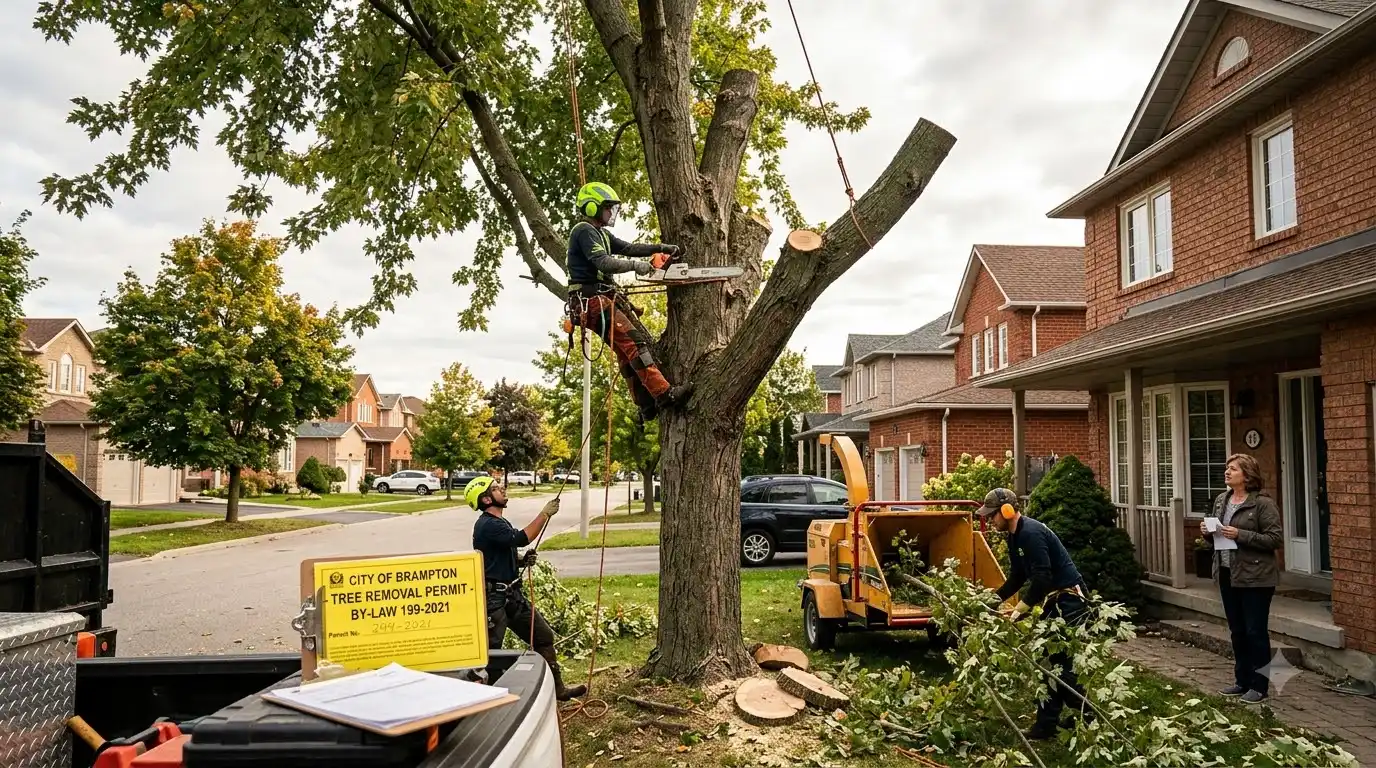
The City of Brampton’s tree regulations page explains that a permit is not required to remove a tree located within 2 metres of an occupied building, and a permit is not required to remove a tree with a diameter of less than 30 centimetres measured at 1.37 metres above ground. The City’s tree services page also states that a private tree removal permit is required when the tree is more than 2 metres from an occupied building and the diameter is 30 centimetres or more at 1.37 metres height.
This is different from the common mistaken claim that Brampton protects every private tree at a 20 cm diameter threshold. The City’s current public guidance instead points to the 30 cm trigger measured at 1.37 metres, together with the occupied-building distance exemption. Homeowners should confirm the current rule and any site-specific exception directly with the City of Brampton or an appropriately qualified arborist before removal or injury.
The City also states that the City’s Urban Forestry team handles trees on public property, including parks, open spaces and boulevard or street trees. Members of the public should not prune, remove or damage City-owned trees. If there is uncertainty about whether a tree is private, shared, boundary, boulevard or City-owned, the property owner should check the property survey and contact the City before work is approved.
Brampton tree removal planning facts for 2026
- Private tree permit trigger: generally 30 cm diameter or more at 1.37 m above ground and more than 2 m from an occupied building.
- Current listed permit fee: Brampton’s tree removal application page lists a $55.73 tree removal permit fee.
- City trees: Brampton’s Urban Forestry team is responsible for trees on City-owned property, including parks, open spaces, boulevards and street trees.
- Woodlots: Brampton has separate Woodlot Conservation By-law rules for qualifying woodlands or woodlots.
- Conservation authorities: CVC and TRCA may be relevant for regulated-area projects, development activity or properties near natural hazard features.
- Private contractor responsibility:
Brampton’s Tree Character by Neighbourhood
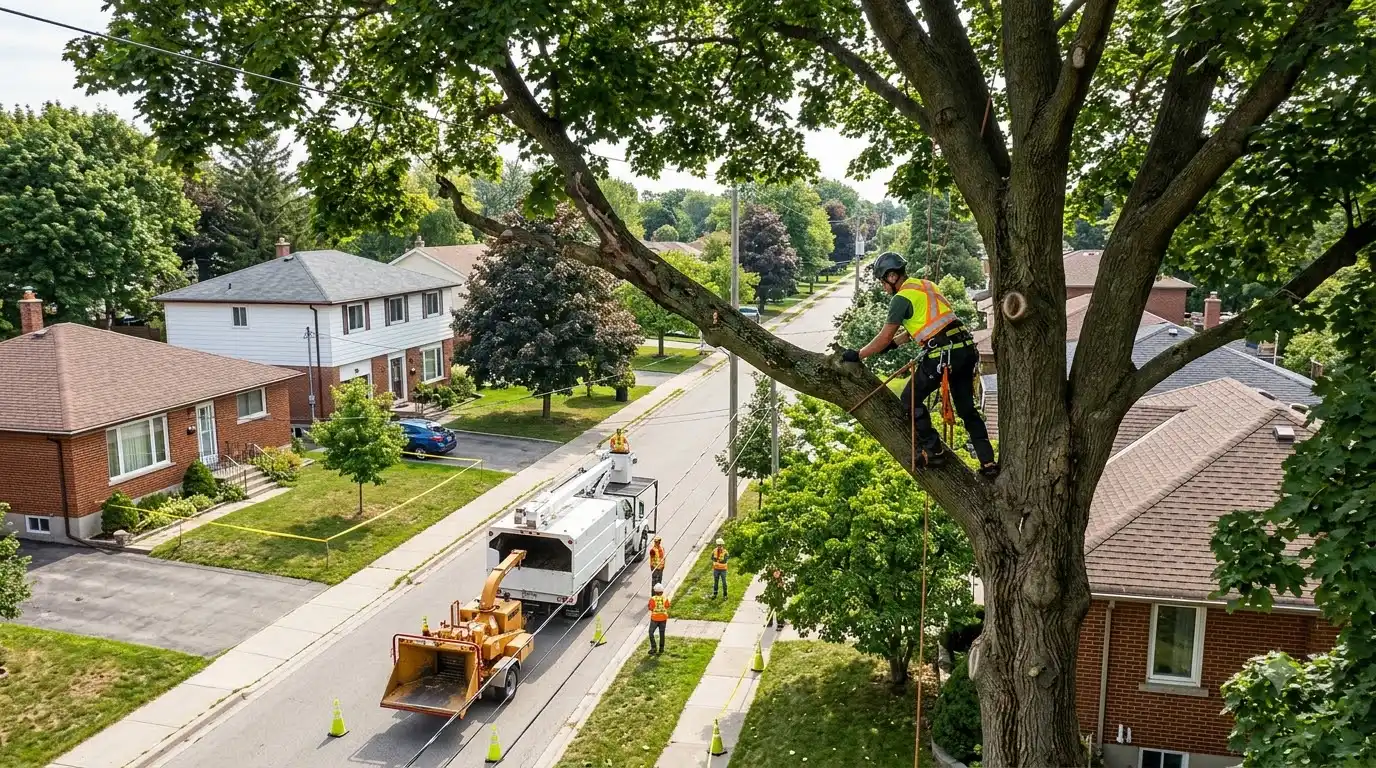
Brampton’s tree population reflects decades of growth. Downtown Brampton and Bramalea include older residential lots with mature backyard trees, large front-yard shade trees and trees close to driveways, garages, fences and neighbouring properties. Heart Lake, Springdale, Madoc, Snelgrove and Fletcher’s Creek have a mix of mature suburban trees, conservation-edge lots and creek-adjacent properties where location can matter as much as tree size.
Newer communities such as Mount Pleasant, Northwest Brampton, Sandringham-Wellington, Credit Valley and Castlemore often have younger trees, narrower side yards, rear-lot access challenges, townhome layouts, newer fencing, grading changes and compact front-yard plantings. A tree that appears small from the street can still create site-specific issues if it is close to structures, utilities, hardscaping, shared property lines or public frontage. These conditions should be reviewed directly with a qualified tree contractor or qualified arborist before pricing or work is approved.
Conservation Authority Context in Brampton
Brampton includes areas connected to Credit Valley Conservation and Toronto and Region Conservation Authority watersheds. The practical point is that conservation authority review is not the same as an ordinary private tree permit. CVC’s planning and permit FAQ states that a CVC permit is not required for tree removal on private lands. However, CVC also provides regulated-area mapping and notes that regulated-area approval may be required for certain projects. TRCA states that it regulates development in or near valleys, streams, wetlands and Lake Ontario shoreline areas.
For ordinary private tree removal, property owners should not assume that a conservation authority permit is automatically required simply because the property is in Brampton. At the same time, if tree work is connected to construction, grading, filling, drainage changes, slope work, shoreline work, creek corridor work, retaining walls, development, or activity within a regulated area, additional review may be needed. Properties near Etobicoke Creek, Fletcher’s Creek, Spring Creek, Heart Lake, the Credit River watershed, the Humber River watershed, valleylands, wetlands, floodplains or erosion hazard areas should be checked carefully.
Costs of Tree Removal in Brampton
Many Brampton residential tree removal projects may fall somewhere around $750 to $3,000, but this is only a planning range. Actual pricing depends on tree size, species, lean, decay, access, proximity to structures, overhead wires, equipment options, rigging needs, debris handling, stump grinding, cleanup terms, permit-related documents, travel, timing and qualified tree contractor pricing.
Larger mature trees in older Brampton neighbourhoods may cost more because of size, access and risk. Smaller subdivision trees in newer areas may cost less, unless access is tight or the tree is close to houses, fences, pools, garages, utilities or neighbouring property. If a permit, arborist report, conservation authority review, utility coordination or special access planning is involved, those details should be confirmed directly with the City, authority, qualified arborist or qualified tree contractor.
Navigating the Brampton Permit Process
The City of Brampton’s tree removal application submission page says applicants must complete the submission steps, attach a completed application and picture of the tree, submit the request, and call 3-1-1 or 905-874-2000 if outside Brampton to process payment for the tree removal permit fee. The City’s application form notes a non-refundable application fee and says to allow up to 30 business days to process the application.
Property owners should check the current City forms and instructions before submitting, because fees, forms, attachment requirements, exemption wording and timelines may change. Shared or neighbouring trees can involve extra ownership and consent issues. City trees, boulevard trees, woodlots, construction-related tree impacts and conservation-area projects may require separate handling.
Woodlots, City Trees and Public Property
Brampton’s tree regulations also refer to the City’s Woodlot Conservation By-law. The City says a permit is required when making alterations to a woodland or woodlot outside the formal development approval process. A wooded property, ravine-edge property or large naturalized lot can therefore involve different rules than a single private yard tree.
City-owned trees are also different from private trees. Brampton’s public information explains that Urban Forestry handles trees on public property, including parks, open spaces and boulevards or street trees. If a tree is near the curb, sidewalk, park edge, road allowance, boulevard or property boundary, the property owner should confirm ownership before any work is considered. Public trees should be handled through the City of Brampton, not by a private homeowner or contractor.
Frequently Asked Questions
What is Brampton’s private tree removal rule?
The City of Brampton says a private tree removal permit is required when the tree is more than 2 metres from an occupied building and has a diameter of 30 centimetres or more measured at 1.37 metres above ground. City-owned trees, boulevard trees and woodlots have separate rules. Property owners should confirm current requirements directly with the City of Brampton, 311 or an ISA Certified Arborist before removing or injuring a tree.
What is Brampton’s tree removal permit fee?
Brampton’s tree removal application page currently lists a $55.73 tree removal permit fee. Fees, forms, exemptions, timing and required attachments can change, so property owners should confirm current requirements directly with the City of Brampton before submitting.
How do conservation authorities affect tree removal in Brampton?
Brampton includes areas under Credit Valley Conservation and Toronto and Region Conservation Authority jurisdiction. CVC states that a CVC permit is not required for tree removal on private lands, but regulated-area permits may be required for certain projects or development activities in regulated areas. TRCA regulates development in or near valleys, streams, wetlands and Lake Ontario shoreline areas. Property owners should confirm requirements directly with CVC, TRCA, the City of Brampton, 311 or a qualified professional where applicable.
What should Brampton homeowners check before tree removal?
Related Guides and Services
- Tree Removal Permit Toronto
- Tree Removal Permit Mississauga
- Tree Removal Permit Brampton
- Arborist Reports
- Tree Removal Requests