
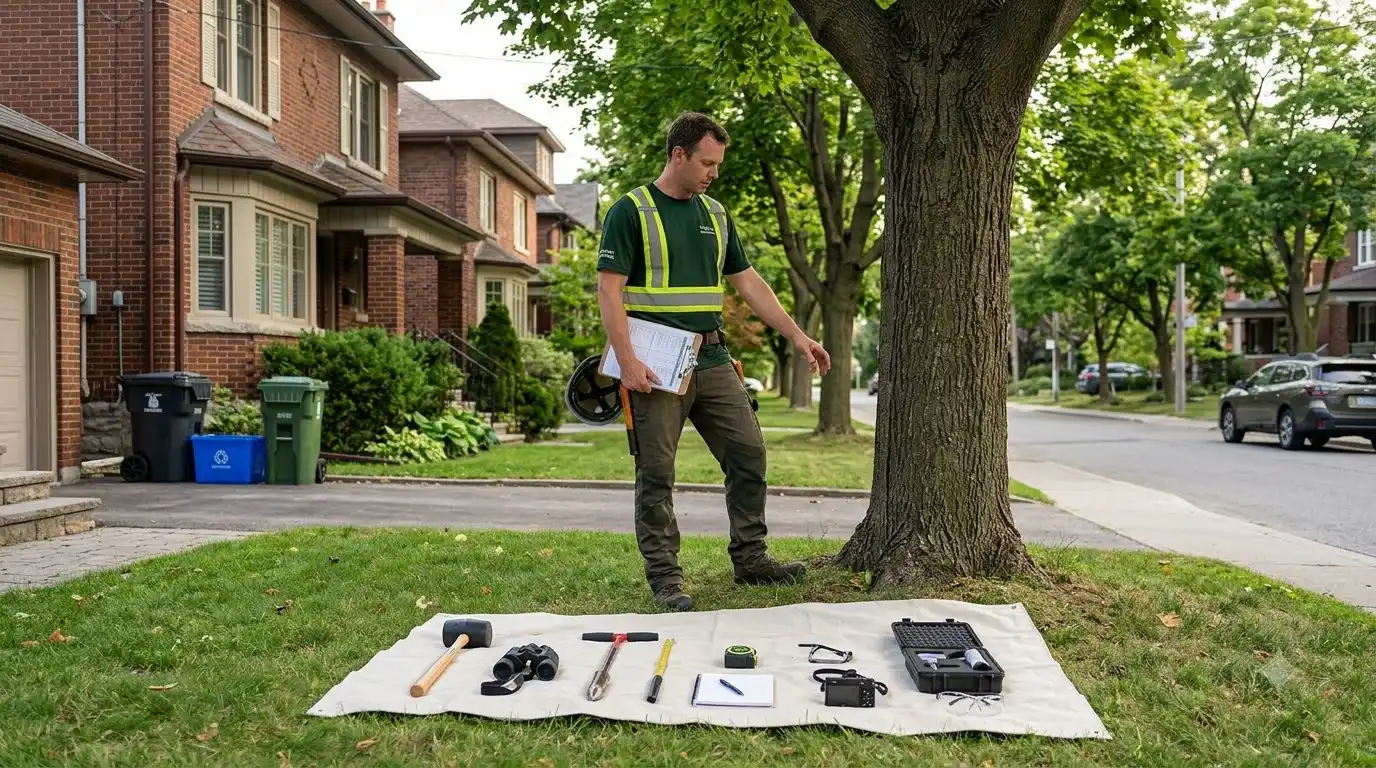
Questions about arborist tree inspection in Toronto usually come down to the rules, site conditions, risks and practical options for the property. A professional tree inspection in Toronto can include a systematic examination of the tree’s structure, crown health, pests and disease, decay indicators, root-zone conditions and risk context. The depth of the visit depends on the purpose: an informal health inspection is different from a written arborist report, construction documentation or a formal tree-risk assessment. Understanding the process helps homeowners ask better questions and understand the limits of the findings.
The Six Components of a Professional Tree Assessment
1. Structural assessment
The structural assessment evaluates the tree’s physical architecture and identifies defects that affect the probability of whole-tree or partial failure. The arborist examines the crown from the ground using binoculars to assess the branch attachment points throughout the canopy, looking for co-dominant stems with included bark (tight V-shaped unions where bark is compressed between stems rather than forming a protective collar), large branches with poor attachment angles, and any visible cracks in major unions or the trunk. The trunk is examined from all sides for signs of lean that may have developed recently, previous wound closure, and any visible decay openings or cankers.
If binoculars reveal a union of concern, the arborist may examine it more closely, either by extending the inspection with a pole to probe the area or noting that a climbing inspection would be needed for a definitive assessment. Ground-level assessments have inherent limitations for tall trees: a significant defect 15 metres up in a silver maple crown cannot always be confirmed from the ground, and the arborist report should note this limitation honestly rather than presenting a ground-level assessment as equivalent to a full canopy inspection.
2. Crown and foliage health assessment
The health assessment during the dormant season, when no leaves are present, focuses on the crown architecture itself: dead branch presence, dieback pattern (tip dieback versus inner crown dieback versus whole-crown dieback all indicate different problems), and the presence of large dead sections relative to the live crown. During the growing season, foliage assessment adds significant information: premature senescence (leaves turning colour before September in Toronto), reduced leaf size compared to expected for the species, chlorosis (yellowing), early leaf drop, and asymmetric foliage distribution all indicate health issues that inform the overall assessment.
3. Pest and disease diagnosis
The arborist examines the bark and foliage for signs of insect activity (exit holes, frass, canopy thinning patterns consistent with specific pests), fungal infections (visible lesions, cankers, dieback patterns consistent with specific pathogens), and root disease indicators. Significant pests in Toronto include emerald ash borer in remaining ash trees, bronze birch borer in declining birches, and various scale insects on maples and other ornamentals. Fungal issues include cytospora canker on maples and spruce, dothistroma needle blight on pines, and various wood-decay fungi that produce characteristic fruiting bodies.
4. Decay assessment
External signs of internal decay include fungal fruiting bodies on the trunk or roots (conks or mushrooms at the base are the most diagnostic), cavities or hollow sections visible at the base or in major branch junctions, oozing or staining on the bark that may indicate decay beneath, and the characteristic sound of hollow wood when the trunk is lightly struck with a mallet. The arborist probes any suspicious bark areas to confirm whether the wood beneath is firm or soft and punky. For significant suspected decay that cannot be confirmed by external examination alone, a Resistograph electronic resistance drill provides a quantitative decay assessment without meaningful harm to the tree.
5. Root zone assessment
The root zone assessment evaluates conditions that affect the tree’s structural stability and long-term health. Girdling roots visible at the trunk base indicate root architecture problems that can eventually kill the tree. Soil heaving or mounding on one side of the trunk base may indicate root plate movement. Grade changes, pavement installation, and utility trenching that are documented or visible in the root zone are noted as potential sources of past or ongoing root damage. For trees at construction sites, the arborist assesses soil compaction with a probe or penetrometer. For trees showing decline without obvious above-ground cause, the root zone is often where the explanation lies.
6. Risk assessment and target evaluation
A formal risk assessment integrates structural, health and site findings with the targets that could be affected by tree or branch failure. The ISA Tree Risk Assessment Qualification (TRAQ) framework is one recognized method for documenting likelihood and consequences. A TRAQ-qualified assessor can provide a structured risk rating, but the appropriate level of assessment and the weight given to it depend on the decision, available evidence and regulatory or legal context.
What the Written Assessment Should Contain
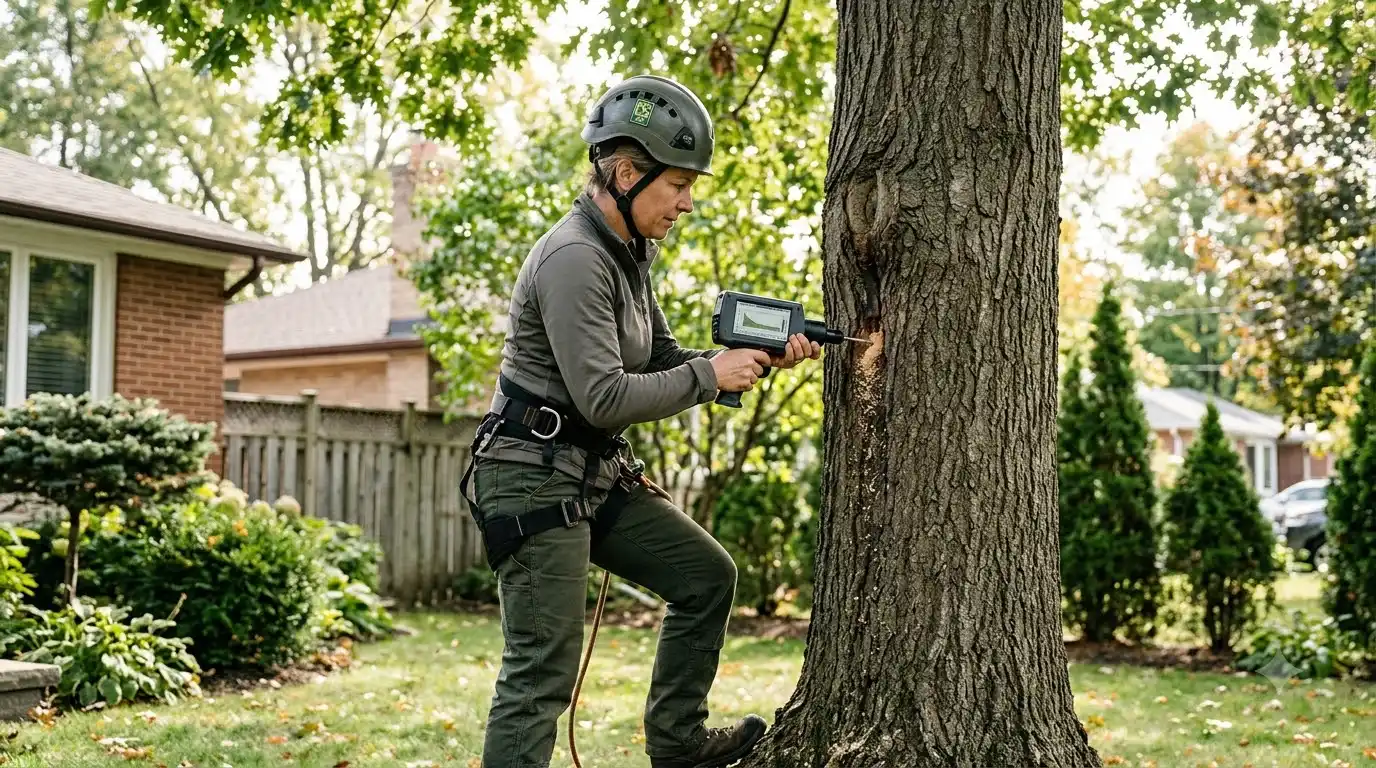
A written arborist report should identify the author and qualifications, assessment date, tree location and species, diameter where relevant, observed condition, significant defects or limitations, photographs where useful, and the reasoning behind any recommendation. For a City of Toronto permit application, follow the City’s current arborist-report requirements. Chapter 813 recognizes several arborist qualification pathways, not ISA certification alone, so the report author should meet the applicable City definition and submission requirements.
Arborist Tree Inspection in Toronto: Preparing for Your Arborist Inspection Visit
Before the arborist arrives for a Toronto inspection, walk your property and note any specific concerns you want addressed: a branch over the house, a recent lean, a crack you have noticed, bark damage. Photographs you have taken over time are useful context. The more specific your observations, the more efficiently the inspection can address the full range of your concerns. The arborist visit is a professional assessment, not a sales call: honest findings are the output, and sometimes the honest finding is that a tree you were worried about is structurally sound and needs no intervention.
Frequently Asked Questions
What does an arborist look for during a tree inspection in Toronto?
Six areas: structural assessment (crown architecture, defects, cracks), health assessment (foliage condition, dieback), pest and disease diagnosis, decay assessment (external signs and optional electronic testing), root zone assessment (girdling roots, compaction, past damage), and risk assessment integrating all findings with target exposure. A thorough inspection documents evidence for each finding.
How long does an arborist tree inspection take?
Inspection time varies with tree size, access, complexity, the number of trees, the purpose of the assessment and whether climbing, diagnostic testing or a formal written report is required. Ask what level of inspection is included rather than judging quality by a fixed number of minutes.
What tools does a Toronto arborist use during a tree inspection?
Diameter tape, binoculars, probe or screwdriver, mallet for sounding, and digital camera are standard. For detailed decay assessment, a Resistograph electronic resistance drill provides quantitative internal decay data. At construction sites, a soil probe or penetrometer assesses root zone compaction. Photographs document all significant findings.
Can a Toronto arborist inspection be done virtually from photographs?
Photographs and video can be useful for triage and for showing a change over time, but they cannot reveal every structural, decay, root-zone or site condition. Important removal, risk, permit or construction decisions may require an on-site assessment by an appropriately qualified professional.
Related Guides and Services
- ISA Certified Arborist vs General Tree Company
- Hazardous Tree Identification Toronto
- Arborist Reports
- Second Opinion on a Tree Quote Toronto
- Tree Removal Permit Toronto
Send Your Tree Request
Need help deciding what to do next? Send your tree request with your location, a brief description and clear photos of the tree or affected area.