Tree Preservation Plan in Ontario: Tree Preservation Plans in Ontario: When They Are Required
For property owners researching tree preservation plan in Ontario, the key issues are the applicable rules, site conditions and realistic next steps. There is no single province-wide rule that makes one standard tree preservation plan mandatory for every Ontario project. Requirements depend on the municipality, property, approval path, protected-tree status, and proposed work. In Toronto, construction that affects a protected tree or its Tree Protection Zone can trigger a tree permit, while construction that does not affect the Tree Protection Zone can still require a Tree Protection Plan and protective measures. Other municipalities use their own tree inventory, preservation-plan, or development-review requirements.
Why Construction Near Trees Needs Early Review
Tree issues are often discovered too late in a project. A homeowner may apply for a building permit, plan a rear addition, widen a driveway, install a pool, or excavate for utilities before checking whether nearby trees are protected. Once drawings are already finalized, tree-related conditions can force redesigns, delays, extra documentation, revised access routes, or changes to construction staging.
The concern is not only tree removal. Construction activity can injure a protected tree by cutting roots, compacting soil, changing drainage, scraping bark, trenching through the root zone, raising or lowering grade, storing materials near the trunk, or running equipment repeatedly over the same soil. Some damage is not visible immediately. A tree may decline one or more growing seasons after the root system was injured.
Building Permit Projects and Protected Trees
Many residential projects can affect protected trees without the homeowner realizing it. Rear additions, second-storey additions, new garages, laneway work, pools, retaining walls, basement underpinning, driveway widening, demolition, grading, patios, decks, utility trenching, and drainage work can all create tree-related concerns.
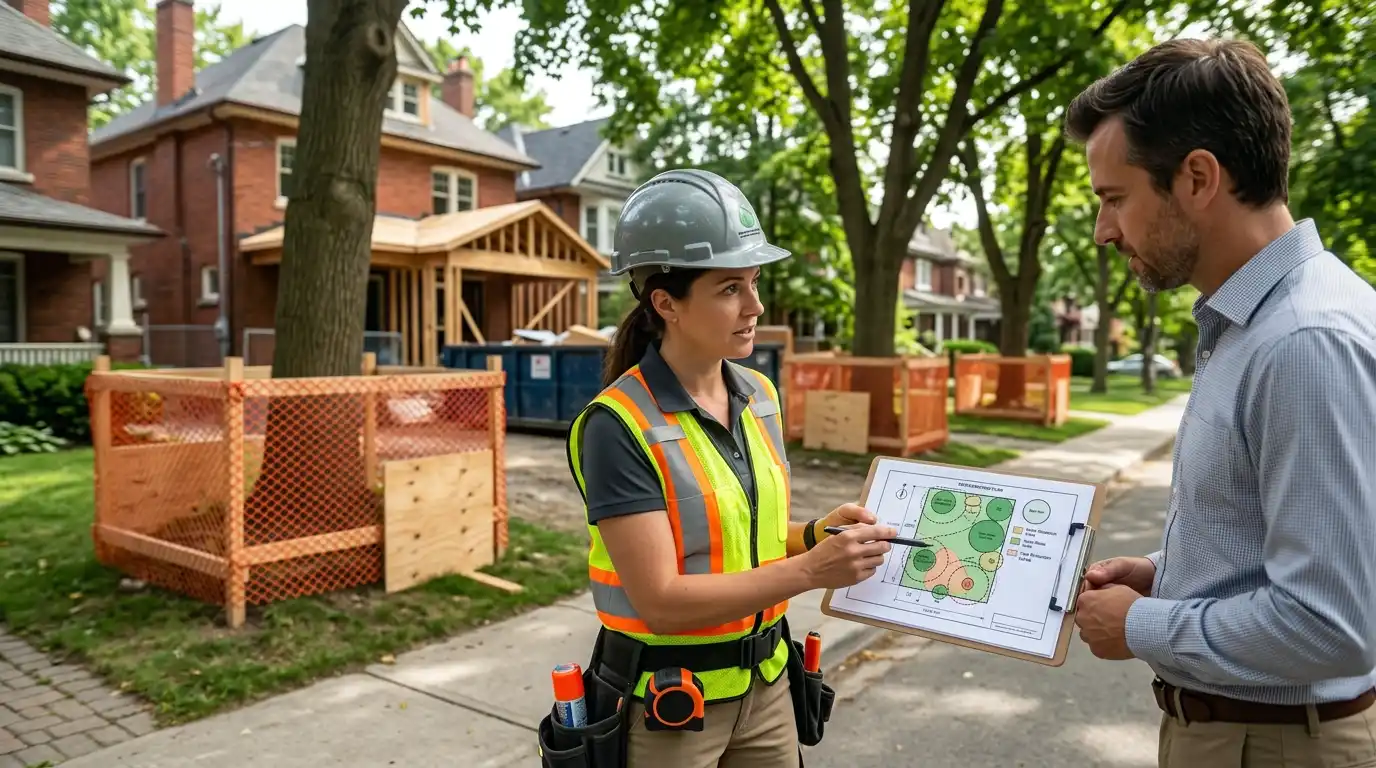
Toronto’s current guidance says construction that impacts a protected tree’s Tree Protection Zone requires a permit to remove or injure the tree. If construction will not impact a Tree Protection Zone, a tree permit is not required for that reason, but nearby trees still have to be protected and a Tree Protection Plan completed in consultation with an arborist. As-of-right development is not an exemption when protected trees or natural features are affected.
Before finalizing drawings, check whether the project may affect:
- Private trees 30 cm DBH or larger in Toronto
- City-owned trees of any size on the boulevard, road allowance, park edge, or public property
- Trees in ravine or natural feature protection areas
- Neighbouring or boundary trees whose roots or branches may extend into the work area
- Replacement trees planted under a previous permit, development approval, or enforcement condition
- Trees affected by excavation, access routes, material storage, grading, drainage, or equipment movement
Construction Project Tree Review: What Information May Be Needed
The exact requirements depend on the municipality, property, project type, tree ownership, and proposed work. In general, the useful information includes tree species, DBH, condition, location, proximity to work, visible defects, excavation limits, access routes, grading changes, drainage changes, and whether roots or branches may be affected.
A qualified arborist may discuss the tree’s condition, construction impact, root-zone concerns, replacement planting issues, and municipal documentation needs with the property owner.
Building-related tree review: common items to check
| Project factor | Why it matters | Who should confirm |
|---|---|---|
| Excavation limits | Excavation can cut roots and destabilize or stress a protected tree. | qualified arborist, designer, builder, and municipality where required |
| Equipment access | Repeated equipment movement can compact soil and damage roots. | Builder, qualified arborist, and property owner |
| Material storage | Soil piles, lumber, bins, and machinery can injure roots and bark. | Builder and qualified arborist where retained |
| Grading changes | Added or removed soil can affect root oxygen, drainage, and stability. | Designer, grading consultant, qualified arborist, and municipality where required |
| Neighbour or boundary trees | Roots or branches can extend into the work area even if the trunk is outside the site. | Property owner, legal advisor where needed, qualified arborist, and municipality where required |
| City-owned trees | Street and boulevard trees are protected separately and require City authorization for injury or removal. | City of Toronto, 311, and qualified arborist |
Root-Zone Impacts: The Part People Miss
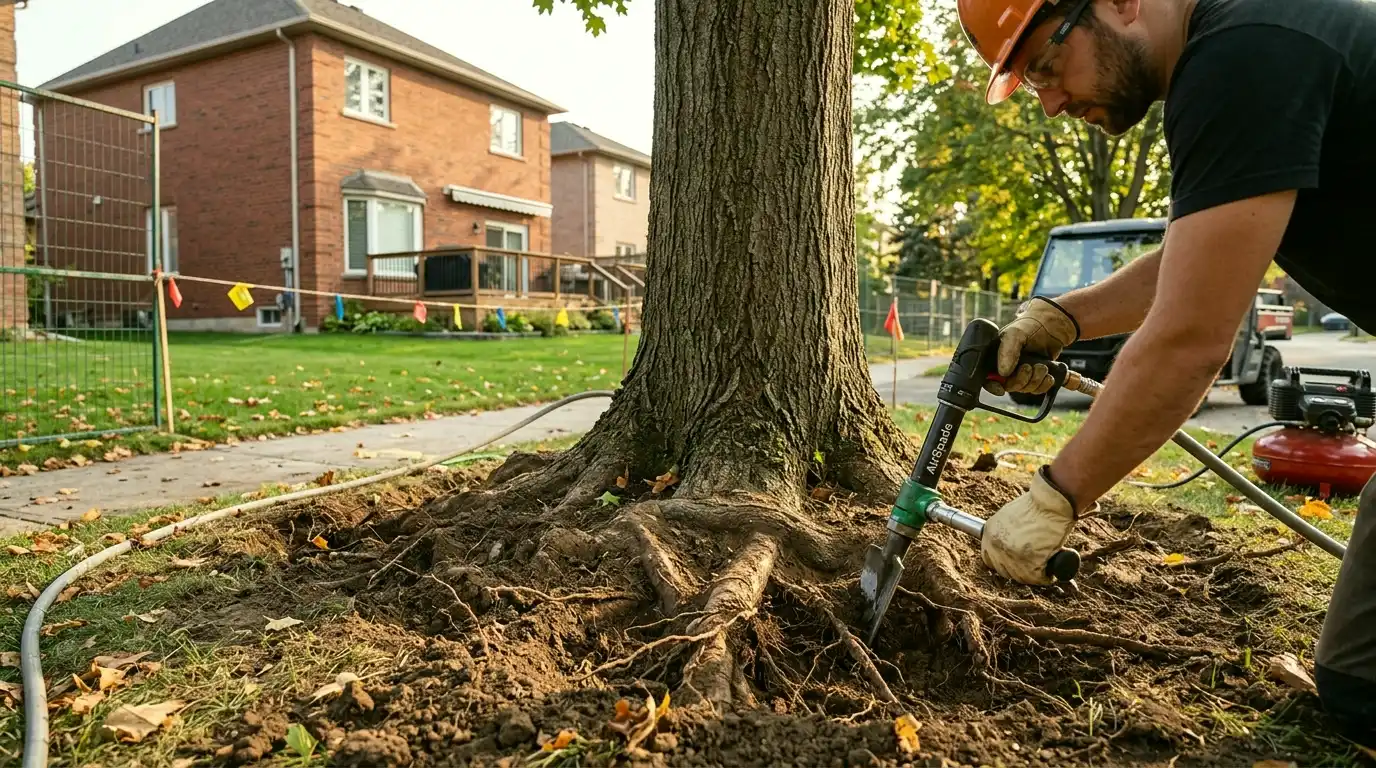
Most construction conflicts happen below ground. A mature tree can have important roots extending well beyond the trunk and beyond the visible canopy edge. Roots need oxygen, moisture, soil structure, and stability. Excavation, trenching, fill, soil removal, compaction, and drainage changes can all affect tree health and stability.
In Toronto, the City’s tree-related construction guidance and tree protection specifications focus heavily on preventing injury during construction. A protected tree may be injured even if it remains standing and even if no branches are cut. Root injury, bark wounds, grade changes, or repeated heavy access can still become a by-law issue if a protected tree is affected.
Before construction begins, property owners should ask the builder, designer, and qualified arborist how the work will avoid root damage, trunk injury, soil compaction, drainage problems, and unapproved tree injury.
Planning Act and Development Projects
Larger projects can involve a different level of tree review. Site plan applications, subdivisions, severances, infill development, and multi-lot projects can raise broader tree inventory, replacement planting, grading, access, and neighbour-tree questions. Municipal requirements vary: for example, Richmond Hill requires a tree inventory and preservation plan for site plan and subdivision applications. These files often involve survey-accurate tree locations, design coordination, and multiple professional roles.
For development projects, tree-related requirements should be checked early with the municipality, project planner, designer, builder, and qualified arborist. Do not assume that a tree can be removed through a simple residential process when the property is tied to a development application, site plan review, subdivision, severance, or other approval path.
What Happens When Construction Damages a Protected Tree?
Damage to protected trees can create enforcement risk, stop-work issues, redesign costs, replacement planting obligations, delays, and disputes between property owners, builders, neighbours, and municipalities. Toronto says injuring or removing a bylaw-protected tree without a permit is illegal and may result in enforcement action, including fines up to $100,000 per tree, stop-work orders, orders to comply, or prosecution.
Construction-related tree damage may not be obvious right away. Soil compaction, root cutting, grade changes, and drainage disruption can cause decline months or years later. That is why it is better to confirm tree requirements before excavation, demolition, access, or material storage begins.
If damage may have occurred, document the condition, stop any activity that may worsen the issue, contact the appropriate municipality where required, and speak directly with a qualified arborist, legal advisor, insurer, or project professional where appropriate.
Construction Near a Protected Tree?
Who Most Often Runs Into Tree Issues Late?
Tree-related construction issues often appear late for homeowners building rear additions, builders working on infill lots, property owners widening driveways, and homeowners planning pools, garages, decks, or basement work. The project may seem unrelated to a tree at first, but excavation, access, staging, and root-zone impacts can bring the tree into the review.
Late discovery is expensive. A permit file can be delayed, drawings may need revisions, the contractor may lose scheduling time, and the homeowner may need extra documentation. A short review early in the planning stage is usually cleaner than trying to fix tree-related issues after construction has started.
Ask these questions before finalizing a project:
- Are any private trees on the property 30 cm DBH or larger?
- Are there City-owned street trees near the driveway, sidewalk, or work area?
- Are any neighbouring or boundary trees close to excavation, access, or grading?
- Is the property in or near a ravine, creek, slope, natural feature, or TRCA regulated area?
- Will excavation, trenching, grading, storage, or equipment access occur near mature trees?
- Has the builder planned safe access routes that avoid tree injury?
- Who is responsible for tree-related documents, municipal communication, pricing, scheduling, insurance, WSIB, cleanup, and service issues?
Frequently Asked Questions
When should I check tree rules before a construction project in Toronto?
Check before drawings are finalized if the project involves excavation, demolition, additions, garages, pools, grading, driveways, utilities, or equipment access near mature trees. Toronto requires a permit to injure or remove a bylaw-protected tree, ravine, or natural feature.
Can construction injure a protected tree even if the tree is not removed?
Yes. Excavation, trenching, root cutting, soil compaction, grade changes, drainage changes, material storage, and equipment access can injure a protected tree. Confirm requirements before work begins if protected trees may be affected.
What tree information may be needed for a building or construction project?
Depending on the municipality and project, useful information may include species, DBH, condition, location, distance from work, visible defects, excavation limits, access routes, proposed grading, root-zone concerns, and replacement planting information where required.
Do trees near a property line need extra review before construction?
Yes. Neighbouring and boundary trees can raise ownership, consent, root-zone, access, and liability questions. Roots and branches may extend into the work area even if the trunk is not fully on the subject property.
Who is responsible for tree-related construction work and documentation?
The qualified arborist, contractor, designer, builder, or other professional retained by the property owner is responsible for their own assessment, documents, recommendations, pricing, scheduling, work performed, communication, qualifications, insurance, WSIB, warranties, and service-related issues.
Related Guides