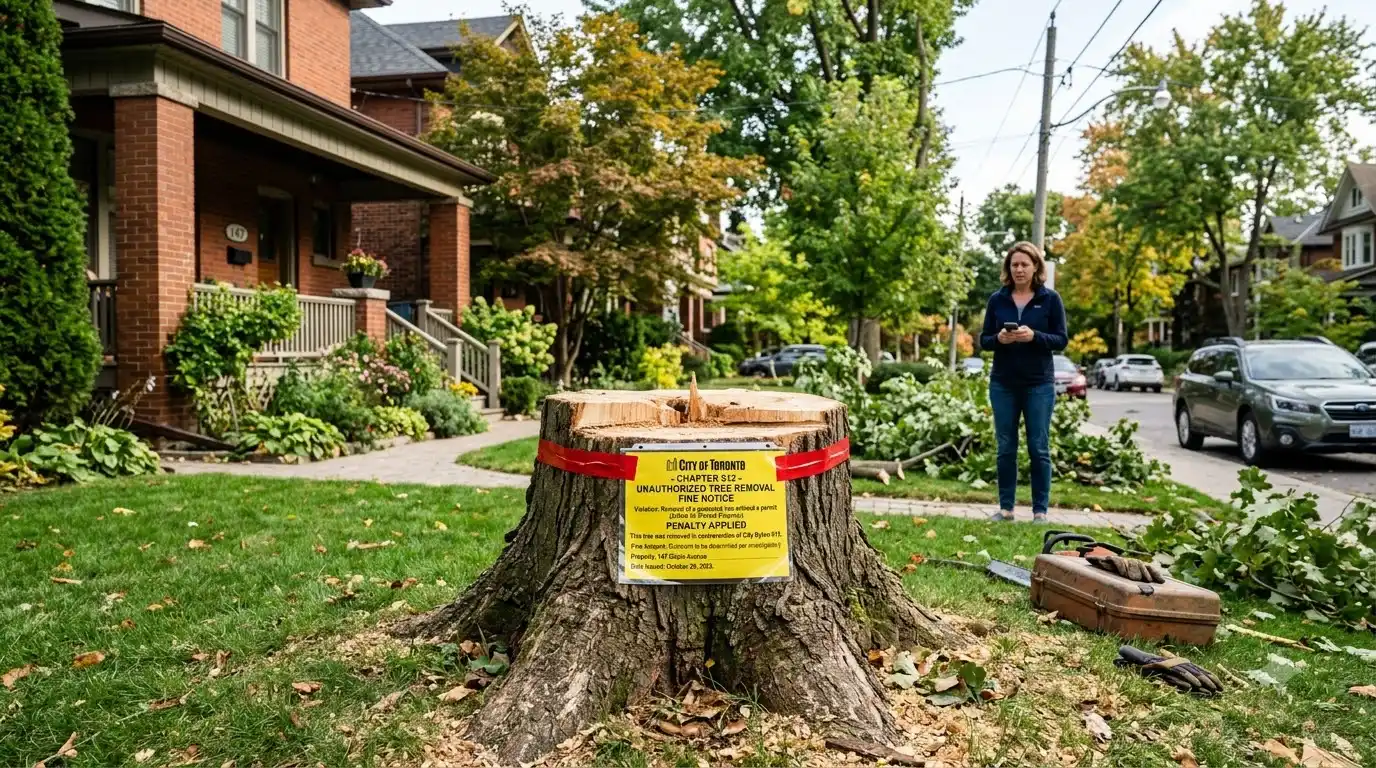
The practical issues around tree removal mistakes in Toronto include tree condition, property context and any rules that affect the work. Tree removal in Toronto involves regulatory requirements, insurance obligations and professional standards that are unfamiliar to most homeowners until something goes wrong. The mistakes described in this guide are not theoretical: they are the situations that commonly appear after a problem has already occurred, including Urban Forestry enforcement concerns, injury-claim exposure, or a severely damaged tree. Most of these mistakes are entirely avoidable with basic due diligence applied before any work begins.
Mistake 1: Skipping the Chapter 813 Permit
The most consequential mistake is removing a protected tree without obtaining the required Chapter 813 permit. This happens in two main ways. The first is a homeowner who does not know the permit requirement exists and proceeds with removal, sometimes using a contractor who also does not know or who knows but fails to mention it. The second is a homeowner who knows a permit is required but decides to proceed without one, often based on the reasoning that the tree is clearly dead or obviously hazardous and the permit is just a formality.
Proceeding without required authorization can create enforcement, replacement and cost consequences. Neighbour complaints, site observations or other evidence can bring unauthorized work to the City’s attention. The safer approach is to confirm whether a permit or permit-exception confirmation is required before work begins, including for dead, terminally diseased or imminently hazardous trees.
For a large tree, the cash-in-lieu requirement can easily reach $5,000 to $15,000, dwarfing the permit fee and arborist report cost that would have been required for the authorized removal. The permit process exists to be followed, and following it is both legally required and financially protective. If a contractor tells you that a permit is not required for a tree you suspect is at or 30 cm DBH or more, get a second opinion from a certified arborist before proceeding.
Mistake 2: Hiring an Uninsured or Uncertified Contractor
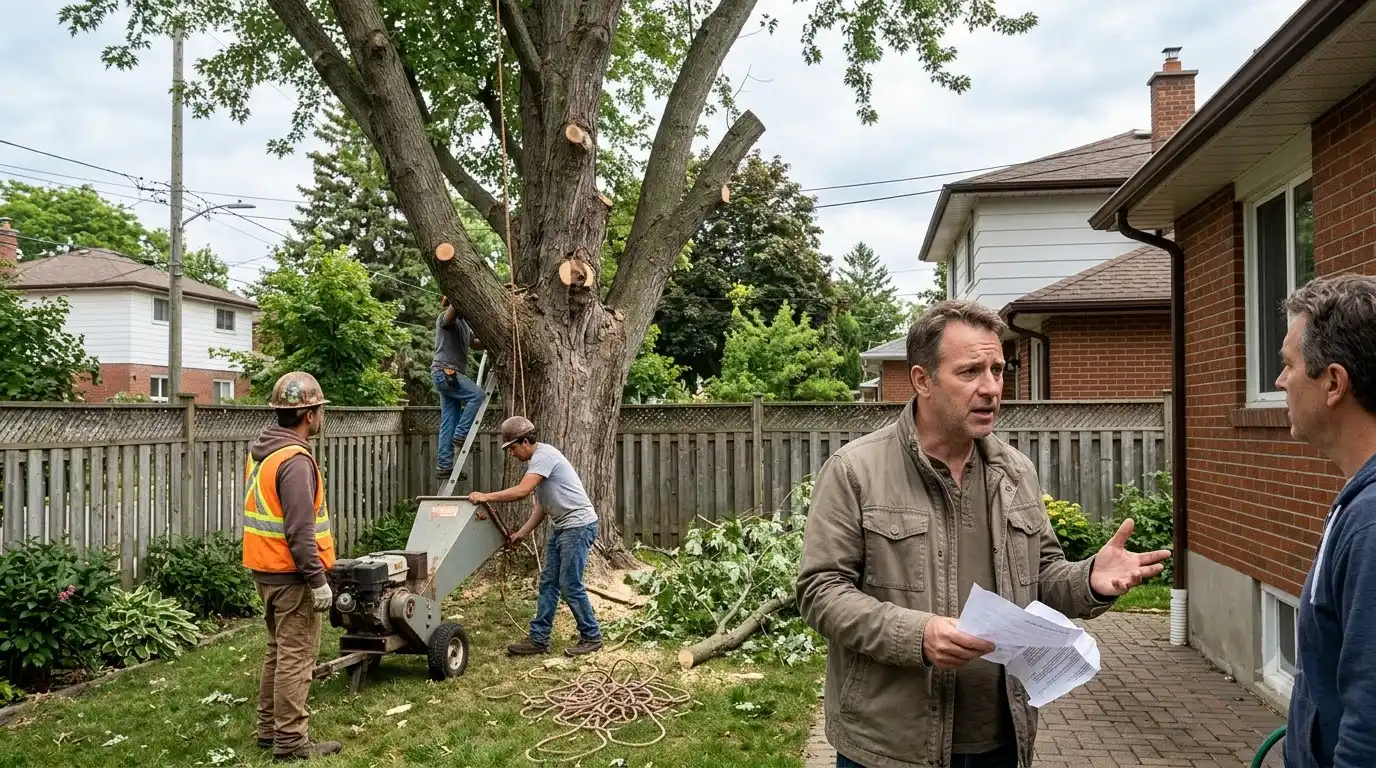
Tree work is one of the highest-injury-rate trades in Canadian construction. Falls from trees and structures, struck-by incidents from falling limbs, and equipment-related injuries occur regularly in tree services that lack adequate safety training and protocols. Hiring an uninsured contractor to save money is a decision that transfers the financial consequences of any incident onto the property owner.
For work where contractor insurance and WSIB status are relevant, ask for current documentation that applies to the business and the work being performed. Commercial general liability limits should be appropriate to the job, and WSIB status or clearance should be checked where applicable to the hiring arrangement. Private householders can be treated differently from construction businesses under WSIB rules, so use the documentation that actually applies rather than assuming one universal clearance requirement.
Mistake 3: Accepting a Phone Quote Without a Site Visit
A tree removal quote provided over the phone or based on photographs is not a reliable basis for a contract in any situation involving a tree larger than a small ornamental. The access situation, the proximity to structures, the soil conditions, and many other factors that determine the actual cost and risk profile of a removal job are not visible in photographs. Phone quotes have a strong tendency to rise significantly once the crew arrives and sees the actual site conditions. Accepting a phone quote from a cheap contractor and booking the work without a site visit is a setup for either a dramatically larger final invoice or a crew that cuts corners to maintain their margin at the quoted price.
Always require an on-site estimate for any tree removal involving a significant tree. A reputable company will visit, measure the tree, assess the access, confirm the permit requirements, and provide a written quote with a clear scope of work. The estimate visit itself takes 15 to 20 minutes and is included in any professional company’s standard process at no charge.
The Chapter 813 permit-exception pathway for dead trees requires that the tree be genuinely dead before the certificate is prepared. A tree that is dormant in November or December is not dead: it will leaf out in April. A tree that suffered a difficult summer and lost early foliage may recover fully the following year. The “dead tree” permit-exception pathway is not a shortcut for removing healthy trees you do not want. Misidentifying a dormant or stressed but living tree as dead, having a certificate prepared on that basis, and proceeding with removal creates significant regulatory exposure. Urban Forestry has arborists who review submitted certificates and can identify certificates that describe a live tree in dead-tree terms.
If a tree appears dead, document its condition and follow Toronto’s current permit-exception process before removal. The City may confirm an exception for a 100 per cent dead tree; an arborist report is recommended but is not automatically required with an exception request because City staff can inspect. Where a professional report is used, the preparer should meet the City’s current recognized arborist qualifications.
Mistake 5: Accepting a Topping Proposal
Tree topping is the practice of cutting the main trunk or primary scaffold branches back to stubs without regard for natural branch attachment points. It is not acceptable arborist practice, it is not permitted under ISA Best Management Practices, and it is not a treatment that reduces a tree’s hazard: it creates a more hazardous tree than existed before. Topped trees develop large internal decay columns at every cut point, produce weakly attached epicormic sprouts that regrow quickly and are more likely to fail than the original branch structure, and present a more complex structural risk profile than an unpruned tree.
Some tree services in Toronto still propose topping as a “size reduction” service, particularly to homeowners who are concerned about a large tree’s proximity to their house. No legitimate arborist prepares or accepts topping specifications. If a contractor proposes topping as part of a quote, treat it as a definitive signal that they do not follow ISA Best Management Practices and should not be hired for any tree work on your property.
Related professional service: Review the Toronto tree removal service information if removal may be part of the next step.
Frequently Asked Questions
What is the most common tree removal mistake Toronto homeowners make?
Removing a protected tree without a Chapter 813 permit, usually because the contractor did not mention the requirement. Enforcement consequences include fines and mandatory replacement planting requirements that can reach $5,000 to $15,000 for a large tree, far exceeding the permit and report cost that would have been required.
What happens if I accidentally hire an uninsured tree service in Toronto?
You may be liable for an injured worker’s medical and wage costs if WSIB coverage is absent. Adjacent property damage may fall on your own insurance if the contractor carries no CGL coverage. Require a current WSIB clearance certificate and CGL insurance certificate (minimum $2 million) from every contractor before any work begins.
Is tree topping ever acceptable in Toronto?
No. Topping creates large unresealable wounds, leads to internal decay, produces weakly attached epicormic regrowth, and makes trees more hazardous than before. It is not permitted under ISA Best Management Practices and Urban Forestry will not approve topping proposals. Any contractor who proposes topping should not be hired for any tree work.
How do I avoid hiring a tree service that does not know Toronto’s bylaws?
Ask three questions: Is this tree protected under Chapter 813 and is a permit or permit exception required? Who will prepare any supporting arborist documentation, and what qualification do they rely on? How will the permit status be confirmed before work begins? ISA Certified Arborist is one useful credential, but Toronto recognizes several arborist qualifications, so verify the credential or professional status that applies to the report.
Related Guides and Services
- ISA Certified Arborist vs General Tree Company
- How to Get a Second Opinion on a Tree Quote
- How to Read a Tree Removal Quote Toronto
- What Happens If You Remove a Tree Without a Permit
- Tree Removal Permit Toronto
Send Your Tree Request
Need help deciding what to do next? Send your tree request with your location, a brief description and clear photos of the tree or affected area.